Practical Guide to Dietary Therapy for Eosinophilic Esophagitis

JW Chang et al. Clin Gastroenterol Hepatol 2023; 21: 1690-1698. Open access! Development of a Practical Guide to Implement and Monitor Diet Therapy for Eosinophilic Esophagitis

  • The authors note that dietary therapy is underutilized–“successful clinical implementation is hampered by the need for a multidisciplinary approach including dietitian support and provider expertise.”
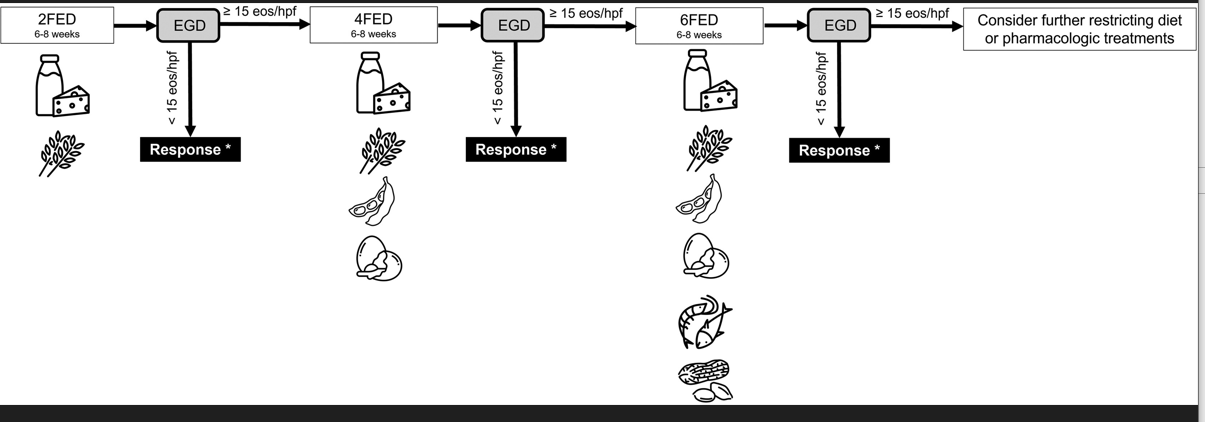
  • “Because symptoms are often discordant with underlying disease activity, symptoms alone should not be used to make decisions about treatment changes.56 Relying on symptoms in isolation to guide food elimination or reintroduction is insufficient and can result in false identification of food triggers and unnecessarily prolonged dietary restriction. Patients should be warned that their trigger foods are not necessarily the foods that cause immediate symptoms related to obstruction (eg, commonly meats, bread, sticky textures). Endoscopy with biopsy is the gold standard for monitoring response to therapy and is recommended at least 6–8 weeks after a change in therapy, including elimination and reintroduction phases to identify of food triggers.57
  • “The most identified food triggers for EoE are animal milk (up to 90%) and wheat (up to 75%), and up to half of patients who undergo dietary therapy will have more than 1 dietary trigger. 58,62 In a recent study of adult patients undergoing dietary therapy with the SFED, 69% of patients had only 1 food trigger identified, making this a reasonable option for long-term therapy.59
  • “The most common reasons for nonresponse to the elimination phase include purposeful or inadvertent dietary nonadherence, cross-contamination, and incorrect or inadequate removal of potential food triggers”
  • While medications used for EoE treatment are expensive, repeated endoscopy for dietary therapy may be costly and is an important consideration
  • The Consortium of Eosinophilic Gastrointestinal Disease Researchers (CEGIR) 58 page Supplement in article: Resource Supplement for Dietary Management for Patients/families -includes guidance for selecting food, apps, websites
Step-up strategy: 1 food dairy, 2 foods dairy/wheat, 4 foods dairy/wheat/soy/eggs, 6 foods dairy/wheat/soy/eggs/fish/peanuts

Related blog posts:

Managing Adrenal Insufficiency in Eosinophilic Esophagitis

M Nistel et al. JGPN 2023; 76: 786-792. Impact of Dose Reduction of Topical Steroids to Manage Adrenal Insufficiency in Pediatric Eosinophilic Esophagitis

In this retrospective study with 32 children with both eosiniphilic esophagitis and adrenal insufficiency (and 81 control subjects), key findings:

  • There was no steroid threshold which corresponded to an increased likelihood of AI
  • 20 of 32 had resolution of AI: 30% discontinued topical steroids, 50% reduced the steroid dose, 20% discontinue ER budesonide. With larger steroid dose reduction, there was an increased likelihood of AI resolution

One of the more useful parts of this publication is the authors provided their standardized approach in identifying AI: “our standard practice is to obtain a morning cortisol level 4-6 months after initiation of STS [swallowed topical steroids]. Subjects with morning cortisol <5 mcg/dL on 2 occasions (due to concerns with assay variation, patient compliance with fasting and holding steroids prior to testing) are then referred to endocrinology for further evaluation.”

My take: This article lays out a good approach for identifying AI in kids with EoE and then provides data on how effective reducing steroids are in resolving AI. It is noted that the peak eosinophil count tended to increase when STS doses were decreased.

Related posts:

Unrelated article from NPR (not from The Onion): Harvard professor who studies dishonesty is accused of falsifying data (June 26, 2023)

Lego turtle above and polar bear below at Tucson Botanical Gardens

Updated Nomenclature for Eosinophilic Gastrointestinal Diseases

ES Dellon et al. Clin Gastroenterol Hepatol 2022; 20: 2474-2484. Open Access! International Consensus Recommendations for Eosinophilic Gastrointestinal Disease Nomenclature

This article has 91 authors! Using Delphi surveys, the authors recommend the following:

  • “EGID” was the preferred umbrella term for disorders of gastrointestinal (GI) tract eosinophilic inflammation in the absence of secondary causes
  • Involved GI tract segments will be named specifically and use an “Eo” abbreviation convention: eosinophilic gastritis (now abbreviated EoG), eosinophilic enteritis (EoN), and eosinophilic colitis (EoC)
  • For EoN, “it is desirable, but not required, to name specific locations of small bowel involvement, if these are known…The abbreviation for eosinophilic duodenitis should be “EoD”… for eosinophilic jejunitis should be “EoJ”….eosinophilic ileitis should be “EoI”
  • The term “eosinophilic gastroenteritis” is no longer preferred as the overall name (but can be used to indicate involvement of both the stomach and small bowel)
  • When >2 GI tract areas are involved, the name should reflect all of the involved areas

I-SEE for Eosinophilic Esophagitis

ES Dellon et al Gastroenterol 2022; DOI: https://doi.org/10.1053/j.gastro.2022.03.025 Open Access: A Clinical Severity Index for Eosinophilic Esophagitis: Development, Consensus, and Future Directions “The Index of Severity for Eosinophilic Esophagitis (I-SEE)—that can be completed at routine clinic visits to assess disease severity using a point scale of 0–6 for mild, 7–14 for moderate, and ≥15 for severe EoE.”

From AGA: Eosinophilic Esophagitis Index

“The Index of Severity for EoE (I-SEE) is now available for you to use as a tool to help assess EoE patients. Developed by a multidisciplinary team of experts, the new tool is now published in Gastroenterology.

Details about I-SEE 

  • “The I-SEE has three domains: (1) symptoms and complications, (2) inflammatory features and (3) fibrostenotic.
  • I-SEE can be used at initial diagnosis and then at each subsequent visit, with the recall being only between visits so that the severity can be assessed over time and ultimately (when data supports this step) treatment and monitoring adjusted based on severity.
  • As the number of children and adults with EoE increases worldwide, a simple system to assess and track disease activity in a meaningful way in a clinical setting is needed.
  • I-SEE is for use in adult and pediatric patients with EoE. It was created by an international team of more than 30 experts in allergy, gastroenterology and pathology.”

Link: I-SEE Tool Scoring Table

Budesonide for Maintaining EoE Remission

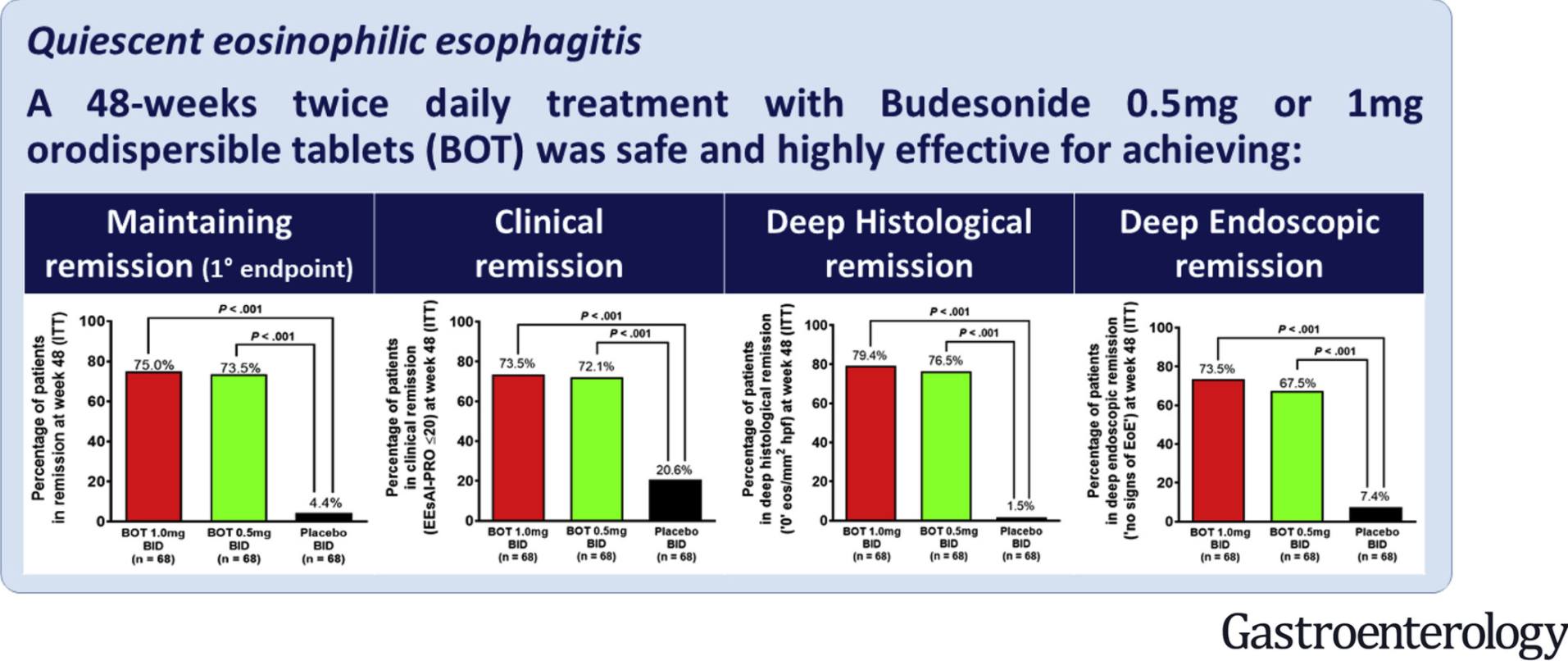
A Straumann et al. Gastroenterology 2020; Free Full Text Link: Budesonide Orodispersible Tablets Maintain Remission in a Randomized, Placebo-Controlled Trial of Patients With Eosinophilic Esophagitis

Methods: Two hundred and four adults with EoE in clinical and histologic remission, from 29 European study sites, were randomly assigned to groups given budesonide orodispersible tablet (BOT) 0.5 mg twice daily (n = 68), BOT 1.0 mg twice daily (n = 68), or placebo twice daily (n = 68) for up to 48 weeks

Key Findings:

  • At end of treatment, 73.5% of patients receiving BOT 0.5 mg twice daily and 75% receiving BOT 1.0 mg twice daily were in persistent remission compared with 4.4% of patients in the placebo group (P < .001 for both comparisons of BOT with placebo)
  • Four patients receiving BOT developed asymptomatic, low serum levels of cortisol. Clinically manifested candidiasis was suspected in 16.2% of patients in the BOT 0.5 mg group and in 11.8% of patients in the BOT 1.0 mg group; all infections resolved with treatment

In the discussion, the authors state that “we recommend monitoring symptoms and signs of adrenal insufficiency when administrating topical-acting corticosteroids over prolonged time periods, in particular in children and when using higher dosages.”

My take (from discussion): “EoE requires a proper long-term anti-inflammatory therapy because, without active treatment, the vast majority of patients experience a relapse within the first 100 days after cessation of the medication.”

Related blog posts:

The Latest on EoE and PPI-REE

A recent study shows similar clinical, endoscopic and histologic findings between eosinophilic esophagitis (EoE) and proton pump inhibitor-responsive esophageal eosinophilia (PPI-REE) (Aliment Pharmacol There 2014; 39: 603-08 -thanks to Seth Marcus for this reference).

The authors used two databases: one from Walter Reed and one from the Swiss EoE database.  All of these patients were >/=18 years.  Response to PPI was defined as achieving less than 15 eos/hpf and a 50% decrease from baseline following at least 6-weeks of PPI treatment.

Demographics: 63 EoE patients, 40 PPI-REE, mean age 40 years (75% male, 89% Caucasian).

Findings:

  • Similar dysphagia 97% vs. 100% (in EoE and  of PPI-REE cohorts)
  • Similar food impaction 43% vs. 35% (in EoE and  of PPI-REE cohorts)
  • Similar heartburn 33% vs. 32% (in EoE and  of PPI-REE cohorts)
  • Similar duration of symptoms: 6.0 years vs 5.8 years (in EoE and  of PPI-REE cohorts)
  • Similar endoscopic findings too: rings 68% in both groups, furrows 70% in both groups, strictures 49% vs 30% (in EoE and  of PPI-REE cohorts)
  • Similar histology: proximal esophagus 39 vs 38 eos/hpf and distal esophagus 50 vs 43 eos/hpf

Take-home message: EoE and PPI-REE are very similar in presentation and indistinguishable without a PPI trial.

Related blog posts:


Esophageal distensibility with FLIP and EoE disease severity

In patients with eosinophilic esophagitis (EoE), the development of fibrosis due to ongoing inflammation is one of the concerns as this can lead to more difficulty with swallowing,  food impactions, a smaller caliber esophagus, and stricturing.  A recent report highlights a way to measure esophageal distensibility and its correlation with disease severity (Clin Gastroenterol Hepatol 2013; 11: 1101-7).

This report describes the evaluation of 70 patients with EoE (ages 18-68 years with median of 38 years`, 50 men) who underwent endoscopy along with high-resolution impedance planimetry.  The average followup was 9.2 months. The functioning luminal imaging probe (FLIP) system was used after the endoscopy by placing a catheter transorally.  The catheter had 16 ring electrodes spaced 5-mm apart in the 8-cm measured segment.  The FLIP distal recording began 3 cm proximal to the esophageal gastric junction.  Esophageal cross-sectional areas were measured during 2-mL stepwise distentions and increasing to a maximum of 40 mL.

Patient EoE Clinical Features at baseline:

  • 26 patients had a history of food impaction
  • 37 patients had dysphagia
  • 5 patients had chest pain
  • 2 patients had heartburn
  • Ringed esophagus: 9 (13%) had severe endoscopic findings, 17 (24%) had moderate endoscopic findings, 40 (57%) had mild endoscopic findings
  • Primary treatment: PPI treatment (78%), Topical steroids (10%), diet 4 (6%)

Key findings:

  • Patients with food impaction had significantly lower distensibility plateau (DP) than those with solid dysphagia alone (see manuscript Figure 1).
  • Mean DP in food impaction 113 mm2 compared with 229 mm2 for those without a history of food impaction
  • The severity of mucosal eosinophilia did not correlate with risk for food impaction, distensibility, or requirement for dilatation.

In many ways, the findings are completely obvious.  If an individuals esophagus is less distensible, it makes sense that food could get stuck. However, the article highlights a novel way of assessing esophageal distensibility in this population.  While the study did not identify higher mucosal eosinophilia as a marker of distensibility, this may be a precursor to future problems.  In the discussion, the authors note that a 12.5 mm barium tablet test correlates with a 125-mm2 threshold. Thus, their data suggest a corresponding diameter of 17 mm as a prerequisite to avoid food impactions.

Bottomline: this study identifies a new way to assess the risk for food impactions in EoE by measuring esophageal distensibility.

Related blog entries:

SFED works for EoE!

A recent study confirms that an empiric ‘6-food elimination diet’ (SFED) works in adults  with eosinophilic esophagitis (EoE) as well as it has been shown to work in kids (J Allergy Clin Immunol 2013; 131: 797-804)).  Thanks to Seth Marcus for this reference.

This Spanish study recruited 67 consecutive adult patients (17-60 years) who were treated with an exclusive diet which eliminated milk (avoided goat’s milk too), wheat/cereals (avoided rice and corn too), eggs, fish/seafood, legumes/peanuts, and soy for 6 weeks.  Subsequent rechallenge followed with repeated endoscopies every 6 weeks.  A food was considered a trigger for EoE if eosinophilic infiltrate ≥ 15 Eos/hpf after reintroduction.

Prior to reintroduction, 73% (n=49) responded to SFED with peak Eos < 15/hpf. Among responders, 37 patients achieved a complete response with Eos 0-5/hpf.  Subsquently rechallenges were instituted and 42 patients completed this part of the study. A single food was identified in 36%, 2 food triggers in 31%, the remainder had at least 3 food triggers.  Cow’s milk was the most common food trigger, in 62%, followed by wheat (29%), eggs (26%), and legumes (24%).

Allergy testing (ImmunoCap IgE-based testing, and skin prick testing) showed no concordance with food reintroduction challenge results.  All patients maintained on avoidance of offending foods maintained remission for up to 3 years.

In the general scheme of food reintroduction, it is interesting that the authors often tested for wheat and milk first.  Also, the Table 1 listed numerous characteristics of responders and nonresponders and none of these had a significant predictive effect.  This table listed symptoms including dysphagia, vomiting and pain, caliber of esophagus, mucosal appearance, atopic history, atopic family history, and eosinophil counts.

Related blog entries:

EoE: Drugs, Diets, Dilatation and PPI-REE

PPI-REE or proton pump inhibitor-responsive esophageal eosinophilia remains a problematic issue for our eosinophilic esophagitis (EoE) patients.  PPI-REE and the 3 D’s (Drugs, diet, and dilatation) have been reviewed recently (Clin Gastroenterol Hepatol 2012; 10: 1066-78).

The issues with PPI-REE that are problematic:

  • If a patient with suspected EoE is pretreated with a PPI and they do not have eosinophils present at the time of endoscopy then a diagnosis of PPI-REE cannot be established.
  • If patients are not pretreated, then determining that they have PPI-REE compared with typical EoE, requires repeat endoscopy.  Furthermore, response to PPI may be transient and/or natural variation in EoE could make definitive diagnosis of PPI-REE quite difficult.
  • If a patient presents with classic-appearing EoE, choosing to treat with a PPI is difficult as the response rate is much lower than with either dietary therapy or drug therapy.  In addition, many symptomatic patients may have been treated to some extent with a PPI.  Do they warrant repeat treatment and repeat endoscopy prior to using more typical treatment for EoE?

Beyond this topic, this review covers the recent consensus guidelines and the typical treatments: diets, drugs, and dilatation.

With regard to dilatation, the author notes that it may be safer than previously believed.  Furthermore, in a recent trial, 81% were symptom free at 3 months and 46% were symptom free at 1 year.  Despite better safety results, 74% of patients in one study complained of retrosternal pain after in endoscopy (moderate in 21% and severe in 17%).

With regard to drug or dietary therapy, the author recommends checking on the effectiveness after 6-8 weeks with a repeat endoscopy.  Until better tools for assessing response to therapy become available, endoscopy remains the only accurate way to determine if treatment is working.

Related blog entries: