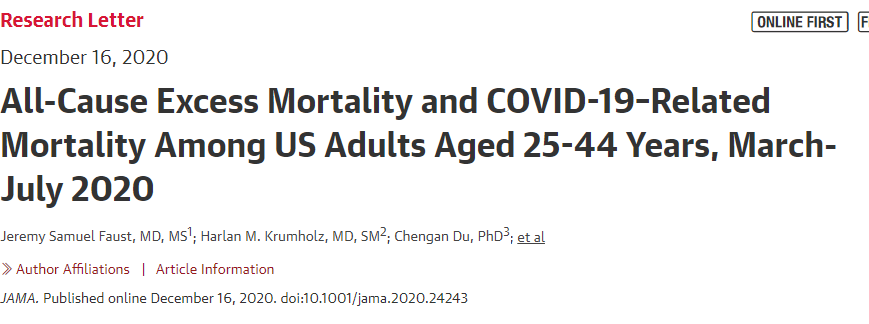
The authors compared deaths from 2014-2020 using data from the National Center for Health Statistics and US Census Bureau.
Key findings:
Between March 1 and August 1, 2020, 1 336 561 deaths occurred in the US, a 20% increase over expected deaths (1 111 031 [95% CI, 1 110 364 to 1 111 697]).
Of the 225 530 excess deaths, 150 541 (67%) were attributed to COVID-19
The authors conclude that the excess deaths attributed to causes other than COVID-19 could reflect deaths from unrecognized or undocumented infection with severe acute respiratory syndrome coronavirus 2 or deaths among uninfected patients resulting from disruptions produced by the pandemic
My take: The COVID-19 situation has worsened considerably in the past 2 months and the final toll from this infection will be truly staggering; this unfortunately will include its indirect effects due to deferral of care
Using UK Biobank data with 120 075 participants with 271 who had severe COVID-19, key findings:
Relative to non-essential workers, healthcare workers (RR 7.43, 95% CI 5.52 to 10.00), social and education workers (RR 1.84, 95% CI 1.21 to 2.82) and other essential workers (RR 1.60, 95% CI 1.05 to 2.45) had a higher risk of severe COVID-19.
More specifically, healthcare professionals (doctors, psychologists, pharmacists) (RR 6.19, 95% CI 3.68 to 10.43). The higher risk of severe COVID-19 among healthcare workers was not reduced after adjustment for socioeconomic, work-related, or health and lifestyle-related factors
Using more detailed groupings, medical support staff (RR 8.70, 95% CI 4.87 to 15.55), social care (RR 2.46, 95% CI 1.47 to 4.14) and transport workers (RR 2.20, 95% CI 1.21 to 4.00) had the highest risk within the broader groups.
Compared with white non-essential workers, non-white non-essential workers had a higher risk (RR 3.27, 95% CI 1.90 to 5.62) and non-white essential workers had the highest risk (RR 8.34, 95% CI 5.17 to 13.47).
My take: This study shows the increased risk of severe COVID-19 among essential workers, particularly in healthcare field and non-white ethnicity was associated with further increased risk.
This article describes the worsening situation with global wildfires and their direct/indirect effects on human health. In addition, “the interplay between wildfires and climate change is likely to form a reinforcing feedback loop, making wildfires and their health consequences increasingly severe.” The authors conclude that “societal action is requisite… to limit the global temperature increase” and reduce the severity of wildfires and other effects of climate change.
Specific health risks:
Direct health effects include burns, injuries, mental health effects, and death due to exposure to flames or radiant heat
There is consistent evidence of an increased risk of respiratory events, including hospitalizations and emergency department visits due to asthma, chronic obstructive pulmonary disease, and respiratory infection.
Heavy smoke can cause eye irritation and corneal abrasions and can substantially reduce visibility, increasing the risk of traffic accidents.
Owing to traumatic experiences, property loss, and displacement, residents in areas affected by wildfires are at an increased risk for mental illness, including post-traumatic stress disorder, depression, and insomnia. The psychological consequences of wildfire events can persist for years, and children and adolescents are particularly vulnerable.
Risks of low birth weight and preterm birth are increased
“The fires sweeping across millions of acres in California aren’t just incinerating trees and houses. They’re also filling the lungs of California’s children with smoke, with potentially grave effects over the course of their lives.” This article goes on to detail the personal effects of wildfires on 5 families.
Our hospital system has been arranging frequent staff meetings to provide situational updates amid the pandemic. On 12/2/20, Evan Anderson (infectious disease) provided an an excellent update on COVID-19/rollout of vaccines.
Key Points:
mRNA vaccines have been remarkably effective, both ~95% and also effective against severe disease (>90%)
Severe reactogenicity occurs >2%. Systemic symptoms like fatigue, myalgia, and chills are more common after 2nd dose
Local reactions are typically more pronounced than flu vaccine but less pronounced compared to shingles vaccine (Shingrix)
Not wise to vaccinate entire care areas at same time
No need to check antibody titers after vaccination
Current contraindications: Pregnant women and children due to lack of data (Pfizer vaccine may be approved for those older than 12 yrs)
Study participants were allowed to take antipyretics
Slides used with permission.
Current pandemic situation in metro Atlanta (slide from Dan Salinas)
Top curve is total cases and bottom curve is ICU beds –both thru 11/27/20
Earlier in the year, I summarized the upcoming changes for 2021: Link Get Ready for 2021 Coding Changes (with links to AMA resources and tables). Subsequently, I went to a coding seminar led by Jan Rasmusen and wanted to share some additional observations.
One of the most important changes is the need for “medically appropriate history and/or examination” rather than focusing on specific elements. This helps eliminate scoring the history and physical exam and should allow more time to document critical thinking. Besides billing, H&P is still key for helping with continuity of care and for liability.
2. When using time codes and not using medical decision-making, the total time –face-to-face and non face-to-face –is what is used. Total time does not include clinical staff time.
3. A lot of the terms have more specific definitions
4. Medical Decision-Making is Similar to Current Guidelines
5.Creation of a new code for additional time
My take: The intent of these changes is logical. The goal of coding is to align the reimbursement with the degree of effort and not simply allow pre-formatted templates to justify upcoding. These changes could lead to simplification of documentation and allow more documentation time for medical decision-making part of the visit.
Disclaimer: This blog, gutsandgrowth, assumes no responsibility for any use or operation of any method, product, instruction, concept or idea contained in the material herein or for any injury or damage to persons or property (whether products liability, negligence or otherwise) resulting from such use or operation. These blog posts are for educational purposes only. Specific dosing of medications (along with potential adverse effects) should be confirmed by prescribing physician. Because of rapid advances in the medical sciences, the gutsandgrowth blog cautions that independent verification should be made of diagnosis and drug dosages. The reader is solely responsible for the conduct of any suggested test or procedure. This content is not a substitute for medical advice, diagnosis or treatment provided by a qualified healthcare provider. Always seek the advice of your physician or other qualified health provider with any questions you may have regarding a condition
“Kansas counties that had mask mandates in place appear to have mitigated the transmission of COVID-19, whereas counties that did not have mask mandates continued to experience increases in cases.”
Aubrey Gordon provides personal insight into the issue of weight stigma in her opinion piece: NY Times Leave Overweight Kids Alone
Here a few excepts:
The war on childhood obesity reached its zenith with the 2010 introduction of the national “Let’s Move!” campaign, “dedicated to solving the problem of obesity within a generation.” It was a campaign against “childhood obesity” — not specific health conditions or the behaviors that may contribute to those health conditions. It wasn’t a campaign against foods with little nutritional value, or against the unchecked poverty that called for such low-cost, shelf-stable foods. It was a campaign against a body type — specifically, children’s body types.
In 2012, Georgia began its Strong4Life campaign aimed at reducing children’s weight and lowering the state’s national ranking: second in childhood obesity. Run by the pediatric hospital Children’s Healthcare of Atlanta, it was inspired in part by a previous anti-meth campaign. Now, instead of targeting addiction in adults, the billboards targeted fatness in children…The billboards purported to warn parents of the danger of childhood fatness, but to many they appeared to be public ridicule of fat kids…
Despite ample federal and state funding, multiple national public health campaigns and a slew of television shows, the war on obesity does not appear to be lowering Americans’ B.M.I.s. According to the Centers for Disease Control and Prevention, since 1999 there has been a 39 percent increase in adult obesity and a 33.1 percent increase in obesity among children.
Weight stigma kick-starts what for many will become lifelong cycles of shame..Yet, despite its demonstrated ineffectiveness, the so-called war on childhood obesity rages on. This holiday season, for the sake of children who are told You’re not beautiful. You’re indulging too much. Your body is wrong. You must have done it, I hope some parents will declare a cease-fire.