Zip Code or Genetic Code -which is more important for longevity?

From NY Times: http://t.co/fNm0nFOUdK

An excerpt:

Fairfax County, Va., and McDowell County, W.Va., are separated by 350 miles, about a half-day’s drive. Traveling west from Fairfax County, the gated communities and bland architecture of military contractors give way to exurbs, then to farmland and eventually to McDowell’s coal mines and the forested slopes of the Appalachians. Perhaps the greatest distance between the two counties is this: Fairfax is a place of the haves, and McDowell of the have-nots. Just outside of Washington, fat government contracts and a growing technology sector buoy the median household income in Fairfax County up to $107,000, one of the highest in the nation. McDowell, with the decline of coal, has little in the way of industry. Unemployment is high. Drug abuse is rampant. Median household income is about one-fifth that of Fairfax.

One of the starkest consequences of that divide is seen in the life expectancies of the people there. Residents of Fairfax County are among the longest-lived in the country: Men have an average life expectancy of 82 years and women, 85, about the same as in Sweden. In McDowell, the averages are 64 and 73, about the same as in Iraq….           

There have long been stark economic differences between Fairfax County and McDowell. But as their fortunes have diverged even further over the past generation, their life expectancies have diverged, too. In McDowell, women’s life expectancy has actually fallen by two years since 1985; it grew five years in Fairfax.

“Poverty is a thief,” said Michael Reisch, a professor of social justice at the University of Maryland, testifying before a Senate panel on the issue. “Poverty not only diminishes a person’s life chances, it steals years from one’s life.”

That reality is playing out across the country. For the upper half of the income spectrum, men who reach the age of 65 are living about six years longer than they did in the late 1970s. Men in the lower half are living just 1.3 years longer.

This life-expectancy gap has started to surface in discussions among researchers, public health officials and Washington policy makers. The general trend is for Americans to live longer, and as lawmakers contemplate changes to government programs — like nudging up the Social Security retirement age or changing its cost-of-living adjustment — they are confronted with the potential unfairness to those who die considerably earlier.

The link between income and longevity has been clearly established. Poor people are likelier to smoke. They have less access to the health care system. They tend to weigh more. And their bodies suffer the debilitating effects of more intense and more constant stress. Everywhere, and across time, the poor tend to live shorter lives than the rich, whether researchers compare the Bangladeshis with the Dutch or minimum-wage workers with millionaires.

But is widening income inequality behind the divergence in longevity over the last three decades? …

Living in Fairfax is different than living in McDowell.

In Fairfax, there are ample doctors, hospitals, recreation centers, shops, restaurants, grocery stores, nursing homes and day care centers, with public and private entities providing cradle-to-grave services to prosperous communities…

The jobs tend to be good jobs, providing health insurance and pensions, even if there is a growing low-wage work force of health aides, janitors, fast-food workers and the like. “It’s a knowledge-based work force,” Mr. Fuller said. “And we have an economy built on services, technology-intensive services.”

…350 miles away, …

Coal miners still dig into and blast off the tops of steep Appalachian hills. But the industry that once provided thousands of jobs is slowly disappearing, and the region’s entrenched poverty has persisted. The unemployment rate is 8.8 percent, down from more than 13 percent in the worst of the recession. The current number would be even higher if more residents hadn’t simply given up looking for work.

Government assistance accounts for half of the income of county residents. Social workers described shortages of teachers, nurses, doctors, surgeons, mental health professionals and addiction-treatment workers. There is next to no public transportation…

Many people … have multiple woes: “Diabetes. Obesity. Congestive heart failure. Drug use. Kidney problems. Lung conditions from the mines.” Problems often start young and often result in shorter lives, she said. Earlier that day, she handed me a list of recent funerals with about half highlighted in yellow; they signified that the deceased was under 50…

But dollars in a bank account have never added a day to anyone’s life, researchers stress. Instead, those dollars are at work in a thousand daily-life decisions — about jobs, medical care, housing, food and exercise — with a cumulative effect on longevity…

As such, the health statistics for Fairfax and McDowell are as striking as their income data. In Fairfax, the adult obesity rate is about 24 percent and one in eight residents smokes. In McDowell, the adult obesity rate is more than 30 percent and one in three adults smokes. And the disability rate is about five times higher in McDowell.

In both counties, food availability matters. There are only two full-size grocery stores in McDowell; minimarts and fast-food restaurants are major sources of nutrition. “We don’t have gyms or fitness centers,” said Pamela McPeak, who grew up in McDowell getting creek water to flush her family’s toilet. “It’s cheaper to buy Cheetos rather than apples.” She now runs a nonprofit program that provides tutoring and helps high school students get into college.

Education is also correlated with longevity, as it is with income and employment. Educated individuals are much more likely to work, and much more likely to have higher incomes. In McDowell, about one in 18 adults has a college degree; in Fairfax, the share is 60 percent.

Finally, and perhaps most powerfully, researchers say that a life in poverty is a life of stress that accumulates in a person’s very cells. Being poor is hard in a way that can mean worse sleep, more cortisol in the blood, a greater risk of hypertension and, ultimately, a shorter life…

It is hard to prove causality with the available information. County-level data is the most detailed available, but it is not perfect. People move, and that is a confounding factor. McDowell’s population has dropped by more than half since the late 1970s, whereas Fairfax’s has roughly doubled. Perhaps more educated and healthier people have been relocating from places like McDowell to places like Fairfax. In that case, life expectancy would not have changed; how Americans arrange themselves geographically would have…

In particular, changes in smoking and obesity rates may help explain the connection between bigger bank accounts and longer lives. “Richer people and richer communities smoke less, and that gap is growing,” said Dr. Murray at the Institute for Health Metrics and Evaluation…

To some extent, the broad expansion of health insurance to low-income communities, as called for under Obamacare, may help to mitigate this stark divide, experts say. And it is encouraging that both Republicans and Democrats have recently elevated the issues of poverty, economic mobility and inequality, But the contrast between McDowell and Fairfax shows just how deeply entrenched these trends are, with consequences reaching all the way from people’s pocketbooks to their graves.

Related blog posts:
Checklists -Helpful? Overhyped? Hawthorne Effect?

Over the last few years, adoption of surgical safety checklists has taken hold due to the promise of improving outcomes with a simple intervention.  While the concept of checklists is sound, new data indicate that in practical experience these checklists may not result in any significant reductions in meaningful outcomes (NEJM 2014; 370: 1029-38).

The study of surgical safety checklists in Ontario (13 million people) examined the 3-month periods before and after adoption of a surgical safety checklist (around July 2010) at a total of 101 hospitals.  In the period prior to adoption, there were 109,341 procedures and afterwards 106,370.

Key findings:

  • Adjusted risk of death during a hospital stay or within 30 days of surgery was 0.71 prior and 0.65 afterwards.  This produced an odds ratio of 0.91 with 95% confidence limits of 0.80 to 1.03.
  • Adjusted risk of surgical complications was 3.86% and 3.82% respectively, yielding an odds ratio of 0.97 with 95% confidence limits of 0.90 to 1.03.
  • Checklists did not reduce emergency room visits or hospital readmissions within 30 days after discharge.

These findings contradict previous WHO estimates that at least 500,000 deaths per year could be prevented through worldwide implementation of checklists.  A previous meta-analysis of three other before-and-after checklist studies determined that the checklists were associated with a pooled relative risk of operative death of 0.57 (confidence intervals 0.42 to 0.76). Yet, this Ontario study had a similar implementation without this reduction.

So, how can this study show no significant reduction in operative mortality or complications?

Possible explanations:

  • Hawthorne effect could explain some of the previous results.  This effect refers to “the tendency for some people to perform better when they perceive that their work is under scrutiny.”
  • Publication bias.  Because these checklists are utilized in thousands of hospitals, “many will have improvements in the outcomes by chance alone.”

The authors note that there has never been a controlled trial with randomization to determine conclusively the effectiveness of checklists.  However, the current study is less susceptible to biases than single center studies and no other confounding variables were identified.

Take-home message: In this study, checklists did not result any striking improvements.  Nevertheless, “there may be value in the use of surgical safety checklists, such as enhanced communication and teamwork and the promotion of a hospital culture in which safety is a high priority.”

On a side note, this study reinforced my view that many quality initiatives are well-meaning but sometimes overhyped with regard to their effectiveness.

Related blog posts:

Alan Alda (aka Hawkeye Pierce) on Communicating Science

Link from Dr. Chris Simpson: http://t.co/f4etUVUiQr

Here’s an excerpt:

While Alda is best known for his role on  M.A.S.H  , the 78-year-old is also a science enthusiast who has spent more screentime hosting a PBS show called Scientific American Frontiers  than portraying Hawkeye Pierce. On that fateful day ten years ago, he was at a mountain observatory in Chile for Scientific American Frontiers, preparing to interview some astronomers, when he felt a sudden pain in his gut….

Alda recounted this [near-death] story…in Chicago, where hundreds of scientists from around the world crowded into a packed conference hall to hear him talk about science communication. Alda was one of       four plenary speakers     at the       2014 AAAS meeting     , the world’s largest annual general science conference.

His plenary speech was about communicating science, a subject Alda has become intensely passionate about over the years. He has described his stint at Scientific American Frontiers as “the best thing I ever did in front of a camera” — but it also showed him that many scientists have incredible stories but lack the tools to describe their work in a way that most people can understand.

This is a very real problem, one that journalists often struggle with when interviewing scientists. But for scientists, learning how to describe their work is not only a necessity, it is also a responsibility.

“Communication is essential to science,” Alda said. “It’s essential to the funding of science and even in the doing of it.”

So nowadays, Alda devotes himself to helping scientists discover their inner storytellers. He is a visiting professor at the Alan Alda Center for Communicating Science at Stony Brook University and has also created an improv class for scientists. A few years ago, he also started an annual competition challenging scientists to explain a scientific concept — for example, “what is a flame?” — in terms that would make sense to 11-year-olds, who actually judge the entries. This year’s challenge: “What is colour?”

(Last year’s winner, by the way, was a       PhD student from the University of Ottawa     who made this       video     to entertainingly answer the question “what is time?”).

On Saturday, Alda said he is often asked for tips on how to communicate science better. But there are no shortcuts, he said— becoming a storyteller is something that takes training, practice and commitment to improve.

But his speech left the audience with one general rule of thumb: storytelling is a powerful tool for helping people understand science.

“If you don’t begin with a story, or some kind of introduction to the hard words, we’re suffering from something awful that a couple of people have called the curse of knowledge,” Alda said. “It’s a curse when you know something in such depth, and with such a level of complexity, that you forget what it’s like not to know it at that depth. That’s a curse.”

Related blog post:

Why I have always liked Arthur Caplan… | gutsandgrowth

How often do you wipe down your stethoscope?

From NY Times, http://t.co/RoyhpjtPTQ; an except:

Doctors’ stethoscopes are contaminated with bacteria that can easily be transferred from one patient to another, a new study has found.

Researchers cultured bacteria from the fingertips, palms and stethoscopes of three doctors who had done standard physical examinations on 83 patients at a Swiss hospital. They tested for the presence of viable bacterial cells, looking specifically for the potentially deadly methicillin-resistant Staphylococcus aureus, or MRSA. The study appears in the March issue of the Mayo Clinic Proceedings.

Fingertips on the doctors’ dominant hands were the most contaminated, but the part of the stethoscope that touches the patients’ skin held more than twice as much bacteria as the physicians’ palms…

The authors acknowledge that the study was small and may not be applicable to other health care sites. Except for MRSA, they did not distinguish harmful from harmless bacteria.

That bacteria are found on stethoscopes is “not a surprise,” said the senior author, Dr. Didier Pittet, a professor of medicine at the University of Geneva Hospitals. He cleans his own stethoscope with alcohol swabs after each examination, but “most physicians do not.”


Facts, “Misfearing” and Women’s Health

A terrific short perspective article shows how “misfearing” affects health care (NEJM 2014; 370: 595-597).

The author quotes one of her patients who when asked what is the number-one killer of women, replies “I know the right answer is heart disease…but I’m still going to say ‘breast cancer.'”

Key points:

  • “Tornadoes. Terrorist attacks. Homicides.  The big, the dramatic, and the memorable occupy far more of our worry budget than the things that kill with far greater frequency.”
  • “Misfearing” is a term coined by Cass Sunstein “to describe the human tendency to fear instinctively rather than factually”  274. Cass R. Sunstein, “Misfearing: A Reply” – University of Chicago 
  • “When I read Angelina Jolie’s New York Times editorial…She’s beautiful and brave, I thought, and I want to be like her.  The cardiologist in me, however, said, ‘Oh no –will this make it even harder for us to help women believe they’re at risk for cardiovascular disease?'” My Medical Choice by Angelina Jolie – NYTimes.com

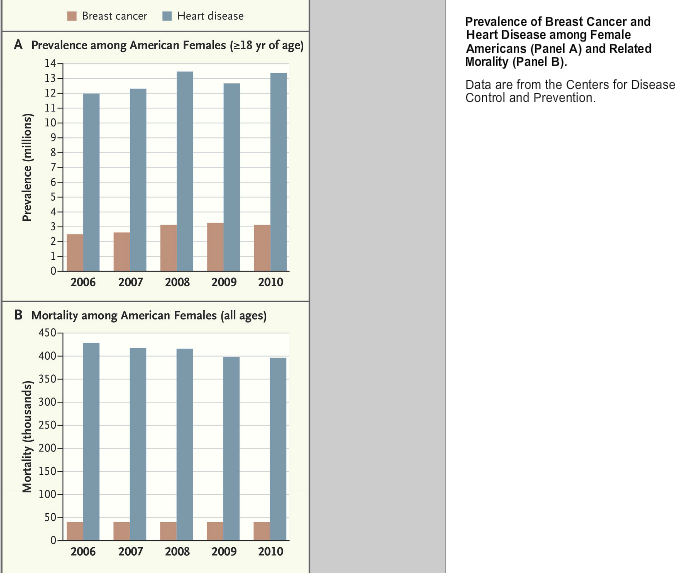
A graphic from this perspective article shows that mortality from cardiovascular disease is approximately ten times greater than mortality from breast cancer (if difficult to see, the graphic is available online http://www.nejm.org/doi/full/10.1056/NEJMp1314638?query=featured_home):

Cardiovascular vs. Breast Cancer Mortality in Women

Cardiovascular vs. Breast Cancer Mortality in Women

In pediatric GI, families are often more worried about the treatment than the disease (e.g.. inflammatory bowel disease), despite the fact that the disease is often far more dangerous.

Take home message: (quote from author) “If we want our facts to translate into better health, we may need to start talking more about our feelings.” This is true not just in cardiovascular disease, but in all aspects of medicine.

Related blog posts:

Crisis or Not -Tough to Change Bad Habits

For those of you with new resolutions, a sobering study from JAMA shows how difficult it is to change bad habits, even after a heart attack or a stroke.

From Sanjay Gupta’s twitter feed, link and excerpt: Video (1:48) http://ow.ly/sdS7R 

Even a brush with death is often not enough to get us to make better choices. Researchers studied more than 150,000 people from all around the world, rich and poor, urban and rural. Participants answered questions about exercise, diet, and smoking.

Because the group was so large, there were almost 8,000 participants who had survived either a heart attack or a stroke. The health habits of this group were startling. Only 39 percent reported improving their diet, and just 35 percent increased their physical activity. Of those who were smokers, only 52 percent quit. Just 4 percent of those 8,000 people improved their habits in all three areas: smoking, diet, and exercise.

Buyer Beware: Online Pharmacy Problems

“It always seems impossible until it’s done.”  –Nelson Mandela

From NY Times:

http://well.blogs.nytimes.com

Though technically illegal, millions of Americans buy prescription drugs from overseas pharmacies to save money.  But the practice can be a huge gamble.

The National Association of Boards of Pharmacy, a professional group, reviewed over 10,000 Internet drug outlets and found that many sold fake or unapproved drugs. Some that claimed to be Canadian pharmacies actually sold medicines from developing countries where regulations are weak and counterfeit drugs are common.

Roger Bate, a pharmaceutical expert at the American Enterprise Institute, estimates that 2 to 3 percent of online pharmacies are legitimate. When buying Canadian, he said, look for outlets certified by the Canadian International Pharmacy Association, a trade group of Canadian pharmacies, or those certified by PharmacyChecker.com, a free website that verifies that the foreign sites it approves protect consumer information and meet quality standards.

Last year, Mr. Bate and his colleagues published a study analyzing 372 orders of five popular prescription drugs – Lipitor, Celebrex, Viagra, Nexium and Zoloft – that they purchased from 79 domestic and foreign online drug outlets. Products bought from Canadian or other foreign sites certified by C.I.P.A. or PharmacyChecker.com were of high quality. So were products ordered from American sites verified by either the N.A.B.P. or LegitScript.com, a certification agency founded by a former White House aide on drug policy issues.

But that was not the case for sites that were not certified by any of these four groups. Many of the drugs they sold were fakes, including about a quarter of the Viagra samples, which largely appeared to have originated in China.

“You can’t be 100 percent certain with any sites, frankly,” Mr. Bate said. “But you are running a much lower risk if you buy from a credentialed site.”

Understanding PEWs & Online Reputation

Most pediatric gastroenterologists would think that the acronym PEWS referred to “Pediatric Early Warning Score” which is used to identify patient deterioration (Sensitivity of the Pediatric Early Warning Score to Identify Patient ).  This PEWS has been an important  achievement in patient safety contributing to lower mortality, reduced codes, and shortened intensive care unit stays (Simple Scoring System and Action Algorithm Identifies Children at ).

PEWs acronym also refers to “physician evaluation websites.”  These type of scores are growing in importance and may also reflect quality care.  As such, a recent article highlights this emerging phenomenon (Am J Gastroenterol 2013; 108: 1676-85 -thanks to Ben Gold for this reference).  While physicians are concerned about their reputations, these websites have not been widely embraced.  This article makes several points about why physicians may need to reconsider.

Key points:

  • 35 websites met criteria to be included in this study: 18 were dedicated physician evaluation websites, 5 were health information websites, and 12 were general information websites (eg. Angieslist.com, kudzu.com, yelp.com).
  • Frequent analysis/questions besides demographics/affiliations: punctuality, quality of staff (office/nursing), bedside manner, ability to make correct diagnosis, spent sufficient time, costs
  • Five sites allow physician feedback and chance to respond to dissatisfied patients: docspot.com, doctorscorecard.com, healthgrades.com, ratemds.com, and your city.md
  • Multiple charts indicate the huge traffic on these websites.  For dedicated PEWs, healthgrades.com has the highest volume at over 5 million unique visitors per month (2011-2012).
  • Most online evaluations are completed by females (with at least some college education) with a peak age between 45-65 years.  Some smaller PEWs attract a younger crowd (eg. Zocdoc.com -4th most visited dedicated PEW).
  • Most evaluations are positive.  “Site administrators…self-reported figures…ranged from 60-75% positive, 4-22% neutral, and 9-21% negative.”

Unique Aspects:

  • ucomparehealthcare.com (3rd most visited dedicated PEW) allows multiple physician profiles to be analyzed side-by-side.
  • docspot.com compiles existing reviews from over 15 other websites.
  • healthgrades.com (most visited dedicated PEW) allows users to rate physicians with a star scale but does not allow free response (avoids libelous comments).
  • vitals.com -2nd most visited dedicated PEW.
  • yourcity.md considered most “doctor friendly.” Prior to publicizing negative comments, this site allow doctors the option to respond publicly or privately; afterwards, the negative review can be revised.  In addition, per user agreement, a negative claim which cannot be substantiated could result in the anonymous reviewer’s name being revealed to the physician or be removed.

One of my mentors told me that the key to patient care was the the 3 A’s: availability, affability, and ability.  PEWs likely can help evaluate the first two A’s.  PEWs allow for constructive criticisms but need to evolve to include other measures of physician performance.  Ignoring PEWs would be a mistake for physicians –they are here to stay.

Related blog posts:

45,000 Unnecessary Deaths Per Year

According to a recent editorial (NEJM 2013; 369: 1180-81), 45,000 American adults die each year because they have no medical coverage (Am J Public Health 2009; 99: 2289-95).

The editorial which describes a late diagnosis of colon cancer in an adult who had been chronically uninsured despite working full-time makes a couple of key points:

  • Lack of insurance can be lethal
  • Underinsured also have higher mortality rates  One example: insurance status, not race, was associated with mortality after an acute cardiovascular event in Maryland (J Gen Intern Med 2012; 27: 1368)

While the rollout for the Affordable Care Act (ACA) has been bad, the underlying reason for it remains sound.  In addition, though the ACA expands coverage, I am skeptical that it will control problems with skyrocketing costs.  As such, many other difficult changes in medical care delivery will ultimately be needed.

Related blog post:

Life in the balance (book) | gutsandgrowth

Quality care = Work Satisfaction for Physicians

From Atul Gawande’s twitter feed:

RAND study:

“Factors Affecting Physician Professional Satisfaction and Their Implications for Patient Care, Health Systems, and Health Policy” Full article: http://bit.ly/19vVAnK 

1) Best predictor of MD work satisfaction: how we rate system’s care quality.  Physicians who felt that they were working in an environment with high quality care had higher work satisfaction.

2) Bad EHRs are killing us.  (Related blog entry: Aptly titled “The Cost of Technology” | gutsandgrowth)