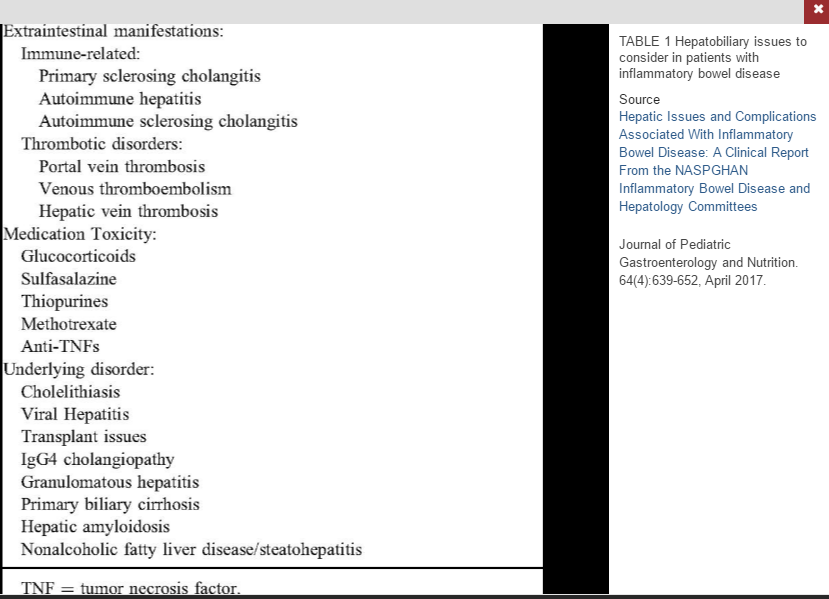
Liver Problems with Inflammatory Bowel Disease

A recent review (Full text: LJ Saubermann et al. JPGN 2017; 64: 639-52)  discusses the hepatic issues and complications associated with inflammatory bowel disease.

Key topics:

  • Primary Sclerosing Cholangitis (PSC)
  • Autoimmune Hepatitis (AIH)
  • Autoimmune Sclerosing Cholangitis (ASC)
  • Portal Venous Thrombosis/hypercoagulability
  • Cholelithiasis (more common in Crohn’s disease if diseased terminal ileum)
  • Viral hepatitis
  • Drug-Induced Liver Disease
  • Fatty Liver disease

Many of these topics have been discussed previously on this blog.  A couple of pointers in this review:

PSC:

  • Greater risk of colorectal carcinoma
  • IBD-PSC patients are at higher risk for pouchitis
  • GGT of >252 U/L “was highly sensitive (99%) and had good specificity (71%) for PSC” [or ASC]
  • The authors recommend “screening all newly diagnosed patients with IBD with ALT and GGT
  • Immunosuppressive therapy is NOT effective
  • Vancomycin therapy is currently being tested (clinical trials: NCT02137668 & NCT01802073)

AIH:

  • Less frequent in IBD patients than PSC
  • Most common treatment is prednisone/azathioprine
  • 40-80% of children have cirrhosis at AIH diagnosis, but “progression to end-stage liver disease is rare and …with appropriate treatment, 80% of patients achieve remission.”

ASC:

  • ASC is an overlap syndrome between AIH and PSC
  • “It is important that children with IBD and apparent AIH are routinely investigated for evidence of biliary disease with MRCP”
  • “ASC responds to the same immunosuppressive combination therapy used for AIH”

HAV/HBV Immunization:

  • HAV vaccination is effective in patients with IBD…although the rate [seroconversion] was significantly lower” in patients receiving anti-TNF therapy (92.4% vs 99.1% in one study).
  • In those needing HBV immunization: “One strategy evaluated to improve HBV immunity in adults with IBD is an accelerated course with double vaccine doses at 0, 1, and 2 months.”

Methotrexate (MTX):

  • “The extent of histological features of hepatotoxicity secondary to long-term MTX use in IBD has been infrequently described; however, the inicdence of significant abnormal histological findings appears to be rather low.”

My take: This article is a good starting point for liver-related issues in IBD.  For concerns regarding medications, the NIH livertox website is more useful and much more comprehensive.

Related blog entries:

DILI:

PSC:

AIH:


Proof That Diet Changes Can Improve a Fatty Liver

A recent prospective study (M Markova, O Pivovarova, et al. Gastroenterol 2017; 152: 571-85) showed that among individuals with nonalcoholic fatty liver disease (NAFLD) and type 2 diabetes that a diet high in protein (animal or plant) reduced liver fat over a 6 week period.

Among 37 participants, body fat and intrahepatic fat were detected with MRI and spectroscopy, respectively. Protein was increased to 30% of the diet. Fat was reduced to 30% and carbohydrates to 40% of diet composition. .

Key findings:

  • With a high animal protein diet, liver fat was reduced by 36%.  In the high plant protein diet group, liver fat was reduced by 48%.
  • Theses changes were unrelated to change in body weight.  However, these changes were correlated with down-regulation of lipolysis and lipogenic indices.

Some of the findings may be limited to older patients as this cohort was older than 60 years of age.  In the pediatric population, the dietary factor that has been linked most closely to NAFLD has been fructose, mainly in sugar-sweetened beverages (R Patusco et al. Top Clin Nutr 2017; 32: 27-46 -thanks to Ben Gold for this reference).

My take: This study shows improvement in liver fat with increased protein/reduced dietary fat.  While this study indicates that dietary modification is important in treating NAFLD, the optimal dietary intervention (eg. higher protein, lower sugar, lower fat) remains uncertain.

Related posts:


FDA Approval of HCV Medications for Children, 12-17 years

4/7/17:  FDA Okays Two Hepatitis C Drugs for Our Pediatric Patients

An excerpt:

The US Food and Drug Administration (FDA) today granted approval for supplemental applications for sofosbuvir (Sovaldi) and ledipasvir and sofosbuvir (Harvoni) to treat hepatitis C virus (HCV) in children ages 12 to 17…

Sovaldi, combined with ribavirin, is indicated to treat pediatric patients 12 years older or weighing at least 77 pounds (35 kilograms) with genotype 2 or 3 HCV infection without cirrhosis or with mild cirrhosis.   Harvoni is indicated for the treatment of pediatric patients 12 years and older or weighing at least 77 pounds (35 kilograms) with HCV genotype 1, 4, 5 or 6 infection without cirrhosis (liver disease) or with mild cirrhosis.   The approval for the new indication was based on an open-label, multicenter clinical trial including 100 pediatric patients 12 years and older looking at the safety, pharmacokinetics, and efficacy of Harvoni to treat HCV genotype 1 infection…

health care professionals should screen all patients for evidence of current or prior HBV infection before starting treatment with Harvoni or Sovaldi.

Liver Briefs -April 2017

JA Flemming et al. Hepatology 2017; 65: 804-12.  This cohort study (2003-2015) of 47,591 adults wait-listed for liver transplantation, using the SRTR registry, showed that the era of direct-acting antivirals for hepatitis C was associated with a drop of 32% for HCV patients who were listed compared to the numbers listed during the interferon era.

AG Feldman et al. J Pediatr 2017; 182: 217-22. This retrospective study showed that elevated lactate levels (≥2.5 mmol/L) and elevated lactate to pyruvate ratio (≥25) were NOT predictive of mitochondrial diseases in pediatric patients who presented with acute liver failure.

AG Feldman et al. J Pediatr 2017; 182: 232-38. This retrospective cohort study showed a high rate of vaccine preventable illnesses (VPIs) following liver transplantation (n=2554), occurring in 1 of 6 liver transplant recipients. Most common infections was RSV; most common VPIs: rotavirus and influenza

Saint Chappelle, Paris

What Works for Itching?

Two recent articles delve into the issue of pruritus associated with cholestasis:

  • JE Squires et al. JPGN 2017; 64: 425-430.
  • Thebaut et al. JPGN 2017; 64: 431-35.

In the first study, a single-center retrospective review of 8 patients with FIC1 disease who underwent partial exernal biliary diversion (PEBD) showed that all patients had resolution of chronic cholestasis (T bili <2 mg/dL) but 7 of 8 experience episodic cholestatic events. Pruritus improved but did not resolve.  PEBD did not obviate the need for aggressive fat-soluble vitamin supplements.

In the second study, the authors added sertraline to patients who had ongoing pruritus despite ursodeoxycholic acid and rifampin therapy.  Patients had either Alagille syndrome or PFIC (progressive familial intrahepatic cholestasis). Two patients had undergone PEBD. Sertraline was started at 1 mg/kg/day and increased as needed every two weeks to max of 4 mg/kg/day (median daily dose 2.2 mg/kg/day).  6 patients had adverse effects, including agitation (2), skin reactions (2), alopecia (1) and vomiting (1). Key finding:

  • 14 of 20 children had improved “itching score” from 8/10 to 5/10.  This correlated with improved sleep and less skin scratch marks.


Disclaimer: These blog posts are for educational purposes only. Specific dosing of medications/diets (along with potential adverse effects) should be confirmed by prescribing physician/nutritionist.  This content is not a substitute for medical advice, diagnosis or treatment provided by a qualified healthcare provider. Always seek the advice of your physician or other qualified health provider with any questions you may have regarding a condition.

Sawnee Mountain Park

March 2017 Briefs

MC Montana, AS Evers. J Pediatr 2017; 181: 279-84. This commentary reviewed recent studies regarding anesthetic neurotoxicity. “Two recently published human studies suggest a lack of harm in otherwise-healthy children following a short duration anesthetic (approximately 1 hour)” References: Lancet 2016; 387: 239-50 & JAMA 2016; 315: 2312-20.

Related posts:

NR Santucci et al. JPGN 2017; 64: 186-93.  This systematic review selected 31 studies (out of 916 citations) and found there is no consensus concerning diagnostic criteria for biliary dyskinesia and the data supporting the concept of biliary dyskinesia in children is weak.  The uncontrolled studies were generally observational, retrospective designs with relatively small numbers.

Related posts

I Youngster et al. J Pediatr 2017; 182: 239-44.  This study examined large prescription databases (more than 74 million person years) and identified wide discrepancy in antibiotic use among the six different countries.  For example, among children less than 2 years of age, South Korea had the highest rate of antimicrobial use, with 3.41 prescribed courses per child-year; in contrast, the rates were 1.4 in Italy, 1.5 in Spain, 1.1 in the U.S., 1.0 in Germany, and 0.5 in Norway.

A Srivastavai et al. JPGN 2017; 64: 194-9. In this retrospective study with 262 children with liver disease-related ascites, the authors found spontaneous bacterial peritonitis (or culture-negattive neurocytic ascites) in 28.6%. Half of these patients were asymptomatic.  SBP/CNNA was defined by having a polymorphonuclear leukocyte count of >250 cells/mm3.  There was a 24% one-year mortality rate for those who had SBP/CNNA.

MR Narkewicz et al. JPGN 2017; 64: 210-7. Using data from the pediatric acute liver failure group, the researchers identified a high rate of autoantibodies (28%) among 986 pediatric subjects with acute liver failure. The presence of autoantibodies was not significantly associate with 21-day outcomes and steroid treatment was not associated with survival; in fact, those without a known diagnosis of autoimmune hepatitis, had a higher risk of death with steroid therapy. In the setting of acute liver failure, autoantibody positivity does not obviate the need for a complete diagnostic workup.

A Lauterio et al. Liver Transplantation 2017; 23: 184-93.  Italian review of living donor safety found that major complications occurred in 12.6% (31 or 246)  but there were no mortalities. 5 (2%) required reoperation.


from Twitter's 'This Week in Church Signs' feed

from Twitter’s ‘This Week in Church Signs’ feed

Rising Rates of Pediatric Fatty Liver

The alarming rates of pediatric nonalcoholic fatty liver disease are summarized in a recent Lancet Blog (Thanks to John Pohl for this link).  Seven million children in U.S. have fatty liver disease.

Link: An alarming trend in fatty livers (in children)

An excerpt:

The rate of NAFLD among US children has tripled over the last twenty to thirty years, rising from 3-4 percent to 10-11 percent, according to Dr. Naim Alkhouri, Director of the Metabolic Liver Center at the Texas Liver Institute in San Antonio…

Lifestyle changes, such as better nutrition and increased exercise, are currently the best-known way of mitigating and possibly reversing its effects…

Some 35-50 percent of obese children have NAFLD, and 20 percent of children with NAFLD have the advanced form of NASH. Also, 10-15 percent of children with NAFLD are in a predicament that could be described as “pre-cirrhosis.”

“Though most cases of juvenile NAFLD are caused by excess weight and associated insulin resistance, “up to 7% of non-overweight or obese children may have NAFLD,” according to a new study that Alkhouri and others will present at the upcoming International Liver Congress, held in Amsterdam this April.

Related blog posts:

Chattahoochee near Azalea Drive

Chattahoochee near Azalea Drive

Pediatric NAFLD Guidelines 2017

The concise recommendations (M Vos et al. JPGN 2017; 64: 319-34) from the Expert Committee on NAFLD (ECON)/NASPGHAN provide helpful advice on this increasingly common disorder. Link to full text: NASPGHAN Clinical Practice Guideline for NAFLD

The recommendations are graded on strength of recommendation and quality of the evidence.

Some key points:

  • Use ALT as a screening tool (despite its imperfections). Persistently elevations (>2xULN) should be evaluated for liver disease, including NAFLD.  (Norms: 22 U/L for girls, 26 U/L for boys). Values above 80 U/L “warrants increased clinical concern.”
  • Screening should be considered between ages 9 and 11 years for all obese children and for overweight children with additional risk factors.
  • Ultrasound and CT scans are NOT recommended.
  • Liver biopsy should be considered for the assessment of NAFLD in children who have increased risk of NASH and/or advanced fibrosis.  This could include those with splenomegaly, AST/ALT>1, higher ALT (>80 U/L), panhypopituitarism, and type 2 diabetes.
  • Treatment: Lifestyle modifications recommended.  No currently avaiable medications or supplements are recommended.
  • Look for & avoid comorbidities: dyslipidemias, hypertension, and diabetes. Assure vaccinations against Hep A/Hep B and counsel against binge drinking and against smoking.

Related blog posts:

screenshot-150

“When the Cause of Liver Disease Is the Heart”

A recent review (S Ofei, C Gariepy. JPGN 2017; 64: 3-7) provides a good review of “congestive hepatopathy.”

Key points:

  • Overall, the liver receives 25% of cardiac output; though, 70% of blood flow to the liver is partially deoxygenated blood.  Cardiac disease can lead to liver disease due to hypoxic injury.
  • “Congestive hepatopathy (CH) results from chronic right heart dysfunction with decreased hepatic blood flow, arterial saturation, and increased central venous pressure.”  Ultimately, CH can lead to hepatic cirrhosis, termed ‘cardiac cirrhosis’ by the authors.
  • “Symptoms of CH are vague.” These symptoms could include abdominal pain nausea, and early satiety.
  • Treatment is uncertain.  “Guidelines and expert consensus..favor use of loop diuretics in patients with jaundice, hepatic congestion, and ascites.”
  • With regard to patients with Fontan-associated liver disease (FALD), “there is no consensus.” Patients should be treated for complications like varices, coagulopathy, and nutritional deficiencies.”  Some patients will need liver transplantation, though liver disease may be reversible with cardiac transplantation.  The article provides many references that provide more in-depth review of this topic.

My take: Overall, this article provides a succinct review of congestive hepatopathy.  There are many other cardiac conditions associated with liver dysfunction including heart disease associated with NAFLD, Alagille syndrome, and Kawasaki’s.

Cozumel

Cozumel

Related blog posts: