Personal Look at 20 Years of Doctoring (Part 2)

“. . . For the secret of the care of the patient is in caring for the patient.”

“These words, burned indelibly into the minds of generations of medical students, closed a lecture given by Francis W. Peabody to Harvard students on October 21, 1925” (N Engl J Med 1993; 328:817-818).

Still Striving to Be the Best

Yesterday, I noted how difficult it is to ‘get away from it all.’ Both technology and empathy are to blame.  The flip side of the message is that I still want to be the best.

In medical school I was eager to read so many books that discussed what it meant to be a physician.  Now having worked as a physician for 20 years I have my own thoughts.  On an abstract level, it is easy to say that you want to be the best physician. To accomplish the task, you work really hard, you read everything you can, you listen intently, and you set aside enough time to think carefully.

Yet, that still is not enough.  As a practical matter, it is not so easy to be the best at anything.  The biggest problem is that there are other people who are really terrific. How can I be the best when there is always someone smarter, funnier, and more empathetic?   In medical school, I was given a few pieces of advice:

‘After 5 years of practice, all of your patients will love you….those that don’t will see someone else.’


‘There are three A’s to being a great physician.  Availability, affability, and ability.  Since most people have difficulty judging ability, you will probably be judged more on the first two.’

Perhaps, the logical conclusion is that I might be the best physician for some patients and not for others.  At this point, I will have to be content with knowing that I am still trying to be as good as I can be.

“When you reach for the stars, you may not quite get one, but you won’t come up with a handful of mud either.” Leo Burnett

If you are a reading this blog, what are you doing to be the best?

 

IMG_1299

Personal Look at 20 Years of Doctoring (Part 1)

As I start the new year, I decided that instead of reviewing an article, I would begin by sharing some personal thoughts.

It’s Harder Than Ever to Take a Vacation

When I was in high school, I often had some trouble getting to sleep.  I had so many ideas rushing through my head about what I wanted to do and what I needed to do the next day, the next week, the next month and so on.  One trick I learned was to teach myself to write down these thoughts before I went to bed and to pick them up when I woke up.  So when I went to bed, I knew I would not forget all these urgent ideas.  After a while I realized that I really did not need to write everything down, but went through the same mental process of putting the ideas aside until the morning.  This helped a great deal and I’ve been a good sleeper for a long time.  In fact, when I started residency, at first I would sleep through pager alarms.

In medical school, I learned about the idea of dissociation.  For me, at that time, this meant focusing on a clinical problem without worrying a lot about the personal aspects of how this problem affected the individual. I think I had a carefree attitude and did not bring problems home with me.

Over time, it became harder to separate the clinical work from the emotional aspects. While empathy can be a wonderful attribute, when one truly understands the suffering that others endure, it is hard not to take that home with you.  Despite this, I find that I don’t discuss clinical issues at home.  While there are patient privacy issues to consider, the biggest limiting factor is that talking about difficult situations doesn’t seem to help. So, when I get home, I either focus on these issues on a solitary basis or focus on something else entirely (eg. journals, books, exercise, etc).

What I lament these days is how with an interconnected world it is harder and harder to dissociate.  Weekends are not long enough.  If an issue pops up, it is so easy to reach out to providers like me with direct emails from families, texts from colleagues, or by other methods.

It used to be that when I went out of town, I was definitely on vacation and I would worry if a complicated patient ran into a problem; of course, the reason I worried about it was because it often seemed to happen.  Then I would hope that my absence did not adversely impact the patient’s care.  Even within a group of 14 highly competent colleagues who are eager to cover, it still seems like it takes a few days to really relax when I’m on vacation.  Since I am most familiar with the patients that I have seen, there is always the temptation to check on emails and access the clinical portal (computer records).  Even if I don’t check, having a smartphone almost always, except perhaps when out of the country, guarantees unwanted intrusions.  That 7:30 am call when I was planning on sleeping in.  Crap! I should have gone into the settings to change the blockout times.

Even if I don’t check any electronic devices, my thoughts periodically wander off thinking about the patients who were having some trouble and hoping they are OK. This is perhaps the biggest intrusion of all.  Perhaps, I need to go back to the tricks that worked for me in high school, though I wonder if that could really still work.  Maybe the biggest problem is that it’s harder to take a carefree vacation because I am much less of a carefree person.

These issues are not unique to physicians/healthcare providers.  Anyone else want to comment on whether they have been affected too?

IMG_1342

Vaccine Safety Comic Book Version – Will It Help?

The following link (from Jeff Lewis’ twitter feed) provides a terrific review and summary of the effectiveness of vaccines, the debunked myths, and how “anti-vax” movement hurt not just themselves but others too.

Vaccines Work, Here Are the Facts -Cartoon

Related blog posts:


2015 Wish List

A recent policy article (JAMA Pediatr 2014; 168: 1155-63 –thanks to Ben Gold for this reference) outlines “10 urgent priorities for the health and health care of US children.”  These priorities and some of the action steps are as follows:

  1. Poverty: “16.1 million children (22%) live in poverty. ” Action steps include enacting measures to improve employment in families and extending child tax credits.
  2. Food Insufficiency: “>16 million children live in food-insecure homes.” Actions could include investing rather than cutting children’s nutrition programs.
  3. Lack of health insurance: affects “7 million children (9%)” though two-thirds are eligible for coverage by Medicaid and CHIP. Actions could include fully funding CHOP and Medicaid and abolishing ACA family glitch along with improving outreach to enroll eligible children.
  4. Child abuse/neglect (maltreatment): “In 2011, 681,000 children experienced maltreatment and 1570 died” as a consequence.  Everyday, a child is abused or neglected every 47 seconds.  Action steps included focusing on domestic violence and treatment and funding more screening and preventative treatment research.
  5. Obesity: “32% of children are overweight and 17% are obese.”  Actions could include passing FIT kids Act (HR 2178) and maximizing funding for USDA’s Farmers market promotion program and the Fresh fruit and vegetable program.
  6. Firearms deaths/injuries: 5 children die daily by firearms.  Actions could include better background checks, along with regulations to require safer storage and safety classes.  Other options include higher taxation on weaponry and ammunition to “better represent societal costs.”
  7. Racial disparities: Action steps include monitoring and disclosing disparities and working to ensure all children have a medical home.
  8. Mental Health: up to 20% of children experience a mental health disorder annually.  Actions could include increasing the number of qualified mental-health providers (by enhancing reimbursement).
  9. Immigration: “children living in immigrant families are the fastest growing group of US children.” Action could include obtain health insurance for all children.
  10. Research: Increase funding for children.  Overall NIH pediatric funding is 12% of total budget whereas children represent 24% of US population.

The problems faced by this nation’s children will reverberate for a long time.  For example, with childhood poverty, it is “associated with substantially higher mortality rates in adults, regardless of adult socioeconomic status (i.e., even affluent adults who were poor as children have elevated death rates), and this increased mortality risk extends across 2 generations.”

Bottomline: Children receive a disproportionately low share of federal expenditures and this extends to healthcare.  In addition, federal spending on children in 2014 has decreased by more than $20 billion (14%) since 2010.

Blog post:

Amplified Pain Syndromes in Children

A recent review (Curr Opin Rheumatol 2014; 23: 1-12 -thanks to our pain team for sending reference) makes a number of important points regarding the pathogenesis and management of amplified pain syndromes (APS).

Table 1 lists the diagnosis and pain presentations.  These include complex regional pain syndromes, juvenile fibromyalgia, diffuse idiopathic pain, concomitant conditions (including irritable bowel syndrome, chronic fatigue syndrome, interstitial cystitis, chronic headache, functional abdominal pain, and conversion symptoms/disorder).

Key points:

  • Pediatric APS are widespread and under-recognized
  • Pathophysiology is complex with numerous contributors “including central sensitization, abnormal cytokine production, sympathetic-sensory disorders, autoimmune responses, altered blood flow, genetic predisposition, and psychosocial factors.”
  • The clinical effectiveness of medication management in pediatric APS remains unclear and controversial.”  It is noted that preoperative gabapentin and pregabalin may reduce the incidence of chronic post surgical pain (in adults); this has not been documented in a pediatric population.
  • Exercise-based and cognitive-based treatments remain the cornerstone of therapy.” Intensive multidisciplinary pain rehabilitation “restores functioning rapidly, reduces pain in the long run, improves comorbid psychological distress, and reduces medical utilization.”
  • Potential elements of treatment noted in Table 2 (geared more towards rheumatology), including exercise, desensitization, self-regulation (eg. diaphragmatic breathing, guided imagery), and stress management/counseling.

Bottomline: For children with severe pain symptoms, multidisciplinary pain teams can be very helpful.  However, there is not a simple pill that will fix everything.

Related blog posts:


Pet Peeves -Cough and Cold Medicines and Antibiotic Usage

Although upper respiratory illnesses are not a primary focus for pediatric gastroenterologists, due to their frequency, we see them quite a bit.  Even with my limited exposure, I frequently receive requests for medications to reduce the symptoms of cough and runny nose.

My approach has typically been to explain that I don’t believe that cough and cold medicines (CCMs) are effective and can be harmful, especially in young children.  This explanation is in agreement with efforts that both the pharmaceutical industry and the Food and Drug Administration (FDA) took in 2007 and 2008 to limit the use of over the counter (OTC) CCMs in young children.  The American Academy of Pediatrics has gone further and advised against their usage in children under age 6 years.  These recommendations came in part due to lack of efficacy of these agents but also due to the recognized potential for adverse effects, including fatalities.

Recently, a study (J Pediatr 2014; 165:1024-8) has shown that despite labeling changes on CCMs there has been virtually no impact on the use of OTC CCMs.  Using information from administrative databases, this study compared prescribing patterns 2005-2006 with 2009-2010 in children aged ≤ 12 years.  Results: There was an increase in use of OTC CCM used in ambulatory clinics (6.3% to 11.1%) but a decrease in the use of prescription CCMs 6.7% to 2.9%.  The OTC CCM use in children <2 years was essentially unchanged between the two timeframes (6.8% compared to 6.5%)

Bottomline: If parents and physicians want to do what is best for the children they care for, then more effort is needed to stop the widespread use of CCMs.  Prevention with influenza vaccination and proper hand hygiene are measures which can help.

A separate problem is the misuse of antibiotics for upper respiratory illnesses.  This is widespread as well.  While this blog has discussed antibiotic resistance and antimicrobial stewardship, a recent article (NEJM 2014; 371: 1761-63) provided a few new ideas on this subject.

  • First, the authors note that modern medicine is entirely dependent on antibiotics.  “Two major ways that modern medicine saves lives are through antibiotic treatment of severe infections and the performance of medical and surgical procedures under the protection of antibiotics.”
  • Second, the authors note that “as people in wealthier regions run out of effective antibiotics, they come to share the lot of people in poorer regions who can’t afford them to begin with.”
  • Third, the authors point out that antibiotic resistance was recognized in 1945 by Alexander Fleming and Howard Walter Florey when they accepted the Nobel Prize for the discovery of penicillin.

The authors then outline the areas that need to be addressed to diminish the prospects of ineffective antibiotics:

  • Prevention with vaccination and sanitation
  • Leadership to coordinate global surveillance and manage rewards for proper usage
  • Access to subsidized appropriate usage in poorer countries
  • Conservation of antibiotic usage –restrain use of antibiotics in agriculture/farming
  • Conservation through appropriate use of prescriptions

Related blog posts:

Measles Epidemic 1991 -Compelling Narrative

I saw two personal heroes yesterday –Donald Schaffner and Paul Offit.  This happened at the 13th annual Donald Schaffner conference.

Dr. Schaffner is a former surgeon at Children’s Healthcare of Atlanta .  In recent years, he has battled a number of medical problems.  During my early years as an attending, he and I worked together to help a number of children.  His patience, caring, and dedication to providing the best care were unrivaled.

I had never met Dr. Offit in person and this was the first time that I heard him speak.  However, he has been an outspoken advocate for vaccines and has written extensively on this subject; in addition, he has cast a critical eye on some alternative medicine practices.  I have quoted him numerous times on this blog (see links below). His topic for this conference: “The Philadelphia Measles Epidemic of 1991: Lesson from the Past or Prologue to the Future.”

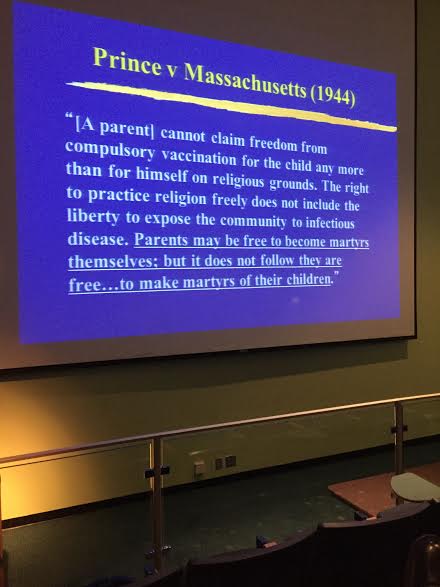
This was an amazing narrative of the measles epidemic combining the epidemiology, with journalism, law, politics, and the history of refusing vaccines.  I did not take any notes, though I did take two pictures.  The lecture was effective because it was presented like any good story with lots of details, facts, and passion.  The lies and mistakes were discussed as well.

Legal Foundation for Compulsory Vaccination during Measles Epidemic

Legal Foundation for Compulsory Vaccination during Measles Epidemic

High case fatality among those who claimed religious exemptions to vaccine

High case fatality among those who claimed religious exemptions to vaccine

Key points:

  • Religious vaccine exemption was claimed initially by Christian Scientists. This has been expanded by other groups claiming personal beliefs.
  • Vaccine successes have made people forget how dangerous diseases like measles can be; unfortunately, resurgence of these diseases may be necessary to convince people that vaccination is worthwhile

One more link -yesterday on NPR: Measles Still Kills

Related blog posts:

Microcytic Anemia Review

A useful review of microcytic anemia (NEJM 2014; 371: 1324-31) discusses the most common causes, mechanisms and treatment of microcytic anemia.

Common causes discussed include thalassemia, iron deficiency anemia, and anemia of inflammation.  With the latter, the authors review the pathophysiology: “the cause of this anemia is twofold. First, renal production of erythropoietin is suppressed by inflammatory cytokines, resulting in decreased red-cell production. Second, lack of iron availability for developing red cells can lead to microcytosis.  The lack of iron is largely due to the protein hepcidin, an acute-phase reactant that leads to both reduced iron absorption and reduced release of iron from body stores.

Treatment of iron deficiency anemia –pointers:

  • Ferrous sulfate (325 mg [65 mg of elemental iron] orally three times a day -considered first line for adults.  Ferrous gluconate at a daily dose of 325 mg [35 mg elemental] is an alternative.
  • “Several trials suggest that lower doses of iron, such as 15 to 20 mg of elemental iron daily can be as effective as higher doses and have fewer side effects.”
  • “There are many oral iron preparations, but no one compound appears to be superior to another.”
  • In those with an inadequate response to oral iron therapy, parenteral iron can be helpful.  The authors note that low-molecular-weight iron dextran (INFeD) is “associated with an incidence of reactions that is similar to that with the newer products but allows for higher doses of iron replacement.”  Typical dosing for adults: 25 mg test dose, and if tolerated for 1 hr, can give 975 mg (1000 mg total) over 4-6 hours.  The low-molecular-weight iron dextran should not be used in patients with previous iron dextran hypersensitivity reactions.
  • Alternative IV iron products: Ferric gluconate [Ferrlecit] 125 mg adult dose over 1 hour -given weekly (8 doses = 1000 mg) or Iron Sucrose [Venofer] 200 mg adult dose over 15-60 min, 300 mg over 1.5 hr, or 500 mg over 4 hr; can repeat in subsequent sessions until total dose of 1000 mg.

Related blog posts:

Disclaimer: These blog posts are for educational purposes only. Specific dosing of medications (along with potential adverse effects) should be confirmed by prescribing physician.  This content is not a substitute for medical advice, diagnosis or treatment provided by a qualified healthcare provider. Always seek the advice of your physician or other qualified health provider with any questions you may have regarding a condition.

More Measles Cases -Here’s the Data

This past month a recent perspective article (NEJM 2014; 371: 1661-3) provides an update on measles and the problems with vaccination rates.

Key points:

  • More measles cases in 2014 (592 thru Aug 29) than in any year in the past 20.  Already, the number of cases this year is >3-fold the number in 2013 and ~10-fold more than in 2012
  • Most cases are due to infections acquired during travel or due to cases being brought into U.S. by foreign travelers
  • Problem has expanded due to increasing number of unvaccinated children.  Vaccines “that remain in the vial are completely ineffective.”
  • Measles remains one of the most contagious illnesses and typically one person can infect up to 18 susceptible persons.  Due to its contagiousness, a high level of herd immunity (>92-94% immune) is needed to prevent sustained spread of virus.
  • Measles can be deadly with case fatality rate of 0.2% to 0.3% in the developed world and much higher in the developing world (2-15%).
  • Even a few cases are very expensive to control. A 2004 Iowa outbreak of only three patients cost more than $140,000 to contain/investigate.  An outbreak in Arizona with only 7 patients cost more than $800,000.

Related blog posts:

Rewarding Restraint vs. Reality

Congratulations to Jeff Lewis, MD.  He has been selected from the Georgia Dept. of Public Health to receive the Maternal & Child Health Treating Children with Special Healthcare Needs Award.  This award will be presented at the Georgia- American Academy of Pediatrics Annual Awards Luncheon at Pediatric on the Perimeter on Friday Oct. 31, 2014 from Noon-1:30 pm.

Previously this blog noted the low usage of bronchiolitis guidelines (If a Guideline Falls in The Woods, and No One Hears It …) More information on this subject and why it is important has been published (J Pediatr 2014; 165: 786-92, ed 655-57).

Why this is important:

  1. Bronchiolitis is one area that has been well-studied and the evidence is strong regarding unnecessary medications and evaluations.
  2. Bronchiolitis is common.  It is the fourth most common reason for hospital care in US children’s hospitals.
  3. Four of five “Choose Wisely” targets in pediatrics focus on bronchiolitis care, including not routinely ordering chest xrays (in uncomplicated cases), avoiding bronchodilators, not using systemic corticosteroids, and not using pulse oximetry when off supplemental oxygen.

However, when one looks at Figure 1 (from the study) -resource utilization over time and Figure 2 – heat map for adjusted use by 42 separate hospitals –it is apparent that only about 5 of the hospitals are successful in at least 3 of 5 areas (albuterol, racemic epinephrine, steroids, chest radiographs, and antibiotics).  The data from these figures is derived from 64,994 hospitalizations that were analyzed.

Median hospital use of nonrecommended tests/treatments:

  • Albuterol 52.4% with range: 3.5% to 81%
  • Racemic epinephrine 20.1% with range: 0.6% to 78.8%
  • Corticosteroids 10.9% with range: 4.1% to 46.6%
  • Chest xray: 54.9% with range 24.1% to 76.6%
  • Antibiotics: 38.4% with range 27.1% to 50.1%

From editorial: “Many of us practice in environments that reward “doing more” as a sign of thoroughness and better clinical care.  Nowhere is this truer than in our acadmeic centers…we need a culture change in our training centers toward role modeling and rewarding restraint in testing and treatment as part of high value care efforts.”

Take-home message: If excessive testing and treatments is rampant for problems like bronchiolitis in which they have been proven to be of low value, what chance is there for restraint in more murky areas?

Related blog post: Trying to make Cents out of Value Care |