Addicts and Anti-Diarrhea Drugs

According to NY Times:

Addicts Who Can’t Find Painkillers Turn to Anti-Diarrhea Drugs

Here’s an excerpt:

The active ingredient, loperamide, offers a cheap high if it is consumed in extraordinary amounts. But in addition to being uncomfortably constipating, it can be toxic, even deadly, to the heart.

A report published online in Annals of Emergency Medicine recently described two deaths in New York after loperamide abuse. And overdoses have been linked to deaths or life-threatening irregular heartbeats in at least a dozen other cases in five states in the last 18 months.

Most physicians just recently realized loperamide could be abused, and few look for it. There is little if any national data on the problem, but many toxicologists and emergency department doctors suspect that it is more widespread than scattered reports suggest.

Meerkat, Atlanta Zoo 2016


Meerkat, Atlanta Zoo 2016

Latest Obesity Data Discouraging

From LA Times (reporting on CDC study): In U.S., 38% of adults and 17% of kids are now obese

“How do government agencies, private foundations, industry groups and professional societies squander hundreds of millions of dollars? By trying to fight America’s obesity epidemic.

Two new studies show that the best efforts of all these players – as well as schools, churches and individual healthcare providers – have largely failed to keep most Americans from getting fatter.”

Screen Shot 2016-06-08 at 8.55.34 PM

Outcome with POTS –Better than Expected?

Adolescents with postural orthostatic tachycardia syndrome (POTS) are often seen in pediatric GI offices due to the associated GI symptoms.  A recent report (R Bhatia et al. J Pediatr 2016; 173: 149-53) offers up some encouraging data.

172 patients (of 502) responded to the authors’ survey.  The mean duration since the time of diagnosis was 5.4 years. Key findings:

  • 19% (n=33) reported complete resolution of their symptoms
  • 51% reported improvement, but persistent, symptoms
  • 28% reported intermittent symptoms
  • Thus, 86% reported that their POTS resolved, improved or was intermittent.

The authors note that some symptoms like dizziness and fatigue are common in patients without POTS and that “persistence of some symptoms can be part of a normal healthy life.”

My take: This study indicates that most adolescents with POTS are likely to have a good functional outcome.

Related blog posts:

BryceNat'l Park

Bryce Nat’l Park

Vedolizumab for Primary Sclerosing Cholangitis (with IBD)?

“The monoclonal antibody vedolizumab may reduce biliary inflammation in patients with primary sclerosing cholangitis and comorbid inflammatory bowel disease, according to early, open-label study findings reported at the meeting sponsored by the European Association for the Study of the Liver”  –according to GIHepNews: Biliary inflammation reduced by IBD drug

“Vedolizumab given to 27 patients with primary sclerosing cholangitis (PSC) and inflammatory bowel disease (IBD) resulted in a 50% reduction or normalization of serum alkaline phosphatase levels in 17 cases (63%).”

This was an open-label, proof-of-concept study involving 27 patients aged 25-30 years with PSC and comorbid IBD.

My take: This is interesting but needs a lot more study.

Atlanta Zoo 2016

Atlanta Zoo 2016

Slipping Rib Syndrome

The entity, of “Slipping Rib Syndrome,” which could be mistaken for a gastronomical error at The Boathouse, is also called Cyriax syndrome.  A recent brief report (L Calvete et al. J Pediatric 2016; 172: 216) describes a typical case.  This teenager had a 1-year history of “brief, episodic, sharp upper left abdominal pain, accompanied by a [subtle] chest wall deformity, which started after physical activity.”

Key points:

  • This disorder is most common in middle-aged females but can occur at any age
  • It can result from hyper mobility of the false ribs, allowing “the affected rib to sublet or ‘slip’ under the adjacent rib,..and cause pain
  • The disorder can be elicited with the ‘hooking’ maneuver.  “In this test, the patient lies in the supine position, while the clinician hooks his or her fingers beneath the costal margins of the affected side, displacing them upward and anteriorly pulling gently.  A positive test reproduces pain.”
  • Treatment: avoidance of displacement and mild analgesics

My take: I’ve only seen this condition once but think it is important to consider in patients presenting with intermittent abdominal pain.

Atlanta Zoo 2016

Atlanta Zoo 2016

Solitary Hepatic Nodule and Alagille Syndrome

A retrospective study (A Alhammad et al. JPGN 2016; 62: 226-32) of 55 children from 1999-2014 examined the frequency of a solitary hepatic nodule adjacent to the right portal vein as a potential diagnostic finding for Alagille syndrome.  Only 39 had appropriate imaging to examine.

Key findings:

  • In 12 (of 39) focal hepatic lesions were evident (11 were solitary).
  • The median diameter was 8.1 cm.
  • In those with pathology review, the cases were suggestive of a regenerative nodule.
  • In all but one case, the alpha-fetoprotein levels were normal.
  • 10 of these lesions were adjacent to the right portal vein.

One other point from the discussion:

  • ~21% of patients with Alagille require liver transplantation, primarily for unremitting cholestasis and pruritus

My take: Recognition of this entity will help avoid mistaking this lesion for hepatocellular carcinoma.

Related blog posts:

HeavenHellBillMurray

Ultra-Short Celiac Disease


It is well-recognized that obtaining a duodenal bulb biopsy increases the likelihood of making a diagnosis of celiac disease.  Another study (PD Mooney et al. Gastroenterol 2016; 150: 1125-34) has tried to quantitate the frequency of “ultra-short” celiac disease (USCD).

In this prospective study of 1378 patients (mean age 50.3 yrs) who underwent endoscopy between 2008-2014, there was a cohort who had a high clinical suspicion of celiac disease in which quadrantic biopsies of the duodenal bulb were obtained.

Key findings:

  • 268 (19.4%) were diagnosed with celiac disease
  • 26 (9.7%) of celiac population had disease identified primarily in the duodenal bulb.  These patients with USCD were younger (P=.03), had lower serologic titers of tissue transglutaminase antibody (tTG) (P=.001), and less frequently had diarrhea (P=.001).
  • In USCD, the tTG titers were a median of 4.8x ULN compared with 20x ULN in those with more extensive disease.
  • While the authors characterize 26 as having USCD, 19 of the 26 did have Marsh 1 (n=18, 69.2%) or Marsh 2 (n=1, 3.8%) lesions, indicating at least some involvement more distally. However, in these patients the duodenal bulb findings clinched the diagnosis.

Despite the protocol, the authors showed that a single biopsy from the bulb was sufficient to increase the diagnostic yield.

My take: This study reinforces the need for duodenal biopsies from both the bulb and more distally when the diagnosis of celiac disease is being considered.

Related blog posts:

Last Year at Turner Field

This is the last year at Turner Field

More Than 100 Leading Scientists: “Stop Bashing GMO Foods”

“Scientific and regulatory agencies around the world have repeatedly and consistently found crops and foods improved through biotechnology to be as safe as, if not safer than those derived from any other method of production,” the group of laureates wrote. “There has never been a single confirmed case of a negative health outcome for humans or animals from their consumption. Their environmental impacts have been shown repeatedly to be less damaging to the environment, and a boon to global biodiversity.”

Here’s the link: NY Times Stop Bashing GMO Foods

Related posts:

Sullivan's Island, SC

Sullivan’s Island, SC

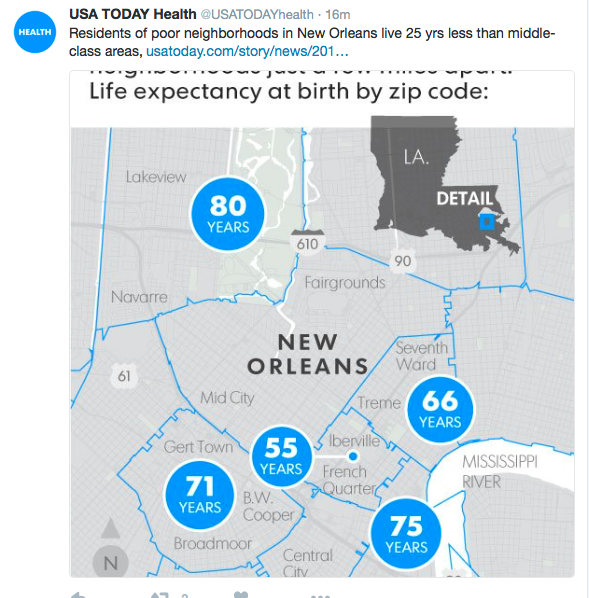
Zip Code vs. Genetic Code

Several posts have highlighted the importance of poverty contributing to high mortality, including the following:

The following infographic shows again how your zip code is likely more important than your genetic code.

Lower Teen Birthrate

Lower Teen Birthrate


Gastrostomy Tubes: The First 30 Days

A retrospective study (AB Goldin et al. J Pediatric 2016; 174: 139-45) provides a better idea about the likelihood of complications by looking for ED visits and admissions within 30  days of placement.

This study involved 38 Children’s Hospitals and 15,642 patients the Pediatric Health Information System (PHIS) database. Key findings:

  • 8.6% had an ED visit within 30 days
  • 3.9% had an admission within 30 days
  • Common reasons for return visits: infection (27%), mechanical complication (22%) and replacement (19%).

The authors note that risk factors for ED visits and admission were mainly non modifiable like race/ethnicity and medical complexity.  They also note that problems in the early postoperative period are grossly underestimated due to many issues being addressed in the outpatient setting.

This study indicates that there is a tremendous opportunity for improvement.  There is great variation in hospital practices with regard to the type and method of placing gastrostomy tube.  In addition, there is a high variability in the determination of the need for fundoplication which is often undertaken at the time of gastrostomy tube placement.

My take:  Understanding these risks is important to give families accurate information prior to placement of gastrostomy tubes.  In addition, these high rates of complications indicate the need for head-to-head prospective trials comparing types of gastrostomy tube placement and education efforts.

Related blog posts:


betterbirthrate

Lower Teen Birth Rates

teen birth rate