Even Normal Body Mass Index Could Be a Problem

A recent study (G Twig et al. NEJM 2016; 374: 2430-40) which had more than 42 million person-years of followup (1967-2010) showed that adolescents with a BMI in the 50th to 74th percentile (CDC values), well within the accepted normal range, had increased cardiovascular and all-cause mortality.

The study involved more than 2.3 million Israeli adolescents with up to 40 years of followup information. The study utilized data obtained from 17 year olds who were seen 1 year prior to mandatory military service. There was increasing mortality associated with higher BMI subgroups.

Key findings:

  • For those between the 50-74% in adolescence: the hazard ratios for coronary heart disease 1.49, for stroke 1.18, and total cardiovascular causes was 1.32.
  • For those ≥95% (obese) in adolescence: the hazard ratios for coronary heart disease 4.89, for stroke 2.64, and total cardiovascular causes was 3.46.

My take: this study shows that even modest increases in BMI are associated with modest increase in cardiovascular mortality over 40 years.  Whether the BMI itself plays a causal role or is more of an epiphenomenon of other risk factors (eg. sedentary risk factors) is not clear.


Screen Shot 2016-06-27 at 1.05.47 PM

Adverse Events Following Pediatric Endoscopy –Underestimated Previously

A recent study (RE Kramer, MR Narkewicz. JPGN 2016; 62: 828-33) report the frequency of adverse events that occurred within 72 hours in a prospective observational cohort of 9577 patients from a single center.

The authors characterized complications more precisely and identified a much higher rate of complications than what has previously been reported.  Key findings:

  • The overall adverse event rate was 2.6% with 1.7% of all cases requiring unanticipated medical care.
  • Absolute risk of bleeding was 0.11%, infection 0.07%, and perforation 0.1% (n=12).  In total, these standard measures of complications were 0.28%.
  • Advanced and therapeutic cases had much higher rates of adverse events. Perforations occurred after esophageal dilatation (5), esophageal food impaction (1), polypectomy (4), and primary GJ placement (2).
  • Adverse rate with ERCP was 11.54%
  • Adverse rate with PEG was 10.71%
  • Adverse rate with dilatation was 10.94%.  It is noted that a total of 319 dilatations were reviewed.  5 had perforations.
  • Adverse rate with polypectomy was 6.27%.  It is noted that a total of 128 polypectomies were reviewed.  4 had perforations.
  • The authors did not identify a significantly higher complication rate with trainee physicians.

As noted in a previous entry (see below), studies in adults have an estimated a perforation rate of 0.09% and serious complication rates (GI and non-GI complications) of 0.15% for upper endoscopy and of 0.2% for colonoscopy. In addition, a large pediatric study of endoscopies, found a perforation rate of 0.014% for EGDs and 0.028% for colonoscopies. Thus, this report identifies a higher rate (10-fold) of perforation (driven by therapeutic endoscopy) and a much higher rate of adverse events, including 2.08% in diagnostic EGD and 3.9% for diagnostic colonoscopy.  Furthermore, for diagnostic EGD and for diagnostic colonoscopy, grade 2 (needing ER or unanticipated physician evaluation) or higher adverse events occurred in 1.21% and 2.31% respectively.

My take: Using a broader (and more accurate) definition of complications after endoscopy, the authors have demonstrated a much higher rate of adverse events, particularly following dilatation, PEG, polypectomy, and ERCP.  This report indicates that our preop counseling needs to be modified to inform families that complications are not quite so rare.

Related blog post:  High Endoscopy Complication Rate After Intestinal …

Complication -Unrelated to endoscopy:

pontine myelinosis

Soap Suds Enemas & ED Management of Impactions

A recent retrospective single-center study (CE Chumpiitazi et al. JPGN 2016; 63: 15-18) identified 512 patients (8 mo-23 years) who were treated with soap suds enemas (20 mL/kg of water with one packet of castile soap).  Key findings: No serious adverse events were identified. “82% were successfully treated.”

While this large study provides a fair amount of reassurance, the associated editorial (pg 1-2) makes some key points:

  • ED diagnosis of fecal impaction is unreliable.  “Abdominal radiographs are often performed…[but] have shown unsatisfactory sensitivity and specificity.”  In this study, only 38% had reported history of constipation; thus a high number of children developed impactions without prior constipation.  Thus, either many of these children were not impacted or the history was unreliable.
  • “SSEs are likely to be very effective, but so are phosphate enemas and milk and molasses enemas that have fallen out of favor because of safety concerns.”
  • In the editorial, until prospective studies are completed, the authors advocate considering oral PEG (high-dose) or ducosate enemas, normal saline enemas, glycerin enemas, mineral oil enemas, or bisacodyl enemas.

My take: While the editorial makes some valid points, particularly making sure that treatment for an impaction is needed, I think this study provides good preliminary data on the safety of soap suds enemas.  As with all pediatric treatments, more high-quality studies would be welcome.

Related blog posts:

AJC Peachtree Road Race 2016

AJC Peachtree Road Race 2016

Apple Juice for Gastroenteritis

While oral rehydration solutions (ORS) are a major advance, particularly for severe diarrhea, for milder cases diluted apple juice is probably better for most children according to a recent study (Freedman SB et al. Effect of dilute apple juice and preferred fluids vs electrolyte maintenance solution on treatment failure among children with mild gastroenteritis: A randomized clinical trial. JAMA 2016 Apr 30; [e-pub]).  While the balance of sugar and salt in ORS enhance fluid absorption, administration of ORS can be complicated by limited acceptance, especially in children.

From Epocrates Summary:

Juice Is Best for Treating Mild Gastroenteritis with Minimal Dehydration

Dilute apple juice for initial hydration followed by fluids of the child’s choice was superior to electrolyte maintenance solution for treating children with mild gastroenteritis and minimal dehydration…

In a single-blind noninferiority trial, researchers randomized 647 children (aged 6−60 months) presenting to a Canadian pediatric emergency department with gastroenteritis and minimal dehydration to receive either 1) half-strength apple juice for initial hydration followed by fluids of the child’s choice or 2) apple-flavored electrolyte maintenance solution. The primary outcome was treatment failure, defined as occurrence of any of the following within 7 days: intravenous rehydration, hospitalization, unscheduled visit to a physician, treating physician’s request to cross over to other study arm, weight loss ≥3% or Clinical Dehydration Scale score ≥5 at follow-up.

Treatment failure was significantly lower in the juice/preferred fluids group (16.7% vs. 25.0%); the difference met the study’s criteria for noninferiority and superiority. Significantly fewer children in the juice/preferred fluids group received intravenous rehydration at the index visit (0.9% vs. 6.8%) and within 7 days (2.5% vs. 9.0%). Juice/preferred fluids was most beneficial in children ≥24 months of age (treatment failure rate, 9.8% vs. 25.9%).

Related blog posts:

freedom bell

Disclaimer: These blog posts are for educational purposes only. Specific dosing of medications/diets (along with potential adverse effects) should be confirmed by prescribing physician/nutritionist.  This content is not a substitute for medical advice, diagnosis or treatment provided by a qualified healthcare provider. Always seek the advice of your physician or other qualified health provider with any questions you may have regarding a condition.

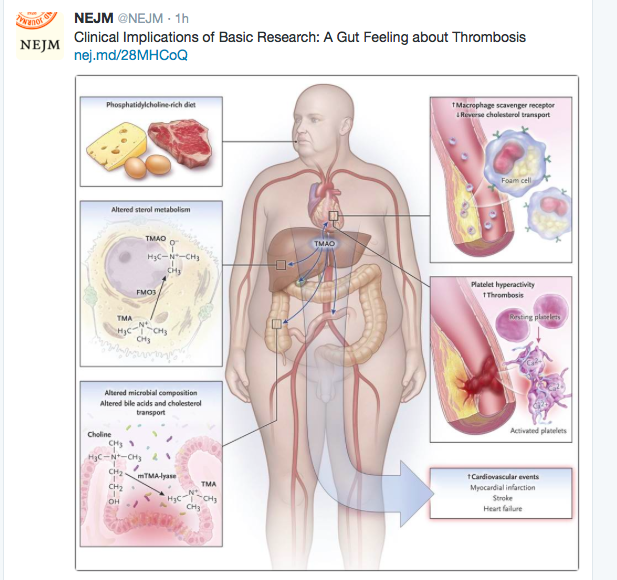
How Gut Microbes Could Lead to Atherothrombotic Disease

About three years ago, this blog looked at the link between gut microbes, diet, genes and heart disease (Linking diet, genes, and gut microbes to…heart disease | gutsandgrowth).

A summary of the most recent information on this topic: H Tilg. “A Gut Feeling About Thrombosis” (NEJM 2016; 374: 2494-6).

Background: Previous research has shown that certain dietary nutrients that include choline are processed by gut microbes to produce trimethylamine (TMA) which is converted into TMA-N-O (TMAO) by the liver.  Particular foods that have been associated with higher TMAO include meats and eggs.  It has been observed that antibiotics, presumably by their affect on gut microbes, reduce TMAO levels.

What’s new: Zhu et al (Cell 2016; 165: 111-24) “gave mice excess of dietary choline, microbe-generated TMAO enhanced platelet responsiveness in vivo, promoting a prothrombotic phenotype” was blocked by the administration of oral antibiotics.  Fecal microbiota transplantation, however, elevated the risk of thrombosis when administered to germ-free mice.

This data shows more clearly a causal relationship between TMAO and thrombotic mechanisms via platelet activation and a causal relationship between gut microbes and TMAO levels. However, this data does not determine exactly how we should modify our diets and or microbes to achieve improved clinical outcomes.

GutFeelingAbout

Politics and Limiting Physician Speech

A concise review/commentary (WE Parmet et al. NEJM 2016; 374: 2304-7) of Wollschlaeger v Governor of Florida explains how attempts to support the gun lobby are likely imposing unconstitutional limits on the free speech of physicians as well as undermining good health policy.

This law “prohibits physicians from intentionally entering into a patient’s record information about firearm ownership that ‘is not relevant to the patient’s medical care or safety, or the safety of others’; prohibits physicians from asking patients (or for minors, patients’ parents) about firearm ownership unless they believe ‘in good faith’ that ‘information is relevant to patient’s medical care or safety.'”

There are good reasons for physicians to inquire about guns in the homes as there is definitive evidence that a gun in the home increases the risk of death, especially by suicide.  The odds, on average from studies, is a 3-fold risk in homes with guns, but even higher for children and adolescents.

The law is counter productive as well. “Studies to date, as limited as they are, suggest that gun owners so counseled are more likely to change storage practices than to remove guns from their homes.”

While the politics with firearms is heavily influenced by well-funded lobbyists, there are other areas in which there are laws regulating physician speech, including abortion and fracking.

My take: I think it is outrageous that there are laws curtailing a physician’s free speech and efforts to dictate practice based on political philosophy. I hope they will not be upheld.

Related blog postCan the FDA prohibit free speech? | gutsandgrowth

MosqitoWarninig

Elafibranor Study & “My compliments to the photographer”

A while back, I remember seeing a cartoon with a dissatisfied patron leaving a restaurant and saying “my compliments to the photographer.”

Sometimes reading journal titles has the same feel.  The title does not always indicate what you are really going to get.  A recent study (V Ratziu et al. Gastroenterol 2016; 150: 1147-59) has the following title: “Elafibranor, an Agonist of the Peroxisome Proliferator –Activated Receptor –α and –β, Induces Resolution of Nonalcoholic Steatohepatitis Without Fibrosis Worsening.”  Sounds great –a new effective treatment for NASH, right?

Here’s are the results:

  • “In intention-to-treat analysis, there was no significant difference between elafibranor and placebo groups in the protocol-defined primary outcome.”
  • However, based on a post-hoc analysis with a modified definition, the treatment group had  a 19% NASH resolution compared with 12% of the placebo group.

This study examined 276 patients in a randomized double-blind placebo-controlled trial.

To me these results are not impressive.  The associated editorial (pg 1073) expresses more optimism and indicates that there have been evolving outcome measures in NASH studies to look for the combination of NASH resolution without worsening fibrosis.  Thus, prior studies that used only NASH resolution, such as pioglitazone (47%), vitamin E (36%) and obeticholic acid (22%) cannot be compared to his current study.

My take: Pretty picture or not, what this really means -is that we need more studies, including the outcome of phase III studies of this medication.

Georgia Terrace

The Georgian Terrace

More than Two Years of Constipation Before Specialty Help

A recent article (S Malowitz et al. JPGN 2016; 62: 600-02) examined the age of onset of constipation in a retrospective review of 538 children with functional constipation between 2012-2014.

Key findings:

  • Median age of onset was 2.3 years
  • On average, “2.7 years pass between the onset of functional constipation and a referral to a specialist.”  In the oldest quartile, the lapse between onset and referral was shorter, 1.8 years.  This may reflect the social consequences of soiling in school-aged children.

The authors note: “encouraging clinicians and parents to think of constipation as a chronic problem with physical and mental health implications may improve outcomes and quality of life for affected children.”

My take: The suffering and burden of constipation is easily overlooked in a busy primary care visit.  This is a shame because this is one area where inexpensive specialty care (i.e. minimal testing) can truly make a big difference.

Related blog posts:

Atlanta Zoo 2016

Atlanta Zoo 2016


What to Make of Post-op Treatment for Crohn’s Disease

In 2009, Regueiro and colleagues published an influential paper “Infliximab prevents Crohn’s disease recurrence after ill resection” (Gastroenterol 2009; 136: 441-50). However, this was a small study with only 24 patients.  In this study, only 1 of 11 patients on infliximab had endoscopic recurrence compared with 11 of 13 of placebo patients at 1 year.  Besides the promising result that infliximab may prevent recurrent Crohn’s disease, this study confirmed that there is poor correlation between endoscopic recurrence and clinical activity scores.  In addition, the implication was that early treatment could be very important.

Now, a much larger study has been published (M Regueiro et al. Gastroenterol 2016; 150: 1568-78) and has cast some doubt on these earlier findings. It may have “muddied the waters” regarding the optimal approach.  The authors conclude that infliximab reduces postoperative endoscopic, but not clinical, recurrence of Crohn’s disease. Furthermore, they recommend in their discussion: “it may be reasonable to approach low-risk patients undergoing their first resection for CD conservatively and initiate treatment only if there is endoscopic recurrence at 6 months” [post-op].  The associated editorial (1521-24), after highlighting some of the important clinical findings, also says, that it may be “difficult to convince payers and patients that >2-4 years of treating an asymptomatic patient with TNFi, with its potential risks of long-term adverse effects, will be required to prevent clinically meaningful endpoints.”

Before accepting these conclusions, a closer look at the study is important.  This randomized study evaluated 297 patients at 104 sites. The study was intended to stop at 200 weeks, but was prematurely terminated at 104 weeks. Infliximab dosing was 5 mg/kg every 8 weeks.  This study was called the PREVENT study:  Prospective, Multicenter, Randomized, Double-blind, Placebo-Controlled Trial Comparing Remade and Placebo in the Prevention of Surgical Resection Who Are at an Increased Risk of Recurrence.

Key findings:

  • At week 76, clinical recurrence was not statistically different, though favored infliximab group: 12.9% vs. 20.0%
  • At week 76, endoscopic recurrence was less in infliximab-treated: 30.6% vs 60.0%
  • Also, more severe endoscopic recurrence  (Rutgeerts scores of i3 or i4) was markedly lower: 22.4% vs 51.3%

Other points:

  • Infliximab effectiveness could have been even higher if there had been an opportunity to escalate dosing; this occurs in about half of patients in typical clinical care.
  • This study’s focus on the primary outcome of clinical recurrence winds up overshadowing the much improved endoscopic results.

My take: I think that most well-informed patients and physicians would prefer to be treated post-operatively if they look at the results of this study closely.

From AGA twitter feed

From AGA twitter feed

Recognizing Reactive Arthritis due to Clostridium difficile

A recent study shows that reactive arthritis can occur in children with Clostridium difficile infection and that recognition of this problem will improve management.

From JAMA Online First, DB Horton et al JAMA Pediatr. Published online May 16, 2016. doi:10.1001/jamapediatrics.2016.0217 (thanks to Ben Gold for this reference):

Abstract:

Importance  The incidence of Clostridium difficile infection has increased among children. The epidemiology of pediatric C difficile infection–associated reactive arthritis is poorly understood.

Objective  To characterize the incidence, recognition, and distinguishing clinical features of pediatric C difficile infection–associated reactive arthritis among children with C difficile infection.

Design, Setting, and Participants  In this cohort and nested case-control study using electronic health records from January 1, 2004, to December 31, 2013, across 3 geographically diverse pediatric health care networks, we screened for reactive arthritis among 148 children between ages 2 and 21 years with diagnostic or procedural codes suggesting musculoskeletal disease associated with C difficile diagnosis or positive testing. We identified 26 cases with acute arthritis or tenosynovitis within 4 weeks before to 12 weeks after confirmed C difficile infection with (1) no alternative explanation for arthritis and (2) negative synovial cultures (if obtained). Network-matched C difficile–infected controls without arthritis were randomly selected at the time of cohort member C difficile infections.

Main Outcomes and Measures  Incidence of C difficile infection–associated reactive arthritis was calculated based on (1) pediatric source population and (2) children with C difficile infection. Characteristics of cases and controls were compared using conditional logistic regression.

Results  Based on the cases identified within the source population of the 3 hospital networks, we estimated that C difficile infection–associated reactive arthritis incidence was 5.0 cases per million person-years (95% CI, 3.0-7.8). Reactive arthritis affected 1.4% of children with C difficile infection yearly (95% CI 0.8%-2.3%). Joint symptoms began a median of 10.5 days after initial gastrointestinal symptoms, often accompanied by fever (n = 15 [58%]) or rash (n = 14 [54%]). Only 35% of cases of C difficile infection–associated reactive arthritis were correctly diagnosed by treating health care professionals (range across centers, 0%-64%). Five affected children (19%) were treated for presumed culture-negative septic hip arthritis despite having prior postantibiotic diarrhea and/or other involved joints. Compared with controls, cases of C difficile infection–associated reactive arthritis were less likely to have underlying chronic conditions (odds ratio [OR], 0.3; 95% CI, 0.1-0.8). Although all cases had community-onset C difficileinfection and fewer comorbidities, they were more likely to be treated in emergency departments and/or hospitalized (OR, 7.1; 95% CI, 1.6-31.7).

Conclusions and Relevance  C difficile infection–associated reactive arthritis is an underdiagnosed, potentially morbid reactive arthritis associated with C difficile infection occasionally misdiagnosed as septic arthritis. Given the rising incidence of pediatric C difficile infections, better recognition of its associated reactive arthritis is needed.

Screenshot from JAMA website

Screenshot from JAMA website