Here’s the link: This Gadget Tests Food For Gluten in Under 2 Minutes. I’m not aware of the data regarding the sensitivity/accuracy of this product. Even still, it is interesting to see its development.


Here’s the link: This Gadget Tests Food For Gluten in Under 2 Minutes. I’m not aware of the data regarding the sensitivity/accuracy of this product. Even still, it is interesting to see its development.
Despite widespread expert opinion that those with irritable bowel syndrome (IBS) should be screened for celiac disease, whether it is a good idea is not settled. A recent study (RS Choung et al. Clin Gastroenterol Hepatol 2015; 13: 1937-43) showed that celiac disease has a low prevalence in US patients (mean age 61 yrs in this cohort) with IBS.
Here’s an excerpt of a summary of this report from the AGA Blog: “Should all Patients with IBS be Screened for Celiac Disease?”
Rok Seon Choung et al investigated whether subjects with positive results from serologic tests for celiac disease are frequently diagnosed with IBS or other functional gastrointestinal disorders (FGIDs).
They sent self-report bowel disease questionnaires to 7217 residents of Olmsted County, Minnesota, to collect data on symptoms compatible with functional GI disorders, including IBS, collecting data on symptoms compatible with functional GI disorders, including IBS. These symptom data were linked to surveys of undiagnosed celiac disease conducted among more than 47,000 individuals from the same region, based on results of tests for immunoglobulin A tissue transglutaminase and then endomysial antibody.
Among the 3202 subjects who completed the questionnaires and had their serum sample analyzed, 13.6% had IBS and 55.2% had some gastrointestinal symptoms.
The prevalence of celiac disease, based on serologic markers, was 1.0%. However, whereas 3% of patients with celiac disease met the criteria for IBS, 14% of patients without celiac disease met the criteria for IBS.
Abdominal pain, constipation, weight loss, and dyspepsia were the most frequent symptoms reported by subjects who tested positive for celiac disease, but none of the gastrointestinal symptoms or disorders were significantly associated with results of serologic test for celiac disease.
My take: This study along with others show that celiac disease is infrequent in patients with IBS. Since the symptoms of celiac disease overlap with IBS, I doubt this study will dissuade practitioners from screening for celiac despite the low yield.
Also, this fall I posted several blogs on GMOs. An interesting article (from Vox/Grist) on this subject explains how GMOs are a lot like pornography: It’s practically impossible to define “GMOs”

Atlanta Sky
A recent abstract indicated that there are high levels of zonulin in patients with gluten sensitivity as well as in patients with celiac disease. These results are preliminary but could indicate a potential biomarker for this condition. Here is a link to a review of these findings from NPR which includes commentary from Alessio Fasano: A Protein In The Gut May Explain Why Some Can’t Stomach Gluten
An excerpt:
Zonulin is an inflammatory protein first discovered by Fasano and his team in 2000. It helps regulate leakiness in the gut by opening and closing the spaces or “junctions” between cells in the lining of the digestive tract…
Giovanni Barbara and a team of researchers at the University of Bologna measured blood levels of zonulin in four groups of individuals: those with celiac disease, those with irritable bowel syndrome marked by diarrhea, those with self-diagnosed gluten sensitivity and healthy volunteers. Both celiacs and gluten sensitives turned up with remarkably high levels of zonulin in their blood. Those with IBS had elevated levels but less than half of celiacs or gluten sensitive individuals. Healthy volunteers had negligible blood levels of zonulin.
The results were presented in October as an abstract at the 23rd United European Gastroenterology Week in Barcelona, Spain.
Related blog posts:
First off -thanks to Ben Gold for the following reference and the blog title as well.
In this retrospective study (alluded to in a previous post:Celiac Update September 2015 | gutsandgrowth), the researchers examined whether “biopsy-sparing” protocols for symptomatic children with high titers of serum anti-transglutaminase (anti-TTG) antibody levels (>10 times upper limit of normal [ULN]) would be suitable for asymptomatic patients.
Background: In 2012, the European Society for Pediatric Gastroenterology Hepatology and Nutrition (ESPGHAN) published guidelines that it is possible to omit endoscopic biopsies for celiac disease if patients older than 2 years of age had high anti-TTG titers (>10 times ULN), positivity for EMA, compatible HLA DQ2 or HLA DQ8 and were symptomatic.
Findings:
Bottomline: Whether symptomatic or not, those with high antiTTG titers who meet all of the other ESPGHAN criteria have a very high probability of celiac disease.
Briefly noted: K Marild et al. Am J Gastroenterol 2015; 110: 1475-84. This study, based on a large prospective Norwegian cohort (72,921 children) that frequent infections (>10) in the first 18 months of life increased the risk of celiac disease with an adjusted odds ratio of 1.32 (highest infection quartile compared to lowest infection quartile). However, alternative explanations, including surveillance bias and reverse causation, cannot be excluded.
Related blog posts:
A study (Kivela L et al. J Pediatr 2015; 167: 1109-15) over a period of 48 years from Finland provides some hard data regarding the changing presentation of celiac disease.
Here are the key points;
Why is the presentation changing? There are increased “proportions of screen-detected and asymptomatic children…[this has] increased over 6-fold and simultaneously gastrointestinal symptoms …decreased.” While there are improved diagnostic methods and increased knowledge, there has also been a “well-defined increase in the true prevalence of celiac disease.”
Related blog posts:
Last week I summarized an excellent talk by Ronald Kleinman. For me, I had never heard such a concise and definitive rebuttal of the claims of those fearful of food biotechnology. There were three other lectures at the symposium. These three lectures covered areas that are well-known to pediatric gastroenterologists but less familiar to general pediatricians. The full set of slides are available at the Georgia AAP Symposium Website.
Jeff Lewis had an excellent lecture that tied together gluten and our microbiome: Gluten – Eat not, suffer not and Microbiome 101: Waste Not, Want Not
After reviewing celiac disease and other wheat-related disorders (eg. wheat intolerance syndrome, and wheat allergy), he summarized a great deal of information regarding the human microbiome and which factors influence this. In addition, he had the opportunity to briefly present data from his research on fecal microbiota transplantation (for C diff) and its influence on the microbiome over time. Here are a couple of slides from his talk:


Key points:
A useful review (CP Kelly et al. Gastroenterol 2015; 148: 1175-86) summarizes the ‘state of the art” information regarding celiac disease presentation and management. The review notes that some expert organization consensus state that intestinal biopsy is mandatory whereas some do not under certain conditions.
According to ESPGHAN, if anti-TTG >10-fold elevated, anti-EMA positive in separate sample, and +HLA typing, then a biopsy may not be required. For the WGO (World Gastroenterologic Organization), the exception focuses on available local resources.
The article recommends the following for monitoring:
A second retrospective indicates that ESPGHAN criteria for avoiding biopsy in children and adolescents with high titers for anti-TTG (>10-fold) along with positive EMA, and HLA-DQ2/DQ8.are reasonable. Here’s the abstract:
,
OBJECTIVES:
In 2012, European Society of Pediatric Gastroenterology, Hepatology, and Nutrition published novel guidelines on celiac disease (CD) diagnosis. Symptomatic children with serum anti-transglutaminase (anti-tTG) antibody levels ≥10 times upper limit of normal (ULN) could avoid duodenal biopsies after positive HLA test and serum anti-endomysial antibodies (EMAs). So far, both asymptomatic and symptomatic patients with anti-tTG titer <10 times ULN should undergo upper endoscopy with duodenal biopsies to confirm diagnosis. The aim of this study was to assess the accuracy of serological tests to diagnose CD in asymptomatic patients.
METHODS:
We retrospectively reviewed data of 286 patients (age range: 10 months to 17 years) with CD diagnosis based on elevated titer of anti-tTG, EMA positivity, and histology. All patients were distinguished between symptomatic and asymptomatic; histological lesions were graded according to the Marsh–Oberhuber (MO) criteria. Fisher exact test was applied to analyze both groups in terms of diagnostic reliability of serological markers.
RESULTS:
A total of 196 patients (68.53%) had anti-tTG titers ≥10 times ULN. Among them, a group of 156 patients (79.59%) also had symptoms suggestive of CD (“high-titer” symptomatic); of these, 142 patients (91.02%) showed severe lesion degree (3a, 3b, 3c MO). Conversely, 40 out of 196 patients (20.40%) were asymptomatic (“high-titer” asymptomatic) and 37 patients (92.5%) of them showed severe lesion degree (3a, 3b, 3c MO). No difference in histological damage was found between “high-titer” symptomatic and “high-titer” asymptomatic children (Fisher exact test, P=1.000).
CONCLUSIONS:
If confirmed in large multicenter prospective studies, the “biopsy-sparing” protocol seems to be applicable to both symptomatic and asymptomatic patients with anti-tTG titer ≥10 times ULN, positive EMA, and HLA-DQ2/DQ8.
Related blog posts:
Turns out that a recent review (AS Oxentenko, JA Murray. Clin Gastroenterol Hepatol 2015; 13: 1396-1404) is a succinct summary on celiac disease with questions focused on diagnosis, endoscopy, genetics/HLA typing, at risk groups, management, adherence, non responsive celiac patient, and refractory patients. Most of these topics have been addressed previously on this blog.
However, here are a few pointers:
Briefly noted: ET Jensen et al. Clin Gastroenterol Hepatol 2015; 13: 1426-31. The authors examined 88,517 patients who had undergone both esophageal and duodenal biopsies. “Odds of EoE (eosinophilic esophagitis) were 26% higher in patients with celiac disease than in patients without celiac disease” (adjusted odds ratio 1.26).
Related blog posts:

From the High Line, NYC
From GI & Hep News: Celiac Disease Associated with 2.5-fold Risk of Neuropathy
Here’s an excerpt:
The use of Swedish population registries enabled first author Dr. Sujata P. Thawani of Columbia University, New York, and her colleagues to find that the risk of neuropathy was increased both before and after a diagnosis of celiac disease (CD).
“We found an increased risk of neuropathy in patients with CD that persists after CD diagnosis. Although absolute risks for neuropathy are low, CD is a potentially treatable condition with a young age of onset. Our findings suggest that screening could be beneficial in patients with neuropathy,” they wrote (JAMA Neurol. 2015 May 11 [doi:10.1001/jamaneurol.2015.0475]).Neuropathy has a known association with CD, an immune-mediated disorder characterized by sensitivity to gluten with an incidence of about 1% in Western Europe…
Dr. Thawani and her associates used Swedish pathology registers to identify individuals whose small intestine biopsies showed villous atrophy between 1969 and 2008 (Marsh stage 3, n = 28,232)…Each CD patient was matched with up to five age- and sex-matched controls (n = 139,473) from the Swedish Total Population Registry, all of whom were diagnosed in the same year and were from the same county as the matched CD patient.
Although 41.7% of CD patients were diagnosed in childhood, the median age at diagnosis was 29 years…
Surveillance bias may account for some of the increased risk for neuropathy…Notably, though, patients with a prior neuropathy diagnosis also were more likely to be diagnosed with CD, showing a bidirectional relationship.

Grand Tetons
A recent randomized controlled trial study (Gastroenterol 2015; 148: 1311-9) examined the effectiveness of larazotide acetate in 342 adults with Celiac disease (CD) who had ongoing symptoms despite the use of a gluten-free diet for at least 12 months.
Larazotide acetate is a locally acting, nonsystemic 8-amino acid oral peptide which is a tight junction (TJ) regulator. “Larazotide acetate appears to prevent opening of intestinal TJs by promoting TJ assembly and actin filament rearrangement, which prevents gluten from reaching the intestinal submucosas and triggering an inflammatory response.”
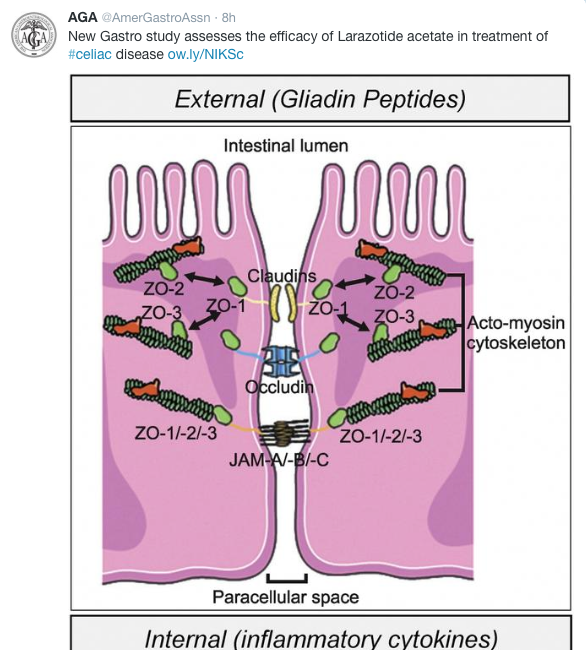
Patients received either placebo, 0.5 mg, 1 mg, 2 mg three times daily. The majority of patients had normalized serology at the start of the study. Key findings:
The authors state that is unclear why the higher doses were not effective “but may involve peptide aggregation … reducing activity in vivo.”
Bottomline: There would be a benefit for an adjunct to a gluten-free diet due to the difficulty in adherence and due to ongoing symptoms in some despite the use of a GFD; in some cases, symptoms may be induced by inadvertent deviation from GFD. More data is needed to determine if larazotide acetate will be useful in this role.
Related blog post: Good Educational Two Minute Celiac Video | gutsandgrowth

