GI Educational Cartoons For Children

Diana Lerner and the Medical College of Wisconsin have developed additional GI educational videos.  Previously, they had developed cartoon videos explaining endoscopy (prev post: Terrific Educational Videos on Endoscopy).  Now there are several more.  All of these are in English and some in Spanish.

Topics include inflammatory bowel disease, gastroesophageal reflux, eosinophilic esophagitis, and celiac disease.

Here’s the link:  Pediatric Gastroenterology Cartoons For Kids

Related blog post:

screen-shot-2016-10-23-at-10-39-50-am


Ultra-Short Celiac Disease


It is well-recognized that obtaining a duodenal bulb biopsy increases the likelihood of making a diagnosis of celiac disease.  Another study (PD Mooney et al. Gastroenterol 2016; 150: 1125-34) has tried to quantitate the frequency of “ultra-short” celiac disease (USCD).

In this prospective study of 1378 patients (mean age 50.3 yrs) who underwent endoscopy between 2008-2014, there was a cohort who had a high clinical suspicion of celiac disease in which quadrantic biopsies of the duodenal bulb were obtained.

Key findings:

  • 268 (19.4%) were diagnosed with celiac disease
  • 26 (9.7%) of celiac population had disease identified primarily in the duodenal bulb.  These patients with USCD were younger (P=.03), had lower serologic titers of tissue transglutaminase antibody (tTG) (P=.001), and less frequently had diarrhea (P=.001).
  • In USCD, the tTG titers were a median of 4.8x ULN compared with 20x ULN in those with more extensive disease.
  • While the authors characterize 26 as having USCD, 19 of the 26 did have Marsh 1 (n=18, 69.2%) or Marsh 2 (n=1, 3.8%) lesions, indicating at least some involvement more distally. However, in these patients the duodenal bulb findings clinched the diagnosis.

Despite the protocol, the authors showed that a single biopsy from the bulb was sufficient to increase the diagnostic yield.

My take: This study reinforces the need for duodenal biopsies from both the bulb and more distally when the diagnosis of celiac disease is being considered.

Related blog posts:

Last Year at Turner Field

This is the last year at Turner Field

NYT: Educate Your Immune System

A recent commentary updates the concept of the hygiene theory and how our lack of exposures to a ‘dirtier’ environment when we are younger can make us more prone to autoimmune diseases, including celiac disease, diabetes, and multiple sclerosis.

Here’s the link: Educate Your Immune

Here’s an excerpt:

People living just over the border in Russian Karelia, as the region is known, have the same prevalence of genes linked to autoimmune disease [as in Finland]. They also live at the same latitude and in the same climate. And yet they have a much lower vulnerability to autoimmune disease. Celiac disease and Type 1 diabetes occur about one-fifth and one-sixth as often, respectively, in Russian Karelia as in Finland. Hay fever and asthma, allergic diseases that also signal a tendency toward immune overreaction, are far less common.

So in a follow-up study, the results of which appeared last month in the journal Cell, Dr. Xavier and his colleagues followed 222 children who were genetically at risk of developing autoimmune diabetes. The newborns were equally divided among Finland, Russia and Estonia, where the prevalence of Type 1 diabetes is on the rise, but still well below Finland’s.

Autoimmune diabetes can be predicted, to some degree, by the appearance of certain antibodies in the bloodstream that attack one’s own tissues. After three years, 16 Finnish children and 14 Estonian children had these antibodies; only four Russian children did. And when the scientists compared the children’s microbiomes in the three countries, they found stark differences. A group of microbes called bacteroides dominated in Finnish and Estonian infants. But in Russia, bifidobacteria and E. coli held sway….

Russian kids have more fecal oral infections, such as hepatitis A, suggesting more sharing not only of pathogens, but of microbes that may benefit health. And previous studies have found that Russian homes harbor a richer and more diverse community of microbes than Finnish ones….

The world today is very different from the one our immune system evolved to anticipate — not just in what we encounter, but in when we first encounter it. Preventing autoimmune disorders may require emulating aspects of that “dirtier” world.

Screen Shot 2016-06-03 at 6.23.18 PM

What is Missing in Doctors’ Toolkits

An excellent editorial provides insight into the complex interaction between social problems and health issues.  In this age of widespread information availability, the biggest problems are not solved by knowing everything and memorizing facts.  Solving problems with teamwork and identifying resources are increasingly important.

Here’s the link: NY Times: Giving New Doctors the Tolls They Need

Here’s an excerpt:

But consider the skills I would need to be more effective in just this one clinic session: understanding social issues that contribute to health; marshaling support resources like case management, social work and rehabilitation centers; exploring my patients’ values and goals and encouraging behavior change; leading interdisciplinary care teams; employing new technologies and methods of patient engagement like telemedicine; and appreciating how health systems fit together to influence an individual patient’s care — from home care and community centers to clinics and hospitals. None have traditionally been emphasized in medical education — and, unsurprisingly, doctors in training like myself are often ill-equipped to practice in today’s health care environment…

The new Dell Medical School at the University of Texas, Austin, which enrolls its first class in June, is hoping to revolutionize medical education. The school plans to focus on helping students understand how health systems, communities and social issues contribute to individual health through a variety of innovative methods.

Instead of traditional lecture halls, Dell’s students will learn in collaborative workspaces with a curriculum that emphasizes team-based management of patients. They’ll take weekly classes with pharmacy, nursing, social work and engineering students. Dell’s “Innovation, Leadership and Discovery” program affords students an entire year to pursue projects related to population health and delivery system redesign.

Dell also features a unique collaboration with the university’s College of Fine Arts — known as the Design Institute for Health — to bring design thinking to health care. Here students will learn to think about everything from better hospital gowns and more hospitable hospital rooms to how patients access services online and how to make waiting rooms obsolete.

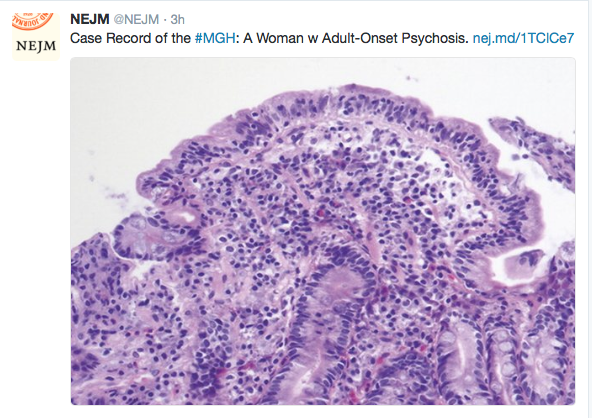
A representative case, associated with this figure of intestinal histology, of the complexity: a lady with psychosis associated with celiac disease is not adherent with her gluten free diet

A representative case of the complexity referred to in this blog post: NEJM 2016; 374: 1875-83.  This figure of intestinal histology shows damaged surface epithelium.  This is from a lady with new-onset psychosis associated with celiac disease who is not adherent with her gluten free diet

Goldilocks and Gluten

A recent study (CA Aronsson et al. Clin Gastroenterol Hepatol 2016; 14: 403-09, editorial 410-12) suggests that how much gluten is given may be another important factor rather than looking at the timing with regard to the development of celiac disease (CD).

In this 1-to-3 nested case-control study with 146 cases of CD and 436 controls, the authors indicate that a larger intake of gluten than controls increased the likelihood of celiac disease.  Specifically, children receiving large amounts of gluten (>5 g/day) during their first 24 months had a 2.6-fold increased risk of CD compared to those who consumed lower quantities.

The associated editorial notes that the total amount of gluten intake was only marginally increased in CD cases versus all control patients (OR 1.05) and that the association was decreased when individuals with first-degree relatives with CD were excluded.  In addition, this high consumption increased the risk after the first 2 years of life, rather than during this period of high consumption.

Does this make sense? Not to me.  These findings need to be replicated in other studies to determine if gluten exposure is like Goldilocks: too little, too much –>just right.

My take: For now, I think sticking with the timing of gluten exposure (recommended at 4-6 months) rather than the quantity is worthwhile.

Related blog posts:

Celiac Studies

Three reports on celiac disease:

  • KM Simmons et al. J Pediatr 2016; 169: 44-8.
  • NR Reilly et al. J Pediatr 2016; 169: 40-54
  • MMS Wessels et al. J Pediatr 2016; 169: 55-60.

In the first study, the authors examined bone mineral density (BMD), glycemic control with hemoglobin A1c, and celiac autoimmunity in children with type 1 diabetes (T1D).  This was a cross-sectional study of 252 children with T1D; 123 had positive serology were anti-tissue transglutaminase (tTG) antibody.  In addition, another cohort (n=141) of children without T1D were examined who carried HLD-DR, DQ genotypes with (n=71) and without (n=70) tTG.  Key findings:

  • Children with T1D: those positive for tTG had significantly worse BMD L1-L4 (-0.45 ± 1.22 vs 0.09 ± 1.10, P= .0003).  Higher tTG and higher HgbA1c were independent predictors of lower BMI.
  • In children without T1D: no differences in BMD were found based on tTG status.
  • The authors concluded that celiac autoimmunity and hyperglycemia had synergistic effects on low BMD.

In the second study, the researchers used a population-based cohort study and compared 958 individuals with both T1D and celiac disease (CD) to 4598 similar individuals with T1D alone. Key finding: Over a 13 year period, 12 patients with both T1D and CD had a fracture (1 osteoporotic fracture). CD did not influence the risk of any fracture (aHR 0.77) in patients with T1D.  The researches concluded: “CD does not seem to influence fracture risk in young patients with T1D.”

My take: Looking at these studies in juxtaposition shows how important it is to consider multiple studies and how frequent discrepant results occur.  While the second study does not show a significant fracture risk, the preponderance of evidence does show an association between celiac disease and low BMD particularly in adults. In addition, a gluten free diet has been shown to reverse low BMD in those with CD.

Relevant studies:

  1. Gastroenterology 2010; 139: 763.
  2. Aliment Pharmacol Ther 2000; 14: 35-43.
  3. JPGN 2003; 37: 434-6.
  4. Gut 1996; 38: 322-7.

In the third study, the investigators looked at “complementary” investigation in children with CD.  These included tests like hemoglobin, ferritin, folate, vitamin B12, calcium, vitamin D, and thyroid assays.  Between 2009-2014, 182 children were evaluated included 119 with new diagnosis. Key findings:

  • At time of diagnosis: Iron deficiency (28%), iron deficiency anemia (9%), folate deficiency (14%), vitamin B12 (1%), and vitamin D deficiency (27%) were identified. No hypocalcemia or thyroid dysfunction was found.
  • At followup: iron deficiency (8%), iron deficiency anemia (2%), folate (3%), vitamin D (25%) were identified and no other abnormalities were evident.
  • The investigators concluded that these complementary tests “are relevant at the time of diagnosis of CD but have little diagnostic yield during followup-visits” after institution of gluten-free diet.

My take: Particularly at followup, identification of nutrient deficiencies is typically similar to the general population.

Related posts:

Castillo San Felipe del Morro, San Juan

Castillo San Felipe del Morro, San Juan

Systematic Review of Gluten Introduction

A recent systematic review/meta-analysis (MI Pinto-Sanchez et al. J Pediatr 2016; 168: 132-43) identified 15 eligible studies among an initial search of 1982 studies.

Key findings:

  • There was a 25% increase in celiac disease risk with late (>6 months) vs recommended (4-6 months) gluten introduction.
  • There was no significant effect of breastfeeding or not breastfeeding.

The authors state there is no evidence on whether early introduction (<4 months) of gluten would affect the risk of celiac disease.  Late introduction (>6 months) is associated with increase risk of celiac disease.

Related blog posts:

Isla Verde, San Juan

Isla Verde, San Juan

Should Patients with IBS be Screened for Celiac Disease?

Despite widespread expert opinion that those with irritable bowel syndrome (IBS) should be screened for celiac disease, whether it is a good idea is not settled.  A recent study (RS Choung et al. Clin Gastroenterol Hepatol 2015; 13: 1937-43) showed that celiac disease has a low prevalence in US patients (mean age 61 yrs in this cohort) with IBS.

Here’s an excerpt of a summary of this report from the AGA Blog: “Should all Patients with IBS be Screened for Celiac Disease?”

Rok Seon Choung et al investigated whether subjects with positive results from serologic tests for celiac disease are frequently diagnosed with IBS or other functional gastrointestinal disorders (FGIDs).

They sent self-report bowel disease questionnaires to 7217 residents of Olmsted County, Minnesota, to collect data on symptoms compatible with functional GI disorders, including IBS, collecting data on symptoms compatible with functional GI disorders, including IBS. These symptom data were linked to surveys of undiagnosed celiac disease conducted among more than 47,000 individuals from the same region, based on results of tests for immunoglobulin A tissue transglutaminase and then endomysial antibody.

Among the 3202 subjects who completed the questionnaires and had their serum sample analyzed, 13.6% had IBS and 55.2% had some gastrointestinal symptoms.

The prevalence of celiac disease, based on serologic markers, was 1.0%. However, whereas 3% of patients with celiac disease met the criteria for IBS, 14% of patients without celiac disease met the criteria for IBS.

Abdominal pain, constipation, weight loss, and dyspepsia were the most frequent symptoms reported by subjects who tested positive for celiac disease, but none of the gastrointestinal symptoms or disorders were significantly associated with results of serologic test for celiac disease.

My take: This study along with others show that celiac disease is infrequent in patients with IBS.  Since the symptoms of celiac disease overlap with IBS, I doubt this study will dissuade practitioners from screening for celiac despite the low yield.

Also, this fall I posted several blogs on GMOs.  An interesting article (from Vox/Grist) on this subject explains how GMOs are a lot like pornography: It’s practically impossible to define “GMOs”

Leaving Work

Atlanta Sky