CCFA Conference Notes 2016 (part 4) –Pregnancy and IBD

Pregnancy and IBD –Dr. Doug Wolf

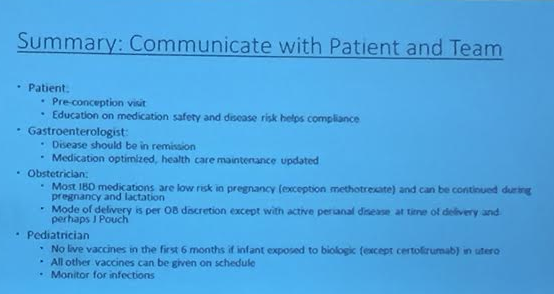
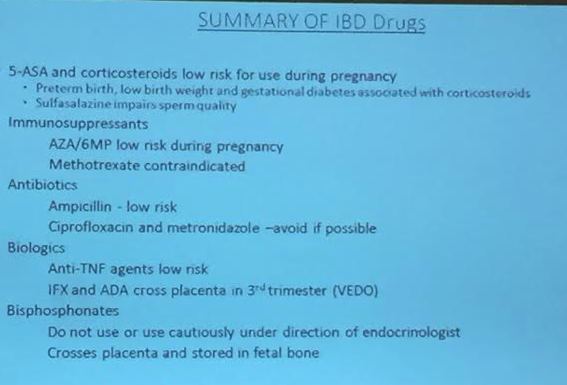
Dr. Wolf reviewed infertility, pregnancy issues, and PIANO registry. This topic has been covered elsewhere in this blog (IBD and Pregnancy | gutsandgrowth). Vedolizumab is a FDA category B; thus far, it is considered fairly safe. Thiopurines are category D but overall thought to be low risk.

This blog entry has abbreviated/summarized this terrific presentation. Though not intentional, some important material is likely to have been omitted; in addition, transcription errors are possible as well.

Screen Shot 2016-04-16 at 2.30.04 PM

Screen Shot 2016-04-16 at 2.28.45 PM

Screen Shot 2016-04-16 at 2.29.35 PM


IBD and Pregnancy

While managing inflammatory bowel disease during pregnancy is not within the scope of my practice as a pediatric gastroenterologist, it is helpful to have some familiarity with the issues.

Here’s a full-text link to AGA Guidelines: The Toronto Consensus Statements for the Management of Inflammatory Bowel Disease in Pregnancy

From the abstract, an excerpt:

Consensus was reached on 29 of the 30 recommendations considered. Preconception counseling and access to specialist care are paramount in optimizing disease management. In general, women on 5-ASA, thiopurine, or anti–tumor necrosis factor (TNF) monotherapy for maintenance should continue therapy throughout pregnancy. Discontinuation of anti-TNF therapy or switching from combination therapy to monotherapy may be considered in very select low-risk patients. Women who have a mild to moderate disease flare while on optimized 5-ASA or thiopurine therapy should be managed with systemic corticosteroid or anti-TNF therapy, and those with a corticosteroid-resistant flare should start anti-TNF therapy. Endoscopy or urgent surgery should not be delayed during pregnancy if indicated. Decisions regarding cesarean delivery should be based on obstetric considerations and not the diagnosis of IBD alone, with the exception of women with active perianal Crohn’s disease. With the exception of methotrexate, the use of medications for IBD should not influence the decision to breast-feed and vice versa. Live vaccinations are not recommended within the first 6 months of life in the offspring of women who were on anti-TNF therapy during pregnancy.

Gastro March2016

Worried About the Zika Virus

While Zika virus infections may not be seen frequently by pediatric gastroenterologists, this infection will be a common concern for the families we treat and we may end up taking care of children with feeding problems/neurologic impairment due to congenital infection.

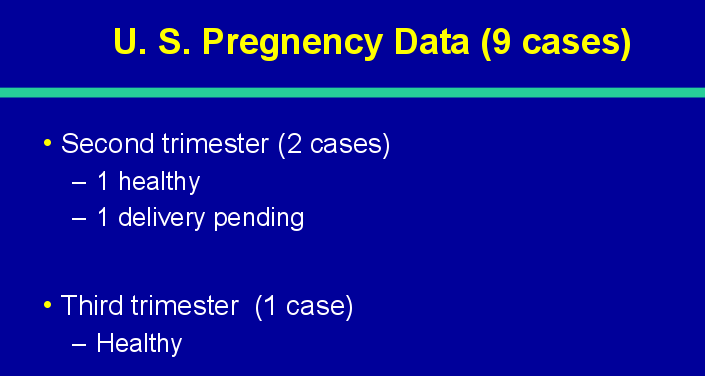
I attended a recent Georgia American Academy of Pediatrics board meeting.  One of the topics discussed was the Zika virus.  An update was given by Dr. Harry Keyserling, chair of the infectious disease committee (who has given permission for me to share some of his slides).  Some of the important points from his talk:

  • The Zika virus shares some similarities with the Dengue virus. The Zika virus is a single-stranded RNA flavivirus. Incubation period is 3 days to a few weeks.  It can be acquired from mosquito bites, spread sexually, transplacentally or intrapartum.  It may be transmissible via blood, organ donation or possibly breastmilk.


History of Zika Virus

History of Zika Virus

Most are asymptomatic. The clinical spectrum in those with symptoms are noted above.

Most are asymptomatic. The clinical spectrum in those with symptoms are noted above.

  • 80% of infected individuals are asymptomatic.
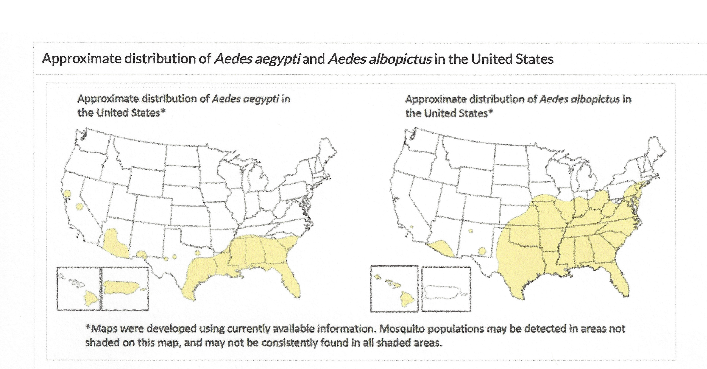
Approximate distribution of mosquito vector

Approximate distribution of mosquito vector

  • Due to the geographic distribution of the vector, it is likely that there will be many more cases in Georgia.

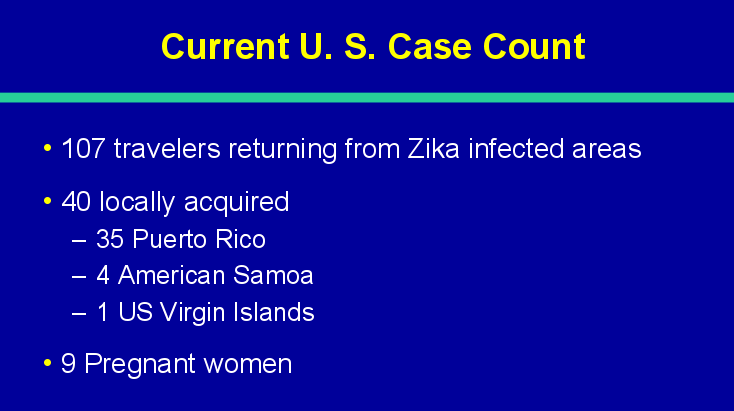
Screen Shot 2016-03-02 at 6.57.28 PM

US DATA 1

US DATA 2

  • The most alarming association has been with microcephaly.  In some locations, there have been recommendations to avoid pregnancy until 2018.  After natural infection has spread, it is likely to lead to immunity and then should be safe to become pregnant.

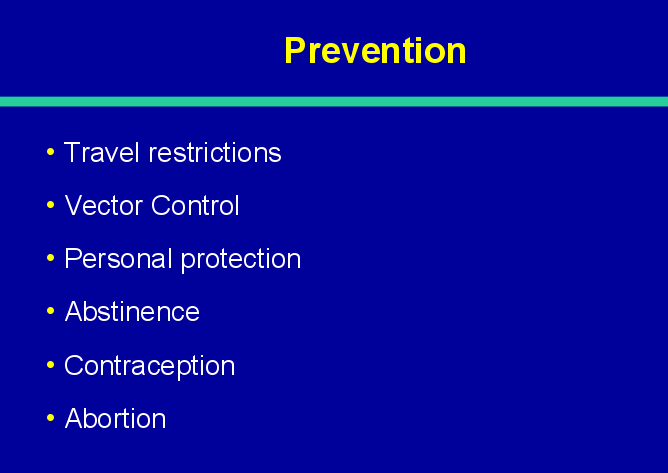
Prevention

  • Zika can be acquired through sexual-transmission which indicates that pregnant women in endemic areas could need to avoid sex.

More resources:

My take: Because the Zika virus is going to continue to spread and the methods for prevention are not entirely effective, the next few years are going to present a lot of challenges.  This will continue until some population immunity develops (following infection or perhaps after development of an effective vaccine).

Anti-TNF Therapies: Safe in Pregnancy

According a review (Inflamm Bowel Dis 2014; 20: 1862-69) of 5 studies with 1216 patients, “the use of anti-TNFα therapy does not seem to increase the risk of unfavorable pregnancy outcomes among women with IBD, although the optimal timing of therapy through pregnancy and the postpartum period was not assessed.”

Other important points:

  • “Current recommendations suggest that anti-TNFα therapies be continued during the first 2 trimesters of pregnancy.”  Withholding of infliximab and adalimumab during the third trimester is due to concerns of increased drug levels in infants.
  • Live virus vaccination should “be avoided for the first 6 months in children who had exposure to anti-TNFα therapies in utero.”

Related blog posts:

Elevated Celiac Serology Associated with Reduced Infant Birth Weights

Using a population-based study of 7046 singleton pregnancies (from the Netherlands), the authors of a recent study have shown an inverse relationship between levels of anti-tissue transglutaminase IgA (TTG) antibodies and fetal growth (Gastroenterol 2013; 144: 726-35).

Results:

  • Newborns of positive TTG (>6 U/mL) weighed 159 g less at birth than newborns of mothers who tested negative for TTG.  In addition, newborns with mothers who had intermediate TTG levels ( 0.8 U/mL to 6 U/mL) had growth restriction of 53 g.
  • Among the intermediate TTG group, the results were more pronounced (2-fold greater) in those carrying the HLA risk molecules for celiac disease.
  • These birth weight changes were not associated with maternal nutritional status or deficiencies related to hemoglobin, iron, folate, or vitamin B12 deficiency.
  • Gestational age was not affected by TTG titers.

In the discussion, the authors note that other studies have shown that undiagnosed celiac disease increases the risk for intrauterine growth retardation; this risk can be eliminated by treating celiac disease.  The latter is a risk factor for lower neuropsychological performance.  This study was the first that took into effect the different TTG titers and correlated with additional nutritional parameters.

The authors speculate that celiac disease could have direct effects on the placenta.  In addition, other nutritional parameters could play a role such as vitamin D and calcium which were not included in this study.  Another important consideration is that celiac disease can result in increased miscarriages.  As a result, the “true” effect on newborn growth may be underestimated due to a “survivor bias.”

Related blog posts:

Pregnancy after Liver Transplantation

As there are about 14,000 women of reproductive age in the U.S. who have undergone liver transplantation (LT), data about the outcomes of pregnancy are important for counseling.  A review and meta-analysis (Liver Transpl 2012; 18: 621-29) provides some information; going forward the National Transplantation Pregnancy Registry (NTPR) which was established in 1991 offers the promise of additional insight.

In the current review, Deshpande et al found 8 of 578 studies which met inclusion criteria; in total 450 pregnancies in 306 LT recipients were examined.  While healthy live births were the most common outcome, there were several pertinent risks identified.  The main concerns were development of preeclampsia, rejection/graft loss as well as the potential for birth defects.  While miscarriage rates were similar to the general population (15.6% compared with 17.1%), the following were much higher:

  • preeclampsia 21.9% vs. 3.8% in general population
  • cesarean section delivery 44.6% vs. 31.9% in general population
  • preterm birth 39.4% vs. 12.5% in general population

While rates of rejection and graft loss are not given for the entire cohort, specific study results were discussed.  In one study, rates of acute rejection ranged from 2% to 8% and loss of graft within two years of pregnancy occurred in 6-11%.

Similar to rejection data, the data for birth defects was not uniformly reported.  Specific study results were discussed and included several birth defects: 1 patient with total anomalous pulmonary venous return, 1 with pyloric stenosis, 2 with hypospadias, 1 with tracheoesophageal fistula, 1 with unilateral cystic kidney, and 2 with ventricular septal defects.

Take-home message:

Liver transplant recipients can have successful pregnancies but should be considered high risk.  Active reporting to established registries can give more accurate and up-to-date information.

Related post:

Alive and well? 10 years after liver transplantation