NASPGHAN Statement on High-Powered Magnet Court Ruling

NASPGHAN Statement on High-Powered Magnet Court Ruling

 The North American Society for Pediatric Gastroenterology, Hepatology and Nutrition (NASPGHAN) is shocked and deeply disappointed by the decision of the U.S. Court of Appeals for the Tenth Circuit to overturn the federal government’s strict safety standard for small, high-powered magnets.  This legal ruling does not change the hazard these products pose to children.

Representing pediatric gastroenterologists who are on the front lines of treating children who accidentally ingest these magnets, NASPGHAN is calling on U.S. retailers, including online retailers, to boycott the sale of products that do not meet the safety standard for magnet sets issued by the Consumer Product Safety Commission in 2014.

 Prior to the new safety standard, pediatric gastroenterologists witnessed a rise in the number of ingestions of high-powered magnets by toddlers and teenagers, often with severe medical consequences. These magnets were sold as part of magnet sets sold as desk toys.

 Kids ingest a lot of things they shouldn’t. High-powered magnet ingestions are different than other ingested foreign bodies. Most foreign bodies will pass through the digestive tract without incident. When two or more magnets are ingested, their attractive force allows the magnets to “find” each other once inside the digestive tract. Consequently, there is a high risk of a fold of intestine becoming trapped between the magnets. When this occurs, ulceration and bowel perforation can occur and lead to death.

 NASPGHAN recommends that high-powered magnet sets should not be stored or used in homes or other settings where children are present. Because these high-powered magnets often come in sets of 100 or more, missing magnets are not easily accounted for and can get lost in carpet or furniture where they can be found by small children.

 Children should receive immediate medical attention for a known or suspected magnet ingestion. Consumers and health care providers are strongly encouraged to report incidents of ingestions to www.saferproducts.gov.

Related blog posts:

Update on Chronic Cough

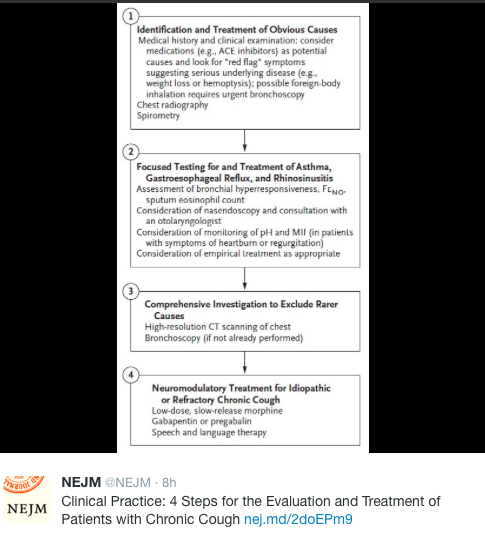
It is not uncommon for a pediatric gastroenterologist to see a patient with a chronic cough due to concerns about potential gastroesophageal reflux disease (GERD).  As such, a recent clinical practice article (JA Smith, A Woodcock. NEJM 2016; 375: 1544-51) by lung specialists was of interest, even though this article was not targeted to the pediatric population.

Key points:

  • The authors define a chronic cough as lasting more than 8 weeks and note that it common with respiratory conditions (eg. chronic obstructive pulmonary disease, asthma, and bronchiectasis) and some non-respiratory conditions (eg. gastroesophageal reflux and rhinosinusitis).  Medications, particularly ACE inhibitors, can trigger a chronic cough as well.
  • Steps in evaluation: 1. H&P, CXR, spirometry. 2. Consider metacholine challenge, ENT evaluation, consider empiric treatment (eg. inhaled glucocorticoids, PPI), and consider GERD evaluation. 3. High-resolution CT and bronchoscopy.
  • For many patients, there is likely to be an abnormality in neuronal pathways controlling cough and the term “cough hypersensitivity syndrome” has been coined.  Figure 2 (below) illustrates the neuronal pathways.
  • For refractory patients, potential therapies would include low-dose morphine, gabapentin or pregabalin, and speech language therapy.

screen-shot-2016-10-26-at-8-24-57-pm

GERD:

  • Guidelines “suggest a trial of treatment with acid-suppression therapy” (eg. twice-daily PPIs for up to 3 months).
  • “Most randomized, controlled trials of reflux treatment for cough have not shown a significant improvement in association with this type of treatment.”
  • Subgroups of patients with heartburn, regurgitation, or excessive acid reflux on esophageal pH monitoring “appeared marginally more likely to have a response to PPI treatment.”  pH or impedance tests “are poorly predictive of a response of cough to acid suppression.”

My take: In the absence of clinical reflux, reflux therapy is unlikely to help with chronic cough.  However, in patients with an adequate workup, an empiric course of a PPI is likely more preferable than empiric morphine or gabapentin.

Related blog posts:


screen-shot-2016-10-22-at-4-01-47-pm

Treatment Outcomes in Children and Adolescents with Hypercholesterolemia

A recent study (MM Mendelson et al. J Pediatr 2016; 178: 149-55) provides some useful data indicating that statin therapy for children and adolescents is typically effective based on cholesterol reduction levels.

This observational study prospectively collected data from 2010-2014 among 1521 pediatric patients seen for a lipid disorder.  In this cohort, 1260 patients (83%) did not receive statin therapy during the study period.  Ultimately, 97 patients (6% of clinic cohort) had received statin therapy and had adequate data for evaluation.

  • 70 patients received simvastatin: 1 at 5 mg/day, 26 at 10 mg/day, and 43 for 20 mg/day.
  • 24 patients received atorvastatin: 22 at 10 mg/day and 2 at 20 mg/day
  • 3 patients received pravastatin: 2 at 10 mg/day and 1 at 20 mg/day

Primary outcome for therapy: LDL-C <130 for patients without high risk factors and <110 for patients with high risk condition(s) (eg. diabetes mellitus, end-stage renal disease, heart transplant, Kawasaki disease with aneurysms)

Key findings:

  • Median baseline LDL-C was 215.
  • LDL-C decreased by 37% on average (83 mg/dL) within the first 60 days of therapy
  • Achieved primary outcome: 60% at 1 year,  73% at 2 years, and 87% at 3 years
  • No patients presented with relevant hepatic or myopathic side effects. 2 of 97 had transient epiosde of ALT > 3 x ULN.

Discussion:

  • Overall, the reported outcomes in this select cohort were at least as good as outcomes reported in studies of adults in the general population.  This may be due to parental supervision or perhaps due to a better physiologic response. In addition, as this was an observational study, poorly adherent patients may be lost to follow-up and would not be accounted for.
  • Currently statin therapy is recommended if lifestyle modifications are not sufficient to lower LDL-C.  Thus, “it is estimated that more than 700,000 US children and adolescents may be eligible for statin therapy according to the 2011 NHLBI guidelines.”

My take: Since cholesterol and LDL-C are biomarkers of treatment, the long-term benefit (& possible risks) of statin therapy remains unclear .  However, more data on meaningful endpoints like heart attacks and strokes could take decades.  Until then, the best evidence available suggests that the potential benefit of statin therapy could be quite substantial.

Related posts:

waterwarriors

HCV Treatment: Nearing 100% Effectiveness

While access to HCV treatment remains the biggest obstacle, recent studies show that the rates of HCV eradication, even in the toughest cases, now approaches 100%.

  • E Lawitz et al. Gastroenterol 2016; 151: 893-901.
  • EJ Gane et al. Gastroenterol 2016; 151: 902-9.
  • Editorial: M Buti pgs 795-8.

Most prior studies examined the use of two direct-acting antivirals (DAAs) with or without ribavirin.  These DAAs targeted nonstructural (NS) proteins necessary for HCV replication: NS3 protease, NS5B polymerase, and NS5A protein.

These two new studies examined whether treatment with a DAA targeting all 3 NS proteins would be effective and possibly allow shorter treatments.  It is noted that currently only treatment-naive genotype 1 (w/o cirrhosis) patients have a regimen that is recommended for only 8 weeks; these patients also should have HCV-RNA<6,000,000 IU/mL.

Lawitz et al studied the combination of sofosbuvir-velpatasvir and GS-9857 (voxilaprevir) for 6-8 weeks (one treatment group received ribavirin); n=197. Among treatment-naive patients w/o cirrhosis, SVR12 was 100% after 8 weeks of treatment and 94% of treatment-naive patients with cirrhosis.  Among treatment-experienced patients treated for 12 weeks, 100% of all patients (w and w/o cirrhosis) achieved SVR12.

Gane et al studied the effectiveness of the combination of sofosbuvir-velpatasvir and GS-9857 in HCV genotypes 2, 3, 4, and 6 (as well as 1 with 1b); n=128. After 8 weeks of treatment, SVR12s were achieved in 93% of treatment-naive patients with cirrhosis.  After 12 weeks, treatment-experienced patients with and without cirrhosis had SVR12s of 97% and 100% respectively.

My take: This combination of therapies should allow shorter treatment regimens in treatment-naive patients and effective rescue therapy for previous DAA failures. Now that we can cure almost everyone with HCV, how do make therapies affordable and accessible?

Glacier Nat'l Park

Glacier Nat’l Park

Severe Hypothyroidism due to Iodine Deficiency Associated with Parenteral Nutrition

From Kipp Ellsworth Twitter Feed:

screen-shot-2016-11-16-at-8-36-51-pm

J Parenter Enteral Nutr November 2016 vol. 40 no. 8 1191-1193

Abstract:

Parenteral nutrition is crucial for supply of nutrients in children who cannot tolerate a full enteral diet. In the United States, it is not standard of care to give iodine to children dependent on parenteral nutrition, hence iodine is not routinely included in the micronutrient package. Herein, we present a case of a boy with hypothyroidism secondary to iodine deficiency after prolonged exclusive use of parenteral nutrition. Our case highlights the importance of screening for iodine deficiency and administering timely iodine supplementation in these at-risk children to prevent iatrogenic hypothyroidism.

Related blog posts:

FDA approves Amjevita (Humira biosimilar)

On 9/23/16: FDA approved Amjevita (Humira biosimilar)

Excerpt:

The U.S. Food and Drug Administration today approved Amjevita (adalimumab-atto) as a biosimilar to Humira (adalimumab) for multiple inflammatory diseases.

Amjevita is approved for the following indications in adult patients:

  • moderately to severely active rheumatoid arthritis;
  • active psoriatic arthritis;
  • active ankylosing spondylitis (an arthritis that affects the spine);
  • moderately to severely active Crohn’s disease;
  • moderately to severely active ulcerative colitis; and
  • moderate to severe plaque psoriasis.

…Amjevita is biosimilar to Humira. It has been approved as a biosimilar, not as an interchangeable product.

Fort Knox, Maine

Fort Knox, Maine

Finding Residual Hepatitis C Virus in Liver Explants

A recent report (M Gambato et al. Gastroenterol 2016; 151: 633-6) provides some insight into the importance of the presence of residual hepatitis C virus (HCV) RNA in the liver of patients undergoing liver transplantation.

The authors note that many patients with cirrhosis due to HCV do not complete a full course of antiviral therapy before liver transplantation as the waiting time is unpredictable.  The authors studied whether there was HCV RNA in the liver of 39 of these patients and tried to assess whether its presence was associated with relapse after liver transplantation.

Background:

  • Only 6 patients (15%) had completed treatment prior to liver transplantation.
  • Most patients (68%) had undetectable serum HCV RNA.
  • Treatment was most commonly sofusbuvir/ribavirin (n=30)

Key findings:

  • HCV RNA was detected in 26 of 39 liver explants (67%). Higher levels were detected in those who had received a shorter course of treatment at time of liver transplantation. Interestingly, HCV RNA was also detected in 2 (20%) of controls who had an SVR after completing an interferon-free treatment regimen.
  • 33 of 39 (85%) achieved a post-transplantation virologic response (pTVR) and 6 (15%) had recurrent HCV infection.  Thus, the persistence of HCV RNA in liver explant did not preclude pTVR.
  • Among the 26 patients with residual HCV RNA in the liver explant, a HCV RNA concentration was higher in the 4 patients that relapsed (23 vs 3 median copies/mcg total RNA).
  • Another unexpected finding was that among the 6 who relapsed, two had undetectable HCV RNA in liver explant –both patients carried mutations which could have rendered treatment less effective.  The authors note that HCV RNA could have been present at concentrations below detection or distributed unevenly (which could have affected testing).

The authors speculate that the presence of HCV RNA may have been sequestered in membranous webs which allowed the virus to avoid degradation/host defenses.

My take (borrowed from the authors): The presence of HCV RNA in the liver explant does not seem to be associated with treatment failure/virologic relapse after liver transplantation, except in case with high concentrations.

Maine’s oldest lighthouse: Portland Head Light

Portland Head Light

Portland Head Light

Academic Performance After Anesthesia

A new study provides some reassurance that anesthesia at a young age is unlikely to cause harm (little to no effect) in most children.

Full text: P Glatz et al. JAMA Pediatrics, Published online November 7, 2016. doi:10.1001/jamapediatrics.2016.3470: Association of Anesthesia and Surgery During Childhood with Long-Term Academic Performance

Findings  In this cohort study among 33 514 exposed children, exposure to surgery with anesthesia before age 4 years was associated with 0.41% lower school grades and 0.97% lower IQ test scores, with no difference in school grades with regard to age. The overall difference was markedly less than the differences associated with sex, maternal educational level, or month of birth during the same year.

Comment: Despite efforts to control for indications which of themselves could impact the results, it is quite possible that the small changes detected in this study are a result of confounding factors rather than due to the anesthetic itself.

My take (from the authors): “Exposure to anesthesia and surgery before age 4 years is associated with a small difference in academic performance or cognitive performance in adolescence on a population level. The magnitude of this association should be interpreted in light of potential adverse effects of postponing surgery.”

Related blog post: More evidence of anesthetic neurotoxicity

screen-shot-2016-11-13-at-8-24-49-pm


Understanding Why Vitamin D Deficiency is Not So Common Afterall

An excellent commentary (JE Marrison et al. NEJM 2016; 375: 1817-20) throws a bunch of cold water on the idea that there is a massive vitamin D deficiency pandemic.  The main contention of the authors is that physicians, and by extension patients, focus too closely at specific thresholds which are poorly understood.

They explain the term “Estimated Average Requirement” (EAR) which is the median of the distribution of human requirements.  Whereas, the RDA or recommended daily allowance “reflects the estimated requirement for people at the highest end of the distribution.”  So, at least 97.5% of people will have a requirement below the RDA.  However, due to Vitamin D’s importance, particularly with bone health, “the EAR is set at 400 IU per day for persons 1 to 70 years of age and 600 IU per day for persons older than 70.”

Other key points:

  • The EAR and RDA assume minimal to no sun exposure.
  • The RDAs of 600 IU/day and 800 IU/day correspond to 25(OH)D level of  16 ng/mlL and 20 ng/mL.
  • “A common misconception is that the RDA functions as a ‘cut point’ and that the entire population must have a serum 25(OH)D level above 20 ng per millimeter to achieve good bone health.”
  • “Approximately half the population has a requirement of 16 ng per milliliter (the EAR) or less.”
  • “Many studes establish ‘inadequacy’ using the RDA, though it is actually at the upper end of the spectrum of human need.” Thus, most people who are labelled as deficient are misclassified.
  • Using correct methodology, the authors assert that 13% of Americans 1-70 years are ‘at risk’ and <6% are deficient (with 25(OH)D < 12.5 ng/mL.

The problem with excessive Vitamin D testing and excessive treatment:

  • If 97.5% of the population has levels of Vitamin D exceeding 20 ng/mL, there are likely to be adverse effects in addition to increased costs of testing/treating.

Who to screen?

  • Those with risk factors for vitamin D deficiency: osteoporosis, osteomalacia, malabsorption, medications that can affect vitamin D metabolism (eg. anticonvulsants), or institutionalization
  • “For healthy patients, routine screening is not recommended by most medical organizations.” Though, the authors do recommend that “the RDA will nearly always meet the needs of generally healthy people.”

My take: This article makes a good argument for less testing along with avoidance of overprescribing vitamin D.  Nevertheless, for healthy people taking the RDA for vitamin D is quite sensible.

Related blog posts:

Disclaimer: These blog posts are for educational purposes only. Specific dosing of medications/diets (along with potential adverse effects) should be confirmed by prescribing physician/nutritionist.  This content is not a substitute for medical advice, diagnosis or treatment provided by a qualified healthcare provider. Always seek the advice of your physician or other qualified health provider with any questions you may have regarding a condition.

Victoria Chimes -Maine's Ship on their state quarter

Victoria Chimes -Maine’s Ship on their state quarter

Guidelines for Esophageal Atresia-Tracheoesophageal Fistula

From a NASPGHAN-ESPGHAN working group of surgeons and pediatric gastroenterologists. a recent guideline (U Krishan et al JPGN 2016; 63: 550-70) regarding esophageal atresia (EA) and tracheoesophageal fistula (TEF) has made 36 specific statements and graded the evidence for these recommendations.

On GERD:

  • Low level evidence: The authors recommended starting PPIs in the neonatal period and continuing them “up to the first year of life or longer, depending on persistence of GERD.”
  • High level evidence: pH monitoring is useful in evaluating the severity of acid reflux in patients with EA.  Low level evidence: pH-impedance monitoring is useful to evaluate and correlate non-acid reflux in selected patients.
  • High level evidence: “Endoscopy with biopsies is mandatory for routine monitoring of GERD in patients with EA.” The authors recommend evaluation (pH, impedance, and/or endoscopy) at time of stopping anti-acid treatment and during long-term follow-up. Specifically,  with low level of evidence, the authors advocate for one endoscopy after stopping PPI therapy, one before age 10 years, and one at transition to adulthood.”
  • High level evidence: Fundoplication has accepted role, despite dysmotility, in patients with recurrent anastomotic strictures and poorly controlled GERD despite maximal PPI therapy. Full evaluation prior to fundoplication is recommended.

Other Statements:

  • Low level evidence: the authors recommend regular multidisciplinary evaluation, the authors note that symptoms of aspiration during swallowing may be identical to GERD symptoms, and evaluation of dysphagia with EGD/UGI.
  • High level evidence: ENT evaluation may disclose other anatomic abnormalities
  • Low level evidence: The authors recommend that anastomotic strictures be excluded in symptomatic children and that there is no “evidence that routine screening and dilatation” is necessary in asymptomatic patients.
  • Low level evidence: Management of EA patients with eosinophilic esophagitis (EoE) should follow the treatment of EoE in non-EA patients.
  • High level evidence: Incidence of Barrett’s esophagus is increased in adults with EA.
  • No level evidence: Potential treatments for recurrent strictures: steroids, mitomycin C, stents, and endoscopic knife.

While some these recommendations noted above are based on low level evidence, it is worthwhile for experts to provide their opinions.  At the same time, there are some completely useless statements included in the guidelines, like those that suggest tailoring the treatment to the underlying problem.  For example: “Statement 19: We recommend tailoring management of post-fundoplication dysphagia to the underlying mechanism(s).”  Another useless statement: “Statement 21: No data are available on the most efficacious methods of avoiding feeding disorders in children with EA. However, the committee recommends a multidisciplinary approach to prevent and treat feeding difficulties.” (very low level evidence).  In my view, shortening the number of recommendations, mainly by eliminating the useless ones, would have been helpful.

My take: Despite my view that about 20% of the recommendations are useless (Statements 17, 19, 21, 25, 26A & 26B, 31, and 34), the overall guideline is helpful and it is still worthwhile for experts to provide their recommendations.

Related blog posts:

Rockland Harbor Lighthouse

Rockland Harbor Lighthouse