IBD Briefs: Upadcitinib in Children with Severe Colitis and Timing of Infliximab Switch to SC Route in Adults

A Yerushalmy-Feler et al. Inflammatory Bowel Diseases, 2025, 31, 3320–3326. Real-World Experience with Upadacitinib for Pediatric Acute Severe Ulcerative Colitis: An International Multicenter Retrospective Study from the Pediatric IBD Porto Group of ESPGHAN

In this study of 22 pediatric patients with ASUC refractory to infliximab, key findings:

  • By week 26, 14 (64%) were in corticosteroid-free clinical remission and 16 (73%) patients remained colectomy-free
  • Two serious AEs of an appendiceal neuroendocrine tumor and cytomegalovirus colitis

My take: It is good to see more pediatric data. The availability of upadacitinib will likely lead to lower colectomy rates.

Related blog post: IBD Briefs: Upadacitinib in Children, Predicting Crohn’s Disease, and Autoimmune Diseases Associated with IBD


L Bertani et al. Inflammatory Bowel Diseases, 2025, 31, 3363–3369. When to Switch to Subcutaneous Infliximab? The RE-WATCH Multicenter Study

Methods: The RE-WATCH study was an observational, multicenter, retrospective study performed in four IBD referral centers. Inclusion criteria meant that only patients receiving on label SC-IFX at a dosage of 120 mg every other week were included in the study. The initiation of IFX therapy as the baseline timepoint.

Key findings:

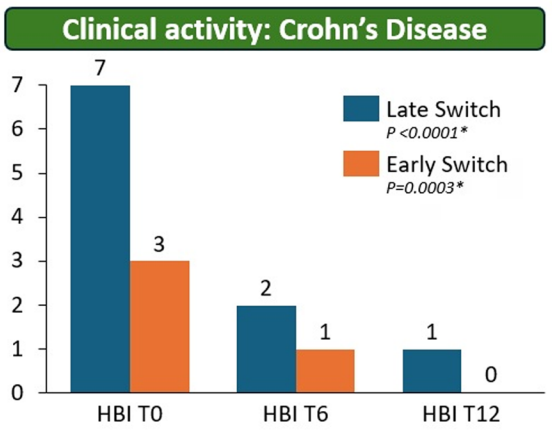
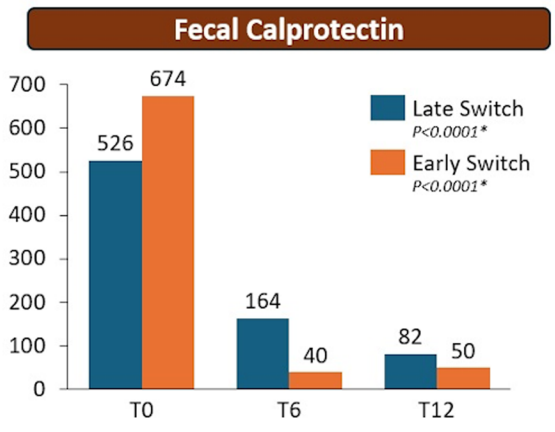
  • There were no statistical differences between the two groups, early vs. late switch, after one year in terms of the respective endoscopic response (71.4% vs 70.8%, P = .95), steroid-free clinical remission (62.5% vs 68.7%, P = .51), or IFX retention rate (75.0% vs 66.7%, P = .35).
  • There was higher endoscopic remission rates in early switch patients as compared to late switch patients; however, this trend was not significant (69.6% vs 52.1%, P = .07).
  • A return to IV-IFX was required in 1 of 43 early switch patients and in 3 of 44 late switch patients (2.3% vs 6.8%, P = .31)
  • While the early switch group appears to fare a little better, there is likely a selection bias. For example, the early group had a much lower rate of severe endoscopic score at baseline (20% vs. 54%) and lower rate of Crohn’s fistulizing disease (8% vs 33%).
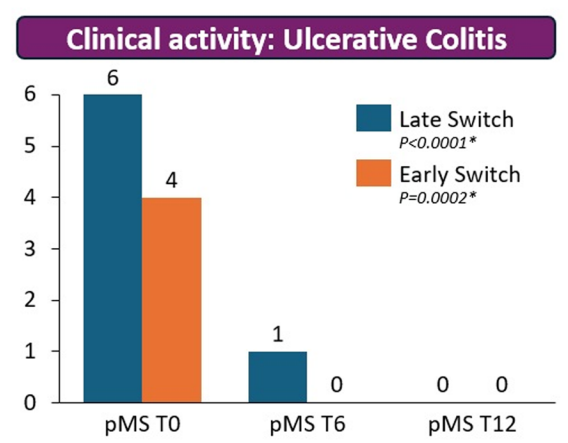
partial Mayo score (pMS)
Harvey–Bradshaw index (HBI)

My take: These results indicate that outcomes are similar between patients switching from to IFX SC at both early (after induction) and late (after 6 months).

It is worth noting that prior studies have shown that home-based therapies (eg. home infusion), compared to office-based therapies, have been “associated with suboptimal outcomes including higher rates of nonadherence and discontinuation of infliximab.” This is a concern for SC biologics as well.

Related blog posts:

Why Changing to Denmark’s Vaccine Schedule is a Bad Idea and Other Ways RFK Jr is Working to Undermine Our Health

Last week, the following article explained why the newest changes, announced yesterday (see link below), to the vaccine schedule recommendations are not a good idea:

J Interlandi. NY Times 12/30/25: This Is the Damage Kennedy Has Done in Less Than a Year

An excerpt:

Proponents of the push to align U.S. recommendations with those of so-called peer nations such as Denmark, Japan and Germany — all of which recommend fewer shots than the United States — have billed it as a common-sense corrective. But, as innumerable doctors and scientists have explained, when it comes to public health, countries with fewer shots on their must-have list are not actually our peers.

In Denmark, to take the administration’s favorite example, prenatal care is free and universal. More than 95 percent of pregnant women are screened for hepatitis B, and those who test positive are promptly treated and duly monitored…

None of this is true in the United States.

Here, nearly a quarter of pregnant women lack adequate prenatal care, and those who face the highest risk of contracting and spreading vaccine-preventable diseases are often the least likely to have access to doctors or pharmacies. When U.S. health officials tried to stamp out hepatitis B through vaccination programs aimed at high-risk groups, they failed miserably. It was not until they carried out a universal, at-birth vaccination policy in 1991 that hepatitis B infections finally plummeted — by about 99 percent.

In fact, if the U.S. public health system has one thing going for it relative to other nations, it’s probably vaccines. As the C.D.C.’s own data indicates, routine childhood vaccination has prevented hundreds of millions of illnesses and tens of millions of hospitalizations here. It has also saved half a trillion dollars in medical costs, a figure that jumps into the multitrillions once you factor in indirect, societal costs like lost productivity and lost wages.

The United States tends to have higher rates of measles vaccination than Europe, and fewer measles cases as a result. Compared with Denmark, we also tend to have lower hospitalization rates for rotavirus (which causes diarrhea and can be fatal in infants and children) and respiratory syncytial virus, or R.S.V. (which is a leading cause of hospitalization among children). The reason for those disparities is not in dispute: We vaccinate routinely against both viruses. Denmark does not…

In the meantime, the Food and Drug Administration is angling to make an even bigger and more enduring impact on Americans’ access to vaccines…top officials at the agency have proposed a roster of new requirements for the shots, including several that critics say would be logistically impossible and could leave us with no F.D.A.-approved Covid or flu vaccines…

We don’t have to wonder what that future will look like. We can glimpse it already in communities across the country where measles and whooping cough are resurgent and where infants and young children have already died from both. We can also see it foretold in the current flu season: This year’s flu vaccine has proved an imperfect match to the currently circulating strains. New shots, based on mRNA technology, would have one day enabled us to avoid this kind of misfire. But the nation’s leaders have imperiled that future with the decisions they made this year…

Mr. Kennedy has brought us to this precipice by aggressively subverting nearly every process and protocol that previously governed our public health institutions. He has granted political appointees enormous sway over agency scientists. He has excluded people with meaningful expertise from his planning and deliberations. And he has fired dissenters all the way up to the C.D.C. director and replaced them with lackeys, sycophants and wellness grifters.”

My take: RFK Jr and this administration has already done great damage to our health care and the toll will be evident for a long time. But, they are not done yet.

Link to yesterday’s announcement: NY Times 1/05/25: Kennedy Scales Back the Number of Vaccines Recommended for Children“Public health experts expressed outrage at the sweeping revisions, saying federal officials did not present evidence to support the changes or incorporate input from vaccine experts…and will endanger the health of children in the United States…The C.D.C.’s new schedule continues to recommend vaccines against some diseases, including measles, polio and whooping cough, for all children. Immunization against six other illnesses — hepatitis A, hepatitis B, meningococcal disease, rotavirus, influenza and respiratory syncytial virus, the leading cause of hospitalization in American infants — will be recommended for only some high-risk groups or after consultation with a health care provider.”

Related blog posts:

Cochran Shoals, Atlanta

Duodenal Hematoma Following Endoscopy

A Coe et al. J Pediatr Gastroenterol Nutr. 2025;81:1514–1517. Duodenal hematoma in pediatric upper endoscopy: A5‐year review and comparison to previous experience

This 5-year single-center study from 2018 to 2022 identified a total of 13 patients with duodenal hematoma (DH). There were a total of 21,569 EGDs, and 16,978 EGDs with duodenal biopsies were performed during the study period.

Key findings:

  • 1 DH in 1306 (0.08%) EGDs with duodenal biopsies. Ten of the thirteen patients had normal duodenal histology, and the other three each had findings of celiac disease, peptic duodenitis, and graft-versus host disease
  • None of the patients had a history of anticoagulant or antiplatelet agent therapy
  • Symptom onset occurred within 24 h for 8/13 (62%),48 h for 11/13 (85%), and 72 h for all 13 patients after EGD. Emesis occurred in all 13 patients and abdominal pain 7/13 (58%)
  • All patients were admitted with a mean length of stay of 18 days
  • Treatment: jejunal feedings in 4 of the 13 patients (31%), and parenteral nutrition in 10 of 13 (77%) patients. Most patients (62%) utilized opioids for pain management following DH
  • A similar study was conducted at the same center in 2015. It was noted that there was a lower rate of duodenal biopsies in the current cohort: 78.7% versus 92.4%
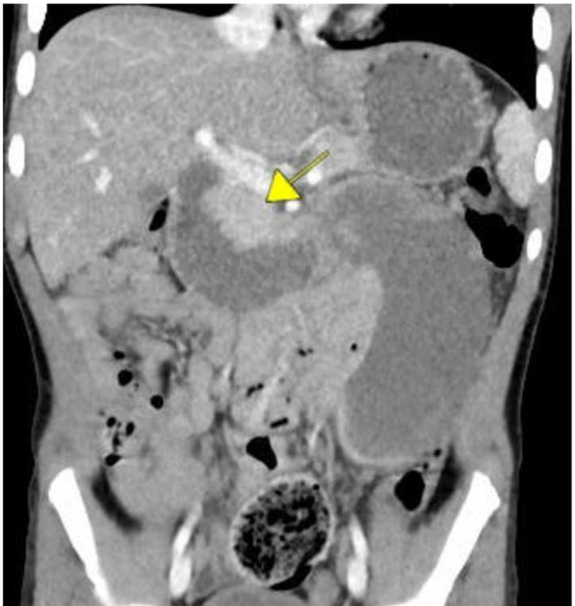
Computed tomography coronal image with hematoma

My take: Duodenal hematoma is a major complication leading to the need for parenteral nutrition and prolonged hospitalization. BMT and organ transplantation appear to increase this risk based on prior studies.

Related blog posts:

Russian Roulette: Refusing Vitamin K Version


R Walrath-Holdridge, USA Today 12/9/25: More parents refusing this shot that prevents serious bleeding at birth

Am excerpt:

“An injection of vitamin K, which helps with blood clotting, within six hours of birth has been a standard practice in the U.S. since 1961.

Since babies are born with low levels of the vitamin, they are more prone to serious bleeding, especially in the brain and gastrointestinal tract, according to the Centers for Disease Control and Prevention (CDC) and the American Academy of Pediatrics (AAP)

Using electronic medical record data, the study’s authors reviewed more than 5 million births at over 40 hospitals across all 50 states between 2017 and 2024. The number of infants who did not receive the shot at birth rose from 2.92% in 2017 to 5.18% in 2024, according to the report…

Since 1961, the AAP has recommended that a single shot of vitamin K be given at birth to protect against bleeding. All babies are born deficient in vitamin K.”

My take: Avoidance of Vitamin K in the newborn period indicates a mistrust of the medical system as well as desire for a more “natural” birth experience. However, this increases the chance than an infant will have permanent severe brain damage. When parents refuse Vitamin K, they are playing Russian roulette with their newborn’s life.

Related blog posts:

Effectiveness of Switch to Subcutaneous Infliximab

N Mathieu et al. Clin Gastroenterol Hepatol 2025; 23: 2597 – 2606. Open Access! PErsistence and Safety of Subcutaneous Infliximab 1 Year After Switch From Intravenous Route in IBD Patients in REMission

Methods: The PEREM (PErsistence, effectiveness and safety of subcutaneous infliximab after switch from intravenous infliximab in IBD patients in REMission) study, a prospective national French cohort trial, enrolled 426 patients with IBD. Participants were in steroid-free clinical remission for at least 6 months on IV-IFX when they switched to SC-IFX. 56% were on IV-IFX standard dosing (5 mg/kg 8-weekly) and 16% received combination therapy with an immunomodulator drug at baseline. All patients were switched to SC-IFX standard dosing (ie, 120 mg every other week). The treatment could be intensified during follow-up, either to 120 mg every week or 240 mg every other week.

Key Findings:

  •  At week 48, SC-IFX persistence was 95.4%
  •  86.9% of patients were in steroid-free clinical remission
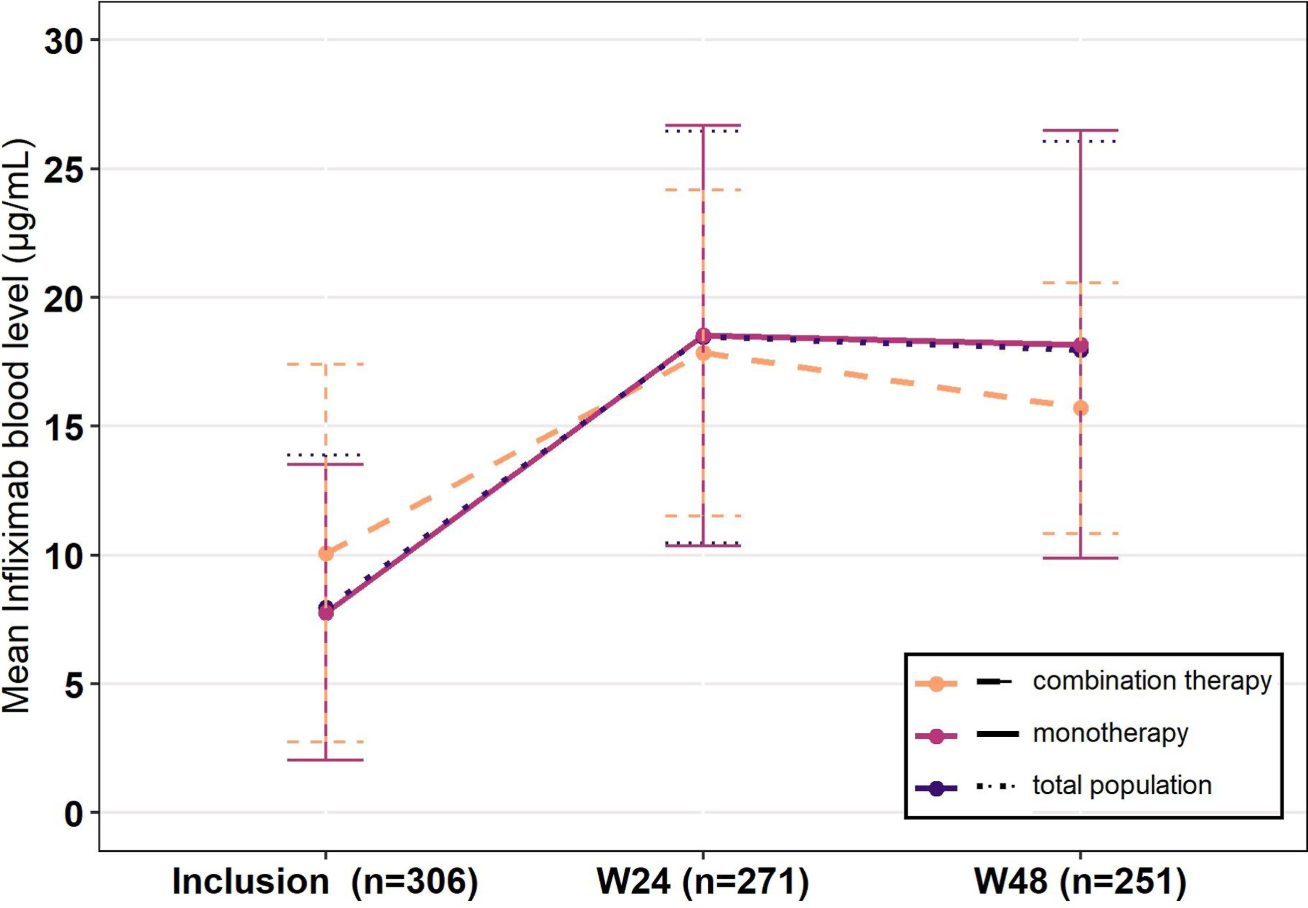
  • Mean infliximab levels were 8.0 μg/mL at inclusion and 18.0 μg/mL at week 48 (P < .0001)
  • Among the 19 (4.5%) patients who stopped SC-IFX, 6 (1.4%) switched back to IV-IFX
  • 23 (5.4%) patients required SC-IFX dose escalation
  • Dosing at 10 mg/kg/Q4W had 100% SC IFX persistence compared to 95% for 5 mg/kg/Q8W; however, at the 48 week followup, there were only 6 patients in the higher dose compared to 149 in the lower dose
  • Ongoing use of combination therapy was not associated with better persistence. Though, only 7 patients were receiving combination therapy at the 48 week followup

From the discussion:

  • “The high persistence observed in the PEREM study is partly explained by the long-term control of the disease by the time of switch, the median time since last flare being over 5 years before inclusion. Henceforth, the persistence observed here is in accordance with results on long term maintenance of IV-IFX, the yearly persistence of IV-IFX without intervention being 87%.”
  • SC-IFX was associated with higher levels. However, this was expected and higher levels are needed with SC administration. The “different bioavailability of SC-IFX compared with IV-IFX is responsible for different goals of infliximab blood levels depending on its route. In particular, a level above 20 μg/mL has been associated with higher rates of remission20” with SC-IFX.

My take: This study shows that SC-IFX is a good option for patients in long-term remission. With SC-IFX therapy, more effort is needed to make sure patients are adherent with therapy and monitoring in order to achieve optimal outcomes.

Related blog posts:

From Treatment to Cures for Autoimmune Diseases


In March 2024, CAR-T therapy was shown to be a promising though difficult and expensive option for severe SLE (NEJM 2024; 390: 687-700. Blog post: CAR T-cell Therapy: A Cure for Autoimmune Disease?)

Eric Topol has summarized more recent advances that indicate that future treatments could be safer and less costly. Instead of manipulating T-cells outside the body, an inside the body (in vivo) approach looks promising. Substack post, 12/14/25: The Exhilarating Movement From Treatment to Cures for Autoimmune Diseases

An excerpt:

“This inside the body, off-the-shelf strategy has already been shown to be safe and successful in Phase 1 trials of refractory SLE and in patients with systemic sclerosis or severe myositisSeveral companies are in clinical trials with in vivo CAR T for autoimmune diseases including Capstan Therapeutics, Kite Therapeutics, Umoja Biopharma, and Shenzhen Magic-RNA. The striking progress in this field towards universal, potential one-shot cures is tempered by residual anticipated high cost, the cytokine release syndrome and neurotoxicity that can occur with CAR T. The mRNA and non-viral vectors are considered a better choice than a lentivirus vector because of the latter’s potential risk of mutagenesis and cancer…

The Soft Reset: Inverse Vaccines to Achieve Tolerance

Tolerogenic vaccines [are] the opposite of standard vaccines that boost the immune system…Inverse vaccines are being pursued in celiac disease (Anokion, with positive clinical trial results reported earlier this year) , multiple sclerosis (ANokion, Moderna, BioNTech), and Type 1 diabetes (Diamyd Medical), rheumatoid arthritis (Janssen clinical trials.

How Progress in Cancer Fuels Autoimmune Disease Innovation

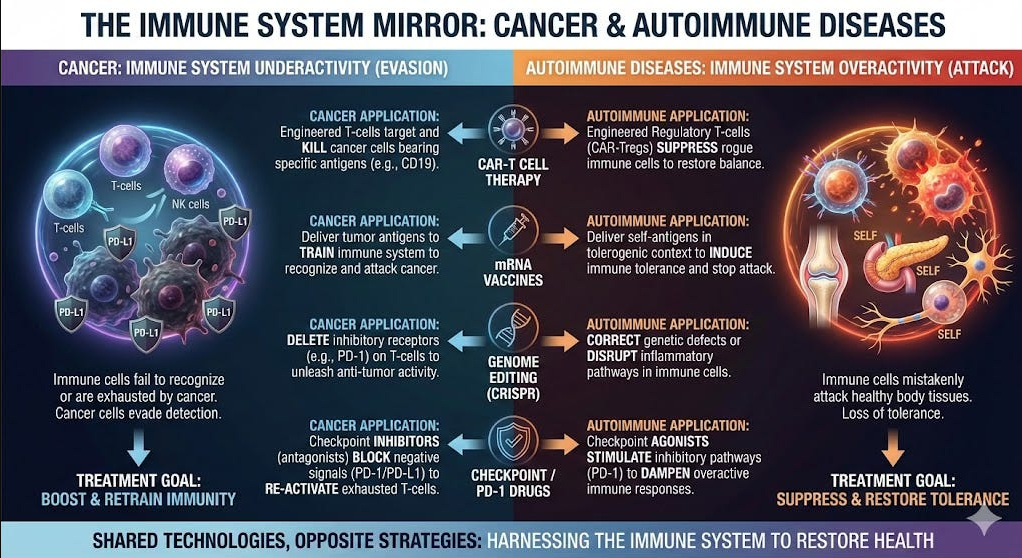
Cancer biology is the mirror image of autoimmunity. Predisposition to cancer occurs when the immune system is hypoactive, losing its protection, whereas autoimmune disease reflects hyperactivity and a dysregulated state…The B cells are a common culprit, hence the successful use of CAR T vs B cells for both diseases. The checkpoint inhibitor PD-1 (prototype Keytruda) is to cancer (cut the brakes on the immune system) as PD-1 agonists (slam on the brakes) are to autoimmune diseases. Similarly, cancer vaccines to rev up immunotherapy are the opposite of inverse, tolerogenic vaccines…

[There is a] reciprocal relationship between CAR T for cancer and autoimmunity. What’s important to emphasize is all the work to achieve in vivo, universal CAR T works for both diseases. Anything that helps cancer immunotherapy has the big dividend of also helping the efforts for curing autoimmune diseases. The new field of structural immunotherapeutics has legs to achieve precise control of our immune system vs either sets of diseases…

We’e seeing the initial stages of a renaissance vs autoimmunity. Curing instead of just treating autoimmune diseases.”

Related blog posts: