Potassium-competitive acid blockers are generally not recommended as first line therapy. This rationale is based on cost, greater obstacles to obtaining medication, and fewer long-term safety data.
Clinicians may use P-CABs in selected patients with documented acid-related reflux & erosive esophagitis who fail therapy with twice-daily PPIs.
Clinicians should use P-CABs in place of PPIs in eradication regimens for most patients with H pylori infection.
P-CABs may be beneficial in high-risk bleeding peptic ulcer disease. “Although there is currently insufficient evidence for clinicians to use P-CABs as first-line therapy in patients with bleeding gastroduodenal ulcers and high-risk stigmata, their rapid and potent acid inhibition raises the possibility of their utility in this population.”
U Bonnet. Gastroenterol 2024; 167:1054-1055 (letter). Cannabis Hyperemesis Syndrome Recovers Completely When the Use of Cannabis or Synthetic Cannabinoids Is Permanently Discontinued—Cyclic Vomiting Syndrome Does Not
ME Mullins et al. Gastroenterol 2024; 167: 1055-1056 (letter). Comments on the AGA Clinical Practice Update on Diagnosis and Management of Cannabinoid Hyperemesis Syndrome
The correspondence regarding AGA’s clinical practice update on Cannabinoid Hyperemesis Syndrome offered a few useful points.
Bonnet notes that “CVS is most likely present if cyclic vomiting persists, recurs or worsens during cannabis abstinence (beyond 3-week cannabis withdrawal period, which may be temporarily accompanied by nausea). In other cases with more fluctuation symptoms, a clear distinction between CHS and CVS is not so easy…Evidence shows that a symptom-free period of about 12 months after cessation of long-term cannabis use should be sufficient to clearly distinguish CHS from CVS…Finally, I emphasize here that…CHS…in exceptional cases can lead to life-threatening conditions (eg due to prerenal failure, severe electrolyte disturbances, or esophageal rupture)…but recovers completely when affected patients permanently stop using cannabis or THC analogues.
Mullins et al note that “ondansetron is uniformly ineffective and that butyrophenones (haloperidol, droperidol) are more effective” for CHS. In the reply, the authors note that the data supporting these medications is based on small studies and some patients have developed acute dystonia.
Yesterday’s pumpkin -please no snide remarks about how I can now retire and become a sculptor:
BE Sands et al. N Engl J Med 2024;391:1119-1129. Phase 2 Trial of Anti-TL1A Monoclonal Antibody Tulisokibart for Ulcerative Colitis
Background: “Several studies have implicated human tumor necrosis factor–like cytokine 1A (TL1A) in the pathogenesis of inflammatory bowel disease…Tulisokibart (formerly PRA023) is a humanized IgG1 kappa monoclonal antibody that binds to the membrane-bound and soluble forms of TL1A with high affinity and specificity. Tulisokibart prevents the interaction of TL1A and DR3, thereby suppressing type 1 and type 17 helper T-cell responses, increasing regulatory T-cell activity, and decreasing profibrotic pathways.”
Methods: (ARTEMIS-UC trial) The authors “randomly assigned patients with glucocorticoid dependence or failure of conventional or advanced therapies for ulcerative colitis to receive intravenous tulisokibart (1000 mg on day 1 and 500 mg at weeks 2, 6, and 10) or placebo. Cohort 1 included patients regardless of status with respect to the test for likelihood of response. Cohort 2 included only patients with a positive test for likelihood of response.”
“The inclusion of an integrated assessment of a panel of genetic markers as a diagnostic assay was based on the notion that patients with a propensity to overexpress TL1A might be more likely to have a response to tulisokibart than an unselected population.”
Key findings:
In the first cohort, a significantly higher percentage of patients who received tulisokibart had clinical remission than those who received placebo (26% vs. 1%), endoscopic healing (31% vs. 4%), endoscopic improvement (37% vs 6%) and clinical response (66% vs 22%)
“Among patients with a positive test for likelihood of response (cohorts 1 and 2 combined), clinical remission occurred in a higher percentage of patients who received tulisokibart than in those who received placebo (32% vs. 11%).”
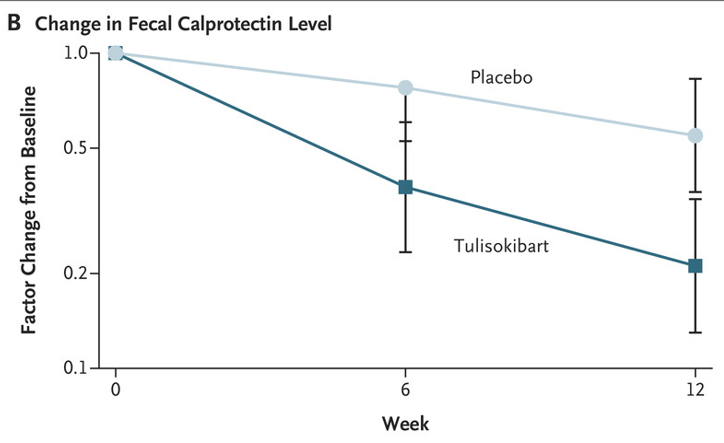
Improvement in CRP and Calprotectin were noted as early as 2 weeks and 6 weeks respectively
The incidence of adverse events was similar in the tulisokibart and placebo groups
My take: Tulisokibart was effective in a group of patients with moderately to severely active ulcerative colitis who were refractory to advanced therapies.
All patients received IV PPI treatment prior to endoscopy. Key finding from this multicenter randomized open-label adult trial:
The 30-day rebleeding rates in vonoprazan and PPI groups were 7.1% (7 of 98) and 10.4% (10 of 96), respectively
There were similar outcomes with regard to safety and secondary outcomes
My take: This study shows that oral vonoprazan is not inferior to IV PPI treatment for high-risk peptic bleeding ulcers. Perhaps, a study with more participants would show superiority of vonoprazan given the absolute lower rebleeding rates in this study.
While this review focuses on acute pancreatitis in adults, there are areas of overlap with pediatric patients who have acute pancreatitis. Many of the points in this article were reviewed in the lecture by Dr. Freeman (summarized earlier this week).
A couple of details regarding these recommendations:
Nutrition: “Current guidelines recommend initiating early (as soon as tolerated) oral feeding with solid (low-fat) diet in patients with predicted mild AP and this approach reduces length of hospitalization. Patients with severe AP or NP may be intolerant to oral diet…studies noted that the pancreas is largely insensitive to meal stimulation during AP. Early enteral nutrition (EN) was shown to have a beneficial trophic effect in preserving gut mucosal integrity and reducing gut bacterial translocation. EN was compared with TPN in AP in several RCTs and the results were statistically aggregated in several meta-analyses to establish the superiority of EN in mortality, multiorgan failure, and rate of infection.”
TPN: “Given the cost burden, risk of catheter-related sepsis, electrolyte and metabolic derangement, and gut barrier failure, currently use of TPN is reserved for patients for whom EN is not possible or is not able to meet the minimum calorie requirements. It should be noted that although all guidelines advise avoiding TPN, it continues to be used.”
Antibiotics: “Current guidelines do not recommend prophylactic antibiotics in predicted severe AP or sterile necrosis because this practice is associated with the development of multidrug-resistant bacteria and fungal superinfection. It can be difficult in severe pancreatitis to know if clinical deterioration is due to ongoing pancreatitis with SIRS, or due to a new infection. Procalcitonin is useful in distinguishing SIRS from bacterial sepsis. The PROCAP randomized trial used procalcitonin testing at 0, 4, and 7 days and weekly thereafter with a threshold of 1.0 ng/mL to guide initiation, continuation, and discontinuation of antibiotics. The procalcitonin based algorithm decreased the probability of being prescribed an antibiotic and the number of days on antibiotics without increasing infection or harm in patients with AP.”
Progression to Chronic Pancreatitis: “A systematic review and meta-analysis of progression showed that 10% of patients with first episode of AP and 36% of patients with recurrent AP develop CP, with risk being highest among smokers, alcoholic patients, and men.”
Risk of Diabetes: “A prior systematic review and meta-analysis of patients with an index attack of AP found that newly diagnosed diabetes occurred in 15% of individuals within 12 months, and risk increased 2-fold for diabetes after 5 years. The development of diabetes was not significantly associated with the severity of pancreatitis, etiology of disease, patient age, or gender.”
Methods: In this prospective, single-center, randomized controlled trial, 322 participants (18-75 yrs) were divided into two groups: a 3-L PEG + 870-μg linaclotide group (administered as a single dose for 3 days) and a 4-L PEG group. All enrolled patients had constipation as defined by the Rome IV criteria (fewer than three bowel movements per week with associated symptoms such as straining and hard or lumpy stools).
Linaclotide dosing: One 290-μg linaclotide capsule 30 min before the first meal for 3 days leading up to the colonoscopy, but not on the day of the procedure itself
Key findings:
The 3-L PEG + linaclotide group showed significantly higher rates of adequate and excellent bowel preparation than the 4-L PEG group (89.4% vs 73.6% and 37.5% vs 25.3%, respectively; P < 0.05).
Boston Bowel Preparation Scale (BBPS) score in the linaclotide group was significantly higher than that in the 4-L PEG group.
Adverse effects like nausea and vomiting were less common in the linaclotide group compared to the 4-L PEG group. Nausea was noted in 10% of linaclotide group compared to 24.5% in the 4-L PEG group. vomiting occurred in 5% and 19.5% respectively. Overall, adverse effects were 24.4% compared to 41.5% respectively.
The cecal intubation rate was 87.5% in the linaclotide group and 81.8% in the 4-L PEG group, which indicated a higher trend in the linaclotide group. Both groups had a lower cecal intubation rate than the 90% benchmark rate and could be related to the underlying constipation.
My take: In patients with constipation, linaclotide with 3L PEG resulted in a better cleanout than a standard 4L PEG prep. Combination laxatives as part of the prep should be considered in those with underlying constipation.
This study would be hard to replicate in children as very few children with constipation need a colonoscopy. It is possible that the addition of linaclotide would improve cleanouts even in children without constipation. Other studies showing linaclotide can help with cleanouts in the general population include the following:
Zhang M, et al. Eur. J. Gastroenterol. Hepatol. 2021; 33: e625–33.
This is a terrific review article. The authors detail the rationale for neuromodulators, strategies for selecting among them, side effects, and dosing.
Background: “IBS is frequently associated with neuropsychiatric disorders such as depression and anxiety, which are considered triggers for the onset of symptoms or occur in response to having them (3). In the Rome Foundation global study that included 54,127 participants, subjects with psychological distress or clinically relevant somatic symptoms were 4.45 times more likely to have 1 or more DGBI than those without psychological distress. The same study reported that those who met specific criteria for bowel disorders presented clinically relevant psychological distress or somatic symptoms in 55.5% of cases (4). In addition, in a meta-analysis that included 7,095 subjects with IBS exclusively, the global prevalence of depression was 36%…Anxiety was present in 44% of patients with IBS….Central neuromodulators act on receptors along the brain-gut axis, so they are useful in treating psychiatric comorbidities, modifying gut motility, improving central downregulation of visceral signals, and enhancing neurogenesis in patients with IBS… Neuromodulator treatment is still considered off-label, many of the recommendations herein are based on expert consensus (6)”
Key points:
“The first-line treatment for pain management in IBS is using tricyclic antidepressants.” Nortriptyline and desipramine are less likely to cause constipation.
“Selective serotonin reuptake inhibitors (SSRIs) are useful when symptoms of anxiety and hypervigilance are dominant but are not helpful for treating abdominal pain….The SSRIs include fluoxetine, fluvoxamine, sertraline, paroxetine, citalopram, and escitalopram. …Sertraline, citalopram, and escitalopram tend to have the fewest pharmacokinetic drug interactions”
“SSRIs are first-line pharmacologic agents for treating anxiety disorders, but they have the potential to induce restlessness and exacerbate anxiety when the drug is initiated. They are typically initiated at half of the usual starting dose to minimize these potential anxiogenic adverse effects. The dose may gradually increase to the regular starting dose after about 1 week… SSRIs should be considered when a significant component of anxiety without pain is present.”
SNRIs: “In addition to showing benefits with depression and painful disorders, SNRIs have shown significant improvement in anxiety.” Thus, they may be useful as monotherapy for patients with pain and anxiety.
Tetracyclics: “The most representative agent of this class is nirtazapine (Table 5). However, their effects seem to be mainly on anxiety, early satiety, nausea, and other symptoms associated with esophageal and gastroduodenal disorders, so their use in IBS is limited.”
“It is important to explain to the patients, …neuromodulators are not necessarily used for the treatment of depression but are a therapeutic alternative in the management of DGBI. It helps to use the term “neuromodulator” instead of “antidepressant” (6,8) It also helps to clarify that these medications can treat pain and other GI symptoms independent of treating depression, and the dosages are often lower than those used for treating major depression. This will preclude any patient concerns that their symptoms are being underestimated or considered to be in their head (6,8).”
Using central neuromodulators for IBS requires long-term treatment. From our experience, 6–12 months of treatment or more are needed to increase the likelihood of remission.
Disclaimer: This blog, gutsandgrowth, assumes no responsibility for any use or operation of any method, product, instruction, concept or idea contained in the material herein or for any injury or damage to persons or property (whether products liability, negligence or otherwise) resulting from such use or operation. These blog posts are for educational purposes only. Specific dosing of medications (along with potential adverse effects) should be confirmed by prescribing physician. Because of rapid advances in the medical sciences, the gutsandgrowth blog cautions that independent verification should be made of diagnosis and drug dosages. The reader is solely responsible for the conduct of any suggested test or procedure. This content is not a substitute for medical advice, diagnosis or treatment provided by a qualified healthcare provider. Always seek the advice of your physician or other qualified health provider with any questions you may have regarding a condition.
Background: “Placebo-controlled trials are especially important during the early phases of drug development, as use of placebo aids early detection of efficacy or futility.”
Methods: The authors performed a systematic review which identified 47 trials including 20,987 patients (14 267 [68·0%] receiving active drug and 6720 [32·0%] receiving placebo) were eligible. The studies involved multiple RCTs of biologics and small molecules in IBD.
Key findings:
The risks of worsening of IBD activity (Active treatment vs placebo: 563/13,473 [4·2%] vs 530/6252 [8·5%];RR 0·48)
Withdrawal due to adverse event (Active treatment vs placebo: 401/13 363 [3·0%] vs 299/6267 [4·8%]; RR 0·62)
Serious adverse event (Active treatment vs placebo: 682/14,267 [4·8%] vs 483/6720 [7·2%]; RR 0·69)
Serious infection (Active treatment vs placebo: 140/14 ,194 [1·0%] vs 91/6647 [1·4%]; RR 0·67)
Serious worsening of IBD activity (Active treatment vs placebo: 187/11,271 [1·7%] vs 189/5056 [3·7%]; RR 0·4)
VTEs (Active treatment vs placebo: 13/7542 [0·2%] vs 12/2981 [0·4%]; RR 0·45)
All of these adverse outcomes were significantly lower with active drug than placebo.
My take: Now that there are proven medications that are effective for moderate-to-severe Crohn’s disease, head-to-head trials of novel drugs against existing drugs with proven efficacy, rather than placebo-controlled trials, should be prioritized.
In June, risankizumab (Skyrizi) received FDA approval as a treatment for moderate to severe ulcerative colitis in adults. FDA approval relied on the data from these two randomized trials.
Methods: For the induction trial, patients were randomized 2:1 to receive 1200 mg of risankizumab or placebo administered intravenously at weeks 0, 4, and 8. For the maintenance trial, patients with a clinical response (determined using the adapted Mayo score) after intravenous treatment with risankizumab were randomized 1:1:1 to receive subcutaneous treatment with 180 mg or 360 mg of risankizumab or placebo (no longer receiving risankizumab) every 8 weeks for 52 weeks.
Key findings:
In the 12-week induction INSPIRE study with 975 patients, the clinical remission rates at week 12 were 132/650 (20.3%) for 1200 mg of risankizumab and 20/325 (6.2%) for placebo (P < .001)
In the induction trial, a greater proportion of treated patients achieved endoscopic improvement (36.5% vs. 12.1%; P < 0.00001) and endoscopic histologic mucosal improvement (24.5% vs. 7.7%; P < 0.00001) after 12 weeks
In the induction trial, a clinical response at 12 weeks was noted in 418/650 (64.3%) of risankizumab-treated patients and 116/325 (35.7%) of the placebo-treated patients
In the COMMAND maintenance trial with 548 patients, the clinical remission rates at week 52 were 72/179 (40.2%) for 180 mg of risankizumab, 70/186 (37.6%) for 360 mg of risankizumab, and 46/183 (25.1%) for placebo. Both doses were statistically-significant compared to placebo, P < .001 and P = .002, respectively
After 1 year of treatment with either maintenance dose of risankizumab, more than 40% of patients had histologic and endoscopic improvement
More than 75% of patients in the maintenance trial had a history of inadequate response to advanced therapies
My take: The published results of risankizumab for Crohn’s disease are much more impressive than the results in this study.
Methods: In this open-label, multicenter, randomized controlled trial, patients aged 18 years or older from 13 Australian tertiary hospitals with intravenous steroid-refractory ASUC were randomly assigned (1:2) to receive a first dose of 10 mg/kg infliximab or 5 mg/kg infliximab (randomization 1). Block randomization was used and stratified by history of thiopurine exposure and study site, with allocation concealment maintained via computer-generated randomization. Patients in the 10 mg/kg group (intensified induction strategy [IIS]) received a second dose at day 7 or earlier at the time of non-response; all patients in the 5 mg/kg group were re-randomized between day 3 and day 7 (1:1; randomization 2) to a standard induction strategy (SIS) or accelerated induction strategy (AIS), resulting in three induction groups. Patients in the SIS group received 5 mg/kg infliximab at weeks 0, 2, and 6, with an extra 5 mg/kg dose between day 3 and day 7 if no response. Patients in the AIS group received 5 mg/kg infliximab at weeks 0, 1, and 3, with the week 1 dose increased to 10 mg/kg and given between day 3 and day 7 if no response.
Thus, this was the first RCT comparing an intensified induction strategy (IIS; 10 mg/kg infliximab at weeks 0 and 1, with the second dose given earlier if no clinical response), an accelerated induction strategy (AIS; 5 mg/kg infliximab at weeks 0, 1, and 3, with the second dose increased to 10 mg/kg and given earlier if no response), and a standard induction strategy (SIS; 5 mg/kg at weeks 0, 2 and 6; with an extra 5 mg/kg dose before day 7 if no response) in steroid-refractory patients with ASUC.
Key findings:
There was no significant difference in the proportion of patients who had a clinical response by day 7 between the 10 mg/kg and 5 mg/kg groups: 65% vs 61%
In patients with a baseline albumin of less than 25 g/L, a day 7 response occurred in nine (64%) of 14 patients in the 10 mg/kg group versus 14 (45%) of 31 in the 5 mg/kg group (RR 1·43, p=0·17)
In patients with a baseline CRP of 50 mg/L or higher, a day 7 response occurred in six (60%) of ten patients in the 10 mg/kg group versus eight (42%) of 19 in the 5 mg/kg group (RR 1·39, p=0·34)
The proportions of patients with clinical response at day 14: 74% in the IIS group, 73% in the AIS group, and 68% of 44 in the SIS group.
The clinical remission at month 3: 50% in the IIS group, 52% in the AIS group, and 48% in the SIS group
The steroid-free remission at month 3: 41% in the IIS group, 42% in the AIS group, and 41% in the SIS group
The endoscopic remission at month 3: 46% in the IIS group, 46% in the AIS group, and 48% in the SIS group
The colectomy rate at month 3: 7% in the IIS group, 19% in the AIS group, and 12% in the SIS group colectomy at month 3 were not significantly different between group (P=0.20)
The colectomy rate at month 12: 7% in the IIS group, 22% in the AIS group, and 15% in the SIS group colectomy at month 3 were not significantly different between group (p=0.13)
In post-hoc analysis of second-dose salvage strategies (among the group who had not responded at day7), a clinical response was observed in 19 (59%) of 32 patients who received a 10 mg/kg salvage dose versus nine (64%) of 14 who received a 5 mg/kg salvage dose (RR 0·92). Endoscopic remission at month 3 was observed in 11 (34%) who received 10 mg/kg salvage versus six (43%) who received 5 mg/kg salvage (RR 0·80). Colectomy by 3 months occurred in ten (31%) who received 10 mg/kg salvage compared with three (21%) who received 5 mg/kg salvage (HR 1·46)
Higher proportions of patients with clinical and biochemical remission between weeks 2 and 6 were apparent in the IIS and AIS groups versus the SIS group, but by 3 months, these differences were lost
My take: Intensified, accelerated, and standard induction regimens in the PREDICT-UC study did not result in a statistically-significant difference in clinical response by day 14 or in remission or colectomy rates by month 3. However, there are some important caveats:
There appeared to be a trend towards a lower colectomy rate in the IIS group.
There appeared to be a favorable trend towards an improved response to IIS group in those with low albumin (<25 g/L) and high CRP (>5 mg/L). The smaller numbers in these subgroups could have precluded statistical significance
Also, even the SIS group were able to receive a 4th induction 5 mg/kg dose between days 3-7 if they had not responded to treatment
In patients who had not responded to either 10 mg/kg or 5 mg/kg, a salvage dose at day 7 resulted in a >60% response rate
It is possible that a sustained strategy of more aggressive dosing (not done in this study) aided with therapeutic drug monitoring could result in better outcomes following IIS