Irritable Bowel Syndrome (part 2)

A terrific 12 page review of irritable bowel syndrome (IBS): AC Ford, BE Lacy, NJ Talley. NEJM 2017; 376: 2566-78. While yesterday’s post reviewed some of the updated diagnostic and pathophysiology information, today’s will focus on treatment.

The article’s Table 2 outlines the most frequent treatments, their efficacy, side effects, costs, and quality of evidence. I’ve tried to highlight the key points from table and discussion:

  1. Soluble fiber (eg. psyllium). Efficacy: effective -start at low doses. Quality of evidence: Moderate, Cost: $15-30 per month.
  2. Low-FODMAP diet. Efficacy: “May be effective, nutritionist guidance helpful.” While there have been studies showing this diet can be effective, two studies have shown that this diet is not significantly superior to conventional IBS diets (eg. “eating small, regular meals and avoiding insoluble fiber, fatty foods, and caffeine”).Quality of evidence: Very low.
  3. Gluten-free diet.  Efficacy: May be effective.  “No additive effect over that of a low-FODMAP diet in another small RCT.” Quality of evidence: Very low.
  4. Antispasmodic drugs (eg. dicyclomine).Efficacy: May be effective. Quality of evidence: Low, “No high-quality trials.” Cost: $50 per month.
  5. Peppermint oil. Efficacy: Effective, though few RCTs and no FDA-approved end points. Quality of evidence: Moderate. “No high-quality trials.”  Cost: $9-19 per month
  6. Lubiprostone. Efficacy: Effective, though “only a modest benefit over placebo, particularly for abdominal pain.” Quality of evidence: Moderate. Cost: ~$350 per month.
  7. Linaclotide.  Efficacy: Effective.. ” Quality of evidence: High. “No high-quality trials.”  Cost: ~$350 per month.
  8. Alosetron/5-HT3 receptor antagonists.  Efficacy: Effective. ” Quality of evidence: High. “No high-quality trials.”  Cost: ~$350-1100 per month. Alosetron may trigger ischemic colitis.
  9. Eluxadoline.  Efficacy: Effective, though “only a modest benefit over placebo for global symptoms and no benefit over placebo for abdominal pain.”  Quality of evidence: High. “No high-quality trials.”  Cost: ~$1100 per month. May trigger pancreatitis.
  10. Rifaximin. Efficacy: Effective. Quality of evidence: Moderate. “Modest benefit over placebo.”  “Relapse among patients who have a response is usual.” Cost: ~$1500 per month.
  11. Probiotics. Efficacy: May be effective.  Quality of evidence: Low. “Few high-quality trials and no FDA-approved end points.”  Cost: ~$20 per month.
  12. Tricyclic antidepressants. Efficacy: Effective. Quality of evidence: Moderate.  “Few high-quality trials and no FDA-approved end points.”   “A meta-analysis showed that tricyclic antidepressants were more effective than placebo in 11 randomized trials involving a total of 744 patients.” Cost: ~$5-10 per month.
  13. Psychological treatments. Efficacy: Effective. Quality of evidence: Low.  “Few high-quality trials and no FDA-approved end points.” “Their efficacy may be overestimated because of the lack of blinding.” There is also difficulty for many patients in finding an appropriate provider.  Cost: ??
  14. Placebo. In treatment trials, a placebo response is noted in 30-40%.
  15. Complementary/Alternative Therapies.  “Herbal therapies remain unclear.  STW5 (Iberogast) has been tested and “showed superiority over placebo.” Melatonin “has been reported to reduce abdominal pain in patients with IBS.”

The authors recommend judicious testing  “Any reassurance derived from colonoscopy to rule out organic disease in patients with IBS is short-lived.”

The authors outline their typical approach.  “Reassurance, explanation, and a positive diagnosis are essential steps in management. We recommend starting with dietary modification (slowly increasing soluble fiber if the patient has IBS with constipation or instituting a low-FODMAP diet temporarily  if the patient has IBS with diarrhea or the mixed subtype of IBS). We also recommend increased exercise and stress reduction.  A probiotic may be added, especially if bloating is prominent.  Pain may be ameliorated with an antispasmodic agent or a tricyclic antidepressant, diarrhea with loperamide or a bile acid sequestrant (eg. colestipol) and constipation with polyethylene glycol.” The other therapies may be used in those with persistent IBS symptoms.

My take: When a disease has this many treatments, usually this means that none of the treatments are all that great.

Related blog posts:

Chattahoochee River

Disclaimer: These blog posts are for educational purposes only. Specific dosing of medications (along with potential adverse effects) should be confirmed by prescribing physician.  This content is not a substitute for medical advice, diagnosis or treatment provided by a qualified healthcare provider. Always seek the advice of your physician or other qualified health provider with any questions you may have regarding a condition.

Irritable Bowel Syndrome 2017 (part 1)

A terrific 12 page review of irritable bowel syndrome (IBS): AC Ford, BE Lacy, NJ Talley. NEJM 2017; 376: 2566-78.

Diagnosis of Irritable Bowel:

Testing: National guidelines recommend that for a patient who meets Rome IV criteria, “the physician should make a positive diagnosis of IBS without resorting to a battery of tests.” Nevertheless, many physicians obtain some workup.  If a workup is undertaken, the authors state “consider limited testing (CBC, CRP level, celiac serological test, fecal calprotectin level)”

Rome IV criteria of IBS are reviewed in Table 1 and includes warning signs.  Summary of Rome IV critieria from emedicine website on Irritable Bowel Syndrome: The Rome IV criteria for the diagnosis of irritable bowel syndrome require that patients have had recurrent abdominal pain on average at least 1 day per week during the previous 3 months that is associated with 2 or more of the following [2]:

  • Related to defecation (may be increased or unchanged by defecation)
  • Associated with a change in stool frequency
  • Associated with a change in stool form or appearance

The Rome IV criteria (May 2016) only require abdominal pain in defining this condition; “discomfort” is no longer a requirement owing to its nonspecificity, and the recurrent abdominal pain. 

Supporting symptoms include the following:

  • Altered stool frequency
  • Altered stool form
  • Altered stool passage (straining and/or urgency)
  • Mucorrhea
  • Abdominal bloating or subjective distention

Four bowel patterns may be seen with irritable bowel syndrome, and these remain in the Rome IV classification. These patterns include the following:

  • IBS-D (diarrhea predominant)
  • IBS-C (constipation predominant)
  • IBS-M (mixed diarrhea and constipation)
  • IBS-U (unclassified; the symptoms cannot be categorized into one of the above three subtypes)

Symptoms not consistent with irritable bowel syndrome should alert the clinician to the possibility of an organic pathology. Inconsistent symptoms include the following:

  • Onset in middle age or older
  • Acute symptoms (irritable bowel syndrome is defined by chronicity)
  • Progressive symptoms
  • Nocturnal symptoms
  • Anorexia or weight loss
  • Fever
  • Rectal bleeding
  • Painless diarrhea
  • Steatorrhea
  • Gluten intolerance

The authors provide a diagnostic algorithm which is straight-forward.  The caption includes “tenderness is not increased by tensing abdominal wall muscles.”  The inclusion of Carnett’s sign is a useful reminder to consider/exclude muscle wall etiologies.

Another important point is that bile-acid diarrhea occurs in a significant fraction of adults with the diarrhea subtype of IBS, more than 25% of cases in a meta-analysis; thus, a therapeutic trial of a bile acid sequestrant may be useful.

Pathophysiology:

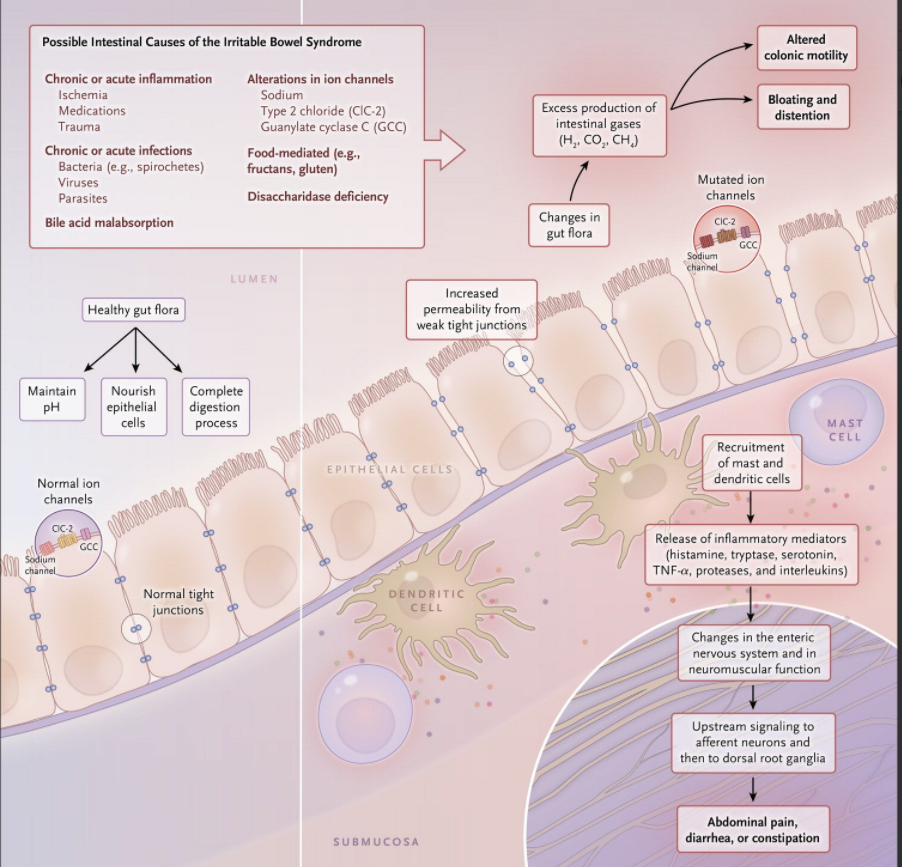
There are likely multiple pathways leading to IBS. In fact, Figure 2 lays out a Brain-Gut pathway as well as a Gut-Brain pathway. In the former, genetic predisposition and environmental factors/CNS alterations, could make one more susceptible to IBS after localized GI inflammation.  In the later, changes in the GI tract induced by infection, inflammation, food antigens, and medications which could alter intestinal permeability and/or microbiome could result in changes in CNS function (eg. new-onset anxiety, depression or somatization).  It is well-recognized that after gastrointestinal infections (bacterial, protozoal, viral), “IBS-type symptoms persist in 10 to 20% of infected patients.”

Image from NEJM twitter feed. It is noted that not all pathophysiological processes shown occur in all patients with IBS or in all IBS subtypes.


Diet, Meat, and Colorectal Cancer

A recent study (RS Mehta et al. Gastroenterol 2017; 152: 1944 & summarized in editorial, 1821-23) examined the effects of a “Western” diet and a “prudent” diet on the risk of colorectal cancer (CRC). Data was derived from two large prospective cohorts involving more than 137,000 participants for up to 32 years; this equated to 3.6 million person-years of follow-up.

Key findings:

  • Those in the highest quartile of a Western dietary pattern had a 31% increased CRC risk (RR=1.31) compared to those in the lowest quartile. In this context, a Western diet was characterized by consumption of red and processed meats, high-fat dairy products (such as whole milk), refined grains, and desserts.
  • The prudent diet cohort, had a 14% reduced risk for those in the highest quartile compared to the lowest quartile. The ‘prudent’ diet included high intakes of vegetables, fruits, whole grains, and fish.

Based on this study and others, the editorial notes the following:

  • Limit red and processed meat consumption to 0.5 servings or 42 g/day of lean red meat
  • A more ‘prudent’ diet has health benefits beyond reduction of CRC, including lower cardiovascular disease mortality

Related blog post: Colon Cancer at Younger Ages

Piedmont Park, Atlanta

Recent Study Did NOT Find Dementia Risk with PPIs

When performing retrospective studies, many times a potential association can be found with medications or diet and specific problems.  When these risks/associations are low (i.e. relative risks <2), often, these findings do not hold up, particularly with prospective studies which are much more able to control for confounding variables.

For proton pump inhibitors (PPIs), many potential complications have been suggested at  low relative risk findings in poorly-controlled studies.  A recent study has contradicted previous findings suggesting that PPIs increase the risk of dementia.

Goldstein FC, et al. J Am Geriatr Soc. 2017;doi:10.1111/jgs.14956. (Thanks to Ben Gold for this reference)

A link and an excerpt from a summary of this study from Healio Gastroenterology:

Link: Study finds no link between PPIs, dementia, Alzheimer’s risk

Excerpt:

They evaluated 10,486 volunteers within the NIH-supported Alzheimer’s Disease Centers who were aged 50 years and older and had either normal cognition or mild cognitive impairment at baseline. Participants underwent neuropsychological evaluations and self-reported PPI use at two to six annual visits between 2005 and 2015.

Overall, 884 reported they were taking PPIs at every visit, 1,925 reported they took PPIs intermittently, and 7,677 never reported taking PPIs.

Those who reported continuous PPI use showed a lower risk for cognitive function decline compared with those who never reported using PPIs (HR = 0.78; 95% CI, 0.66-0.93) as well as a lower risk for developing mild cognitive impairment or Alzheimer’s disease (HR = 0.82; 95% CI, 0.69-0.98).

Those who reported using PPIs intermittently also showed a lower risk for cognitive function decline (HR = 0.84; 95% CI, 0.76–0.93) and for developing mild cognitive impairment or Alzheimer’s disease (HR = 0.82; 95% CI, 0.74–0.91).

My take: This study provides reassurance that PPIs are unlikely to result in cognitive decline. Particularly when a study suggests a low risk of an association, further studies are needed to clarify the true risks.

Related blog posts:

Lennon Wall, Prague

Mandated Malpractice in IBD Care?

A recent study (A Yada et al. Inflamm Bowel Dis 2017; 23: 853-7) finds that insurance policies are not in compliance with expert guidelines.  The authors reviewed 79 policies from the top insurance companies to examine their policies regarding anti-TNF agents, vedolizumab, and ustekinumab.  These policies were compared with the American Gastroenterological Association (AGA) clinical pathway recommendations for ulcerative colitis (UC) and Crohn’s disease (CD).

Key findings:

  • “90% of the policies required step-wise failure prior to starting anti-TNF for non-fistulizing CD.”
  • “When choosing anti-TNF therapy, 26% of policies required the use of adalimumab as the first anti-TNF agent.”
  • 98% of policies are inconsistent with AGA IBD guidelines

Discussion from authors:

  • “The plans do not allow for treatment based on disease severity but rather dictate treatment based on the required failure of different drug classes.”
  • “Only 2% of UC policies and 10% of CD policies allowed for early initiation of biologic therapy to reduce the risk of complications.”
  • “The goal of medical management is to minimize the use of corticosteroids…However, the majority of the current policies…preclude this standard-of-care management.”

My take (from authors): “Most insurance companies do not comply with the current standard of care for treating IBD.” My expectation is that these problems will continue and/or worsen as the options for IBD treatment become more complex.

Normandy American Cementary


Hepatitis C -New Studies & New Recommendations (2017)

Briefly noted:

EJ Gane et al. Gastroenterol 2017; 152: 1366-71.  This phase 2, open-label study (n=53) examined the efficacy of ledipasvir plus sofusbuvir for 8 or 12 weeks for Hepatitis C virus (HCV) genotype 2.  An SVR was noted in 96% with 12 weeks of treatment and 74% with 8 weeks of treatment.  The only patient in the 12 week group without an SVR did not complete treatment.  Overall, this study stands in contrast with the ION-3 study which showed that 8 weeks of therapy led to an SVR of 94% among genotype 1.  Thus, this study is consistent with ledpasvir having more potency against genotye 1 and the need for a 12 week course with genotype 2 HCV.

IM Jacobson et al. Gastroenterol 2017; 152: 1372-82. This retrospective study examined 402 patients with HCV genotypes 1, 4 or 6 with Child-Pugh A compensated cirrhosis who were treated with Elbasvir/GrazoprevirKey finding: SVR12 was 98% and 89% for treatment-naive and treatment-experienced patients after 12 weeks of therapy. The authors noted that baseline tests were done to look for resistance-associated substitutions (RASs).  They recommend: “GT1a patients with RASs require extension of therapy to 16 weeks and addition of ribavirin.”

IM Jacobson et al. Gastroenterol 2017; 152: 1378-87. This AGA clinical practice update makes recommendations for patients have achieved an SVR after HCV therapy. These recommendations are mainly expert opinion given the recent advent of newer treatments for HCV and lack of data regarding long-term outcomes after these treatments. Recommendations from authors:

  • SVR should be confirmed by undetectable HCV RNA at 12 weeks after treatment regimen
  • Reconfirmation of SVR at 48 weeks after treatment is recommended.
  • Surveillance for HCC with liver imaging ± AFP should be pursued twice annually for an indefinite duration in all patients with stage 3 fibrosis or liver cirrhosis post-SVR.  Surveillance is “not recommended for patients with stages 0-2 fibrosis post SVR.”
  • Endoscopic screening for varices is recommended for all patients with cirrhosis, independent of SVR. Repeat screening should be considered if no varices or small varices are noted 2-3 years later.  If there are still no varices at 2-3 years, no further endoscopic screening is recommended.

Related blog posts:

If this picture and reports are accurate, this man’s family urged him to come inside. He said he was keeping an eye on it.


Caution with Celiac Genetic Testing Plus Two

Conventional wisdom and previous studies have indicated that negative testing for HLA-DQ8 and HLD-DQ2.5 alleles makes a diagnosis of celiac disease (CD), now or in the future, very unlikely.  While ~60% of the population has one of these alleles, testing negative for these alleles has been regarded as having a high negative predictive value (>99%) and can be valuable in cases of equivocal diagnosis.

The authors of recent report (F Fernandez-Banares et al. Clin Gastroenterol Hepatol 2017; 15: 594-96) challenged this wisdom, noting that there is expected to geographical variation in the presence of these alleles. The goal of their study was to assess the prevalence of HLA-DQ2.5/8 among CD patients in Spain by reviewing previous studies; 12 studies were included. To be included, patients had to have villous atrophy, positive serology and available genotyping.

Key finding:

  • Among 2963 Spanish CD patients, 3% “might be negative for HLA-DQ2.5/8.”

This is a brief report.  It is expected that limitations would relate to the accuracy of genotyping and of excluding other causes of villous atrophy.

My take: (from the authors) “This information highlights the need to be cautious when ruling out CD only on the basis of genetics.”

Related blog posts:

Briefly noted:

L Kivela et al. J Pediatr 2017; 183: 115-21.  This study divided children with CD into those identified via screening (n=145) and those identified due to clinical symptoms (n=359). Key findings:

  • There were no differences in serology or histology between the two groups
  • More than half (51.8%) of screen-detected patients had symptoms at diagnosis, but typically these were milder than in the clinically-detected group.
  • Anemia was more common in the ‘clinical group’ 22.9% vs 7.1% (screen group) as was poor growth (36.9% vs. 15.7%).

AJ Irvine et al. Am J Gastroenterol 2017; 112: 65-76. (Thanks to Ben Gold for this reference) In this systemic review with 15,256 individuals (& 9,275 with irritable bowel), “prevalence of positive celiac serology and biopsy-proven CD was significantly higher in subjects with symptoms suggestive of IBS vs. healthy controls.”  The odds ratio for serology-positive and/or biopsy-proven CD ranged from 2.75 to 4.48, though there was no significant increase in these ORs for North American studies.

Palace of Versailles


FDA Warning on Eluxadoline (Viberzi)

Briefly noted: The FDA has issued a safety warning for patients with irritable bowel syndrome who have had their gallbladder removed.

FDA Warns of Increased Risk of Serious Pancreatitis with irritable bowel drug eluxadoline (Viberzi) in patients without a gallbladder

An excerpt:

Viberzi is a prescription medicine used to treat irritable bowel syndrome in adults when the main symptom is diarrhea (IBS-D)…From May 2015, when Viberzi was first approved, through February 2017, FDA received 120 reports of serious cases of pancreatitis or death.* Among the 68 patients who reported their gallbladder status, 56 of them did not have a gallbladder and received the currently recommended dosage of Viberzi. Seventy-six patients were hospitalized, of which two patients died.

My take: Now that this warning has been issued, there may be additional cases identified. While this medication is mainly used in adults, pediatric gastroenterologists need to be aware of this risk in counseling potential patients.

Related blog posts:

Palace of Versailles -fountain turned off!


Two for the PPI Team

Medicine safety is not nearly as straight-forward as most people would expect.  Virtually all medicines have the potential for adverse reactions.  In addition, there are often conflicting reports on how frequent adverse reactions occur; furthermore, negative studies demonstrating safety may be published less frequently due to publication bias.

This problem is compounded by the frequent misunderstanding of statistics.  Frequently, risks of medications are expressed as an odds ratio.  So, if an adverse reaction occurs twice as often with the medication than without the medication, the odds ratio would 2.0.  Yet, if the adverse reaction is rare (eg. one in a million), then the absolute increase in risk remains minuscule.

Proton pump inhibitors have received a lot of press, often about rare increases in adverse reactions. But, there are many potential benefits to these medications and numerous studies demonstrating fairly good safety profiles.  A few more studies (thanks to Ben Gold for these references) on their safety have recently been published:

  • 1. “Long-term Proton Pump Inhibitor Use is Not Associated with Changes in Bone Strength and Structure” LE Targownik et al. Am J Gastroenterol 2017; 112: 95: 101.
  • 2. “Proton Pump Inhibitors Do Not Increase Risk for Clostridium difficile Infection in the Intensive Care Unit.” DM Faleck et al. Am J Gastroenterol 2016; 111: 1641-8.

In the first study, the authors examined 52 PPI-users (>5 yrs) and 52 non-PPI users with mean age of 65 years.  They underwent quantitative CT , DXA, and markers of bone metabolism. “There were no differences detected..between the two groups.”  The conclude that PPIs were not associated with changes that increase a risk of fracture and “provide further evidence that the association between PPI use and fracture is not causal.”

In the second study, the authors analyzed data from 14 ICUs 2010-2013 and identified 18,134 patients (mean age 66-67 yrs) who met inclusion criteria.  271 (1.5%) developed Clostridium difficile infection (CDI) in the ICU.  The main risk factor for CDI was antibiotics with adjusted Hazard Ratio (aHR) of 2.79.  “There was no significant increase in risk for CDI associated with PPIs in those who did not receive antibiotics (aHR 1.56; 95% CI, 0.72-3.35).”  “PPIs were actually associated with a decreased risk for CDI in those who received antibiotics (aHR 0.64; 95% CI 0.48-0.83).”  The authors also noted that even those who received the highest doses of PPIs, “there was no risk for health-care facility-onset CDI.”

My take: PPIs can be life-saving medications and can alleviate a lot of suffering.  These studies pushback on some of the concerns about PPI risk.

Related blog posts:

The Coronation of Napoleon (Louvre); Jacques-Louise David

Correlation between Microbiome and Irritable Bowel Syndrome

I vaguely remember jokes that I heard as a teenager about computers that could analyze stool or urine and then come to remarkable conclusions about the person’s health or extramarital problems.  Fast-forward a few decades and these jokes are not so far off.

A recent study (J Tap, M Derrien, et al. Gastroenterol 2017; 152: 111-23) describes an intestinal microbiome ‘signature’ associated with severity of irritable bowel syndrome (IBS).  Thanks to Ben Gold for highlighting this article.  (He placed this one on my desk: “Jay -FYI -It is all about the poop!”)

In this study, the authors collected fecal and mucosal samples from adult patients who met Rome III criteria for IBS.  They started with an exploratory set of 149 subjects (110 with IBS, 39 controls).  Subsequently, they used a validation cohort of 46 subjects (29 with IBS, 17 controls).

Key findings:

  • “By using classic approaches, we found no differences in fecal microbiota abundance or composition between patients with IBS vs healthy patients.”  But, “a machine learning procedure, a computational statistical technique, allowed us to reduce the 16S ribosomal RNA data complexity into a microbial signature for severe IBS, consisting of 90 bacterial operational taxonomic units.”
  • This microbial signature showed IBS to be associated negatively with microbial richness, exhaled CH4, presence of methanogens, and enterotypes enriched with Clostridiales or Prevotella species.  Figure 6 provides a graphic summary of the study and the microbial signature.
  • The authors note their findings were not explained by differences in diet or medications.
  • Overall, the microbial signature has a low sensitivity and thus at this point does not have clinical applicability.

My take: There are a number of studies showing that our gut microbiome is associated with numerous conditions, including IBS, inflammatory bowel disease, and metabolic syndrome.  Having our poops analyzed by a computer to tell us what is wrong does not seem all that funny anymore.

Related blog posts:

Bridge on Seine River