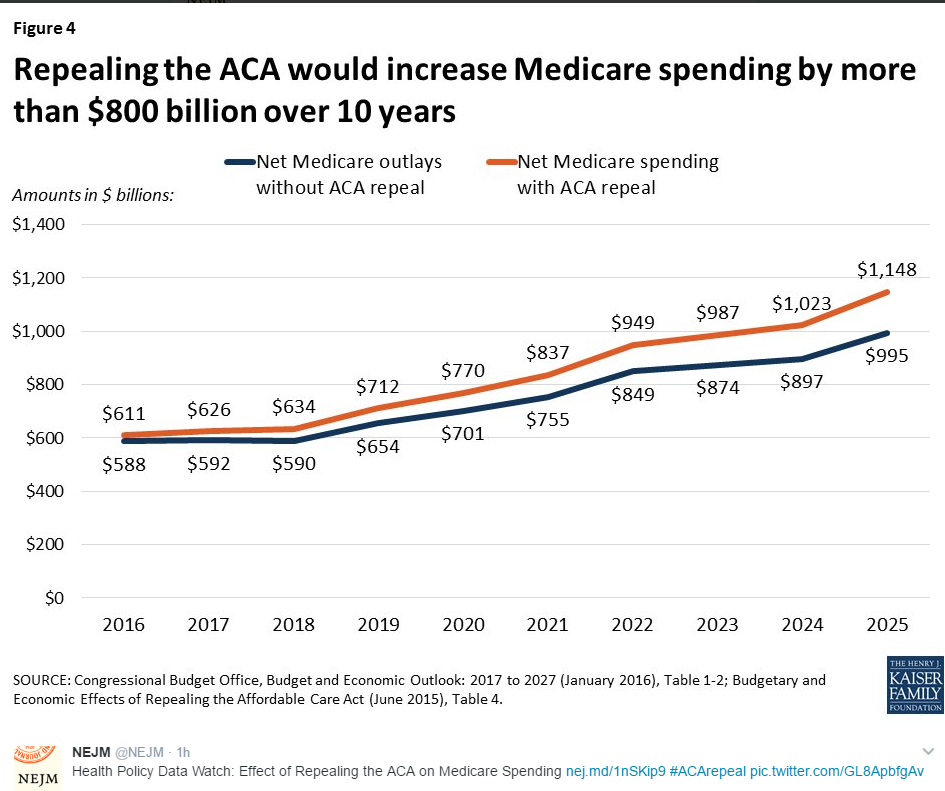
Repealing the Affordable Care Act Without a Replacement

Barack Obama, in a perspective article (BH Obama. NEJM January 6, 2017; DOI: 10.1056/NEJMp1616577), explains the hazards of “repeal and delay.”

Here’s a link to the full text: Repealing the ACA without a Replacement — The Risks to American Health Care

Here’s an excerpt:

Put simply, all our gains are at stake if Congress takes up repealing the health law without an alternative that covers more Americans, improves quality, and makes health care more affordable. That move takes away the opportunity to build on what works and fix what does not. It adds uncertainty to lives of patients, the work of their doctors, and the hospitals and health systems that care for them. And it jeopardizes the improvements in health care that millions of Americans now enjoy.

Congress can take a responsible, bipartisan approach to improving the health care system. This was how we overhauled Medicare’s flawed physician payment system less than 2 years ago. I will applaud legislation that improves Americans’ care, but Republicans should identify improvements and explain their plan from the start — they owe the American people nothing less.

Health care reform isn’t about a nameless, faceless “system.” It’s about the millions of lives at stake — from the cancer survivor who can now take a new job without fear of losing his insurance, to the young person who can stay on her parents’ insurance after college, to the countless Americans who now live healthier lives thanks to the law’s protections. Policymakers should therefore abide by the physician’s oath: “first, do no harm.”

A related article from the LA Times indicates that Aetna misled the public with regard to its reasons for pulling out of several exchanges: Link:U.S. judge finds that Aetna misled the public about its reasons for quitting Obamacare

An excerpt:

The judge’s conclusions about Aetna’s real reasons for pulling out of Obamacare — as opposed to the rationalization the company made in public — are crucial for the debate over the fate of the Affordable Care Act. That’s because the company’s withdrawal has been exploited by Republicans to justify repealing the act. Just last week, House Speaker Paul Ryan (R-Wisc.) cited Aetna’s action on the “Charlie Rose” show, saying that it proved how shaky the exchanges were. ..

Bates found that this rationalization was largely untrue. In fact, he noted, Aetna pulled out of some states and counties that were actually profitable to make a point in its lawsuit defense — and then misled the public about its motivations.

Related blog posts:

screenshot-77

How Rudeness Affects Performance in Medicine (and probably elsewhere)

From A Riskin et al. Pediatrics Jan 2017 (Thanks to Seth Marcus for pointing out this study), Link: Rudeness and Medical Team Performance

Abstract

OBJECTIVES: Rudeness is routinely experienced by medical teams. We sought to explore the impact of rudeness on medical teams’ performance and test interventions that might mitigate its negative consequences.

METHODS: Thirty-nine NICU teams participated in a training workshop including simulations of acute care of term and preterm newborns. In each workshop, 2 teams were randomly assigned to either an exposure to rudeness (in which the comments of the patient’s mother included rude statements completely unrelated to the teams’ performance) or control (neutral comments) condition, and 2 additional teams were assigned to rudeness with either a preventative (cognitive bias modification [CBM]) or therapeutic (narrative) intervention. Simulation sessions were evaluated by 2 independent judges, blind to team exposure, who used structured questionnaires to assess team performance.

RESULTS: Rudeness had adverse consequences not only on diagnostic and intervention parameters (mean therapeutic score 3.81 ± 0.36 vs 4.31 ± 0.35 in controls, P < .01), but also on team processes (such as information and workload sharing, helping and communication) central to patient care (mean teamwork score 4.04 ± 0.34 vs 4.43 ± 0.37, P < .05). CBM mitigated most of these adverse effects of rudeness, but the postexposure narrative intervention had no significant effect.

CONCLUSIONS: Rudeness has robust, deleterious effects on the performance of medical teams. Moreover, exposure to rudeness debilitated the very collaborative mechanisms recognized as essential for patient care and safety. Interventions focusing on teaching medical professionals to implicitly avoid cognitive distraction such as CBM may offer a means to mitigate the adverse consequences of behaviors that, unfortunately, cannot be prevented.

This same group had a related study in 2015:The Impact of Rudeness on Medical Team Performance: A Randomized Trial

My take:The saying “you catch more flies with honey than you do with vinegar” is probably accurate.

Costa Maya, Mexico

Costa Maya, Mexico


Is It OK for Pediatricians to try to Prevent Firearm Injuries? Focus on Child Safety –Not on Gun Safety

A recent study (JM Garbutt et al. J Pediatr 2016; 179: 166-71 and related editorial by MD Dowd, pg 15-17) provide relevant information on the issue of firearm injury prevention.

The study describes the results of a survey provided to 1246 parents at a diverse group of practices around St Louis.

Key findings:

  • 36% reported being owners of firearms
  • Of the owners, 25% reported ≥1 firearm was stored loaded and 17.9% carried a firearm when leaving the house.
  • 75% of all parents thought pediatricians should provide advise on safe storage of firearms (71% of owners); however, only 12.8% of all parents reported a discussion about firearms with the pediatrician

The discussion and commentary on this study are more interesting than the actual results. Key points:

  • The AAP has recommended that pediatricians screen for the presence of household firearms and has stated that a “home without guns is the safest option…Advising safe storage is also encouraged.”  Prior surveys have echoed this study that few pediatricians counsel families about firearm safety.
  • Despite AAP recommendations, over “60% of Americans believe that a ‘gun in the house makes it safer’ which is a more common attitude than in 2004 when 42% of Americans held that view.
  • Providing a child with firearm avoidance educational programs (eg. NRA’s “Eddie Eagle”) “is unlikely to lead to safe behaviors…[and] may give parents a false sense of security.”
  • “Children cannot distinguish real guns from toy guns and are strong enough to pull a trigger as early as 3 years of age.”
  • Approaching the topic of safe storage “as an expert in child development” and children’s unpredictable behavior rather than in firearm safety “may be acceptable to both pediatricians and parents.”
  • The authors advocate keeping firearm storage on a checklist of hazards (eg. medication storage, avoiding household poisons) –though this has not been well-studied.
  • From editorial: “When compared with other developed nations, US children under 15 years of age are 12 times more likely to be killed by a gun…We know that nearly 1 in 10 families with guns admit to keeping at least 1 gun loaded and unlocked, and nearly one-half keep at least 1 gun unlocked.”

So, in fact, having a gun in the home does not make a home safer, just the opposite.  But delving into this topic is probably not productive due to strong feelings tangential to gun ownership.  There have been unsuccessful legislative efforts in over 10 states to prevent physicians from discussing the topic as well as a protracted legal battle in Florida.

My take (borrowed from editorial): “Although the difference between “gun safety” and “child safety” may seem subtle, such a shift allows a consistent approach to home injury prevention across mechanisms of injury with the focus on the child, not the gun.” “Little children are curious and big children (teens) are impulsive, so exposure to unsecured guns can lead to tragic outcomes that cannot be prevented by child education.  Who better to deliver this message than pediatricians?”

Related blog posts:

screenshot-7


Understanding the “Rashomon Effect”

An interesting commentary (GM Ronen, DL Streiner. J Pediatr 2016; 179: 17-18) discusses the “Rashomon” effect and how this can relate to studies which show differences between children with health problems and their parents’ perception of how they are doing.

“In this famous Japanese tale, set in the 12th century, a notorious bandit attacked a samurai and his wife in the woods.”  Afterwards, all of the accounts of the incident by the participants were widely discrepant. “When the tale is over, the reader realizes that even though none of the version is a truthful objective account, all must be true at least from the character’s own unique perspective.”

In medical studies with children and their parents, different versions of the truth can be due to many factors:

  • Depression distortion hypothesis –raters with depression tend to score poorer on numerous health variables
  • Disability paradox –“some persons with impairments, against all odds, are satisfied with their life and rate their health similar to typical children”
  • Parents may also be affected by the emotional impact of their child’s health problem even when the problem is well-controlled

My take: This short commentary has a lot to say about understanding why a person with a medical problem may rate their health much better or much worse than an outside observer would expect.

Penobscot Narrows Bridge, Maine

Penobscot Narrows Bridge, Maine


Does a Healthy Lifestyle Result in Better Outcomes?

It’s easy to become discouraged that sensible actions may not be effective due to general pessimism and sometimes conflicting medical reports.  On the positive side of the ledger, a recent study (AV Khera et al. NEJM 2016; 375: 2349-58) provides compelling data that a combination of healthy lifestyle changes make a BIG difference.

The study focused on 4 healthy lifestyle factors: no smoking, no obesity, regular physical activity, and a healthy diet.  The study examined three large prospective cohorts with a total of more than 55,000 patients.

Key finding:

  • Among participants with high genetic risk, a favorable lifestyle was associated with a 46% lower relative risk of coronary events compared to those with an unfavorable lifestyle over the 10-year study period.

In the same issue, a review of the human intestinal microbiome (pages 2369-79) notes that “dietary intake appears to be a major short-term and long-term regulator of the structure and function of gut microbiota.  Still, only a relatively small number of randomized, clinically controlled dietary interventions targeting the gut microbiota have been reported in humans and these show that energy restriction and diets rich in fiber and vegetables are associated with gut microbial changes that, in turn, are associated with a health benefit.”

My take: To enhance your odds of good health, avoid smoking, stay fit, and eat your fruits/veggies.

coldcomment


Care Coordination and Magical Thinking

One myth that has been promulgated has been that care coordination will lead to cost containment. A commentary on this topic (JM McWilliams. NEJM 2016; 375: 2218-20) explains the fallacy of this thinking.  While care coordination can improve medical care, “conflating cost containment and care coordination poses many potential dangers.”  Good care is worthy goal even in the absence of saving money.

Key points:

  • Care coordination often improves outcomes but typically involve interventions to correct underuse of care
  • For every costly complicated prevent, “a care coordination program must manage care for multiple patients…[which] is costly.”
  • Early evaluation of care coordination in accountable care organizations (ACOs) have shown the efforts “have meaningfully improved patient experiences but not rates of hospitalizations for ambulatory care-sensitive conditions.” There has not been evidence of fewer readmissions or fewer preventable hospitalizations with care coordination.
  • Other strategies to reduce cost are now being targeted, like steering patients to lower-priced providers

My take (from author): “We should coordinate care not to save money but because coordinated care is better care.”

Yosemite

Yellowstone (I took this picture!)

Can the FDA stop snake oil salesmen?

A recent commentary (C Robertson, AS Kesselheim. NEJM 2016; 375: 2313-5) examines how the issue of “free speech” may undermine the FDA’s ability to regulate ineffective or dangerous medications. This has been discussed in a previous blog:

Can the FDA prohibit free speech?

In a previous case, Caronia had promoted sodium oxybate for a wide range of nonapproved uses; some of these uses “were likely to cause patients substantial harm.”

Yet, the 2nd Circuit court reversed a lower court in ruling that Caronia’s sale pitches were protected free speech.  This decision “subverted decades of presumptions about how the government could oversee the behavior of the pharmaceutical and medical device industries.”

The authors hope that an upcoming case to the 1st circuit will uphold the FDAs ability to assure that patients are protected and that the use of drugs is driven by science and not marketing.  If manufacturers are allowed to promote a wide range of uses for drugs with narrow indications, there will not be an incentive to determine if these medications are safe and effective.

My take: If the principles of free speech are extended to promoting bogus claims about pharmaceuticals and medical devices, this would be a huge blow to medical science.

Acadia Natl Park

Acadia Natl Park

Gut Makeover -A New Years’ Resolution?

A recent NY Times article reviews a recent study which shows that changes in diet that incorporate more fruits and vegetables appears to create a ‘healthier’ microbiome.

Link: A Gut Makeover for the New Year?

screenshot-8

An excerpt:

screenshot-9

Related article: VJ Martin, MM Leonare, L Fiecntner, A Fasano. J Pediatr 2016; 179: 240-48.This review provides more specific information regarding the microbiome in health and disease.  Specifically, the authors provide data on the relationship of the microbiome to five common pediatric chronic inflammatory conditions: allergic diseases, celiac disease, inflammatory bowel disease, necrotizing enterocolitis, and obesity.

Related blog posts:


NEJM Critique of the HHS Pick: Forsakes Tradition of Looking Out for Vulnerable

A recent NEJM commentary reviews Dr. Tom Price’s congressional record and the implications for his impending appointment to head HHS.

Full Text: Care for the Vulnerable vs Cash for the Powerful –Trump’s Pick for HHS

Here’s an excerpt:

Ostensibly, he emphasizes the importance of making our health care system “more responsive and affordable to meet the needs of America’s patients and those who care for them.”4 But as compared with his predecessors’ actions, Price’s record demonstrates less concern for the sick, the poor, and the health of the public and much greater concern for the economic well-being of their physician caregivers…

Price has sponsored legislation that supports making armor-piercing bullets more accessible and opposing regulations on cigars, and he has voted against regulating tobacco as a drug. His voting record shows long-standing opposition to policies aimed at improving access to care for the most vulnerable Americans. In 2007–2008, during the presidency of George W. Bush, he was one of only 47 representatives to vote against the Domenici–Wellstone Mental Health Parity and Addiction Equity Act, which improved coverage for mental health care in private insurance plans. He also voted against funding for combating AIDS, malaria, and tuberculosis; against expansion of the State Children’s Health Insurance Program; and in favor of allowing hospitals to turn away Medicaid and Medicare patients seeking nonemergency care if they could not afford copayments.

Price favors converting Medicare to a premium-support system and changing the structure of Medicaid to a block grant — policy options that shift financial risk from the federal government to vulnerable populations.

My take: I’m worried that patients who need even basic care may not receive it if the affordable care act is repealed without a backup plan in place.

Related NY Times article discusses Dr. Price: Trump’s Health Secretary Pick Leaves Nation’s Doctors Divided The article discusses the AMA’s endorsement of Dr. Price and how many physicians have countered that the AMA does not speak for them.

screenshot-5