Web is Better: Liver Toxicity from Herbs

A recent review article (Clin Gastroenterol Hepatol 2014; 1069-76) provides a good overview of herbs and liver injury; however, the NIH website http://livertox.nih.gov/ is more comprehensive.

The article notes the difficulty in assessing liver injury from herbs and dietary supplements due to the permissive regulatory environment and underreporting.

Specific products reviewed include the following:

  • Weight loss supplements: hydroxycut, herbalife, green tea, usnic acid
  • “Health-promoting” herbs: black cohosh, comfrey, kava
  • Joint health supplements: flavocoxid, glucosamine
  • Bodybuilding supplements: anabolic steroids

The article explains issues with regard to causality and the regulatory issues. However, for each of these products, I found them on the livertox website. So, that is where I would start if I needed to look up herb-induced liver injury.  Reporting of adverse events can occur through FDA website: http://www.fda.gov/safety/medwatch/default.htm or through hotline: 800-FDS-1088.

A related reference –Bad Way to Lose Weight: “SlimQuickTM-Associated Hepatotoxicity Resulting in Fulminant Liver Failure and Orthotopic Liver Transplantation” ACG Case Rep J 2014;1(4):220–222. http://dx.doi.org/10.14309/crj.2014.59. Published: July 8, 2014

Related posts:

A New Villain for Hepatitis C

A recent article (Hepatology 2014; 59: 2403-12) notes a changing perception for Hepatitis C (HCV) genotype 3.  Previously, HCV genotype 3 was considered easy-to-treat with pegylated interferon and ribavirin.  Along with genotype 2, treatment for genotype 3 was given for half the duration as treatment for genotype 1; in addition, the response was much better than genotype 1 (~70-80% compared with ~50%).

With new treatments, the situation has changed.  In the U.S., genotype 1 accounts for about 70% of all infections and worldwide about 60% of all HCV infections.  In contrast, genotype 3 accounts for 10-15% of the world HCV reservoir.

Specific problems (alluded to by the authors) with genotype 3:

  • Increased steatosis
  • Increased liver fibrosis progression
  • Increased risk of hepatocellular carcinoma (HCC)
  • Increased risk of end-stage liver disease
  • Reduced sustained virological response (SVR) after direct-acting antiviral therapies

While the newest therapies have dramatically increased SVR rates for genotype 1 and improved treatment for genotype 2, this is not the case with genotype 3 thus far.  Instead of being a good genotype, genotype 3 is now a villain.

Another article provides additional data on HCV genotype 3 (Hepatology 2014; 60: 98-105).  In this study of U.S. Veterans with HCV (n=110,484), there were 8,337 with genotype 3.  In this group, despite being younger, they had a higher risk of cirrhosis (HR 1.40) and hepatocellular carcinoma (HCC) (HR 1.66) in comparison to HCV genotype 1.

Related blog posts:


AASLD/NASPGHAN 2014 Guidelines for Evaluation of Pediatric Liver Transplantation

I want to congratulate the authors of a recent AASLD/NASPGHAN report (Hepatology 2014; 60: 362-98 & JPGN 2014; 59: 112-31) and in particular Rene Romero who has been a terrific colleague in Atlanta.  I’m grateful for his timely advice to me and my colleagues along with the excellent care that he has provided to children referred for liver transplantation (LT).

The link to full article, Evaluation of Pediatric Liver Transplantation, and other AASLD practice guidelines can be accessed from this website: AASLD guidelines.

Some of the useful recommendations include the following:

  • For biliary atresia, “patients who are post hepatoportoenterostomy (HPE) should be promptly referred for LT evaluation if the total bilirubin is greater than 6 mg/dL beyond 3 months from HPE” and should be considered if total bilirubin is ≥2 mg/dL.  According to the authors in the Hepatology article, ‘84% of those with a total bilirubin <2 mg/dL will survive with native liver beyond 2 years of age whereas only 16% will if total bilirubin is >6 mg/dL.’ [Interestingly, this information is stated differently in the JPGN article where the authors state  “up to 70% of patients with BA may have prolonged transplant-free survival if the total serum bilirubin falls below 2 mg/dL” w/in 3 months following HPE.]
  • For biliary atresia: HPE is recommended as 1st line treatment except in infants with “evidence of decompensated liver disease.”
  • Ascites management: can be managed with an aldosterone antagonist.  Reserve more aggressive measures (paracentesis, TIPS, surgical shunt) for those with compromised respiratory effort or severely impaired quality of life.
  • Recurrent disease: families should be informed that autoimmune hepatitis, PSC, and bile salt excretory pump disease can recur post-LT.
  • Recommends screening with use of pulse oxygen with the patient in upright position in all patients with possible portosystemic shunting.
  • Discusses immunizations for child and for family members (all family members need to fully immunized).
  • The review provides recommendations specific for virtually each liver condition, including Alagille, Wilson’s, Tyrosinemia, PFIC, hemangioendothelioma, Cystic fibrosis, urea cycle defects, autoimmune hepatitis, PSC, Hepatoblastoma, Alpha-1 Antitrypsin deficiency, Bile Acid Synthesis Disorders, Glycogen Storage Disease, Fatty Acid Oxidation defects, Parenteral Nutrition-Associated Liver Disease (PNALD), and many others.
  • Contraindicated for LT:  Alper’s syndrome/valproate-associated liver failure, mitochondrial disease with severe extrahepatic disease, Hepatocellular carcinoma with extrahepatic disease and rapid progression, uncontrolled systemic infection, Niemann-Pick Disease Type C, and severe medically-refractory portopulmonary hypertension

Take-home message: This practice guideline is an excellent resource in the evaluation of pediatric liver transplantation and pre-transplant management.  The ease of accessing the entire report online is a big plus too.

Related posts:

Emerging Treatment for PFIC-2

A great example of “bench to bedside” research was recently published (J Pediatr 2014; 164: 1219-27). While this research involved treatment of a rare condition, progressive familial intrahepatic cholestasis type 2 (PFIC2), the way the authors used a series of convincing experiments to determine the effect of a new medication shows how important a single patient can be in advancing medical treatment.  For PFIC2, the implications of this study are more direct since there are no established medications.

Previous experimental evidence has indicated that 4-phenylbutyrate (4PB), a drug used to treat ornithine transcarbamylase deficiency (OTCD), can increase the expression of the bile salt export pump (BSEP). Since BSEP, encoded by ABCB11 gene, is defective in PFIC2, the authors sought to determine whether 4PB would be effective for patients with PFIC2 who showed a reduced (but not absent) BSEP expression.

They identified a jaundiced infant female at 2 months of age with normal GGT who was diagnosed with PFIC2 due to the presence of the c.3692G>A (p.R1231Q) mutation in both alleles of ABCB11.

The authors then treated this infant with 200 mg/kg/day (into 4 doses a day) with 4PB; gradually the dosage was increased to 500 mg/kg/day.  The authors performed elegant in vitro studies from genomic DNA from peripheral leukocytes along with histologic studies from liver biopsy specimens.

Key Findings:

At the 500 mg/kg/day dosage, BSEP expression at the canalicular membrane was partially restored and this coincided with improved liver tests, improved liver histology, and relief of pruritus.

Conclusion: 4PB retards degradation of the canalicular BSEP which resulted in biochemical and histologic improvement.  This study involved only one patient; thus, further studies will be needed.

Related blog post:

BRIC, PFIC, and nasobiliary drainage | gutsandgrowth

Imaging in NAFLD -Don’t Rely on Ultrasound

A recent article (Clin Gastroenterol Hepatol 2014; 12: 765-73) notes that ultrasound is not accurate for diagnosing NAFLD:

The link to the article: http://goo.gl/R1GdAG, video abstract: http://youtu.be/spnlSPTS-SE (from Jeff Schwimmer’s twitter feed) ,and an excerpt from the article’s abstract:

Results

We analyzed 9 studies comprising 610 children; 4 studies assessed ultrasonography and 5 studies assessed magnetic resonance imaging (MRI). Ultrasonography was used in the diagnosis of fatty liver with positive predictive values of 47% to 62%. There was not a consistent relationship between ultrasound steatosis score and the reference measurement of hepatic steatosis. Liver fat as measurements by MRI or by spectroscopy varied with the methodologies used. Liver fat measurements by MRI correlated with results from histologic analyses, but sample size did not allow for an assessment of diagnostic accuracy.

Conclusions

Available evidence does not support the use of ultrasonography for the diagnosis or grading of fatty liver in children. Although MRI is a promising approach, the data are insufficient to make evidence-based recommendations regarding its use in children for the assessment of hepatic steatosis.

Related blog posts:

START Study: Steroids Not Effective For Biliary Atresia (After Kasai)

A recent multicenter study has shown that steroids are not helpful after hepatoportoenterostomy for Bilairy Atresia (BA) (Bezerra JA et al. Hepatoportoenterostomy for Bile Drainage in Infants With Biliary Atresia. JAMA. 2014 May 7;311(17):1750).  Thanks to Saul Karpen for the reference.  I want to congratulate all of the authors, but particularly Jorge Bezerra, Saul Karpen, and Rene Romero for collaborating on this important study.

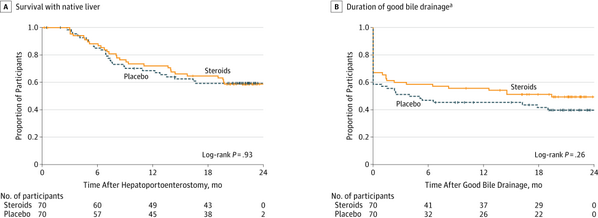
The randomized, double-blind, placebo-controlled START trial from the NIH-supported ChiLDren study enrolled 140 patients (257 were screened) from 2005-2011.  High-dose steroids, starting with methylprednisolone 4 mg/kg/day for 2 weeks and then tapered was compared with placebo.  No statistically significant improvement was noted.  Ultimately, the steroid intervention did not affect transplant-free survival which was 58.7% in the steroid group and 59.4% in the placebo group at 24 months of age.  Figure 2 (see below -from @JAMA twitter feed) shows Kaplan-Meier analysis plots with regard to transplant-free survival and bile drainage; the latter was slightly better in steroid group, but not statistically significant. In addition, steroids were associated with an earlier onset of first serious adverse events, 37% in steroid group compared with 19% in the placebo group within 30 days of Kasai.

Embedded image permalink

With regard to safety, the authors note that both groups were “found to have a high incidence of adverse events, indicating that they were most likely the direct consequences of the severe liver disease typical of biliary atresia. However, steroid therapy was associated with…complications at the sites of surgical anastomoses and intestinal perforation.”

Take-home message: Avoid steroids after Kasai procedure.

Related blog posts:

Taking a Quick Peek

A brief case presentation makes the point that completing the physical exam can help establish the reason for neonatal cholestasis (J Pediatr 2014; 164: 939).

The authors present a 2-month old with cholestasis who had a micropenis with a length of 1 cm (a stretched length of <2 cm [mean -2.5 SD]) and ultimately was diagnosed with hypopituitarism which has been associated with neonatal hepatitis.  “Low thyroid and cortisol levels may impair bile acid synthesis, bile acid secretion and/or bile flow.”  Hormone replacement is associated with improvement in 10 weeks and complete resolution in 3-9 months.

It is worth noting that the authors decided, despite the physical exam findings that  a liver biopsy wa indicated.  Given the likelihood of hypopituitarism, many practitioners may have opted for a HIDA scan to exclude biliary atresia.

Take-home message:  Don’t forget to check the genital exam in jaundice newborns.

OTCD –Another Reason for Acute Liver Failure

A recent study shows that a significant number of patients with Ornithine Transcarbamylase Deficiency (OTCD), which is the most common urea cycle defect (UCD), can present with significant hepatic involvement and even acute liver failure (ALF) (J Pediatr 2014; 164: 720-25).

This retrospective study reviewed 71 patients with OTCD at 2 centers.  Longitudinal data collected over 10 years was analyzed.

Key result:

  • 57% of the 49 patients with symptomatic OTCD had liver involvement and 29% of these patients met criteria for ALF

“Although the urea cycle enzymes are active in the liver, standard liver function generally has been considered to be largely unaffected in UCD.”   This study shows that this concept is mistaken.OTCD has been viewed mainly as a disorder that presents with marked hyperammonemia in the newborn period.  However, there is variable clinical expression and some may remain asymptomatic throughout their lifetime.

Take-home message: Check plasma amino acids, urine organic acids and urine orotic acids when patients do not have an established etiology for hepatic dysfunction, including ALF.


Related blog posts:

NAFLD –Analogous to a Dog Chasing A Bus?

I am not sure of the origin of the expression “what is a dog going to do if it catches a bus?”  However, I am reminded of this expression after reading a recent article about nonalcoholic fatty liver disease (J Pediatr 2014; 164: 707-13).

This retrospective study, “Histologic Abnormalities in Children with Nonalcoholic Fatty Liver Disease with Normal or Mildly Elevated Alanine Aminotransferase Levels,” analyzed 91 children (5-18 years) with suspected NAFLD who had normal or mildly elevated ALT values from 12 U.S. medical centers.  They obtained liver biopsy specimens within 180 days of the ALT measurement and compared them from 392 children with elevated ALT.

When reading this title, one has to wonder, how did they select these children for this study?  First of all the authors used two NASH CRN databases with 483 children.  The reasons for NAFLD evaluation at entry in the current study included symptoms of liver disease in 22%, identification during evaluation of another illness in 38%, routine physical exam (41%), and other causes in 6%. At one point, elevated ALT was evident in 74% and radiographic evidence of steatosis in 55%.

The authors conclude that “liver biopsy specimens from children with NAFLD with normal or mildly elevated ALT levels show significant histological abnormalities, including advanced fibrosis…measurement of ALT may underestimate liver injury in NAFLD.” Yet, while it is true that ALT values may not have adequate sensitivity for liver injury, the authors deploy some circular logic; when one understands the selection of these patients, it comes as no surprise that some had advanced liver findings on biopsy.  If one identifies an abnormal liver on ultrasound and confirms this on liver biopsy, this is targeting a population whose findings are not generalizable.

Outside of a research study, how does one decide which patients will benefit from a liver biopsy? This study does not offer any clarity.

And, if one identifies more cases of NAFLD, what is one to do?  Besides weight loss (which should be recommended already in the majority), there are no other proven treatments.  The associated editorial (pgs 684-86) reminds the reader to use appropriate normative values for ALT (<25.8 U/L for boys and <22.1 U/L for girls).  In the study’s discussion, the lack of consensus among expert recommendations is acknowledged.  Furthermore, in those who have recommended frequent screening with ALT values in obese children, the authors note that “evidence of the utility and cost-effectiveness of this approach is still lacking.”

Another study in the same issue (J Pediatr 2014; 164: 699-706) suggests a possible link between obstructive sleep apnea (OSA) and more advanced liver histology in NAFLD.  This was a cross-sectional study with only 25 patients (88% Hispanic, mean age 12.8 years).  The authors speculate that nighttime hypoxemia triggers oxidative stress and may induce further liver injury.  53% of those with OSA had stage 2 or higher fibrosis compared with only 10% of those without OSA.

Bottomline: NAFLD occurs in a lot of children and a normal or mildly elevated ALT does not exclude more severe disease.  OSA may be either an epiphenomenon or a causative factor for more severe NAFLD findings.

Related blog posts:

Withdrawing Immunosuppression with Autoimmune Hepatitis

A recent retrospective study indicates that withdrawal of immunosuppression in autoimmune hepatitis (AIH) can be successful in carefully selected children (J Pediatr 2014; 164: 714-19).

A cohort of 56 children with AIH were followed for a median of 5.6 years and with a median age of 11 years (62% female).  Demographics noted that cirrhosis was present in 14%, primary sclerosing cholangitis 21%, and AIH type II in 9%.

Key findings:

  • Biochemical remission with immunosuppression was achieved in 76% of all patients at a median of 1.2 years; 23% of these patients experienced a subsequent relapse.
  • Withdrawal of immunosuppression was successful in 14 of 16 of patients with type 1 AIH who had been treated for a median of 2.0 years after diagnosis.
  • When the authors excluded patients with inflammatory bowel disease, they noted that the probability of achieving a sustained immunosuppression-free remission was 42% at 5 years.  Sustained remission was defined as biochemical remission for >1 year, liver biopsy without inflammation, and no relapses.
  • Patients less likely to reach a biochemical remission with immunosuppression included patients with cirrhosis, elevated INR, positive ANCA titer, and patients with coexisting autoimmune disorder.

In their discussion, the authors note that treatment withdrawal is “generally considered more successful after at least 3 years of therapy,” though only 50% of their patients who had therapy withdrawn had been treated that long.  In addition, they state that while coexisting immune disorders often result in more frequent relapses, the one exception in the literature is celiac disease when patients adhere to a strict gluten-free diet.  They also urge all patients diagnosed with AIH to undergo testing for celiac disease and thyroid disease.

Limitations of the study include the following: small numbers of patients, single center (Utah), retrospective design, and cholangiography was not performed uniformly.

Take-home message: In patients doing well with AIH for 2-3 years & with normalized liver histology, it may be possible to withdraw immunosuppression.

Related blog posts:

Disclaimer: These blog posts are for educational purposes only. Specific dosing of medications (along with potential adverse effects) and specific medical management interventions should be confirmed by prescribing physician.  Application of the information in a particular situation remains the professional responsibility of the practitioner.