Pediatric Intestinal Pseudo-obstruction: Consensus Recommendations

A new report from an ESPGHAN-Led Expert Group (N Thapar et al. JPGN 2018; 66: 9991-1019) provides detailed recommendations for pediatric intestinal pseudo-obstruction (PIPO).  In addition, this report serves as an excellent self-assessment of your vision.  If you can read figure 1, which has some incredibly tiny font size, then your vision is fantastic.

Full Link“Paediatric Intestinal Pseudo-obstruction: Evidence and Consensus-based Recommendations From an ESPGHAN -Led Expert Group”

Aside from that snarky comment, the report offers a great deal of useful advice.

  • After obstruction has been excluded, the authors recommend that patients should undergo a basic laboratory evaluation (including CBC, CMP, ESR/CRP, Celiac serology, Cortisol, Thyroid testing, Metabolic tests [urine organic acids, ammonia, lactate]) and to consider more extensive evaluation.
  • If primary, rather than secondary, PIPO is suspected, the authors recommend neurogastroenterology evaluation.

Subsequently, the authors review management: potential medications (Table 6), enteral feeds, gastrostomy and ileostomy, and in more than 80% then need for parenteral nutrition. At the time of therapeutic procedures, it is recommended to obtain full-thickness biopsies to further characterize the PIPO.

Clinical features which distinguish pediatric chronic intestinal pseudo-obstruction (CIPO) from adult CIPO are listed in Table 2. These include the following:

  • Frequent urologic involvement in pediatric CIPO which is rare in adults with CIPO.
  • Dilated bowel loops are commonly absent (~40%) in pediatric CIPO in the neonatal period and universal in adult cases.
  • Unlike in adults, there is a high risk of colonic and small bowel volvulus in pediatric CIPO and malrotation is evident in ~30% of pediatric CIPO (rarely seen in adults).
  • Also, in pediatrics, fabricated cases are more commonly encountered.

Intestinal transplantation should be considered in patients with PIPO who develop life-threatening complications associated with TPN or poor quality of life/high morbidity.

Pictures below from yesterday’s Peachtree Road Race and previous T-shirts from previous years.

 

Disclaimer: These blog posts are for educational purposes only. Specific dosing of medications/diets (along with potential adverse effects) should be confirmed by prescribing physician/nutritionist.  This content is not a substitute for medical advice, diagnosis or treatment provided by a qualified healthcare provider. Always seek the advice of your physician or other qualified health provider with any questions you may have regarding a condition.

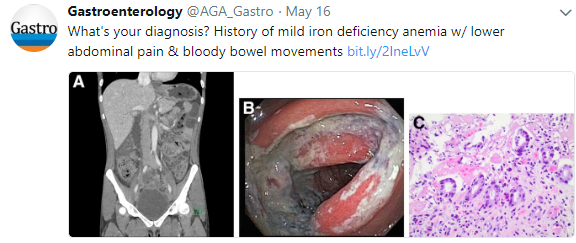
Why Does this Patient Have Colitis?

Just in time for this year’s Peachtree Road Race…

A brief report (RS Robinson et al. Gastroenterol 2018; 154: 1582-83) presents a case of a 28 year old, who had been in training for a marathon, with mild iron deficiency anemia, lower abdominal pain, and bloody bowel movements. The CT scan and colonoscopy showed diffuse colonic/ileal inflammation; the histology showed mucosal necrosis, crypt atrophy and acute inflammation (see below).

Answer to title question: Runner’s Colitis.  The authors note that in some long-distance runners an ischemic colitis can develop in part due to rerouting of blood with prolonged exercise.  Dehydration may exacerbate poor perfusion.  The splenic flexure and the rectosigmoid junction are particularly susceptible due to the ‘watershed’ nature of their blood supply.

The majority of individuals recover fully from this insult, though the literature describes one individual who required a subtotal colectomy after perforation.

HCV Treatment and “MELD Purgatory”

A recent study (A Kwong et al. Liver Transplantation 2018; 24: 735-43) and associated editorial (P Martin, pg 727-8) highlight an unintended consequence of HCV therapeutic success –“MELD purgatory.”

The study notes that with the availability of more effective direct-acting antivirals for HCV, there has been a decrease in wait-list mortality and a decrease in disease severity.  This was determined by reviewing 3 timed cohorts (2004 n=2408, 2009 n=2402, and 2014 n=2817) from the Organ Procurement and Transplantation database.

  • For example, the 2014 had a 21% lower risk of wait-list death (HR 0.79) than the 2009 cohort.  This is in contrast to other (non-HCV) disease in which there was no change in mortality.
  • Also, the MELD rate of change was 2.35 per year for the 2009 cohort compared to 1.90 for the 2014 group.
  • In their discussion, the authors note that while patients with HCV can achieve a sustained virologic response, those with advanced liver disease still need liver transplantation.  In these patient, there is a much lower prospect of attaining a high enough MELD score to receive organ offers –“leaving them with persistent complications and a decreased quality of life.”  This situation has been termed “MELD purgatory.”

The editorial notes that in the five years since the introduction of sofosbuvir, HCV has been displaced as the single commonest indication for liver transplantation by nonalcoholic fatty liver disease.  These agents have led to a decrease in advance HCV-related liver disease.  In addition, in the past, HCV infection had near universal recurrence after transplantation and this is no longer the situation.

My take: Undeniably, the advent of DAA have made a huge dent in progressive HCV liver disease. However, those with advanced liver disease may be stuck in a purgatory between good health and poor quality of life even after clearance of HCV infection.

Related blog posts:

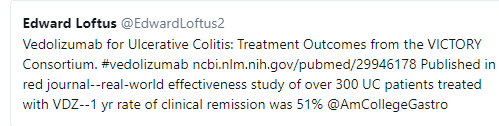
VICTORY Consortium Showing Good Results for Vedolizumab

A presentation at the 13th Congress of the European Crohn’s and Colitis Organization (ECCO, Feb 2018) indicated that Vedolizumab had similar effectiveness as anti-TNF agents for both ulcerative colitis and Crohn’s disease. This data has been presented at a recent meeting in our office, some of the GI news magazines, and also ImproveCareNow listserv.

From Takeda website: Entyvio® (vedolizumab) Shows Higher Rates of Mucosal Healing Versus TNFα-Antagonist Therapy in Ulcerative Colitis and Crohn’s Disease Patients in Comparative Effectiveness Real-World Data Analysis

These analyses observed that patients with UC treated with Entyvio compared to TNFα-antagonist therapy had statistically significant higher 12-month cumulative rates of mucosal healing (50% vs 42%, hazard ratio [HR] 1.73, 95% confidence interval [CI] 1.10‑2.73) and clinical remission (54% vs 37%; HR 1.54, 95% CI 1.08‑2.18), and numerically higher steroid-free clinical remission rates (49% vs 38%; HR 1.43, 95% CI 0.79‑2.60). In CD, results reported statistically significant higher 12-month cumulative rates of mucosal healing (50% vs 41%; HR 1.67, 95% CI 1.13‑2.47), and numerically higher rates of clinical remission (38% vs 34%; HR 1.27, 95% CI 0.91‑1.78) and steroid-free clinical remission (26% vs 18%; HR 1.75, 95% CI 0.90‑3.43) compared to TNFα-antagonist therapy. These analyses were conducted by the VICTORY (Vedolizumab Health OuTComes in InflammatORY Bowel Diseases) Consortium.

My take: While the data compare anti-TNFs to vedolizumab in a “real-world setting,” the reported outcomes for anti-TNFs are lower than in other studies.  Vedolizumab had the best results in those with colonic disease.  Patients with Crohn’s disease with isolated small bowel disease had lower response rates.

Related study: AK Waljee et al Inflamm Bowel Dis 2018; 24: 1185-95. Using phase 3 clinical trial data with 594 subjects, the authors note that the majority of patients who will respond to vedolizumab can be identified by week 6 using a laboratory algorithm based on hemoglobin, albumin, vedolizumab level and CRP. Fformula: Hgb*Albumin*VDZ level/CRP*Weight. A cutoff of 185.96 predicted success with an AuROC of 0.75.   Higher hemoglobin, higher albumin, and higher vedolizumab level, and lower CRP are associate with higher response rates.

Related blog posts:

Red Top Mountain, Homestead Trail


What to Make of Median Arcuate Ligament Syndrome

A recent study (C Stiles-Shields et al. JPGN 2018; 66: 71) reports on 32 cases of median arcuate ligament syndrome (MALS) from a single center, 2011-17.  To me, this is an astounding number of individuals who were operated on for this disorder.  As the authors note, “MALS remains a controversial and vexing condition. 13% to 50% of healthy patients may exhibit radiographic features of celiac artery compression.”

While the authors note that pain symptoms improved significantly, they report that “comorbid psychological conditions were common, occurring in about half the sample before and after surgery.”

My take: If one finds celiac artery compression and suspects MALS, it is unclear to me if an operation is indicated and how to determine when it is indicated.

Related blog post:

Proctor Creek Trail

Which Proton Pump Inhibitor is the Most Potent?

A recent study (DY Graham, A Tansel. Clin Gastroenterol Hepatol 2018; 16: 800-808) analyzed 56 randomized trials to determine relative potency of proton pump inhibitors (PPIs) based on time in which intragastric pH was 4 or less (pH4time).

Key findings:

  • Pantoprazole 20 mg was equivalent to 4.5 mg of omeprazole
  • Lansoprazole 15 mg was equivalent to 13.5 mg of omeprazole
  • Esomeprazole 20 mg was equivalent to 32 mg of omeprazole
  • Rabeprazole 20 mg was equivalent to 36 mg of omeprazole

The authors note that peak effectiveness for PPIs was at ‘approximately 70 mg of omeprazole equivalents’.  In addition, they state that twice a day dosing was more effective than increasing once a day dosing; however, three times a day dosing was not more effective than twice a day. “Dexlansoprazole, a quasi-twice-a-day formulation produced similar acid suppression to the lowest twice-daily PPI regimen and 20 mg vonoprazan once daily provided similar efficacy aas high-dose twice-daily PPI.” The authors also compare costs; generics of pantoprazole, omeprazole, and esomeprazole cost as little as $0.02-0.04 per omeprazole equivalent.  Thus, 20 mg of omeprazole would be as little as 40 cents.

My take: Using the lowest effective dose of a PPI is recommended.  In patients needing higher dosing or with suboptimal response to acid suppression, this data can be very helpful.


Proctor Creek Trail

The Risk of Pancreatic Cancer After Acute Pancreatitis

A recent study (J Kirkegard et al. Gastroenterol 2018; 154: 1729-36) determined that acute pancreatitis is associated with an increased risk of pancreatic cancer. This finding is based on a nationwide (Denmark), matched cohort study of all patients admitted with acute pancreatitis from 1980 to 2012.  This involved 41,669 patients with acute pancreatitis and 208,340 comparison subjects.

Key finding:

  • Five year pancreatic cancer risk was 0.87% compared to a risk of 0.13% in the comparison group (HR 2.02)

Limitations: While this study is based on a Danish registry, the authors note that the data had been prospectively entered and has a high validitiy.

My take: While I have not seen pancreatic cancer in the pediatric population, it is concerning that episodes of pancreatitis are likely to increase this risk for the children as well (over their lifetimes).

Mountain Laurel (?) -Pine Mountain Trail