Celiac Titers and Likelihood of Celiac Disease

A recent study (A Ermarth et al. Clin Gastroenterol Hepato 2017; 15: 396-402) retrospectively examined serology from 3555 pediatric patients who had intestinal biopsies, including 517 with celiac disease from a total of 30,413 with serologic testing These patients had their testing at a commercial lab (ARUP laboratiories). The authors note their regional prevalence of celiac disease was 1.7% of screened patients.

Table 1 lists the PPV, NPV, Sens, Spec based on the degree of elevation of the TTG IgA value.

Some examples:

  • If TTG IgA at 1-fold ULN, then PPV 61%, NPV 98%, Sens 90%, Spec 90%
  • If TTG IgA at 2-fold ULN, then PPV 79%, NPV 97%, Sens 82%, Spec 96%
  • If TTG IgA at 5-fold ULN, then PPV 93%, NPV 94%, Sens 62%, Spec 99%
  • If TTG IgA at 7-fold ULN, then PPV 96%, NPV 91%, Sens 41%, Spec 100%

Related blog links:

Sawnee Mountain

Liver Briefs -April 2017

JA Flemming et al. Hepatology 2017; 65: 804-12.  This cohort study (2003-2015) of 47,591 adults wait-listed for liver transplantation, using the SRTR registry, showed that the era of direct-acting antivirals for hepatitis C was associated with a drop of 32% for HCV patients who were listed compared to the numbers listed during the interferon era.

AG Feldman et al. J Pediatr 2017; 182: 217-22. This retrospective study showed that elevated lactate levels (≥2.5 mmol/L) and elevated lactate to pyruvate ratio (≥25) were NOT predictive of mitochondrial diseases in pediatric patients who presented with acute liver failure.

AG Feldman et al. J Pediatr 2017; 182: 232-38. This retrospective cohort study showed a high rate of vaccine preventable illnesses (VPIs) following liver transplantation (n=2554), occurring in 1 of 6 liver transplant recipients. Most common infections was RSV; most common VPIs: rotavirus and influenza

Saint Chappelle, Paris

What Works for Itching?

Two recent articles delve into the issue of pruritus associated with cholestasis:

  • JE Squires et al. JPGN 2017; 64: 425-430.
  • Thebaut et al. JPGN 2017; 64: 431-35.

In the first study, a single-center retrospective review of 8 patients with FIC1 disease who underwent partial exernal biliary diversion (PEBD) showed that all patients had resolution of chronic cholestasis (T bili <2 mg/dL) but 7 of 8 experience episodic cholestatic events. Pruritus improved but did not resolve.  PEBD did not obviate the need for aggressive fat-soluble vitamin supplements.

In the second study, the authors added sertraline to patients who had ongoing pruritus despite ursodeoxycholic acid and rifampin therapy.  Patients had either Alagille syndrome or PFIC (progressive familial intrahepatic cholestasis). Two patients had undergone PEBD. Sertraline was started at 1 mg/kg/day and increased as needed every two weeks to max of 4 mg/kg/day (median daily dose 2.2 mg/kg/day).  6 patients had adverse effects, including agitation (2), skin reactions (2), alopecia (1) and vomiting (1). Key finding:

  • 14 of 20 children had improved “itching score” from 8/10 to 5/10.  This correlated with improved sleep and less skin scratch marks.


Disclaimer: These blog posts are for educational purposes only. Specific dosing of medications/diets (along with potential adverse effects) should be confirmed by prescribing physician/nutritionist.  This content is not a substitute for medical advice, diagnosis or treatment provided by a qualified healthcare provider. Always seek the advice of your physician or other qualified health provider with any questions you may have regarding a condition.

Sawnee Mountain Park

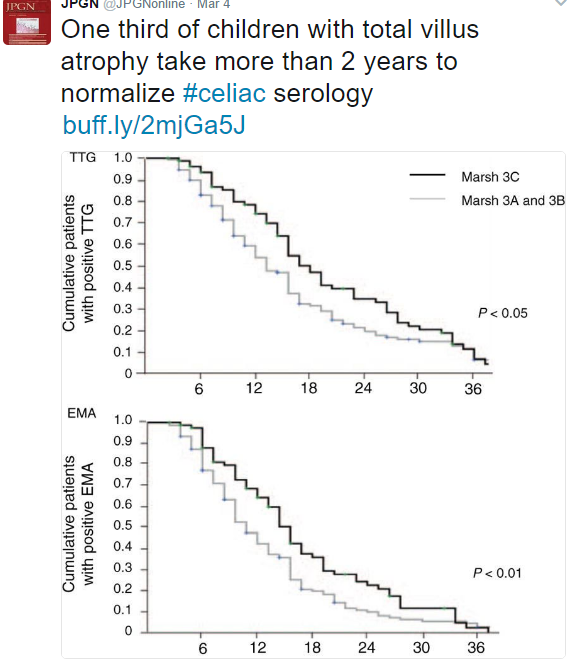
How Slow Do Objective Markers of Celiac Change After Treatment?

In a recent study (D Gidrewicz et al. JPGN 2017; 64: 362-7) with 228 consecutive, newly diagnosed children with biopsy-proven celiac disease, the authors followed improvement in serology.  Patients were divided into tertiles based on the degree of TTG IgA/EMA abnormalities. For example, Group A had the most abnormal serology: TTG >10 times ULN and EMA ≥1:80.

My take: This data confirms the fact that it takes a long time for resolution of celiac serology, particularly in those with the most severe disease.

FDA Warning: Anesthesia and Developing Brains

A good review on the issue of anesthesia and the developing brain: DB Andropoulos, MF Greene. NEJM 2017; 376: 905-7.

The authors from Texas Children’s Hospital comment on the prior studies and how their approach has changed since the FDA on December 14, 2016 issued a “Drug Safety Communication” (www.fda.gov/Drugs/DrugSafety/ucm532356.htm).  The FDa warning targets anesthesia in children less than 3 yrs of age and pregnant women in the 3rd trimester who undergo anesthesia for >3 hrs.

At Texas Children’s, the authors state that the FDA warning is now discussed with parents of all children younger than 3 yrs receiving an anesthetic. The authors, however, worry that the “FDA warning will cause delays for necessary surgical and diagnostic procedures.”

Related Posts:


Bowel Management Recommendations

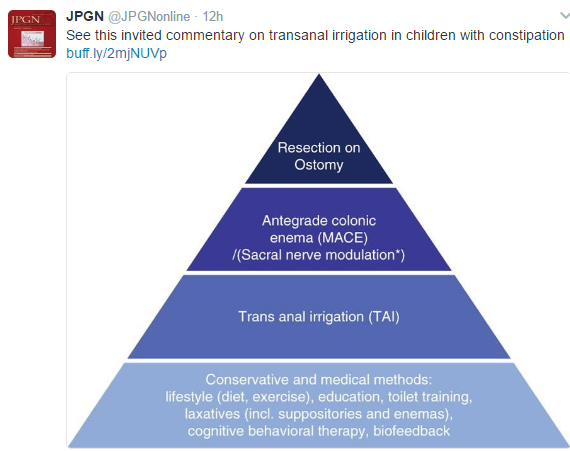
A recent “consensus” review on bowel management (G Mosiello et al. JPGN 2017; 64: 343-52) is available as an open access article –Link: Consensus Review of Best Practic of Transanal Irrigation in Children

The use of bowel management tube (or cone) for transanal irrigation has been around since ~1987 (B Shandling et. al. J Ped Surg 1987; 22: 271-3) and generally is considered in children older than 3 years of age with severe problems with defecation (organic and functional).

This particular review has a very good table on troubleshooting (Table 4) and a succinct summary of indications/contraindications (Table 2).

Related blog entries:


Opioid Use and Liver Transplantation Outcomes

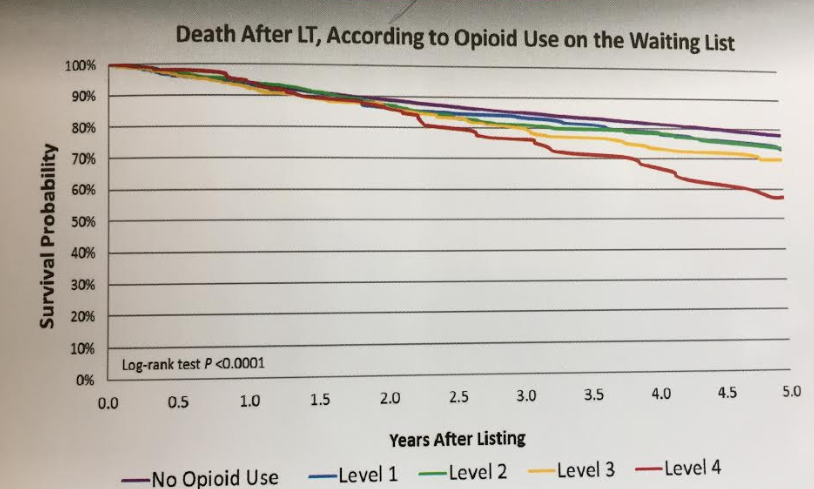
Not surprisingly, a recent study (HB Randall et al. Liver Transplantation 2017; 23: 305-14) has found that use of opioid medications prior to liver transplantation (LT) increased mortality over 5 years after transplantation.

This retrospective cohort study with data from nearly 30,000 patients correlated outcomes with pre-LT opioid exposure.  Overall, 9.3% of recipients filled opioid prescriptions while on the waiting list. Adjusted hazard ratios for death were 1.28 and 1.52 respectively for opioid use of level 3 and level 4.

In the associated editorial (pg 285-7), the authors note that animal models have shown direct hepatotoxic effects of opioid use, though they speculate that the driver for mortality could be due to “sustained opioid use over time or return to illicit drug use.”

A unrelated commentary by CDC director Tom Frieden (AJC “Protect Ga. families from opioid overdose”, March 18, 2018) explains the scope of the opioid epidemic.  “Since 2000, more than 300,000 of our sons, daughters, brothers, sisters, mothers, fathers, and friends have been killed by opiates.  In 19999, approximately 6,000 Americans died from opiate overdose –including both prescription pain medicines … and heroin.  By 2015 that number increased to more than 33,000.”  This is more than a five-fold increase.

He emphasized that opiates serve as a gateway drug for those addicted to heroin; that is, the majority of those hooked on heroin were started on an opioid medication.

My take: The worsened outcomes of LT due to opioids are unfortunately a tiny part of an enormous tragic problem of the opioid epidemic.

Related posts:

Why Do Canadians with Cystic Fibrosis Live Longer than Patients in U.S.?

NY Times Summarizes the reasons why Canadians with Cystic Fibrosis Live Longer: Link:  Canadians With Cystic Fibrosis Live 10 Years Longer Than Americans With the Disease

Cystic fibrosis is an inherited disease that causes recurrent lung infections and other problems. The average lifespan for an American with the illness is 37 years. In Canada, it is 49.

Researchers studied records of 5,941 Canadian and 45,448 American cystic fibrosis patients between 1990 and 2013. After controlling for severity of disease, age and other factors, they found that overall death rates were 34 percent lower in Canada than in the United States.

There was no difference in death rates between Canadians and Americans with private health insurance. But Canada provides universal health care coverage under a single-payer system, so every Canadian has some kind of health insurance. The Canadian death rate was 44 percent lower than that of Americans on Medicaid or Medicare, and 77 percent lower than Americans without insurance.

 AL Stephenson et al.  Ann Intern Med. 2017. DOI: 10.7326/M16-0858

Abstract

Background:In 2011, the median age of survival of patients with cystic fibrosis reported in the United States was 36.8 years, compared with 48.5 years in Canada. Direct comparison of survival estimates between national registries is challenging because of inherent differences in methodologies used, data processing techniques, and ascertainment bias.
Objective:To use a standardized approach to calculate cystic fibrosis survival estimates and to explore differences between Canada and the United States.
Design:Population-based study.
Setting:42 Canadian cystic fibrosis clinics and 110 U.S. cystic fibrosis care centers.
Patients:Patients followed in the Canadian Cystic Fibrosis Registry (CCFR) and U.S. Cystic Fibrosis Foundation Patient Registry (CFFPR) between 1990 and 2013.
Measurements:Cox proportional hazards models were used to compare survival between patients followed in the CCFR (n = 5941) and those in the CFFPR (n = 45 448). Multivariable models were used to adjust for factors known to be associated with survival.
Results:Median age of survival in patients with cystic fibrosis increased in both countries between 1990 and 2013; however, in 1995 and 2005, survival in Canada increased at a faster rate than in the United States (P < 0.001). On the basis of contemporary data from 2009 to 2013, the median age of survival in Canada was 10 years greater than in the United States (50.9 vs. 40.6 years, respectively). The adjusted risk for death was 34% lower in Canada than the United States (hazard ratio, 0.66 [95% CI, 0.54 to 0.81]). A greater proportion of patients in Canada received transplants (10.3% vs. 6.5%, respectively [standardized difference, 13.7]). Differences in survival between U.S. and Canadian patients varied according to U.S. patients’ insurance status.
Limitation:Ascertainment bias due to missing data or nonrandom loss to follow-up might affect the results.
Conclusion:Differences in cystic fibrosis survival between Canada and the United States persisted after adjustment for risk factors associated with survival, except for private-insurance status among U.S. patients. Differential access to transplantation, increased posttransplant survival, and differences in health care systems may, in part, explain the Canadian survival advantage.
Primary Funding Source:U.S. Cystic Fibrosis Foundation.

Sainte-Chapelle, Paris

Colon Cancer at Younger Ages

From USA Today: Colon and rectal cancers surge in millennials and GenX

An excerpt:

Someone born in 1990 has double the risk of early colon cancer and quadruple the risk of early rectal cancer as someone born in 1950…

Most of the nation’s 135,000 annual cases and 50,000 deaths related to colon and rectal cancer still occur among people over age 55. But the share of cases involving younger adults has risen to 29% for rectal cancer and 17% for colon cancer, the study showed. About 11,000 people in their 40s and 4,000 under 40 were diagnosed in 2013…

Known risk factors for colon and rectal cancer include obesity, inactivity and diets high in red and processed meat and low fruits, vegetables and whole grains.

screenshot-163