JAKne: JAK inhibitor–induced acne

S Honap et al. Clinical Gastroenterology and Hepatology 2025 (EPUB). Open Access! Janus Kinase (JAK) Inhibitor-Induced Acne in Inflammatory Bowel Disease: An International, Multicenter, Retrospective Cohort Study

Mehtods: This international, multicenter, retrospective cohort study consecutively enrolled JAK-inhibitor-treated patients with IBD who subsequently developed acne (aka JAKne).

Key findings:

  • Among 2183 JAK inhibitor–treated patients with IBD, 272 developed acne
  • 70% of acne cases occurred within the first 3 months of treatment initiation
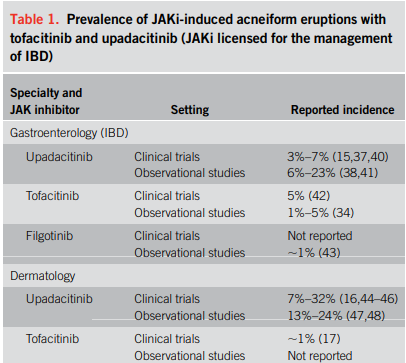
  • The crude prevalence rates of acne were 15.9% for upadacitinib, 4.3% for tofacitinib, and 1.9% for filgotinib, with dose-dependent relationships observed for upadacitinib and tofacitinib
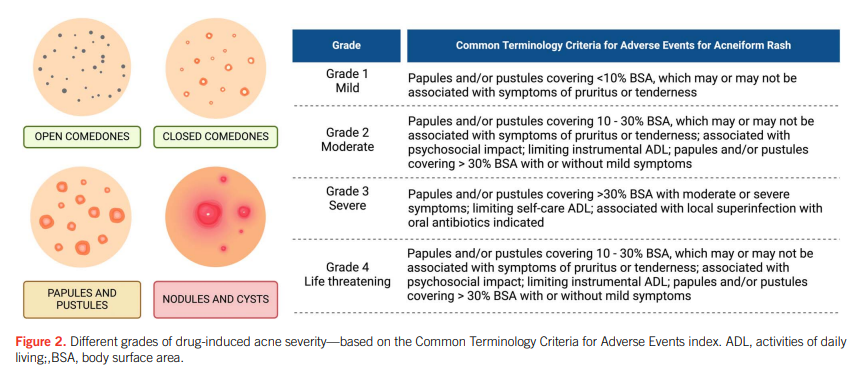
  • Most cases were mild-moderate in severity. Mild (<10% of body surface area) was noted in 68%, Moderate (10-30% of BSA) was noted in 24%, and Severe (>30% of BSA) was note in 8%
  • Among those who developed acne, areas that were affected included the face in 89%, the back in 33%, the chest in 27% and the scalp in 1%
  • 40% received pharmacologic intervention
  • 18% of patients who developed acne had JAK inhibitor dose reduction or discontinuation

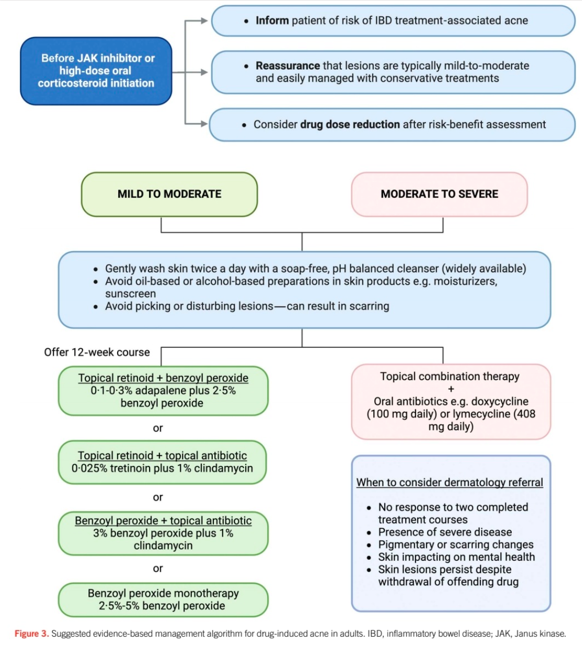
My take: JAKne is a common adverse effect.  Early identification, proactive counseling, and timely interventions, such as dose reduction, acne therapies or referral to dermatology, are crucial in managing this side effect.

Related blog posts:

St James’s Park, London

Disclaimer: This blog, gutsandgrowth, assumes no responsibility for any use or operation of any method, product, instruction, concept or idea contained in the material herein or for any injury or damage to persons or property (whether products liability, negligence or otherwise) resulting from such use or operation. These blog posts are for educational purposes only. Specific dosing of medications (along with potential adverse effects) should be confirmed by prescribing physician.  Because of rapid advances in the medical sciences, the gutsandgrowth blog cautions that independent verification should be made of diagnosis and drug dosages. The reader is solely responsible for the conduct of any suggested test or procedure.  This content is not a substitute for medical advice, diagnosis or treatment provided by a qualified healthcare provider. Always seek the advice of your physician or other qualified health provider with any questions you may have regarding a condition.
Managing Drug-Induced Acne in IBD: A Guide for Gastroenterologists

MJ Temido et al. Am J Gastroenterol 2025;120:125–134. Drug-Induced Acne in Inflammatory Bowel Disease: A Practical Guide for the Gastroenterologist

“Corticosteroids and Janus kinase inhibitors (JAKi) are commonly used for the treatment of inflammatory bowel disease (IBD) and are known to aggravate a prior tendency to acne or trigger the development of new acneiform eruptions. Both randomized controlled trials and real-world studies have identified acne as one of the most common treatment-emergent adverse events in JAKi… This review examines the characteristics of drug-induced acne in IBD treatments, provides a practical guide for gastroenterologists to manage mild-to-moderate occurrences, and highlights when to seek specialist dermatology advice.”

My take: This is a helpful review of acne management in the setting of IBD.

Related blog posts:

Disclaimer: This blog, gutsandgrowth, assumes no responsibility for any use or operation of any method, product, instruction, concept or idea contained in the material herein or for any injury or damage to persons or property (whether products liability, negligence or otherwise) resulting from such use or operation. These blog posts are for educational purposes only. Specific dosing of medications (along with potential adverse effects) should be confirmed by prescribing physician.  Because of rapid advances in the medical sciences, the gutsandgrowth blog cautions that independent verification should be made of diagnosis and drug dosages. The reader is solely responsible for the conduct of any suggested test or procedure.  This content is not a substitute for medical advice, diagnosis or treatment provided by a qualified healthcare provider. Always seek the advice of your physician or other qualified health provider with any questions you may have regarding a condition.
A-OK for Accutane

Another article has reaffirmed that isotretinoin (Accutane) does not increase the risk of IBD (JAMA Dermatol 2013; 149: 216-20).  Thanks to Mike Hart for this reference. However, this data will not reverse the millions of dollars that have been lost in litigation (Isotretinoin – Wikipedia, the free encyclopedia).

Using a large U.S. health claims database (68 million patients), the authors examined women ages 18-46 years who had received at least one oral contraceptive prescription between 2001-2009.  For each patient with IBD, 20 controls were identified in a nested case-control study design.

In total, 2159 IBD cases (1056 UC, 1103 CD) were matched with 43,180 controls.  Only 10 patients with IBD were exposed to isotretinoin compared with 191 controls.  The adjusted relative risk (RR) for IBD was 0.99; for ulcerative colitis the RR was 1.1 (confidence intervals 0.44-2.7) and for Crohn’s disease the RR was 0.91 (confidence interval 0.91).  For the meta-analysis which was a secondary part of this study, the RR for IBD with 5 studies was 0.94.

Conclusion: The study results do not suggest an increase risk of IBD with isotretinoin use.

Why did previous studies suggest a link between IBD and isotretinoin? The authors note that this is the first study to adjust for two main confounders, mainly a diagnosis of acne and use of oral tetracycline antibiotics.  Oral antibiotics, including tetracyclines, have been associated with IBD previously.  In addition, the design limits the confounding of contraceptive usage.

Limitations of this study:

  • Only women were studied; however, there are no known biologic factors that would make isotretinoin more problematic for males.
  • Other risk factors were not examined: smoking, ethnicity, diet, IBD family history

Additional references:

  • -Am J Gastroenterol 2009; 104: 2774-78.  Population-based study in Winnipeg, <40yrs.  n=1960 cases and 19,419 controls.  No differences in the proportions of IBD cases taking isotretinoin vs controls.  1.2% of IBD cases received isotretinoin prior to IBD diagnosis (n=25) compared with 1.1% of controls (n=213).  Mean # of days prior to IBD dx was 1102.  Thus, isotretinoin unlikely to be causally-associated with idiopathic IBD.
  • -IBD 2009; 12: Supplement -abstract O -0002  Increased risk of UC after isotretinoin.  OR 4.36 for developing UC
  • -Am J Gastroenterol 2009; 104: 2387-93.  7 country study found no causal association between isotretinoin & colitis.