Teaching an Old Dog a New Trick: Optimizing Thiopurine Therapy in Autoimmune Hepatitis

Key findings:

  • Over 4 years (N = 146), patients with higher average 6TGN levels were associated with those with stable complete biochemical remission (CBR) (260 pmol/0.2 mL) compared to those failing to maintain CBR (181 pmol/0.2 mL; p = 0.0014) or never achieving CBR (153 pmol/0.2 mL; p < 0.0001), with an optimal 6TGN cutoff of ≥223 pmol/0.2 mL
  • Adding allopurinol to thiopurines in difficult-to-treat patients (N = 36) raised 6TGN (168→321 pmol/0.2 mL; p < 0.0001) and lowered 6MMP (2125→184 pmol/0.2 mL; p < 0.0001), resulting in improved transaminases in all patients and long-term CBR in 75%.
  • Limitation: most of the 337 patients did NOT have sequential azathioprine metabolite monitoring. This could indicate that the 146 patients with sequential monitoring could have a selection bias favoring patients with a more aggressive disease course. Thus, the proposed 6-TGN level of 223 may not be applicable for all patients.
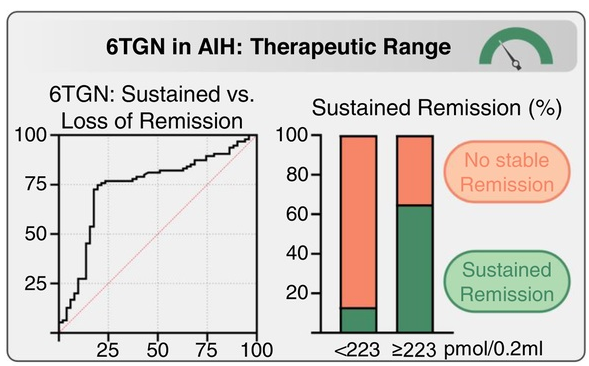
From editorial:

  • “In this issue of Hepatology, “Weltzsch et al1 conducted a multicenter study on the metabolic monitoring of thiopurines in AIH. The authors defined an optimal cutoff of ≥223 pmol/0.2 mL average 6TG level to maintain long-term biochemical remission (BR). Notably, 66% of patients with 6TG levels above this cutoff sustained BR rates. 
  • Allopurinol shifts the thiopurine metabolism toward 6TG production, allowing thiopurine dose reduction to 25%–30%, which improves efficacy and tolerability. (The 100 mg dose of allopurinol had more favorable 6MMP/6TG ratio).
  • However, they note that in a prior study (J Hepatol 2021; 75: 324-32), “patients with subtherapeutic 6TG levels (75–225) achieved similar BR rates (75% vs. 81%, p = 0.589) to those with therapeutic levels (225–450), while experiencing significantly fewer adverse drug reactions (44% vs. 86%, p = 0.0002).”
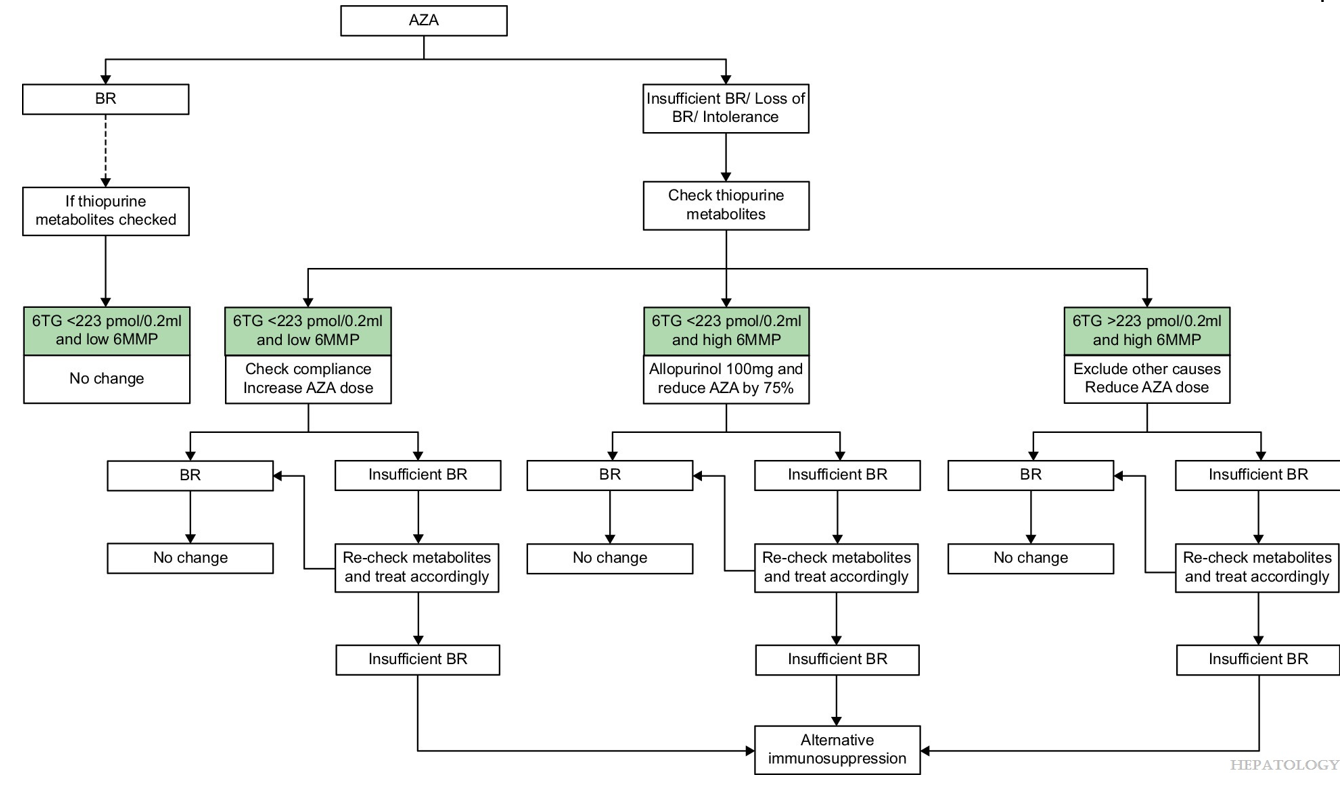
Proposed Algorithm

My take: This study shows in patients who have not achieved a biochemical remission, optimization of azathioprine dosing with metabolite monitoring improves biochemical remission. In those with low 6TG and low 6MMP, increasing the azathioprine should be considered. In those with low 6TG and high 6MMP, reducing azathioprine and adding allopurinol should be considered.

Related blog posts:

Disclaimer: This blog, gutsandgrowth, assumes no responsibility for any use or operation of any method, product, instruction, concept or idea contained in the material herein or for any injury or damage to persons or property (whether products liability, negligence or otherwise) resulting from such use or operation. These blog posts are for educational purposes only. Specific dosing of medications (along with potential adverse effects) should be confirmed by prescribing physician.  Because of rapid advances in the medical sciences, the gutsandgrowth blog cautions that independent verification should be made of diagnosis and drug dosages. The reader is solely responsible for the conduct of any suggested test or procedure.  This content is not a substitute for medical advice, diagnosis or treatment provided by a qualified healthcare provider. Always seek the advice of your physician or other qualified health provider with any questions you may have regarding a condition.

IBD Updates

  1. Allopurinol makes thiopurines more effective. A Vasudevan et al. AP&T 2023; https://doi.org/10.1111/apt.17831 Clinical trial: Combination allopurinol-thiopurine versus standard thiopurine in patients with IBD escalating to immunomodulators (the DECIDER study)

This was  a multicenter, randomized, placebo-controlled trial to compare the efficacy and safety of thiopurine-allopurinol versus thiopurine with placebo for adults commencing a thiopurine for IBD in 102 patients. Allopurinol was dosed at 100 mg. Key findings:

  • A higher proportion achieved the primary outcome (improved clinical score and fecal calprotectin <150) in the thiopurine-allopurinol group (50% vs 35%, p = 0.14) and fewer participants stopped their allocated therapy due to adverse events (11% vs 29%, p = 0.02

Related blog posts:

2. Newer treatments and lower colectomy rates in pediatric UC. D Ley et al. AJG 2023; 118:1997-2004 New Therapeutic Strategies Are Associated With a Significant Decrease in Colectomy Rate in Pediatric Ulcerative Colitis. Thanks to Ben Gold for this reference.

Medication exposure and disease outcomes were compared between 3 diagnostic periods: 1988 to 1993 (period [P] 1; pre-IS era), 1994 to 2000 (P2; pre-anti-TNF era), and 2001 to 2011 (P3; anti-TNF era).

  • Key finding: The risk of colectomy at 5 years decreased significantly over time (P1, 17%; P2, 19%; and P3, 9%; P = 0.045, P-trend = 0.027) and between the pre-anti-TNF era (P1 + P2, 18%) and the anti-TNF era (P3, 9%) (P = 0.013). 

Related blog posts:

3. More data indicating that anti-TNF therapy does not increase post-operative complications. D Bajzat et al. Inflamm Bowel Dis 2023; 29: 1971-1980. Safety Analysis of Preoperative Anti-TNF-α Therapy in Pediatric IBD After Intestinal Resection: A Systematic Review and Meta-analysis

In this systematic review, the authors identified 8 eligible articles with 526 pediatric patients with IBD. Key finding: “There is no significant association between preoperative anti-TNF-α therapy and postoperative complications in children with IBD after intestinal resection.”

Related blog posts:

Pics from Island Ford/Chattahoochee River

Disclaimer: This blog, gutsandgrowth, assumes no responsibility for any use or operation of any method, product, instruction, concept or idea contained in the material herein or for any injury or damage to persons or property (whether products liability, negligence or otherwise) resulting from such use or operation. These blog posts are for educational purposes only. Specific dosing of medications (along with potential adverse effects) should be confirmed by prescribing physician.  Because of rapid advances in the medical sciences, the gutsandgrowth blog cautions that independent verification should be made of diagnosis and drug dosages. The reader is solely responsible for the conduct of any suggested test or procedure.  This content is not a substitute for medical advice, diagnosis or treatment provided by a qualified healthcare provider. Always seek the advice of your physician or other qualified health provider with any questions you may have regarding a condition.

Anemia in Pediatric Inflammatory Bowel Disease

A recent retrospective study (G Aljomah et al. JPGN 2018; 67: 351-5) provides some useful information about anemia in the pediatric inflammatory bowel disease (IBD) population. This study included 153 patients, though the diagnostic tests varied considerably; for example, only 42 patients had a serum transferrin receptor (sTR) assay available at followup.

Key points:

  • 67.3% of patients had anemia at diagnosis.  38.5% had anemia of chronic disease (ACD) and the remainder had either iron deficiency anemia (IDA) or IDA in combination with ACD.
  • 20.5% had anemia at followup approximately 1 year after diagnosis. 5.1% with ACD alone and 15.4% had IDA or IDA in combination with ACD.
  • In a subset of patients with more complete data, it was shown that anemia was much more common in patients with Crohn’s disease: 91.2% at diagnosis and 27.3% at followup compared with patients with ulcerative colitis with 40.0% at diagnosis and 7.7% at followup.

The authors used the sTR index (sTR/log ferritin index) to determine if ACD was present.  “This index can differentiate IDA from ACD; however, it cannot separate IDA from the combination of IDA/ACD.  IDA or IDA/ACD were considered to be present if the sTR index was greater than 1.03. An sTR index of <1.03 was taken to be indicative of the presence of ACD.”

Briefly noted: MR Serpico et al. JPGN 2018; 67: 341-5.  This retrospective study  examined the use of allopurinol to optimize thiopurine levels.  32 of 52 patients remained on the combination for 1 year.  In this group, median alanine transaminase decreased to 19 from 77 (P<0.001) and median 6-TG levels increased to 322 from 166 (P<0.001). In addition, steroid-free remission rates improved to 82% (23 of 28).  About 40% of the initial cohort of 52 patients were switched to antitumor necrosis factor therapy.

My take: The initial study shows that anemia is frequent in pediatric IBD, especially at diagnosis (67%).  Even at followup, 20% of patients had ongoing anemia.

Related blog posts:

More on Ustekinumab, plus Allopurinol Study

More data emerging that indicates that subcutaneous ustekinumab will be useful for refractory Crohn’s disease: S Khorrami et al. Inflamm Bowel Dis 2016; 22: 1662-69.

  • This open-label cohort of 116 patients identified a clinical response (Harvey-Bradshaw Index) in 97 (84%) after loading dose, and clinical benefit in 58% at 12 months of followup.
  • Perianal disease improved in 11 of 18 (61%).
  • This cohort had refractory disease with almost 90% had failed or were intolerant to 2 or more anti-TNFs.

Another strategy for managing inflammatory bowel disease is using allopurinol which can help low-dose azathioprine achieve therapeutic levels.  In the largest cohort to date, Pavlidis et al (Inflamm Bowel Dis 2016; 22: 1639-46) showed that at the end of followup (median 19 months after treatment initiation) 113/164 (69%) of patients with Crohn’s disease and 83/136 (61%) with ulcerative/unclassified colitis had a clinical response; 52% and 54% respectively were in remission. The azathioprine dose was 25% of weight-based monotherapy dose adjusted based on TPMT status; thus, for normal/high TPMT activity, azathioprine was dosed at 0.5 mg/kg whereas for heterozygous/intermediate activity, azathioprine was dosed at 0.25 mg/kg.

Related blog posts:

Disclaimer: These blog posts are for educational purposes only. Specific dosing of medications/diets (along with potential adverse effects) should be confirmed by prescribing physician/nutritionist.  This content is not a substitute for medical advice, diagnosis or treatment provided by a qualified healthcare provider. Always seek the advice of your physician or other qualified health provider with any questions you may have regarding a condition.

Vickery Creek, Sandy Springs

Vickery Creek, Sandy Springs

Not Much Data with Allopurinol

The authors of a recent case report (JPGN 2014; 59: 22-24) note that there has been “only 1 study on the pediatric use of allopurinol in inflammatory bowel disease.”  A previous post on this blog has reviewed the use of allopurinol for IBD and provided several references –mainly from use in adults (Data on Allopurinol | gutsandgrowth).

This current study reports on three cases.  In all three cases the combination of allopurinol with low-dose 6-mercaptopurine resulted in clinical remission, including one patient which was poorly responsive to infliximab.  In all three cases, frequent thiopurine metabolites were obtained to help guide dosing.  Prior to allopurinol, all 3 patients had a 6-MMP/6-TG ratio >20; with use of allopurinol there was a decrease in this ratio.

Among these patients, one developed mild leukopenia which resolved with medication adjustment.

Bottomline: Allopurinol can be effective in optimizing thiopurine treatment, but need to be administered carefully.  More studies on its use are needed.

Data on Allopurinol

Given the limited number of therapeutic options for inflammatory bowel disease (IBD), it is important to optimize each individual treatment.  Allopurinol can increase the effectiveness of thiopurines and if used properly can be safe (Inflamm Bowel Dis 2013; 19: 363-69).

The referenced study took place between 2004-2011 and examined 77 patients who failed monotherapy with a thiopurine due to “skewed” metabolism.  The average age of study participant was 38 years (28-45).  23% had previous surgery. Cotreatment with an anti-TNF occurred in 7 patients and with an 5-ASA i 17 patients.

Results:

  • Median 6-thioguanine (6-TGN) levels increased from 145 to 271 pmol/8 x10-to-the-8th. 6-methyl mercaptopurine (6-MMP) concentrations decreased from 10,110 to 265 pmol/8 x10-to-the-8th.
  • Leukopenia occurred in 16%, necessitating dose reductions.
  • Liver tests normalized in 81% with the addition of allopurinol
  • The median azathioprine dose while on combination therapy was 0.64 mg/kg/day and the median 6-mercaptopurine dose was 0.39 mg/kg/day.  While on mono therapy, median values were 2.05 mg/kg/day and 1.23 mg/kg/day respectively.
  • 21% had to discontinue combination therapy.
  • Combination therapy was continued at 6, 12, 24, and 60 months in 87%, 85%, 76%, and 65%.

Take-home Message:

Allopurinol can salvage failed thiopurine monotherapy, but only in a minority of these patients.  Allopurinol should be considered for patients unable to achieve therapeutic 6-TGN levels who have liver toxicity/elevated 6-MMP levels.  Careful attention to dose reduction of the thiopurine is essential to avoid life-threatening bone marrow suppression.

Related blog entry:

Thiopurine Metabolite Testing -NASPGHAN … – gutsandgrowth

Additional references:

  • -Aliment Pharmacol Ther 2010; 31: 640-47. use of allopurinol.
  • -Gastro & Hep 2008; 4: 505. use of allopurinol. Consider if pts unable to enter steroid-free remission AND on adequate AZA/6MP dose. ONLY in those who preferentially metabolize towards 6-MMP (~15% of population); thus subtherapeutic 6-TG levels and increased 6-MMP (>5700). Need adequate WBC >4.5 at start since this will decrease. Check labs every week x 4 at start, then qoweek x 4, then per routine.
  • -IBD 2008; 14: 1678. Experience with allopurinol in children -dose 100mg of allopurinol if >30kg and 50mg if < 30kg. AZA dose decreased to 25% of previous dose. n=13.
  • -Clin Gastro & Hep 2007; 5: 170 (editorial) & 209.  Use of allopurinol (100mg/day) in 20 adults.  Dose of 6-MP reduced 25-50% concomitantly.  Improved disease control w/o hepatotoxicity.  Important to follow counts closely for first 2 months.

Thiopurine Metabolite Testing -NASPGHAN Consensus Recommendations

The inflammatory bowel disease committee of NASPGHAN has published a review and recommendations for the use of thiopurine metabolite testing (JPGN 2013; 56: 333-40).

The effectiveness of thiopurines is reviewed with a few key points:

  • Cochrane reviews have shown that azathioprine and 6-mercaptopurine are effective in inducing remission in Crohn’s disease.  For active disease the overall response rate has been reported as 54% compared with 33% for placebo.
  • For ulcerative colitis, a Cochrane analysis deemed the methodologic quality of 4 of the 6 studies as unsatisfactory and that all studies were small.  “The reviewers concluded that azathioprine may be effective treatment for patients with ulcerative colitis.”

The review covers the potential adverse effects of the thiopurines: myelosuppression, pancreatitis, elevated transaminases, susceptibility to infection, and malignancy.  The review suggests that the risk of non-Hodgkin lymphoma is probably increased up to 4-fold. Though, it is difficult to determine how much of the risk is truly due to the usage of thiopurines or other confounding factors.  The studies about the risk of non-melenoma skin cancer are not discussed.

Other covered topics: advantages of thiopurine metabolite testing (6-thioguanine [6-TGN] and 6-methylmercaptopurine[ 6-MMP]), potential disadvantages of metabolite testing (e.g.. cost), use of genotype versus phenotype (phenotypic testing is generally preferred), thiopurine metabolism, devising target levels, use of allopurinol, and misinterpretation of metabolite testing.

Specific Consensus Recommendations:

  • Obtain thiopurine methyltransferase (TPMT) testing prior to initiation of thiopurines.
  • Avoid use of thiopurines in individuals with extremely low TPMT activity or who are homozygous recessive for TPMT activity
  • TPMT testing does not predict all cases of leukopenia.  All individuals receiving thiopurines should have routine monitoring with CBCs.  “Most adverse effects from thiopurines are not directly related to 6-TGN or 6-MMP levels.”
  • Metabolite testing can help determine adherence to therapy
  • Metabolite testing may be helpful in guiding dose adjustment and/or adding allopurinol treatment
  • Routine and repetitive testing of metabolites is not recommended in patients who are doing well on an acceptable thiopurine dosage.

Related blog posts: