Kids With Acute Pancreatitis Need Followup

F Ahmed, M Abu-El-Haija. Gastroenterol 2025; 169: 572-584. Open Access! Acute Pancreatitis in Children: It’s Not Just a Simple Attack

This is a really good review of acute pancreatitis covering epidemiology, diagnosis, severity classification, management, microbiome/metabolite derangements, genetics, and complications. Most of these topics have been covered in numerous blog posts (see below).

Selected Key Points:

  • Diagnostic testing -Amylase/Lipase:  “The diagnostic efficacy of amylase for AP, in terms of sensitivity and specificity, is contingent on the selected threshold value. Elevating the cut-off point to 1000 IU/L results in a high specificity of approximately 95%. However, this comes at the cost of reduced sensitivity, which some studies report to be as low as 61%… the activity of serum lipase remains elevated for a longer duration, typically between 8 and 14 days,… Lipase demonstrates superior accuracy with most studies reporting specificities exceeding 95% and sensitivities ranging from 55%–100% at a threshold activity level of 600 IU/L…hese tests have excellent sensitivities, they may have a few limitations such as being poor predictors of severity”
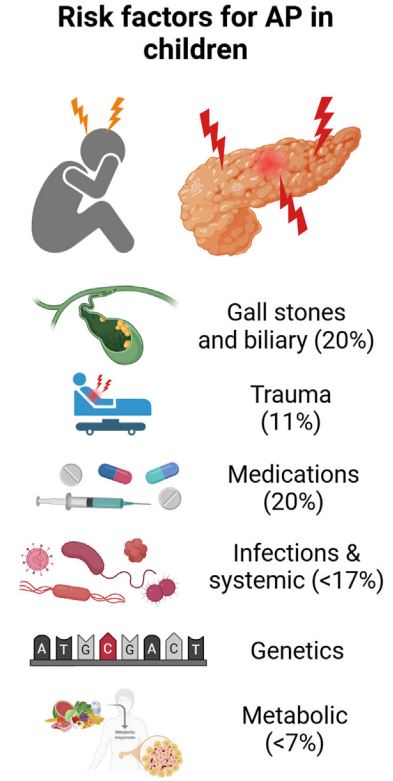
  • Risk Factors in Children (from Figure 1):
  • Incidence and Severity in Children (from Figure 1):

[At a recent lecture, Jay Freeman (How to Upgrade Pancreas Care –Jay Freeman MD (Part 1)) noted that severe pancreatitis is often defined by degree of organ dysfunction (eg. cardiac, pulmonary, renal). A practical definition of severe pancreatitis in children is whether the patient requires admission to an ICU]

  • Diagnostic testing -Imaging: “Imaging techniques are crucial for diagnosing and managing AP in children…NASPGHAN) and the Society for Pediatric Radiology formed consensus guidelines where transabdominal ultrasonography was recommended as the primary imaging technique for pediatric cases with suspected AP…Recent studies in the pediatric population have indicated that US’s sensitivity for AP detection ranges from 47%–52%.25Magnetic resonance cholangiopancreatography (MRCP) is useful for anatomical assessment without radiation but may require sedation”
  • Management: “The cornerstones of therapy are early feeding and intravenous fluids… Allowing patients to eat on admission was feasible and was associated with lower length of stay. Rates of intravenous fluids are recommended at 1.5–2 times maintenance rates,49 and the preferred fluid is Lactated Ringer’s due to limited studies including a recent randomized controlled study that showed that Lactated Ringer’s was associated with a faster discharge rate when administered compared with normal saline.50
  • Genetics:  “A recently conducted study investigated the importance of genetics in pediatric AP patients…use of an extensive panel of 8 genes… PRSS1CFTRSPINK1CPA1, CTRCCLDN2CASR, and SBDS… genetics is a major component in all types of pancreatitis in children, with genetic variants being most prevalent in CP cases at 31%, followed by AP at 19%, and ARP at 6%. A key discovery was that variants in SPINK1CFTR, or PRSS1 genes were associated with faster progression from first episode of AP toward CP.53
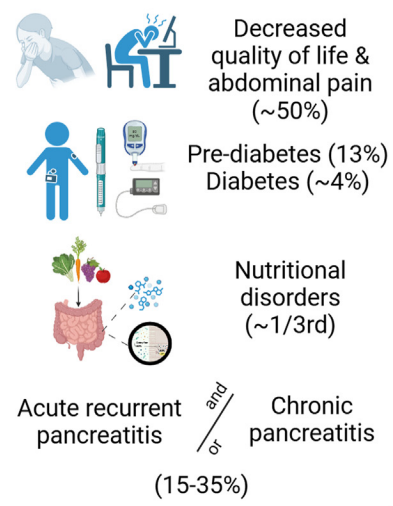
  • Complications (from Figure 1): “After the first episode of AP, the QoL is decreased, and it may lead to other disorders such as exocrine dysfunction, endocrine dysfunction and diabetes, nutritional deficiencies, and acute recurrent pancreatitis and CP.”
My take: Even after a single episode of acute pancreatitis, there are risks for long-term complications and patients need to follow-up.

Related blog posts:

What Can Go Wrong with Living Liver Transplantation for the Donor

J Xiao et al. Liver Transplantation 2024; 30: 493-504 The incidence of adverse outcome in donors after living donor liver transplantation: A meta-analysis of 60,829 donors

This meta-analysis consisted of eighty-seven articles involving 60,829 living liver donors.

Key findings:

  • The overall pooled incidence of complications in LDLT donors was 24.7%
  • The incidence of minor complications was 17.3%
  • The incidence of major complications was 5.5%
  • The overall incidence of donor mortality was 0.06% in 49,027 individuals**. 
  • Psychological complications 7.6% were the most common complications among LDLT donors. This was followed by wound-related complications 5.2%
  • Table 2 (below) gives an extensive list of potential complications and their incidences in this cohort

**In the discussion, the authors note that “donor mortality is a devastating outcome in LDLT…Our study found that Asian countries reported a lower rate…For example, in Japan, the rate of donor mortality was 0.3 deaths per 1000 donors, while in the United States and Europe, donor mortality rates were 1.7 and 2.3 deaths per 1000 donors, respectively. While this observation may be attributed to greater experience in LDLT in Asian centers, it is also possible that underreporting in Asian centers might play a role. Mortality in donors…may result in the suspension or termination of an LDLT program.”

My take: Even with potential underreporting, this study highlights the very real risks associated with trying to save a life via LDLT.

Related blog posts:

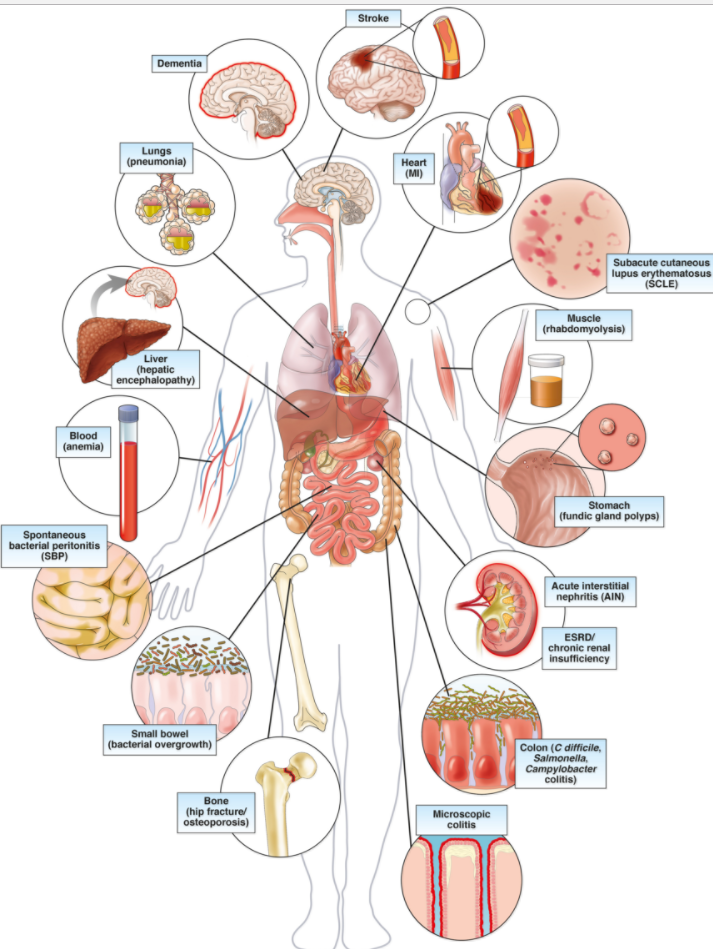
AGA Blog: What are the complications of PPI Therapy?

AGA Journals Blog: What are the complications of proton pump inhibitor (PPI) Therapy?

The blog post reviews a recent article on PPIs and potential complications.

An excerpt:

review article from Michael F. Vaezi et al discusses potential adverse consequences of proton-pump inhibitor (PPI) therapy in the July issue of Gastroenterology…(2017; 153: 35-48). The authors discuss overzealous conclusions based on weak associations that have caused widespread alarm, leading to inappropriate discontinuation of a medicine that is needed for an established disease process. They present absolute and relative risks for adverse effects associated with long-term use of PPIs…

Vaezi et al review the consistency of proposed associations with PPI use and the time period between the PPI exposure and outcome, and the effects of different doses. They provide guidance for methodologies of future studies.

The review article concludes that PPIs have revolutionized the management of patients with GERD and patients at risk of upper gastrointestinal ulceration and bleeding from aspirin or NSAIDs. However, many patients receive PPIs unnecessarily for conditions or symptoms for which they would not have been expected to provide benefit… Vaezi et al state that, as always, PPIs should be given in the lowest effective dose, for the shortest possible time.

They add that much of the evidence linking PPI use to serious long-term adverse consequences is weak and insubstantial. It should not deter prescribers from using appropriate doses of PPIs for appropriate indications.

Full text of original article: Complications of Proton Pump Inhibitor Therapy

Table 6 lists the strengths of the findings along with other Hill Criteria to assess all of the proposed complications.  The vast majority of potential complications have “weak” proof; the exceptions include bacterieal enteric infections/Clostridium difficile infection which have moderate strength of evidence and and fundic gland polyps which have high strength of evidence.

My take: This study and the associated AGA Journals blog post indicate that most of the reports of complications associated with PPI remain unproven and are based on weak evidence.


Gastrostomy Tubes: The First 30 Days

A retrospective study (AB Goldin et al. J Pediatric 2016; 174: 139-45) provides a better idea about the likelihood of complications by looking for ED visits and admissions within 30  days of placement.

This study involved 38 Children’s Hospitals and 15,642 patients the Pediatric Health Information System (PHIS) database. Key findings:

  • 8.6% had an ED visit within 30 days
  • 3.9% had an admission within 30 days
  • Common reasons for return visits: infection (27%), mechanical complication (22%) and replacement (19%).

The authors note that risk factors for ED visits and admission were mainly non modifiable like race/ethnicity and medical complexity.  They also note that problems in the early postoperative period are grossly underestimated due to many issues being addressed in the outpatient setting.

This study indicates that there is a tremendous opportunity for improvement.  There is great variation in hospital practices with regard to the type and method of placing gastrostomy tube.  In addition, there is a high variability in the determination of the need for fundoplication which is often undertaken at the time of gastrostomy tube placement.

My take:  Understanding these risks is important to give families accurate information prior to placement of gastrostomy tubes.  In addition, these high rates of complications indicate the need for head-to-head prospective trials comparing types of gastrostomy tube placement and education efforts.

Related blog posts:


betterbirthrate

Lower Teen Birth Rates

teen birth rate

Adolescent Bariatric Surgery Outcomes at 3 Years

A prospective study (TH Inge et al. NEJM 2016; 374: 113-23) with 242 adolescents from five U.S. centers provides data on outcomes at 3 years. Here’s the scoop:

  • At baseline, mean age was 17 years, 75% were female, 72% were white, and mean BMI was 53.

At 3 years:

  • Mean weight decreased 27% (similar results for gastric bypass and gastric sleeve)
  • 95% had remission of type 2 diabetes (of those with diabetes at baseline)
  • 86% had remission in abnormal kidney function (of those with diabetes at baseline)
  • 74% had remission in elevated blood pressure (of those with diabetes at baseline)

lonnnngg Table 4 details the serious complications:

  • 13% of the participants (n=30, 47 procedures) had undergone additional abdominal procedures. While most of these were related to the procedure, a good number may have occurred regardlessly (eg. 18 cholecystectomies, 2 appendectomies)
  • 13% (n=29) also underwent endoscopic procedures including 9 who needed stricture dilatation.

The most common nutrient deficiency at followup was iron deficiency.  57% had low ferritin levels at 3 years compared with 5% at baseline.  Vitamin B12 deficiency was common; it declined by 35% and 8% had a deficiency at 3 years.  Vitamin A deficiencies increased (16% at 3 years). My take: this study documents the durability of weight loss and its beneficial effects on a multitude of problems.  It also shows that careful followup is needed for nutrient deficiencies and the risks of adverse events. Related blog posts:

Something Bad is Going to Happen

A recent commentary (Sonnenberg A, Clin Gastroenterol Hepatol 2015; 13: 820-23) discusses the statistical inevitability of adverse events.  As such, despite our efforts to provide the best care, we should consider how we look at bad outcomes. This article highlights a few common issues in adult gastroenterology, failing to identify colorectal cancer and adverse events at the time of endoscopy.  Using statistical models, the author notes that avoiding all adverse events is nearly impossible.

The broader points for pediatric gastroenterologists/all physicians:

  • Using simple statistics, “adverse events can be expected to occur with a high probability.  Their occurrence is a function of the number of patient encounters and the probability of making mistakes.”
  • “It is a statistical misconception to believe that their rare occurrence would make it possible for an individual gastroenterologist to dodge the bullet.”
  • “It is another statistical misconception to assume that by exerting extreme caution a gastroenterologist also could avert adverse events. The only means to truly reduce adverse events is to avoid patient encounters.”
  • “The physician rarely is given credit for innumerous other patient encounters with good outcomes.  The bad outcome is considered potentially reflective of professional failure or flawed performance. The process ultimately is geared toward showing avoidable mistakes and assigning guilt.  The occurrence of an error, even at its lowest rate, generally is not accepted as a viable reason, although under different circumstances the same reviewers would be willing to accept the less-than-perfect sensitivity or specificity of all diagnostic tests.”
  • “We have to …free ourselves from the illusion that perfection will become achievable through limitless quality assurance.”
  • “Highlighting the statistical nature of adverse events is not meant to belittle the need for continued efforts at improving patient safety and increasing the quality of health care delivery…In a ‘just culture’ of safety and accountability, the occurrence of any error would become an opportunity for learning and improvement rather than retribution or punishment.”

As a personal aside, I took some solace in reading this article and previously in reading the book “Complications: A Surgeon’s Notes on an Imperfect Science” (Complications | Atul Gawande). I clearly remember a few terrible situations that from time to time still fill me with sadness and regret.  I feel better knowing that the mistakes that I have made were not due to a lack of effort or due to a lack of caring.

Take-home message: If you practice medicine, something bad is going to happen. Can we forgive ourselves if our judgement contributed to an adverse event?

Zoo Atlanta

Zoo Atlanta

Helpful Position Paper: Percutaneous Endoscopic Gastrostomy in Children

A recent European Society for Pediatric Gastroenterology Hepatology and Nutrtition (ESPGHAN) position paper provides some useful advice regarding the management of percutaneous endoscopic gastrostomy (PEG) in children and adolescents (JPGN 2015; 60: 131-41).

Table 1 provides a succinct description of the potential benefits of PEG compared with nasogastric tube including less dislodgement, reduces risk of aspiration, better appearance, safer/more reliable enteral access, optimizes development of oral skills, less blockage/clogging, cost-effective, less interference with daily activities, avoids nasal irritation/trauma, reduced anxiety at mealtimes, and shorter meal times.

Table 2 provides a good summary of clinical indications including optimizing nutritional status, maintaining hydration, supporting unpalatable diet, decompressing stomach, improving medication adherence, ensuring safe feedings/prevent aspiration, and improving quality of life.

The position paper reviews relative and absolute contraindications (uncorrectable coagulopathy, interposition of enlarged organs, frank peritonitis); I did not see any mention of high dose steroids as a relative contraindication.  Given high dose steroids’ impact on healing, PEG needs to be avoided if possible in this setting (in my opinion).

The authors provide extensive information on potential complications (table 6 and table 7).

Other key points:

  • “In the United Kingdom, it is accepted by the National Institute of Clinical Effectiveness that expectation of continuous NGT use for a minimum of 4 weeks (www.nice.org.uk/CG032 –this reference provided by authors focuses on NGT in adults), or even 2 to 3 weeks, should prompt consideration of PEG insertion.”
  • “The use of a routine preoperative upper GI contrast study is NOT advised to rule out malrotation.”
  • “Asymptomatic children do not require investigation for GERD before PEG insertion.” However, the authors note that in the presence of significant symptomatic reflux, or reflux in the presence of an unsafe swallow/progressive neurologic disease, or chronic respiratory disease, this should prompt discussion around the need for a surgical antireflux procedure.
  • The authors suggest that PEG change to a button can occur “after a period of 2 months or more.” Our institution generally does not change prior to 3 months.
  • The authors state that formula (rather than clears) can be started within 4 to 6 hours of PEG insertion.
  • One aspect of their recommendations that I disagreed with was their advice on preventing a ‘buried bumper.’  “To prevent a ‘buried bumper,’ the PEG should be carefully pushed into the stomach by 1 to 2 cm and then rotated once a week from day 7 postinsertion.”
  • Perhaps this advice is offered as the guideline also suggests that patients do not need much follow-up: “The child will require follow-up, typically provided by nurse specialists 3 months after placement of the gastrostomy.  Thereafter, annual review of the device is usually adequate…between routine appointments caregivers should have access to appropriately trained professionals.”  In my view, if the tube is appropriately sized (checked early on) and patients are followed (for excessive weight gain), then pushing in the tube should be unnecessary.

Take-home message: Overall, this is a useful reference/summary for PEG tube management, though some recommendations are based on practice patterns rather than high-quality data.

Are there others who would like to relay their experience and advice?

Related blog posts:

Suffering

I was intrigued by the title “The Word That Shall Not Be Spoken” (NEJM 2013; 369; 177-78).

According to the author the word is “suffering.”  He notes that clinicians do not like to use this word. Some of the reasons:

  • It is not “actionable”..it is “too heterogeneous, too complicated”
  • It reminds us that we are “powerless against so many of our patients’ problems”
  • Because “the idea of taking responsibility for it overwhelms us as individuals –and we are already overwhelmed by our other duties and obligations

His conclusion: “in truth, I’m less interested in the words we use than in what we actually do, and what we organize ourselves to do. Collectively, we should not shy away from work that can never be completed.  For our organizations, relief of suffering does seem like the right goal, endless though the work might be.”