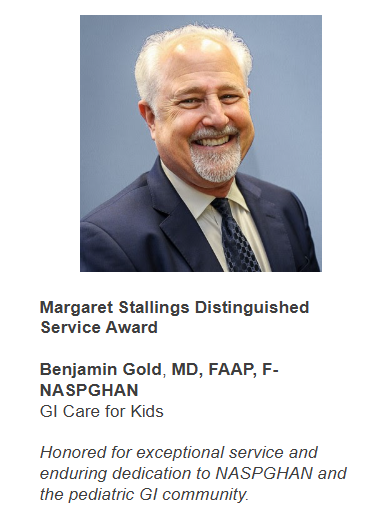
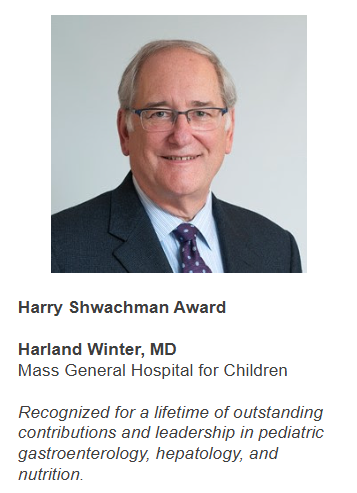
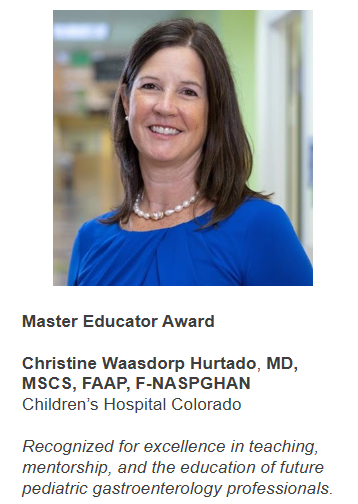


I wanted to congratulate/recognize this year’s awardees at NASPGHAN and to summarize some of the associated presentations.
This blog entry has abbreviated/summarized the presentations. Though not intentional, some important material is likely to have been omitted; in addition, transcription errors are possible as well.
Major Awards:
Fellow Research Award: “Bile Acid Signatures in Children Confer Protection From Clostridium Difficil Infection” ME Tessier et al (Baylor College of Medicine). Conclusions: Stool bile acids profiles are different in children with C difficile infection and could be a predisposing factor. C diff toxins may alter bile acid profiles via inducing epithelial FGF-19 production.
Young Investigator Award “Analysis of Candidate Genes by Whole Exome Sequencing in Very Early-Onset IBD” J Kelsen (CHOP), et al. VEO-IBD cohort. Excellent presentation! (Related blog post: Just the Beginning: Mutations in Very Early Onset ..)
William Balistreri Prize “A Prospective Newborn Screening Study for Biliary Atresia” Sanjiv Harpavat (Baylor College of Medicine) et al. Excellent talk!
Background: 67 infants with biliary atresia (2007-2014) on retrospective review—ALL had elevated conjugated/direct bilirubin levels in first 24-48 hours of life. (Related blog post: Diagnosing biliary atresia earlier | gutsandgrowth)
Repeat testing at 2 weeks can identify those infants that need to be followed closely. Workup needed for those who remained abnormal at 2 weeks of life.
This algorithm was studied at 4 different hospitals in Houston with 2-12% premature infants)
In newborn period:
Baylor Workup approach to cholestasis:
Current AAP recommendation (per Ronald Sokol) is for all infants to have fractionated bilirubin.
Take-home message: How can we diagnose every infant on time? Possibly check every infant for direct/conjugated bilirubin in first 48 hours.
Young Clinical Investigator Award: “Poop-MD: A mobile health application accurately identifies acholic stools.” Douglas Mogul
Problem of delayed diagnosis has been improved in some studies with stool color cards. With emergence of smart phones (80% of 18-35 year olds have smart phones), opportunity to identify echoic stools with new technology.
Other awards:

NASPGHAN Foundation Awards

Sponsored Awards

