Desperate Measures in Refractory IBD

The often cited, ‘desperate times call for desperate measures,’ resonates in the setting of refractory inflammatory bowel disease (IBD).  [Of course, this saying could be used to justify about anything you want to do.]  For IBD, two recent studies point out potential remedies:

  • SA Merkley, et al. Inflamm Bowel Dis 2015; 21: 1854-59.
  • M Lazzerini, et al. Inflamm Bowel Dis 2015; 21: 1739-49, with editorial by A Bousvaros (1750-51)

In the first study, the authors retrospectively analyzed date from 24 IBD patients who were treated with intravenous immunoglobulin (IVIG) at a dose of 0.4 g/kg/day for 3 days, then 0.4 g/kg once a month. Key findings: 16 (67%) had a response and 3 (12.5%) obtained remission. Measures of improvement included CRP, ESR, Simple Endoscopic Score for Crohn’s disease, and the Harvery-Bradshaw Index. The researchers speculate that IVIG has anti-inflammatory and immunomodulator effects.  In addition, they note that IVIG can be given with concurrent infections.

In the second study, the authors studied thalidomide(1.5-2.5 mg/kg/day) in a double-blind, placebo-controlled randomized pediatric clinical trial in children with refractory active ulcerative colitis. Key findings: at week 8, clinical remission was achieved in 10/12 (83%) of thalidomide arm compared with 2/11 (19%) of control patients.  Then, among control patients who were switched, 8 of 11 (72%) reached remission as well. Peripheral neuropathy and amenorrhea were reported adverse effects. In the accompanying editorial, Dr. Bousvaros notes that there has been some data to suggest thalidomide efficacy in ulcerative colitis since 1979.  However, due to widespread bad publicity related to thalidomide-induced teratogenicity (eg. phocomelia) and side effects including neuropathy, it has not been used with much frequency. He notes that this study, as well, requires replication and speculates that “the primary focus on drug development will focus on newer small molecules and biologics, and this potentially useful medication may be left on the sidelines.” It is worth noting that the authors response (pg 1752) to this editorial was that the stigma of thalidomide is unwarranted and that teratogenicity can be avoided. “No case was observed out of 124,000 patients enrolled in the thalidomide distribution risk management program for more than 6 years.”

Bottomline: Both thalidomide and IVIG may be beneficial to desperate patients (and desperate doctors).  While small trials appear promising, larger trials are needed.  Don’t hold your breath waiting … will they ever happen?

Related blog posts:

1000th Tweet: GI Symptoms Preceding IBD Diagnosis

Another milestone for this blog: since 2012, the blog has been publicized on twitter; this is the 1000th tweet. It is also 1314th blog post over nearly 4 years.

A recent study (H Singh et al. Clin Gastroenterol Hepatol 2015; 13: 1302-09) indicates that children with inflammatory bowel disease (IBD) were more likely to have gastrointestinal symptoms in each of the 4 years before the diagnosis of IBD than children without IBD.

In this study, the researchers identified all children with IBD from a population-based Manitoba database; Manitoba had a population of 1.27 million in 2012.  651 children were matched with 5950 controls without IBD.  The study’s Table 1 & 2 indicates that children with IBD had increased clinic visits prior to diagnosis:

  • 54-66 months prior: standardized rate ratio for number of ambulatory visits 1.15; & for ≥1 visit due to GI symptoms odds ratio 1.44
  • 42-54 months prior: standardized rate ratio for number of ambulatory visits  1.22; & for ≥1 visit due to GI symptoms odds ratio 2.05
  • 30-42 months prior: standardized rate ratiofor number of ambulatory visits 1.19; & for ≥1 visit due to GI symptoms odds ratio 2.16
  • 18-30 months prior: standardized rate ratio for number of ambulatory visits 1.23; & for ≥1 visit due to GI symptoms odds ratio 2.93
  • 6-18 months prior: standardized rate ratio for number of ambulatory visits  1.15; & for ≥1 visit due to GI symptoms odds ratio 5.23

There was not a clear trend in increased symptoms between those who developed Crohn’s disease compared with Ulcerative Colitis. In addition, the study noted a trend towards decreased colectomy and resective surgery in Crohn’s in the time period 2002-2010 compared with 1987-2001.  One limitation of this study is the few number of pediatric gastroenterologists in Manitoba (only 1 before 2003); the lack of pediatric gastroenterology availability could impact timely diagnosis.

My take: This data shows that GI symptoms still predate diagnosis in many children and indicate a potential for diagnosis delay. The authors note that noninvasive tools like stool calprotectin have not been widely adopted (at least in Manitoba) and could be helpful in reducing diagnostic delays.

Estes Park, Colorado

Estes Park, Colorado

Higher Stool Infliximab Correlates with Poor Response in Severe Ulcerative Colitis

A recent study (full text link: “Loss of Infliximab into feces is associated with lack of response to therapy in patients with severe ulcerative colitisGastroenterol 2015; 149; 350-55.e2) provides information about patients with ulcerative colitis who do not respond well to infliximab therapy.

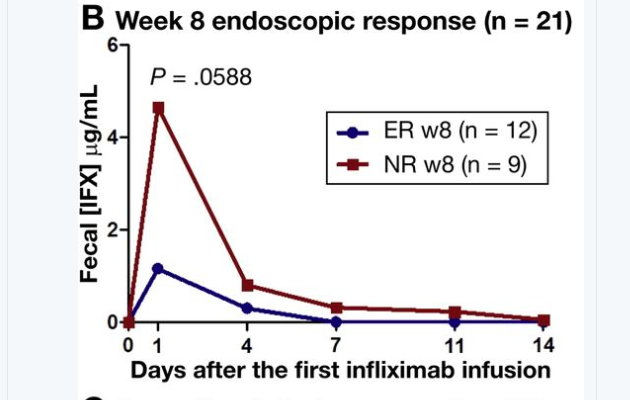
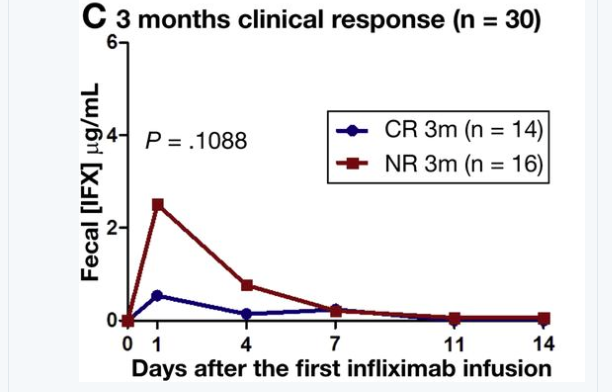
In this study, the authors obtained fecal samples from 30 consecutive patients with moderate to severe UC during the 1st 2 weeks of therapy.  In addition, they obtained serum infliximab levels as well as assessed clinical and endoscopic response at 2 weeks, 8 weeks, and 3 months after treatment began.

Key findings:

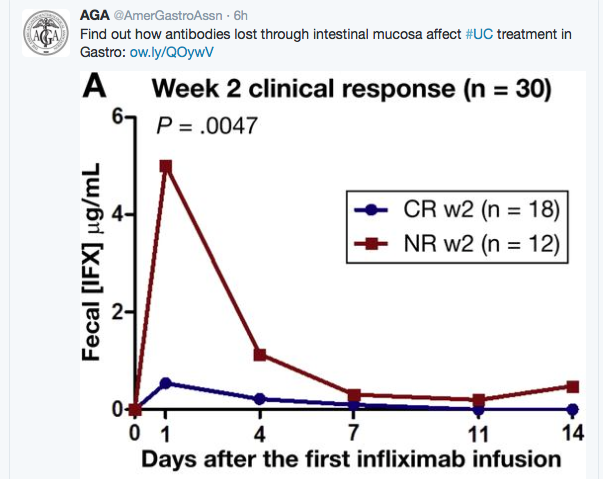
  • Fecal infliximab was detected in 129 of 195 (66%) samples.  The greatest loss was observed approximately 2 days after infusion. Low serum albumin was associated with greater infliximab levels in the stool.
  • Clinical nonresponders at week 2 had significantly higher fecal infliximab
  • The authors did not observe a correlation between fecal and serum infliximab concentrations.  However, it is possible that stool losses could indicate lower mucosal concentrations of infliximab.
From AGA twitter account

From AGA twitter account

From AGA twitter account

From AGA twitter account

From AGA twitter feed

From AGA twitter feed

Bottomline: It is not clear whether stool losses of infliximab directly contribute to drug failure or whether the loss is another biomarker of disease activity/high-risk patients.

The study authors note that “intestinal loss of IFX in moderate to severely active UC is associated with a diminished response to this treatment.  Patients with severe disease can, therefore, benefit from more intensive dosing regiments. This strategy warrants a prospective clinical trial.”

Related blog posts:

Spice It Up? Curcumin for Ulcerative Colitis

This past week I’ve been on call and had not finished a few articles.  One article that was on the to do list: A Lang et al. Clinical Gastroenter Hepatol 2015; 13: 1444-9.

I’ve read it now.  However, even before finishing the article, I read a few good summaries of this article, including one from my colleague Stan Cohen/Nutrition4Kids: Curcumin Helps (A Lot) in Ulcerative Colitis

Here’s an excerpt:

The cover of a prestigious medical journal shows a pile of curcumin and over it, the announcement reads: Curcumin Helps Induce Remission in Mild-to-Moderate Ulcerative Colitis.  That’s big news for a lot of reasons: first, this Indian spice (derived from tumeric) is inexpensive and well-tolerated; second, in a well-designed scientific study, curcumin showed that it was more effective than some medicines; and third, it showed, again, that careful trials of long-used herbs can be done with important results being shown.  Again, because an earlier study (H Hanai, Clinical Gastroenterology 2006, pages 1502-6) had previously shown that curcumin can help keep ulcerative colitis (UC) patients from flaring for up to 12 months. 

This new study (A Lang, Clinical Gastroenterology 2015, pages 1444-9) compared curcumin to a placebo in patients who were not doing well on the standard therapy (mesalamine) for mild to moderate UC.  With a single daily dose of 3 grams of curcumin in capsule form, 65% responded (compared to 12% with a placebo) and 54% actually went into remission, having essentially no symptoms.  Perhaps even, more importantly, 38% of those taking the curcumin showed improvement in the intestinal tissue when a colonoscopy was performed.  That’s comparable or better than some of the medications that are being used.

A few other details: The researchers used a product called Cur-Cure from Bara Herbs Inc (Yokneam, Israel).  Also, the associated commentary in the same journal by CN Bernstein (pages 1450-52) suggests that the study may have targeted mild ulcerative colitis (rather than moderate ulcerative colitis). He comments that the increasing rates of ulcerative colitis among Indian immigrants could be related to including less curcumin in their now more westernized diets.  He also notes, as did Dr. Cohen, that there were previous promising studies dating back to 2006.  Why has it taken nine years for this report?

My Take: This is probably an article worth reading.  Although curcumin appears promising, I worry that a lack of financial incentive may hamper research efforts to better define its place as an agent for treatment of ulcerative colitis.

Related blog posts:

Curcumin

This has been a sad week in our office.  Here are links to two poems that come to mind:

Not Using and Stopping Therapy in IBD

Two recent articles show that a lot of patients are not receiving much therapy in inflammatory bowel disease.

  • Moreno-Rincon E et al. Inflamm Bowel Dis 2015; 21: 1564-71.
  • Melesse DY et al. Inflamm Bowel Dis 2015; 21: 1615-22.

In the first article, a multicenter retrospective study of 102 patients, the authors examined the relapse rates of patients with ulcerative colitis who had withdrawal of thiopurines.  They defined “significant clinical relapse” (SCR) as “the occurrence of UC typical signs or symptoms requiring a rescue therapy such as oral or intravenous corticosteroids, biological therapy, immunosuppressant drugs, recapture with TP [thiopurine] or surgery.”

Key findings:

  • Overall SCR was 32.35%.
  • Predictors of relapse included pancolitis (HR 5.01) and duration of treatment with thiopurines (HR 0.15).

Among those without relapse, the mean duration of remission prior to withdrawal of thiopurines was 54 months compared with 34 months in those who relapsed. In figure 2, the authors note that the rate of relapse was 19.2% for those who received >48 months of thiopurine treatment compared with a 45% rate of relapse for those who received treatment for 13-47 months.  The authors note that several studies have shown higher relapse rates than reported in this cohort and that interruption of therapy is associated with a considerable risk of relapse.

Limitations: small retrospective study and the expectation that their SCR would capture the true relapse rate.

The second study, using a Manitoba database, shows a strikingly-high rate of nonuse of medical therapy. Between 1996-2012, 3902 patients with IBD were identified; 47% with Crohn’s disease (CD) and 53% with ulcerative colitis (UC).  While only 11.7% of IBD patients did not have medication dispensed in the first year after diagnosis, beyond this period, “roughly half of all patients with IBD have not used IBD-specific medications in the previous year.”  The authors are not certain how much nonuse is due to nonadherence or nonprescription. They note that there was higher nonuse in patients with CD, possibly due to use of surgical treatment.  However, they note that multiple medications have been shown to reduce postsurgical relapse in CD.

My take: There are a lot of patients off therapy, both due to withdrawal of therapy when doing well and others due to nonadherence or nonprescription.  With or without overt symptoms, these studies make one wonder whether undertreatment will lead to long-term complications or whether there could be a significant number of patients who are overtreated.  Either way, it remains quite difficult to predict which patients will do well off medical therapy.

Broadcasters Really Know the Key Points to Winning!

Broadcasters Really Know the Key Points to Winning!

Is It Right? Anti-TNF Therapy Does Not Fix IBD-Related Anemia

A surprising study (Koutroubakis, IE et al. Inflamm Bowel Dis 2015; 21: 1587-93) of prospectively-collected data from 430 patients with inflammatory bowel disease (IBD) showed that the rate of anemia did not change after 1 year in patients treated with anti-tumor necrosis factor (anti-TNF) therapy and oral iron.

The data was derived from 2010-2012 and included 324 patients with Crohn’s disease (51.6% females) with a median age of 41 years.  Anemia was defined as hemoglobin (Hb) <13 g/dL in men and <12 g/dL in women.  Patients with Hb <10 g/dL were considered to have severe anemia. Key findings:

  • Prevalence of anemia in IBD patients treated with anti-TNF was 38.1% at baseline and then 36.6% at 1 year.
  • Severe anemia was identified in 10% at baseline and 9.9% at 1 year.
  • A hematopoietic response with a Hb ≥2 g/dL was observed in 33.6% (n=45 of 134 anemic patients) and 14 (40%) of those with severe anemia.
  • There were 45 new anemic patients at 1 year; 64.4% were nonresponders to anti-TNF treatment.
  • Using multivariate logistic regression analysis, the author noted that use of immunomodulators was associated with an odds ratio of 2.56 of improvement in hemoglobin levels.

The authors state that anemia is the most common extra intestinal manifestation of IBD and remains underappreciated.  Anemia in IBD correlates with the extent of intestinal disease and activity.

Bottomline: “Use of anti-TNF therapy had only a modest effect on patients’ Hb level.”

From related post: IBD Update January 2015 (Part 2)

Inflamm Bowel Dis 2014; 20: 2266-70.  This study with 749 patients from Sweden showed that a large number of inflammatory bowel disease patients did not receive with iron supplementation: “Only 46% of patients with anemia were treated with iron supplementation or blood transfusion.”  This study showed frequent persistence of anemia one year after diagnosis, especially in children. At time of diagnosis, 55% of children and 27% of adults had anemia and 28% and 16% at one year followup, respectively.

My take: Treatment of the underlying IBD, often helps anemia.  However, in some patients treating the anemia with iron may help improve symptoms as much or more than other aspects of treatment.

Related blog post: Microcytic Anemia Review | gutsandgrowth

Sandy Springs, Georgia

Sandy Springs, Georgia


Ulcerative Colitis with Questionable Response to Fecal Transplant

Fecal microbiota transplantation (FMT) is not going to be a “magic bullet” for most patients with inflammatory bowel disease. So far, it is unclear whether FMT works at all.  A recent study (full text link: Rossen NG et al. Gastroenterol 2015; 145: 110-8) with only 37 patients echo that experience. Here is the abstract:

Background & Aims

Several case series have reported the effects of fecal microbiota transplantation (FMT) for ulcerative colitis (UC). We assessed the efficacy and safety of FMT for patients with UC in a double-blind randomized trial.

Methods

Patients with mild to moderately active UC (n = 50) were assigned to groups that underwent FMT with feces from healthy donors or were given autologous fecal microbiota (control); each transplant was administered via nasoduodenal tube at the start of the study and 3 weeks later. The study was performed at the Academic Medical Center in Amsterdam from June 2011 through May 2014.

The composite primary end point was clinical remission (simple clinical colitis activity index scores ≤2) combined with ≥1-point decrease in the Mayo endoscopic score at week 12. Secondary end points were safety and microbiota composition by phylogenetic microarray in fecal samples.

Results

Thirty-seven patients completed the primary end point assessment. In the intention-to-treat analysis, 7 of 23 patients who received fecal transplants from healthy donors (30.4%) and 5 of 25 controls (20.0%) achieved the primary end point (P = .51). In the per-protocol analysis, 7 of 17 patients who received fecal transplants from healthy donors (41.2%) and 5 of 20 controls (25.0%) achieved the primary end point (P = .29). Serious adverse events occurred in 4 patients (2 in the FMT group), but these were not considered to be related to the FMT. At 12 weeks, the microbiota of responders in the FMT group was similar to that of their healthy donors; remission was associated with proportions of Clostridium clusters IV and XIVa.

Conclusions

In this phase 2 trial, there was no statistically significant difference in clinical and endoscopic remission between patients with UC who received fecal transplants from healthy donors and those who received their own fecal microbiota, which may be due to limited numbers. However, the microbiota of responders had distinct features from that of nonresponders, warranting further study. ClinicalTrials.gov Number: NCT01650038.

Related blog posts:

Cumberland Island

Cumberland Island


Will Infliximab Worsen Flare-ups Associated with Cytomegalovirus Infection?

Another look (Pillet S, et al. Inflamm Bowel Dis 2015; 21: 1580-86) at Cytomegalovirus (CMV) infection in patients with ulcerative colitis (UC) examines 109 flareups in 73 patients who were receiving maintenance therapy with anti-TNF therapy.

This was a single-center prospective observational study.  CMV load was determined with PCR based on a pair of biopsies. DNA load was either undetectable, mild (10-250 copies/mg of tissue) or high (>250 copies/mg of tissue). 69 patients with anti-TNF therapy were compared with 40 patients receiving azathioprine. Key findings:

  • CMV reactivation was noted in 35% of anti-TNF therapy patients and 38% in azathioprine patients.
  • Among 45 patients requiring infliximab optimization, clinical remission was not significantly impacted by the presence of CMV reactivation.
  • 17 of 20 who had repeat biopsies 8 weeks later had stable or decreased CMV load.

Bottomline: This prospective, small study shows that “in patients with moderate-to-severe UC, treatment with anti-TNF mab does not increase the risk of colonic CMV infection.”  In addition, “no adverse influence of CMV colonic infection was observed in patients with flare-up treated by anti-TNF mabs.”

Disclaimer: These blog posts are for educational purposes only. Specific dosing of medications/diets (along with potential adverse effects) should be confirmed by prescribing physician/nutritionist.  This content is not a substitute for medical advice, diagnosis or treatment provided by a qualified healthcare provider. Always seek the advice of your physician or other qualified health provider with any questions you may have regarding a condition.

Zoo Atlanta

Zoo Atlanta

Utility of Antiviral Therapy for Cytomegalovirus in the Setting of Inflammatory Bowel Disease

According to a recent study (Jones A et al. Clin Gastroenterol Hepatol 2015; 13: 949-55), the tissue density of cytomegalovirus (CMV) is an important determinant of antiviral response in patients with inflammatory bowel disease (IBD).

In this case-control study, the authors identified 68 samples from 1111 patients with IBD that were found to contain CMV.  Adequate data was available for 50, including 16 with high-grade CMV (all treated) and 34 with low-grade CMV (20 treated).  High-grade CMV was defined as biopsies with 5 or more inclusions.  Treatment included ganciclovir, valganciclovir or both; 33 of 36 treated patients received at least 21 days of therapy.

Key findings:

  • Patients with high-grade CMV showed significant benefit from treatment: they had the best outcomes with “only 33% undergoing surgery by 1 year after biopsy.”
  • All patients with low-grade CMV, treated or not, were more likely to undergo surgery than those with high-grade CMV, with HR of 2.13.  However, the treated low-grade CMV had a lower risk of surgery (HR 0.39) compared with the untreated group.  73% of the untreated low-grade CMV group had undergone resection by 1 year after biopsy.

The authors note the many limitations of the study.  Requests to rule out CMV were not done uniformly but “usually reflected refractoriness of steroids or failure to respond to escalation of therapy.”

Bottomline: In those with high-grade CMV, the likelihood of responding to antiviral therapy was much higher than in patients with low-grade CMV; however, treatment in all patients with CMV inclusions was associated with improved outcomes.

Disclaimer: These blog posts are for educational purposes only. Specific dosing of medications/diets (along with potential adverse effects) should be confirmed by prescribing physician/nutritionist.  This content is not a substitute for medical advice, diagnosis or treatment provided by a qualified healthcare provider. Always seek the advice of your physician or other qualified health provider with any questions you may have regarding a condition.

Bird in Flowers

Money Matters in Pediatric Inflammatory Bowel Disease

A very pragmatic article (Sin AT et al. Inflamm Bowel Dis 2015; 21: 1368-77) describes the out-of-pocket cost burden in pediatric inflammatory bowel disease (IBD). For anyone who lives on planet earth, how much a procedure or treatment costs weighs very heavily on many decisions.  This is particularly relevant in pediatric IBD.

In a cross-sectional cohort analysis, the researches collected data with surveys from 150 parents of children with IBD (67 Crohn’s disease, 83 Ulcerative colitis).  The median patient age was 14 years.

Findings:

  • Annually, out-of-pocket expenses were >$5000 in 5.3%, >$1000 in 28.6%, and >%500 in 63.6%.
  • Increased expenditures were derived from the following: emergency department visits with 36% having had an ED visit in past year, procedures/testing with 20% who spent >$2000, and from treatments (medications/diet).  10.7% reported missing medications due to cost.
  • “Families with household incomes between $50,000-100,000 had a statistically-significant probability (80.6%) of higher annual OOP costs than families with lower income…or higher income.”
  • Not surprisingly, patients with IBD “who have relapsing or uncontrolled IBD states are particularly at risk to require acute care services, which represent high OOP costs for families.”
  • The authors also describe missed workdays and lost wages as another financial burden.

Take-home message: This study helps quantitate the out-of-pocket expenses and financial burden that families face when they have a child with IBD.  In some patients, improved control of IBD will lower these expenses by decreasing costs from emergency department visits, office visits, and hospitalizations.

Cumberland Island

Cumberland Island