Unknown's avatar

About gutsandgrowth

I am a pediatric gastroenterologist at GI Care for Kids (previously called CCDHC) in Atlanta, Georgia. The goal of my blog is to share some of my reading in my field more broadly. In addition, I wanted to provide my voice to a wide range of topics that often have inaccurate or incomplete information. Before starting this blog in 2011, I would tear out articles from journals and/or keep notes in a palm pilot. This blog helps provide an updated source of information that is easy to access and search, along with links to useful multimedia sources. I was born and raised in Chattanooga. After graduating from the University of Virginia, I attended Baylor College of Medicine. I completed residency and fellowship training at the University of Cincinnati at the Children’s Hospital Medical Center. I received funding from the National Institutes of Health for molecular biology research of the gastrointestinal tract. During my fellowship, I had the opportunity to work with some of the most amazing pediatric gastroenterologists and mentors. Some of these individuals included Mitchell Cohen, William Balistreri, James Heubi, Jorge Bezerra, Colin Rudolph, John Bucuvalas, and Michael Farrell. I am grateful for their teaching and their friendship. During my training with their help, I received a nationwide award for the best research by a GI fellow. I have authored numerous publications/presentations including original research, case reports, review articles, and textbook chapters on various pediatric gastrointestinal problems. In addition, I have been recognized by Atlanta Magazine as a "Top Doctor" in my field multiple times. Currently, I am the vice chair of the section of nutrition for the Georgia Chapter of the American Academy of Pediatrics. In addition, I am an adjunct Associate Clinical Professor of Pediatrics at Emory University School of Medicine. Other society memberships have included the North American Society for Pediatric Gastroenterology Hepatology and Nutrition (NASPGHAN), American Academy of Pediatrics, the Food Allergy Network, the American Gastroenterology Association, the American Association for the Study of Liver Diseases, and the Crohn’s and Colitis Foundation. As part of a national pediatric GI organization called NASPGHAN (and its affiliated website GIKids), I have helped develop educational materials on a wide-range of gastrointestinal and liver diseases which are used across the country. Also, I have been an invited speaker for national campaigns to improve the evaluation and treatment of gastroesophageal reflux disease, celiac disease, eosinophilic esophagitis, hepatitis C, and inflammatory bowel disease (IBD). Some information on these topics has been posted at my work website, www.gicareforkids.com, which has links to multiple other useful resources. I am fortunate to work at GI Care For Kids. Our group has 17 terrific physicians with a wide range of subspecialization, including liver diseases, feeding disorders, eosinophilic diseases, inflammatory bowel disease, cystic fibrosis, DiGeorge/22q, celiac disease, and motility disorders. Many of our physicians are recognized nationally for their achievements. Our group of physicians have worked closely together for many years. None of the physicians in our group have ever left to join other groups. I have also worked with the same nurse (Bernadette) since I moved to Atlanta in 1997. For many families, more practical matters about our office include the following: – 14 office/satellite locations – physicians who speak Spanish – cutting edge research – on-site nutritionists – on-site psychology support for abdominal pain and feeding disorders – participation in ImproveCareNow to better the outcomes for children with inflammatory bowel disease – office endoscopy suite (lower costs and easier scheduling) – office infusion center (lower costs and easier for families) – easy access to nursing advice (each physician has at least one nurse) I am married and have two sons (both adults). I like to read, walk/hike, bike, swim, and play tennis with my free time. I do not have any financial relationships with pharmaceutical companies or other financial relationships to disclose. I have helped enroll patients in industry-sponsored research studies.

“Weekend Effect” –From the Other Side of the Bed

Many times when I’m working at the hospital on a weekend I’ve wondered how long hospitals can continue to offer fewer services during weekends than during the work week.  Usually if I’m there, I don’t want to hear that something has to wait until Monday.  It also puts me in the uncomfortable position of deciding whether something is urgent enough that on-call staff (eg. radiology, anesthesiology) need to be called in.  At the same time, some services in the hospital, for example, interventional radiology may have only one or two people who are qualified and it is unrealistic to expect them to be available 24/7/365.

A recent commentary (Klass P, NEJM 2015; 372: 402-405) helps provide a family’s perspective regarding this situation. Here are some of the key points:

  • “It can be shocking to hear, over and over, about the ways that weekends are slower and things don’t get done.”
  • Often many services are absent like physical therapy and psychiatry.  Most other services are understaffed and “cross-covering” patients with less familiarity.
  • For many conditions, morbidity and mortality are higher on weekends. (J Pediart Surg 2014; 49: 1087-91, NEJM 2001; 345: 1580, JAMA 2008; 299: 785-92))
  • “When you’re sick and scared, Sunday is the same as Tuesday.”

Bottomline: This commentary makes a strong case for saying “the hospital is not actually about patients. It’s about doctors and nurses, physical therapists and nutritionists.”

Question: Do you think weekend staffing should change or will change to address these shortcomings?

Related blog post:

Related link:


Cool Mirror at High Museum

Cool Mirror at High Museum

What to Fear in 2015

From Parade Magazine,  What to Fear in 2015:

An excerpt:

Here are a few of the things you should and should not fear in 2015:

  • Flu not Ebola
  • Domestic violence not serial killers, pedophiles
  • Heart disease not Mercury in fish
  • Not getting enough dietary fiber not gluten
  • The re-appearance of measles, whooping cough, and other preventable diseases not vaccine side effects
  • Texting while driving not air travel
  • Malware on your cell phone not bulk password theft
  • Gun violence among young people not school shootings/mass murders
  • Sitting too much not heart attacks during exercise

Another link on the measles epidemic from NY Times: Vaccine Critics Defensive. Another editorial remarked on how Ebola which is much less contagious than the measles alarmed so many people in this country; it stated that if a terrorist, rather than parents refusing vaccinations, had unleashed a highly contagious virus on our communities, many would be calling for military retaliation. Unfortunately, it takes a measles epidemic to provide a passionate argument for immunizations. Related blog post1400 Different Immunization Schedules -What Could Go Wrong …

From NBC News Measles Vaccine FAQ

Leptin Deficiency and Early-Onset Extreme Obesity

A brief report (NEJM 2015; 372: 48-54) details a case of 2.5 year old who weighed 33.7 kg (>99.9% and z score of 7.2) and had BMI of 38.6 (>99.9% and z score of 5.8).

Link to article (and picture/growth curve)

The authors determined that he had a mutation which caused biologically inactive leptin.  Subsequently, treatment with metreleptin injections, improved eating behavior and resulted in substantial weight loss.

Key points:

  • “Current clinical recommendations advise that leptin serum concentrations be measured in children who have rapid weight gain in the first months of life.” (“The severely obese patient –a genetic work-up.” Nat Clin Pract Endocrinol Metab 2006; 2: 172-7)
  • This case report demonstrates that normal circulating levels of the hormone “do not rule out disease-causing mutations in the gene encoding leptin.”

Related blog posts:

Screen Shot 2015-01-01 at 5.12.58 PM

Not So Promising: FMT for Ulcerative Colitis

After initial reports suggesting that fecal microbiota transplantation (FMT) may be helpful for ulcerative colitis (UC), more recent data suggest that it is not so promising (JPGN 2015; 60: 27-29, editorial 3).

In this open-label, prospective study of four patients, all boys aged 13-16 years, patients tolerated a single-dose FMT (via nasogastric tube) without adverse effects but there was no significant clinical or laboratory improvement.

The article provides a number of references regarding the experience of FMT for UC.

Related blog posts:

1400 Different Immunization Schedules -What Could Go Wrong?

A recent study (J Pediatr 2015; 166: 151-6) has examined the frequency of “alternative” (non-standard) vaccination schedules among 222,628 children in New York (2009-2011), using a statewide mandatory immunization information system.

Key findings:

  • 25% of children followed an non-standard immunization schedule.
  • At 9 months of age, children on an non-standard schedule were less likely to be up-to-date (15% compared with 90%, P<0.05).

The authors note that in a separate study that there were “1400 individualized vaccination patterns.”  These patterns break down into three: delays of vaccine, selective refusal of specific vaccines, and reduction in the number of vaccines.

In a brief summary, Sarah Long notes that for parents/doctors –“Although their intent is heightened protection of their children/patients from harm, the result is the opposite.  Alternative “schedules” are completely untested for immunogenicity or safety.”

One limitation of this study is that it was conducted in New York.  There is wide variability in the resistance to vaccination among states.

Bottomline: Their has been an increase in the use of non-standard vaccine schedules.  This is contributing to community vulnerability to vaccine preventable diseases.

A related story: “Disneyland” Measles Outbreak (from USA Today) and from NY Times (1/21/15): Measle cases linked to Disneyland (& unvaccinated students).  1/28/15 Measles in Arizona reaches ‘critical point’

Related blog posts:

Which is Safer –Drip Feeds or Bolus Feeds in Healthy Preterm Infants?

A recent provocative study (J Pediatr 2014; 165: 1255-7) takes a look at the frequency of cardiorespiratory events in healthy neonates <33 weeks gestation who needed supplemental enteral tube feeds.

It is generally accepted that continuous or “drip” feedings are less likely to provoke reflux events (and reflux-induced cardiorespiratory events) by limiting the amount of formula in the stomach at any time point.  If there is less formula, presumably there would be less stomach distention and a lower likelihood of reflux.  In addition, a continuous amount of formula would serve to buffer stomach acid.

Despite the sound theoretical underpinnings, is this really true?  In this study, the authors detected fewer cardiorespiratory events with polysomnographic monitoring in healthy premature neonates who were fed with bolus feedings rather than with drip feedings.

Study design: Each of 33 infants served as its own control.  During a 6-hour monitoring period, noninvasive polysomnographic recordings were performed.  Each infant was fed twice via an orogastric tube.  The first meal was given as a 10-minute bolus (by gravity) and the second was delivered over 3 hours. It is noted that the tube was removed after the bolus feeding (this is not routinely done in clinical practice).

Demographics: Median gestational age was 31 weeks and median postnatal age was 16 days.  Fortified human milk was given in 12, premature formula in 7, and 14 had mixed feeding.

Results (Table 2): “continuous feeding was associated with a greater number of prolonged apneas and apnea-related hypoxic episodes.”

  • Median Apnea Frequency: 4 in continuous versus 2 in bolus group (no obstructive apneas were noted)
  • Median hypoxic episodes: 3 in continuous versus 2 in bolus group.

The authors speculate that leaving the tube in place for continuous feeds could increase GER-related apnea or trigger ‘protective upper airway reflexes in response to the irritating stimulus.’

Bottomline: The assumption that continuous feedings will reduce cardiorespiratory events is not supported by this study.  The findings warrant cautious interpretation; the small sample size and specific ages of the premature infants are significant limitations.   In addition, leaving an enteral tube in place after a bolus feeding would be a better design as this is a routine practice.

Related blog post:

Prucalopride -Not Better Than Placebo for Children with Constipation

Background: There were high expectations for prucalopride for the treatment of constipation based on previous small studies as well as a placebo-controlled trial in adults.  In adults, after 12 weeks of treatment, between 19.5-29% were responders compared to 9.6-12.1% in placebo patients. Prucalopride is a 5-hydroxytryptamine receptor-4  (5HT4) agonist which has been shown to accelerate colonic motility and is similar structurally to agents like cisapride and tegaserod; these latter medications have shown effectiveness as prokinetics but were limited by life-threatening cardiovascular side effects.

Design: Large (n=213), multicenter, placebo-controlled trial (Mugie SM, et al. Gastroenterol 2014; 147: 1285-95, editorial 1214-16). Response to medication indicated by >3 spontaneous bowel movements per week and <1 episode of fecal incontinence every 2 weeks.

Findings:

  • 17% of prucalopride subjects and 17.8% of placebo subjects were considered responders.
  • If based solely on bowel movement frequency, 29.2% of prucalopride achieved >3 BMs/week, whereas 35.5% of placebo-treated patients achieved this frequency.
  • Adverse effects were similar

Why did Prucalopride not work?

The authors and editorial make several speculations.  In children, withholding behavior is much more important in the pathophysiology of functional constipation (FC) than in adults.  In addition, slow transit constipation is much more common in adults than in children. In the adolescents (≥12 to <18) there was a mild response noted: 18.5% compared with 14.8% of placebo-treated patients (P=.38). The editorial notes that the short length of the trial (8 weeks) could explain the negative results, though this is unlikely.

The editorial, by Samuel Nurko and Miguel Saps, notes a much higher response to polyethylene glycol which “is the mainstay of treatment.”  “PEG-based solutions achieved a successful outcome in 56% of participants compared with 29% in the lactulose group.”

Take-home message: “This study does not provide new data to justify a change in the indication of PEG as first line of treatment for FC in children.”

In followup to questions regarding Miralax safety, here is a link from NASPGHAN’s Neurogastroenterology and Motility Committee: Miralax FAQ

Related blog posts:

A Sign in Our Office --Needs Clarification

A Sign in Our Office –Needs Clarification

AAP -Behind the Scenes (Part 2)

Besides the focus on legislation and access to care, the AAP meeting provided an infectious disease update from Dr. Harry Keyserling, membership update by Dr. Roma Klicius, the Pediatric Foundation Report by Dr. Bob Wiskind, an update on oral health care by Dr. Chevron Brooks, a brief update on AAP Friends of Children by Dr. Jay Berkelhammer, and discussion about transitional care.

With regard to the infectious diseases update, Dr. Keyserling noted that despite the flu vaccine’s lower “match” this year and its reduced effectiveness, it is still quite important to receive the flu vaccine.

  • Each year, about 1/3rd ot the population gets the flu.
  • About 1 in 10,000 people die due to the flu.
  • In 2012-13, there were 171 pediatric deaths across the country due to influenza.  90% of these deaths occurred in children who were not immunized; in other words, for a child with the flu, the risk of death is more than 10 times higher in those who do not receive the immunization.

Here are a couple of slides (used with permission) regarding the flu:

Risk of Death from the Flu

Risk of Death from the Flu

Flu Data thru Jan 2015

Flu Data thru Jan 2015

Flu Vaccine Coverage

Flu Vaccine Coverage

Bottomline: The AAP is working on preventing deaths from all vaccine-preventable deaths, including the flu.

Related blog posts:

Since my job at the AAP is to work on nutrition-related issues, I would welcome suggestions for areas of concern.  As there are separate areas devoted to obesity and breastfeeding, my goal is to work on other aspects of nutrition in children.  Some ideas that have come up already include an update on gluten-related disorders and nutritional supplements.  Any other advice?

Upcoming AAP Schedule

Upcoming AAP Schedule

AAP -Behind the Scenes (Part 1)

Recently I was asked to become a board member for the Georgia Chapter of the American Academy of Pediatrics (AAP) in the role of chair of the section of nutrition.  My role at this meeting was limited.  I was impressed by the commitment of the participants and by the range of activities that the AAP chapter was working on –all in the efforts of improving the health of children in Georgia.

I only took a few notes but here are some of the details.  Dr. Evelyn Johnson (President) provided the president’s report and an overview of the chapter activities.

Dr. Anu Sheth provided an update on the Medicaid Task Force.  This issue was discussed in some detail.  The issue at stake is the low reimbursement for office visits for children with Medicaid coverage; the rate has not changed in 13 years with one notable exception.  In 2013-2014, the federal government provided a one-time boost in the rates of Medicaid reimbursement with the role out of the ACA (Obamacare) to encourage availability of primary care physicians to see the new enrollees.  There is preliminary evidence that this boost did improve access to care.

According to a recent study (NEJM 2015; January 21, 2015DOI: 10.1056/NEJMsa1413299), “Our study provides early evidence that increased Medicaid reimbursement to primary care providers, as mandated in the ACA, was associated with improved appointment availability for Medicaid enrollees among participating providers without generating longer waiting times.”

Since 43.2% of all children in Georgia receive their health insurance through Medicaid this is a big issue.  It is also directly related to another topic of provider access.  61 counties in Georgia have a deficit of needed pediatricians and 23 counties have no pediatrician at all.  Currently, Medicaid rates to physician practices are only about 75% of Medicare rates and compared to commercial insurance plans, they pay only half.

Based on these considerations, the AAP is urging its members to contact their state legislators, particularly those more involved in the budget decision-making process.  While bumping Medicaid rates in the face of other budget constraints may be difficult, default limiting of access results in higher costs through emergency room visits and complications.
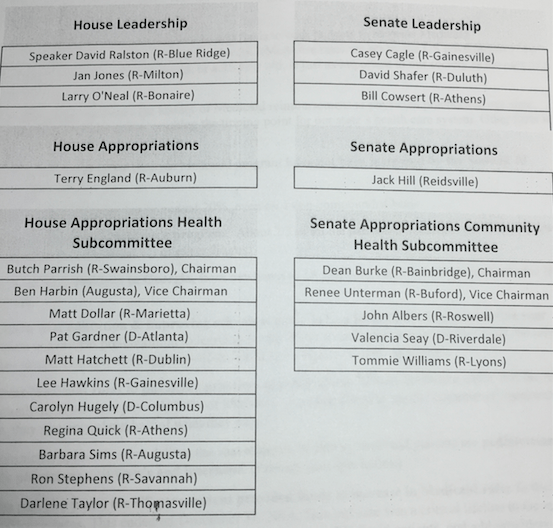
Georgia Politicians with Greatest Impact on Healthcare Decisions

Georgia Politicians with Greatest Impact on Healthcare Decisions

Rural communities are more affected by access issues than urban counties.  Dr. Angela Highbaugh-Battle provided an update on the Governor’s Rural Hospital Task Force.  There have been a number of hospital closures and more appear to be imminent.  Communities that are losing hospitals are losing important jobs, access to timely care, and will have difficulty attracting new businesses.

Another related topic was the issue of ‘retail-clinic’ healthcare.  While the ease of access is quite helpful for families, there are numerous concerns about the quality of care.  Several clinicians described their efforts to provide alternatives including extended hours in their practices and weekend hours as well.

Here’s a related article: “Retail clinics are in, traditional primary care practices are out”

One fascinating aspect about the discussion of retail clinics was its juxtaposition with efforts to improve the process of remaining board-certified (See related blog: Resistance to Maintenance of Certification | gutsandgrowth).  Given the increasing use of retail-clinics and midlevel providers, several clinicians emphasized that board-approval is not a strong consideration for families seeking healthcare.  The fact that the board approval process is not tied to a broad effort to show its impact on patient care and/or to market the efforts of pediatricians has led to widespread dissatisfaction.

Take-home message: The issue of adequate access to primary care physicians along with high quality care is important for everyone.  Make your voice heard!

Related blog posts:


Helpful Position Paper: Percutaneous Endoscopic Gastrostomy in Children

A recent European Society for Pediatric Gastroenterology Hepatology and Nutrtition (ESPGHAN) position paper provides some useful advice regarding the management of percutaneous endoscopic gastrostomy (PEG) in children and adolescents (JPGN 2015; 60: 131-41).

Table 1 provides a succinct description of the potential benefits of PEG compared with nasogastric tube including less dislodgement, reduces risk of aspiration, better appearance, safer/more reliable enteral access, optimizes development of oral skills, less blockage/clogging, cost-effective, less interference with daily activities, avoids nasal irritation/trauma, reduced anxiety at mealtimes, and shorter meal times.

Table 2 provides a good summary of clinical indications including optimizing nutritional status, maintaining hydration, supporting unpalatable diet, decompressing stomach, improving medication adherence, ensuring safe feedings/prevent aspiration, and improving quality of life.

The position paper reviews relative and absolute contraindications (uncorrectable coagulopathy, interposition of enlarged organs, frank peritonitis); I did not see any mention of high dose steroids as a relative contraindication.  Given high dose steroids’ impact on healing, PEG needs to be avoided if possible in this setting (in my opinion).

The authors provide extensive information on potential complications (table 6 and table 7).

Other key points:

  • “In the United Kingdom, it is accepted by the National Institute of Clinical Effectiveness that expectation of continuous NGT use for a minimum of 4 weeks (www.nice.org.uk/CG032 –this reference provided by authors focuses on NGT in adults), or even 2 to 3 weeks, should prompt consideration of PEG insertion.”
  • “The use of a routine preoperative upper GI contrast study is NOT advised to rule out malrotation.”
  • “Asymptomatic children do not require investigation for GERD before PEG insertion.” However, the authors note that in the presence of significant symptomatic reflux, or reflux in the presence of an unsafe swallow/progressive neurologic disease, or chronic respiratory disease, this should prompt discussion around the need for a surgical antireflux procedure.
  • The authors suggest that PEG change to a button can occur “after a period of 2 months or more.” Our institution generally does not change prior to 3 months.
  • The authors state that formula (rather than clears) can be started within 4 to 6 hours of PEG insertion.
  • One aspect of their recommendations that I disagreed with was their advice on preventing a ‘buried bumper.’  “To prevent a ‘buried bumper,’ the PEG should be carefully pushed into the stomach by 1 to 2 cm and then rotated once a week from day 7 postinsertion.”
  • Perhaps this advice is offered as the guideline also suggests that patients do not need much follow-up: “The child will require follow-up, typically provided by nurse specialists 3 months after placement of the gastrostomy.  Thereafter, annual review of the device is usually adequate…between routine appointments caregivers should have access to appropriately trained professionals.”  In my view, if the tube is appropriately sized (checked early on) and patients are followed (for excessive weight gain), then pushing in the tube should be unnecessary.

Take-home message: Overall, this is a useful reference/summary for PEG tube management, though some recommendations are based on practice patterns rather than high-quality data.

Are there others who would like to relay their experience and advice?

Related blog posts: