AGA Guidelines on Medicines for Irritable Bowel

New guidelines on the use of medicines for irritable bowel syndrome from Atlanta Gastroenterology Association (AGA) have been published (Gastroenterol 2014; 1146-48, technical review: 1149-72).

Here’s the link: AGA IBS Guidelines.

In brief:

For IBS-C

  • Linaclotide: AGA recommends as better than no drug treatment in adult. This is the only “strong” recommendation with high-quality evidence.
  • Lubiprostone: AGA suggests over no drug treatment.
  • PEG Laxatives: AGA suggests over no drug treatment.

For IBS-D:

  • Rifaximin: AGA suggests over no drug treatment.
  • Alosetron: AGA suggests over no drug treatment.
  • Loperamide: AGA suggests over no drug treatment.

For IBS:

  • Tricyclic antidepressants: AGA suggests over no drug treatment.
  • Selective Serotonin Reuptake Inhibitors: AGA suggests against using for IBS.
  • Antispasmotics: AGA suggests over no drug treatment.


Also noted:

Am J Gastroenterol 2014; 109: 1547-61. (Thanks to Ben Gold for this reference.) Meta-analysis of prebiotics/probiotics for IBS.  43 RCTs were eligible for inclusion.  Key finding: IBS symptoms, including pain, bloating and flatulence were improved with RR of 0.79 compared with placebo.  “Probiotics are effective treatments for IBS, although which individual species and strains are the most beneficial remains unclear.”

Related blog posts:

“The future of gastrointestinal disease and symptom monitoring: biosensor, E-portal, and social media”

At this year’s NASPGHAN meeting, the keynote lecture was given by Brennan Spiegel.  (Brennan Spiegel, MD (@BrennanSpiegel) | Twitter) This was a great talk!

This blog entry has abbreviated/summarized the presentation. Though not intentional, some important material is likely to have been omitted; in addition, transcription errors are possible as well.

Challenges in healthcare:

  • Time with patient is limited/poorly-timed in comparison to health care needs.
  • Care is reactive rather than proactive.
  • Care is expensive.

We spend all our time within walls of our clinic/hospital, but patients spend 99% time outside


How do we tailor care to the individual and make it more cost-effective? How do we get there?  Potential/Emerging Tools:

    • Patient provider portals (including mobile)
    • Social media
    • Wireless biosensors


Key question for patients: What is the most important goal for you/your family today?

How to improve communication with family? Electronic medical records often designed for billing rather than educating

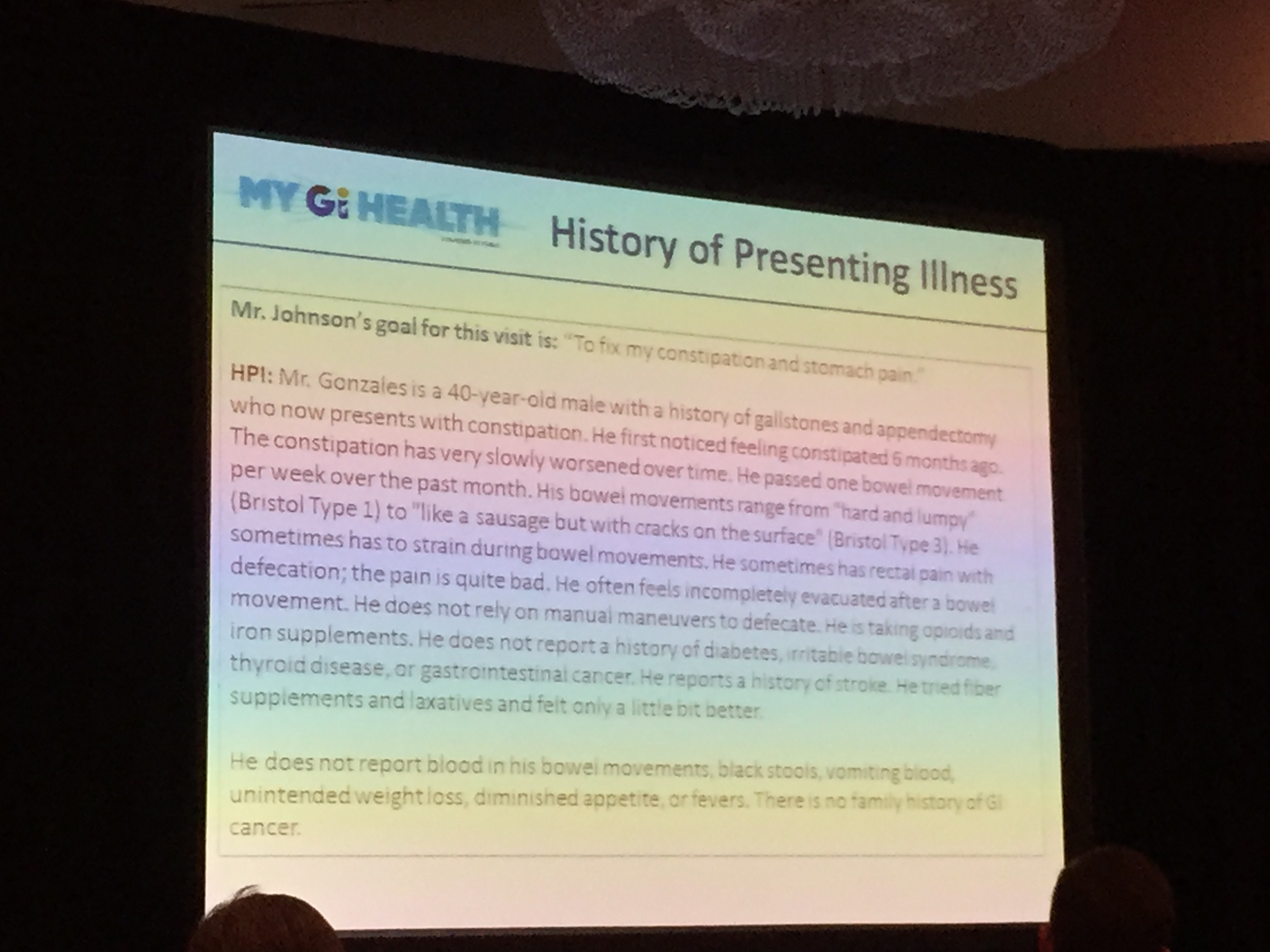
MyGiHealth website/soon-to-be-app.  Here’s a link to YouTube video introduction.

  • HISTORY: Trained computer to interview patient re: abdominal pain –where, timing, risk factors for H pylori, etc.
  • Symptoms and severity: constipation, abdominal pain, gas/bloating, heartburn, diarrhea, dysphagia, incontinence, nausea/vomiting (Promise scales –percentiles).
  • Computer history looked better than history by physician (example below with fictional patient). If history obtained prior to physician coming into room, this would allow physician more time to communicate with patient rather than documenting (Related post: Aptly titled “The Cost of Technology” | gutsandgrowth)
  • Man vs Machine (Spiegel in press Am J Gastro 2014). History performed well with regard to billing complexity and completeness.
  • THIS IS COOL!
  • Physician still needed to analyze information and make diagnosis/treatment plan.
  • Also website/app with EDUCATION applicable to patient.
History by computer outperformed physicians

History by computer outperformed physicians

Obtaining information outside the confines of the office can help overcome Hawthorne effect. (Related blog post: Checklists -Helpful? Overhyped? Hawthorne Effect …). Passive vs Active monitoring.

Twitter: “What you say on twitter may be seen by everyone all over the word instantly”

  • Tool for epidemiologic data.
  • Marketing/advertising
  • Recruiting for clinical studies
  • Measure consumer sentiment
  • Educate patients/providers
  • Forge patient affinity groups
  • Monitor patients for clinical practice
  • Help to manage and direct care

Mayo clinic is studying the impact of social media.

Example of patients initiating research. “Spontaneous Coronary Artery Dissection: A Disease-Specific Social Networking Community-Initiated Study” Lead author: Marysia Tweet

Biosensors:

  • “91% of people keep their phone within 3 feet of themselves 24 hours a day.”
  • Can be used to track intake of food, air quality, movements etc
  • Current sensors: Fit bit, amigo (?sp), shine (?sp), Zeo (for sleep) others.
  • Fitbit: Calories, distance, active time, sleep time
  • More advanced sensors for athletes. Stride dynamics can predict marathon winner at mile 16!
  • Wireless sleep (eg. Zeo) monitor equivalent to formal sleep study
  • Q Sensor –can measure stress: physical ,cognitive, emotional (watching horror movie)
  • Hapi fork –can tell if you are eating too fast (correlated with BMI)
  • Proteus –monitors intake
  • Propeller –monitors MDI use for asthma (FDA approved)
  • AbStats Digestion Sensor –adheres to abdomen and can provide neurogastroenterology data. Green light –will tolerate feeds, Yellow light –will tolerate clears

75,000 health apps available at this time.

Recommended Reading by Dr. Spiegel: The Creative Destruction of Medicine by Eric Topol.  The Creative Destruction of Medicine: How the Digital …

 

Genetics of Autoimmune Hepatitis

Briefly noted:

Recently, the first genome-wide association identified mutations associated with type 1 autoimmune hepatitis (AIH1) (Gastroenterol 2014; 147: 443-52).

Cohort: 649 Dutch adults with AIH1 and 13,436 controls

Findings: prominent association with rs2187668 (associated with variants in the major histocompatibility complex region) and with variants of SH2B3 (rs3184504) and CARD10 (rs6000782)

Interpretation (from authors): “These findings support a complex genetic basis for AIH pathogenesis and indicate that part of the genetic susceptibility overlaps with that for other immune-mediated liver diseases.”

Related blog posts:

Podcast on Vedolizumab Efficacy for Crohn’s Disease

According to AGA Journals blog, one may need to wait up to 10 weeks to determine whether vedolizumab is effective for Crohn’s disease. Here’s the link: Vedolizumab for Crohn’s.

Here’s an excerpt: (re: Bruce Sands’ article in the September issue of Gastroenterology)

Sands et al. report that vedolizumab, an antibody against the integrin α4β7, is no more effective than placebo in inducing clinical remission at week 6 in patients with Crohn’s disease in whom previous treatment with tumor necrosis factor antagonists had failed.

However, at week 10, a higher proportion of patients given vedolizumab were in remission (26.6%) than of those given placebo (12.1%)… Adverse events were similar between groups.

Related blog post:

Ondansetron for Irritable Bowel with Diarrhea?

Briefly noted: A selected summary (Gastroenterol 2014; 147: 527-28) reviews the potential utility of ondansetron (median dose in adult participants was 4 mg) for irritable bowel syndrome with diarrhea (IBS-D) based on a recent study (Link to full online journal article: Randomized Trial of Ondansetron for IBS-D in Gut).

Several limitations are discussed including patient dropout, crossover study design, and short term study (in chronic disease).  As such, even though this study provides some evidence that ondansetron may be helpful for IBS-D, this probably needs “to be replicated in large-scale, parallel group, randomized, placebo-controlled trials…with longer duration of therapy..before the true place of ondansetron in the management of IBS-D is known.”

Related blog posts:

Barrett’s Esophagus -New Review

An up-to-date concise review: NEJM 2014; 371: 836-45.

A few key points:

  • “Despite the lack of high-quality evidence to support the practice, medical societies currently recommend endoscopic screening for Barrett’s esophagus in patients with chronic GERD symptoms who have at least one additional risk factor…such as age of 50 years or older, male sex, white race, hiatal hernia, elevated body-mass index…or tobacco use.”
  • If nondysplastic Barrett’s is identified, then followup endoscopy is recommended at intervals of 3 to 5 years.  Though, authors note that surveillance has not been proven to reduce death from esophageal cancer.
  • The authors recommend PPIs even in asymptomatic Barrett’s esophagus.

One other reference: Gastroenterol 2014; 147: 314-23.  “Statin Use is Assciated with a Decreased Risk of Barrett’s”

Related blog posts:

Mechanism for FODMAPs diet

According to a recent study (Gut doi:10.1136/gutjnl-2014-307264 -thanks to KT Park for reference), a low FODMAPs diet changes the microbiome which in turn may relate to improvements in patients with irritable bowel syndrome.

Abstract

Objective A low FODMAP (Fermentable Oligosaccharides, Disaccharides, Monosaccharides And Polyols) diet reduces symptoms of IBS, but reduction of potential prebiotic and fermentative effects might adversely affect the colonic microenvironment. The effects of a low FODMAP diet with a typical Australian diet on biomarkers of colonic health were compared in a single-blinded, randomised, cross-over trial.

Design Twenty-seven IBS and six healthy subjects were randomly allocated one of two 21-day provided diets, differing only in FODMAP content (mean (95% CI) low 3.05 (1.86 to 4.25) g/day vs Australian 23.7 (16.9 to 30.6) g/day), and then crossed over to the other diet with ≥21-day washout period. Faeces passed over a 5-day run-in on their habitual diet and from day 17 to day 21 of the interventional diets were pooled, and pH, short-chain fatty acid concentrations and bacterial abundance and diversity were assessed.

Results Faecal indices were similar in IBS and healthy subjects during habitual diets. The low FODMAP diet was associated with higher faecal pH (7.37 (7.23 to 7.51) vs 7.16 (7.02 to 7.30); p=0.001), similar short-chain fatty acid concentrations, greater microbial diversity and reduced total bacterial abundance (9.63 (9.53 to 9.73) vs 9.83 (9.72 to 9.93) log10 copies/g; p<0.001) compared with the Australian diet. To indicate direction of change, in comparison with the habitual diet the low FODMAP diet reduced total bacterial abundance and the typical Australian diet increased relative abundance for butyrate-producing Clostridium cluster XIVa (median ratio 6.62; p<0.001) and mucus-associated Akkermansia muciniphila (19.3; p<0.001), and reduced Ruminococcus torques.

Conclusions Diets differing in FODMAP content have marked effects on gut microbiota composition. The implications of long-term reduction of intake of FODMAPs require elucidation.

Related blog posts:

Low-FODMAPs with or without Gluten-Free Diet in IBS

In a small study with 60 patients with irritable bowel syndrome (DDW abstract 374), the response rate to a Low-FODMAPs/Normal gluten diet was as effective as a Low-FODMAPs/Gluten-free diet.  Both diets were more effective in reducing abdominal symptoms than a normal diet.  A summary of this abstract from Gastroenterology & Endoscopy News: Nixing Gluten Offers No Added Benefit To Low-FODMAPs Diet for IBS

According to Lin Chang, MD: “The beneficial effect of low FODMAPs does not appear to be predominantly due to gluten avoidance.”

Related blog post: An Unexpected Twist for “Gluten Sensitivity” | gutsandgrowth


Naloxegol for Opioid-Induced Constipation

Opioid narcotics are ubiquitous therapeutic agents for acute and chronic pain.  In the United States, more than 240 million opioid prescriptions are dispensed per year.  One of the most common sided effects is constipation.  The mechanism of this side effect is the binding of opioid agonists to μ-opioid receptors located in the enteric nervous system.

The recognition of this mechanism has allowed the development of μ-opioid receptor antagonists. A recent study has shown that Naloxegol helps treat constipation related to opioids in patients with noncancer pain (NEJM 2014; 370: 2387-96).  Naloxegol is a pegylated derivative of the μ-opioid receptor antagonist naloxone.  Pegylation limits the ability of naloxegol to cross the blood-brain barrier; hence, the central pain effects of narcotics are not blocked whereas the effects on the enteric nervous system are limited.

This study reported the results of two phase 3, double-blind studies with a combined 1352 participants.  Response to treatment was defined as having ≥3 spontaneous BMs/week and an increase in baseline of ≥1 spontaneous BM/week for ≥9 of 12 week study period and for ≥3 of the final 4 weeks.

Key results:

  • Response to Naloxegol at 25 mg dosing: 44.4% in first study and 39.7% in second study (compared with 29% of placebo treated patients in both studies).
  • Most adverse effects were mild to moderate and included increased abdominal pain, diarrhea, nausea, and flatulence.  Major cardiovascular events were rare and not increased compared to placebo.

Related blog posts: