108 (23%) physicians reported being personally attacked on social media with no significant differences between males and females
Women were significantly more likely than men to report online sexual harassment: 44 (16%) vs. 3 (1.5%)
Attacks were common within some topics like vaccines and gun control
The authors note that their study is limited by potential sampling error and may not be representative of the physician workforce.
My take: Online harassment is common, particularly with controversial topics. The effects of these attacks is to create distress and reluctance to engage in social media.
Ask for the credentials of the payer representative who initially denied the request. Even when payer representatives are physicians, they are often not gastroenterologists. Ask to speak with a representative actively practicing gastroenterology.
Ask to record your conversation with the payer representative for documentation purposes.Ask to speak directly to the payer’s medical director.
Bring the complaint to the payer’s attention on social media. Using social media to bring attention to a denial can sometimes elicit quick, personal outreach from the payer to address the issue.
Let the AGA know what’s happening. Reach out to the AGA via the AGA Community, via Twitter, or by emailing Leslie Narramore, the director of regulatory affairs at AGA (lnarramore@gastro.org).
File a complaint with the State Insurance Commissioner. State Insurance Commissioners are responsible for regulating the insurance industry in their state and can investigate to ensure the laws in their state are being followed and providers and patients are being treated fairly. While insurance law and regulation are established at the state level, the insurance commissioners are members of the National Association of Insurance Commissioners (NAIC), which allows them to coordinate insurance regulation among the states and territories. Find out your state’s complaint process because many state insurance commissioners have on online complaint forms. Keep records of all interactions with the insurance company to document that you have attempted to resolve the matter with the payer first.
File a complaint at the federal level for states without an external review process. If your state doesn’t have an external review process that meets the minimum consumer protection standards, the federal government’s Department of Health & Human Services oversees an external review process for health insurance companies in your state. See www.healthcare.gov/appeal-insurance-company-decision/external-review/ for more information. In states where the federal government oversees the process, insurance companies may choose to participate in an HHS-administered process or contract with independent review organizations. If your plan doesn’t participate in a state or HHS-Administered Federal External Review Process, your health plan must contract with an independent review organization.
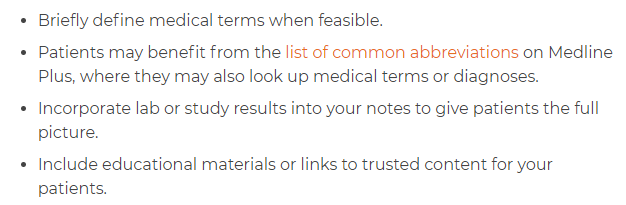
When I was in training as a pediatric gastroenterology fellow, one of my mentors relayed a story (perhaps embellished) that a parent had confronted him: “Doctor, I know you are lying to me. You told me my son had Crohn’s disease but the chart said he had TERMINAL ileitis.”
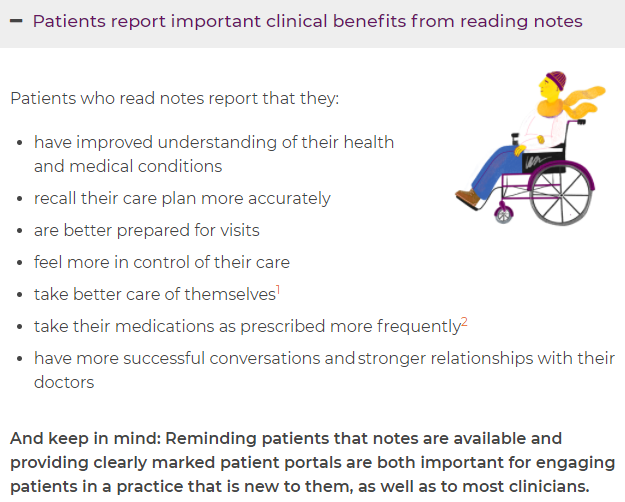
In their survey of patients in the Boston, Seattle, and rural Pennsylvania health systems, …among the respondents, 22 947 said they had read at least 1 clinical note and half said they had read at least 4 notes. Only 737 patients said the notes were very confusing.”
11% said they felt judged or offended or both. Those reactions were more common among women and people who reported poor health, unemployment, or inability to work. Among patients’ comments about why they felt judged or offended, the researchers identified 3 main themes: errors and surprises, labeling, and disrespect.
Another recent publication based on the patient survey reported that 96% of the patients said they understood all or nearly all of a note they selected from a recent visit…93% agreed or somewhat agreed that the note accurately described the visit, while 6% said something important was missing.
One of the researcher’s advice to physicians is to write the note as if the patient were sitting beside them, collaborating.
Physicians shouldn’t write anything in the health record that the patient doesn’t already know.
Many patients don’t even know that notes are available for them to read.
My take: As noted in the article, office notes have been used mainly for communication between physicians and to support billing. Whether open notes can lead to more engagement of patients and provide health benefits is uncertain. What is certain is that the availability of these notes is going to alter what becomes part of the medical record.
“Red Man” syndrome “calls up historical narratives that endorse and reinforce discrimination against Native American and Indigenous peoples”
Vancomycin infusion reactions are more readily documented in white males than in females and black patients. The combination of rash, itching, flushing and hives may be less apparent in some groups and/or mistaken as a true allergy.
“We recommend using the term “infusion reaction” for all non-immune-mediated drug reactions”
My take: I agree with the authors that the term “red man syndrome” should be dropped. It is both an insensitive term and also hinders appropriate diagnosis of vancomycin infusion reactions.
A recent political cartoon by Mike Lukovich had a caption/commentary on U.S. troops leaving Afghanistan: “Our times up here. We are being redeployed to a war zone.”
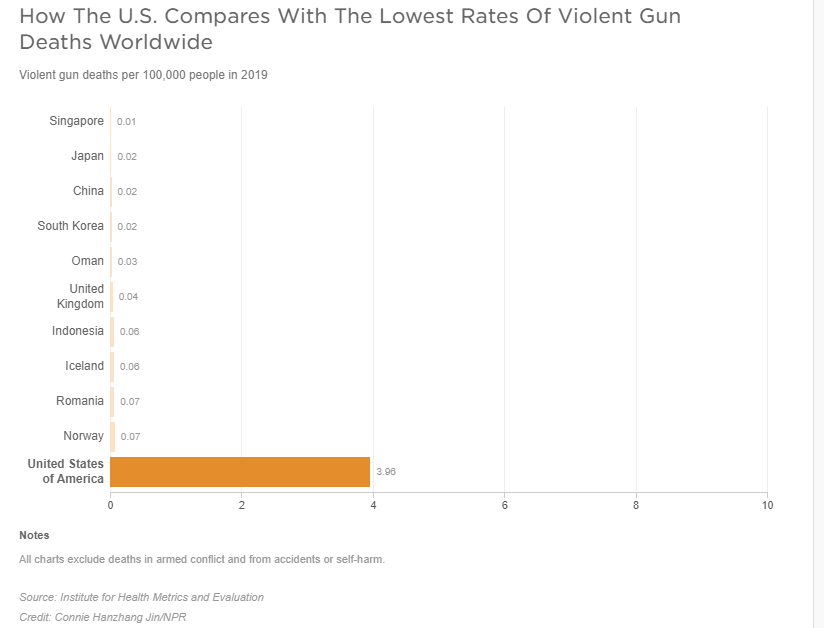
No Exaggeration: Too Many Children Are Dying in the U.S. “The sad fact is that a child or adolescent in the United States is 57% more likely to die by the age of 19 years than those in other wealthy nations.” This is due mainly to more deaths from MVAs and from gun violence.
Pediatricians who choose to use social media should have separate personal and professional social media pages, with patients and their parents directed to the professional page.
A pediatrician’s personal page should have adequate privacy settings to prevent unauthorized access. Professional pages should be set to prevent tagging.
It is wise to pause before posting, given that information posted online can exist in perpetuity and can be captured and redisseminated by viewers before it can be deleted.
Pediatricians should follow state and federal privacy and confidentiality laws as well as the social media policies of their health care organization and any professional society to which they belong.
Independent practitioners should develop social media policies for their practices to protect patients and clarify expectations. These policies should be in writing and widely distributed to all staff and clinicians. If restrictions on communicating with patients are in place in such policies, this should be shared with patients. Given advances in technology, these policies should be reviewed regularly and updated as needed.
Conflicts of interest, including in tweets, blog postings, and media appearances by pediatricians, should be disclosed.
Pediatricians should use a HIPAA-compliant secure site with encryption when communicating about health care or rendering advice directly to patients or families. Individually identifiable protected health information should not be shared through social media without documented authorization from the patient or guardian.
Before posting on social media, protected health information should be deidentified (and clearly noted to be so) and presented respectfully.
Professional boundaries should be maintained in the use of social media. Accepting (and certainly initiating) friend requests from current patients is discouraged. It is up to the pediatrician’s discretion whether to accept such requests from former patients. It may be appropriate to accept a friend request from a patient’s parent if the physician’s relationship to that person extends beyond the clinical environment.
Searching for patient information through the Internet or social media should have a specific purpose with clear clinical relevance. Any information obtained through this route should be shared directly with the patient to maximize transparency and before recording any such information in the patient’s chart.
Pediatricians should monitor their online profile to protect against inaccurate postings. Negative online reviews warrant a thoughtful response that honors confidentiality requirements, including the fact that the reviewer is or was the physician’s patient.
Pediatricians should recognize that providing specific medical advice to an individual through social media may create a physician-patient relationship that may have documentation, follow-up, state licensing, and liability implications.
1st Advance: In 1796, Edward Jenner “found that an animal virus (cowpox) could protect against disease caused by a human virus (smallpox)… Jenner’s work ultimately led to the eradication of a disease that is estimated to have killed more than 300 million people in the 20th century”
2nd Advance: In 1885, Louis Pasteur developed an inactivated virus vaccine for rabies. This has led to the development of many other inactivated vaccines, including the influenza vaccine.
3rd Advance: In 1937, Max Theiler attenuated yellow fever virus by means of serial passage in mouse and chicken embryos. This has led to the development of numerous attenuated vaccines to prevent polio (Sabin, 1960s), measles (1963), mumps (1967), rubella (1969), varicella (1995), and rotavirus (2008).
4th Advance: In 1980, Stanford biochemists Richard Mulligan and Paul Berg developed recombinant DNA technology which led to vaccines containing purified surface proteins. This led to the hepatitis B virus (1986), human papillomavirus (2006), and influenza virus (2013) vaccines.
Some of the notable improvements related to vaccines:
In U.S., the incidence of polio dropped from 29,000 cases in 1955 to elimination
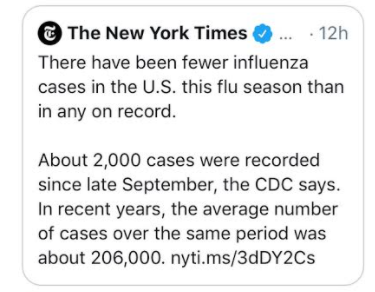
In U.S., during the “2019–2020 influenza season, the influenza vaccine prevented an estimated 7.52 million infections, 3.69 million medical visits, 105,000 hospitalizations, and 6300 deaths”
In U.S., the measles vaccine has nearly eliminated a virus that previously caused 2 million to 3 million infections, 50,000 hospitalizations, and 500 deaths every year
In U.S., “since the hepatitis B virus vaccine started being routinely recommended for newborns in the early 1990s, rates of hepatitis B virus infection among children younger than 10 years have fallen from about 18,000 per year to nearly zero”
Globally, “between 2000 and 2018, roughly 23 million measles deaths were prevented by vaccination…Live attenuated rotavirus vaccines are countering a virus that once killed more than 500,000 infants and young children each year”
5th Advance: In 2020 “with the recent authorization of mRNA vaccines, we have entered the fifth era of vaccinology. This class of vaccines doesn’t contain viral proteins; rather, these vaccines use mRNA, DNA, or viral vectors that provide instructions to cells on how to make such proteins. The SARS-CoV-2 pandemic will be an important test of whether these new platforms can fulfill their promise of creating safe, effective, and scalable vaccines more quickly than traditional methods.”
An excerpt: “The 2021 “Dirty Dozen,” released Wednesday by the Environmental Working Group, ranked pesticide residue levels of fruits and vegetables based on samples taken by the U.S. Department of Agriculture and the U.S. Food and Drug Administration…’The most important thing is that everyone should be eating lots of fruits and vegetables…We do recommend you try to reduce your pesticide exposure.'”
“USDA’s Pesticide Data Program report finds that 99% of samples tested fell below the safety standards set by the Environmental Protection Agency…Only one in 10 Americans eat enough fruits and vegetables daily, according to the Centers for Disease Control and Prevention…Dirty Dozen list creates fear and disparages consumers from buying — organic or not.”
Related article: NY Times, Nicholas Kristof: What are Sperm Telling Us? “Scientists are concerned by falling sperm counts and declining egg quality. Endocrine-disrupting chemicals may be the problem.”
My take: It is concerning that many foods have pesticides. However, adequate fruit and vegetables in the diet offers many health advantages and this is probably a greater priority.













 gutsandgrowth