COVID: Schools & Age-Related Morbidity and Mortality

JF Ludvigsson et al NEJM 2021; 384: 669-671. Full text: Open Schools, Covid-19, and Child and Teacher Morbidity in Sweden In this letter to the editor, the authors report on outcomes in Sweden, which kept schools open during the pandemic; time period: from March 1-June 30, 2020 (schools end around June 10th). Key findings:

  • Among 1-16 years of age (~1.95 million in total), 15 required ICU admission; there were no deaths in this age group
  • “Fewer than 10 pre-school teachers [1-6 years] and 20 schoolteachers received ICU care up to June 30, 2020.” Excluding health care workers, the occupational risk was similar to other occupations, with relative risk of 1.10 (0.49-2.49, 95% CI) and 0.43 (0.28-0.68, 95% CI) for preschool and school teachers respectively.

My take: This study suggests that school teachers are at similar risk for COVID-19 infection as other essential workers. In Sweden, during this timeframe, distancing but not masking was recommended. Thus, transmission rates could be lowered further.

Related article: SR Kadire et al. NEJM 2021; 384: DOI: 10.1056/NEJMclde2101987. Full text: Delayed Second Dose versus Standard Regimen for Covid-19 Vaccination This article provides rationale for both vaccine options.

Related blog posts:

Screening for Melanoma in At-Risk (Pediatric) Patients –Is This a Good Idea?

It would seem intuitive that screening for melanoma in at-risk pediatric patients would be worthwhile. And, this has been recommended in pediatric patients with inflammatory bowel disease who have received medications which increase the risk. However, a recent article (HG Welch et al. NEJM 2021; 384: 72-79. The Rapid Rise in Cutaneous Melanoma Diagnoses) provides a lot of reason to question this practice;. This article did not focus on pediatrics but its message about overdiagnosis of melanoma is applicable to this population as well.

Key points:

  • The increase in melanoma diagnosis (6-fold increase over 40 years) without a significant change in mortality (see Figure 4) indicates that the increase is primarily related to diagnostic scrutiny
  • This is driven by a fear of missing a diagnosis, medicolegal concerns and patient anxiety along with lower thresholds for referring to dermatology, lower thresholds for dermatologists to biopsy, and lower threshold by pathologists to diagnose melanoma
    • There are “no definitive diagnostic criteria for the pathological diagnosis of melanoma”
    • “The incidence of melanoma in situ is now 50 times as high as it was in 1975 (25 vs 0.5 per 100,000 population)…[yet there is a] lack of any appreciable effect in reducing the occurrence of invasive melanoma.”
  • Adverse consequences of unnecessary dermatology referrals: feeling vulnerable related to overdiagnosis of melanoma, increased costs, and difficulty obtaining life or health insurance
  • More “survivors” of melanoma overdiagnosis increase awareness of melanoma and can increase the cycle of overdiagnosis

My take: Routine visits to dermatology are difficult to justify in the absence of worrisome skin findings. “Although the conventional response has been to recommend regular skin checks, it is far more likely that more skin checks are the cause of the epidemic — not its solution.”

COVID-19 Vaccine in Israel & Effectiveness for Variants

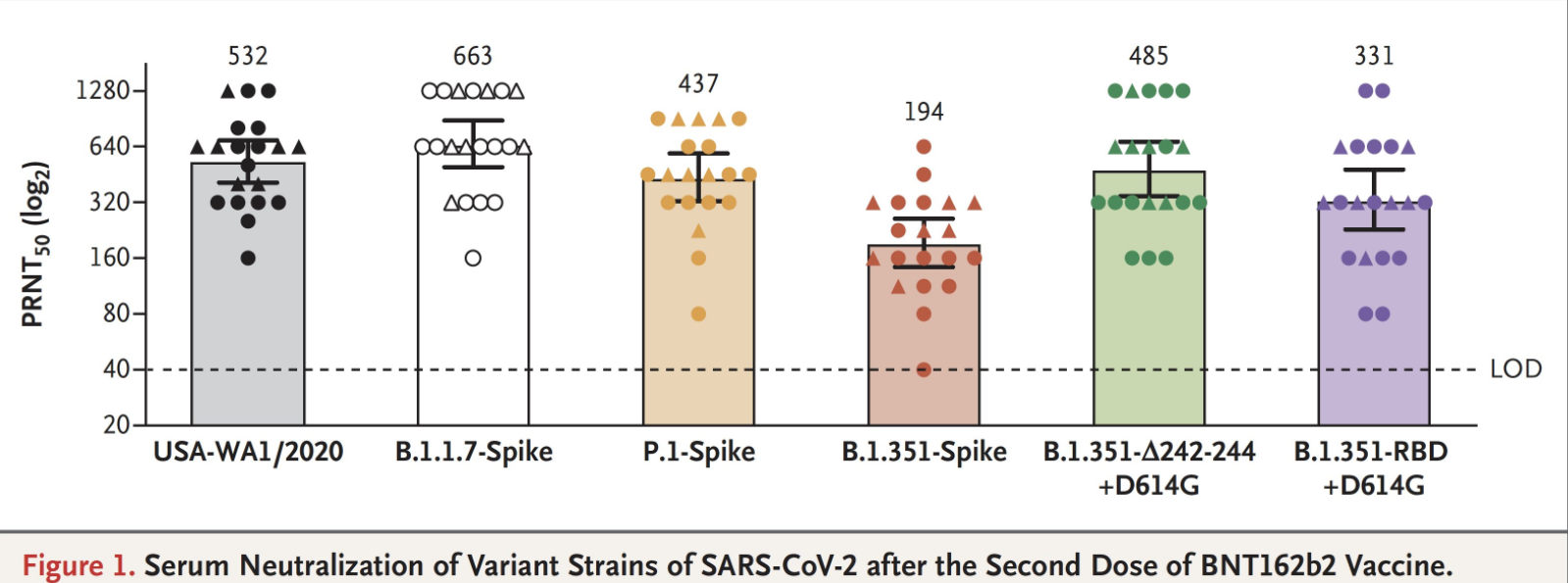
From BBC (1/25/21): Moderna vaccine appears to work against variants

An excerpt:

“For the Moderna study, researchers looked at blood samples taken from eight people who had received the recommended two doses of the Moderna vaccine. The findings are yet to be peer reviewed, but suggest immunity from the vaccine recognises the new variants. Neutralising antibodies, made by the body’s immune system, stop the virus from entering cells.

Blood samples exposed to the new variants appeared to have sufficient antibodies to achieve this neutralising effect, although it was not as strong for the South Africa variant as for the UK one. Moderna says this could mean that protection against the South Africa variant might disappear more quickly.”

When We Can Stop Pre-Procedure Screening For COVID-19

Briefly noted: S Sultan, SM Siddique et al. Gastroenterol 2020; 159: 1935-1948. Full text: AGA Institute Rapid Review and Recommendations on the Role of Pre-Procedure SARS-CoV-2 Testing and Endoscopy

Table 1 provides a summary of the recommendations and indicates a threshold for which routine pre-procedure testing may not be needed:

  • “For endoscopy centers where the prevalence of asymptomatic SARS-CoV-2 infection is low (<0.5%), the AGA suggests against implementing a pretesting strategy.”
  • Conditional recommendation, very low certainty evidence
  • Rationale: “In low-prevalence settings, a pretesting strategy may not be informative for triage due to the high number of false positives, thus PPE availability may drive decision-making.”

My take: Particularly after the rollout of vaccination to health care providers, routine testing for SARS-CoV-2 is not likely to be needed once the prevalence drops to low levels.

Related blog posts:

More on COVID-19 Vaccines

Yesterday, Evan Anderson (infectious disease) shared some updates on COVID-19 vaccines.

  • Dr. Anderson noted that more research is needed in children, pregnant women and immunocompromised populations. Immunocompromised patients may have a lower response rate to vaccination.
  • The South African 501Y.V2 COVID-19 variant may be less responsive to neutralization from donor plasma and the vaccines may be less effective in this variant.
  • He reviewed ACIP recommendations -available from CDC website as well
  • Dr. Anderson noted there is a good response to vaccination even in those with a lack of adverse effects with vaccination
  • Immunity after vaccination: data has been published showing good antibody levels at 3 months. Moderna has stated that they expect vaccine will provide immunity for at least a year
  • Immunity after infection with COVID-19: at least 3 months. Those with milder infection are more likely to get reinfected.
  • Antibody testing after vaccination to assess for immunity is not recommended

Vaccination Recommendations for IBD Patients

From COVID-19 Memorial in Washington D.C. 1/19/21

Siegel CA, Melmed GY, McGovern DP, et al. Full text link: SARS-CoV-2 vaccination for patients with inflammatory bowel diseases: recommendations from an international consensus meeting Gut  Published Online First: 20 January 2021. doi: 10.1136/gutjnl-2020-324000

From David Rubin’s Twitter Feed

In the article, they note “the exception is for any live-attenuated virus vaccines or replication-competent viral vector vaccines that come to market.” Currently, all of the vaccines are inactivated (not live-attenuated).

These recommendations apply to approved populations which currently do not include pediatric patients or patients who are pregnant.

Related blog posts:

From Children’s Healthcare of Atlanta:

“Socialism” is Already Here & Increasing in U.S. Health Care

The U.S. government now pays for nearly 50% of health care expenditures (Government Now Pays For Nearly 50 Percent Of Health Care Spending, An Increase Driven By Baby Boomers Shifting Into Medicare, Kaiser Health News, 2/21/19). Both in adults and children, the share of public sector spending is increasing. The biggest areas of costs include Medicare, Medicaid, CHIP and Veterans health care. The U.S. government also funds the HHS which includes the FDA, NIH, CDC, and AHRQ.

A recent commentary (JM Perrin et al. NEJM 2020; 383: 2595-2598. Medicaid and Child Health Equity) describes what is happening with Medicaid and the Children’s Health Insurance Program (CHIP).

Key points:

  • Over the past 20 years, the proportion of pediatric health care coverage provided by Medicaid and CHIP has been increasing. In 1997, these programs represented about 15% of health care coverage compared to ~35% in 2018. This corresponds to reductions in employer-provided coverage
  • Unlike private insurance, Medicaid is always available as it doesn’t have fixed enrollment periods
  • Medicaid disproportionately covers minority populations
  • State funding of Medicaid creates challenges. “States have routinely used strategies for limiting enrollment”
  • “Medicaid’s low physician payment rates, which average about two-thirds of rates paid by Medicare for the same services, depress physician participation…Lack of access to specialists poses additional problems in many communities”
  • The authors recommend the following:
    • Medicaid should be expanded to cover all children from birth through 21 years of age
    • The federal government should assume full financial responsibility
    • Medicaid payments should parallel national Medicare standards

Related blog posts:

Persistent Symptoms After COVID-19, FAQs, and New Strain

A large study from Wuhan showed that after 6 months following hospitalization, most still had lingering symptoms.

Full text: C Huang et al. Lancet DOI:https://doi.org/10.1016/S0140-6736(20)32656-8; 6-month consequences of COVID-19 in patients discharged from hospital: a cohort study

Key point: At 6 months after acute infection, COVID-19 survivors (n=1733 enrolled in study) were mainly troubled with fatigue or muscle weakness, sleep difficulties, and anxiety or depression. Patients who were more severely ill during their hospital stay had more severe impaired pulmonary diffusion capacities and abnormal chest imaging manifestations

NY Times analysis (Jan 8, 2021): 6 Months After Leaving the Hospital, Covid Survivors Still Face Lingering Health Issues

  • The most common issue was ongoing exhaustion or muscle weakness, experienced by 63 percent of the patients
  • About one-quarter of the patients reported difficulty sleeping
  • 23 percent said they experienced anxiety or depression
  • “Some of the sickest patients were excluded, so perhaps some of the outcomes that were reported would be worse if those patients were included”

NEJM Link: COVID-19 Vaccine: Frequently Asked Questions

NY Times (1/15/21): C.D.C. Warns the New Virus Variant Could Fuel Huge Spikes in Covid Cases “The new variant, called B.1.1.7, was first identified in Britain, where it rapidly became the primary source of infections, accounting for more than 80 percent of new cases diagnosed in London and at least a quarter of cases elsewhere in the country.”

NPR Story: How Clinic Staff Decided to Accept COVID-19 Vaccine

NPR (Jan 12, 2021): How Health Care Workers Made Up Their Minds On The COVID-19 Vaccine At One Mass. Clinic

“A doctor researched the safety of the COVID-19 vaccinations not only to counsel his patients and staff but also to make his own decision about whether to get the vaccine.

Carey Goldberg of WBUR has the story about how most of the staff at the Cambridge Health Alliance COVID-19 clinic in Somerville, Massachusetts, “got to yes.”

22 minute presentation: COVID Vaccine Primer available at NPR website is a really good presentation (for more widespread adoption)

Shush -Let’s Not Talk About Firearm Safety

A Connor et al. Annals Int Med 2020; https://doi.org/10.7326/M20-6314 Firearm Safety Discussions Between Clinicians and U.S. Adults Living in Households With Firearms: Results From a 2019 National Survey

Methods: Data were obtained from the second National Firearms Survey, conducted online 30 July 2019 to 11 August 2019. Respondents (n=4030) were asked, “Has a physician or other health care practitioner ever spoken to you about firearm safety?”

Key finding:

  • Of all respondents, 7.5% (95% CI, 6.6% to 8.6%) had ever discussed firearm safety with a provider (12.0% [CI, 9.9% to 14.6%] of those living with children vs. 5.3% [CI, 4.4% to 6.3%] in homes without children)

In the comments to this brief study, several useful points were made.

  • #1: Train physicians on this topic: “1. This is not taking a position regarding gun ownership; 2. Access to firearms is associated with suicide, accidents, and firearm-related violence; 3. State laws regarding safe firearm storage; 4. Principles of safe storage; 5. Principle of separate ammunition storage; 5. Concept of removing firearms to another location (e.g., a relative) when children are small.”
  • #2 We can do better. “It’s not that hard to ask the question or put into your intake questionnaire; Is there a gun in the house? and if yes is the answer, follow-up”

Related blog posts: