Should We Care About Subclinical Primary Sclerosing Cholangitis with Inflammatory Bowel Disease?

A recent study (AK Lunder et al. Gastroenterol 2016; 151: 660-69, editorial 590-3) provides more information about the prevalence of subclinical primary sclerosing cholangitis (PSC) in the setting of long-term inflammatory bowel disease. From a cohort of 756 Norwegian patients in the “IBSEN” cohort of patients with inflammatory bowel disease, the authors analyzed 327 patients with magnetic resonance cholangiography (MRC).

Key findings:

  • 24 (7.5%) of 327 patients who had been followed for 20 years were found to have PSC lesions.  Only 7 (2.2%) were known to have PSC based on biochemical or clinical features. Subsequently, a missed case of small-duct PSC was recognized increasing the rate to 8.1%.
  • Subclinical PSC, interestingly, was detected more often in Crohn’s patients (9.0%) compared with ulcerative colitis (6.8%)
  • Extensive colitis, high prevalence of colectomy, and refractory IBD symptoms were more common in patients with suspected PSC compared with those without PSC features (P= .029, P= .002, and P= .012 respectively)

The natural history of these subclinical cases of PSC is unclear.  Studies have shown that patients with PSC with normal alkaline phosphatase values have an excellent outlook.  Yet, there should be some concern.  PSC has been associated with 400-fold higher chance of cholangiocarcinoma and 5-fold increased risk of developing colorectal cancer.  This could indicate the need for more intensive surveillance in these patients –though the exact risks in those with subclinical disease is unknown.

My take: Until we know more, I doubt looking for subclinical PSC makes sense outside research protocols.

Related blog posts:

insurancecoverage

Primary Sclerosing Cholangitis 2016

Though this blog has reviewed primary sclerosing cholangitis (PSC), it has been a while since I’ve posted much.  As such, I thought I would place a post of a recent review (KN Lazaridis, NF LaRusso. NEJM 2016; 375; 1161-70).

Key points:

Epidemiology:

  • Strongly associated with inflammatory bowel disease with 70-80% of PSC patients having IBD
  • Median age at diagnosis 41 years with ~6-% male

Clinical manifestations:

  • Insidious disease in most.  “About half the patients with this condition do not have symptoms but receive a diagnosis after liver-function tests are found to be abnormal.”
  • Diagnostic criteria include increased alkaline phosphatase for more than 6 months
  • In adults, a liver biopsy is not need for diagnosis
  • Tends to be slowly progressive
  • Bacterial cholangitis is reported as initial presentation in ~6% and can be recurrent and intractable
  • Colon cancer is more frequent in patients with PSC.  “Colonoscopy is warranted in all patients who have received a new diagnosis”

Subtypes:

  • Classic subtype (90%) involves the entire biliary tree
  • ~5% have only small intrahepatic bile duct involvement
  • ~5% of adults have overlap syndrome with autoimmune hepatitis.  In children, overlap syndrome is present in ~35%.
  • There are numerous “secondary” PSC causes including AIDS-related cholangiopathy, amyloidoiss, eosinophilic cholangiopathy, histiocytosis X, IgG4-associated cholangitis, and sarcoidosis (most extensive list -see Table 1)

Pathogenesis:

  • The exact reasons remain unclear.  There are associations with environmental triggers but these have not been proven to be causally related.  For example, patients with PSC are more likely to consume steak or hamburger compared with controls and less likely to consume similar amounts of fish.
  • Due to its association with IBD, there are “microbiota hypothesis” to account for the aberrant cholangiocytic response.

psc-nejm

Treatment:

  • “As of this writing, no effective medical therapy exists.”
  • The authors detail eight potential treatments that are being studied: obeticholic acid, simtuzumab, 24-nor-ursodeoxycholic acid, an apical sodium-dependent bile acid transporter inhibitor (LUM001), a human monoclonal antibody that targets vascular adhesion protein 1 (BTT1023), oral vancomycin (NCT01802073 -pediatric trial), and fecal microbiota transplantation.
  • Management: includes managing varices in those with cirrhosis, following for benign and malignant biliary strictures, following for gallbladder disease (eg. polyps or masses), colon cancer surveillance (typically yearly screening), and managing metabolic bone disease.

Briefly noted: M Bramuzzo et al. JPGN 2016; 63: 259-64.  Using an Italian Pediatric IBD registry, the authors noted 6.8% of 677 patients had autoimmune liver disease: 61% with PSC and 33% with overlap syndrome.

Related blog posts:


First-Hand Account: Living-Donor Liver Transplantation

From NY Times: Donating an Organ to My Son

An excerpt:

It has been a year and half since the surgery. Sammy looks great and is on minimal medication. He goes to school full time, and most people have no idea what he went through. The scar on his abdomen has mostly faded, and we aren’t sure if he even has any memories of this experience.

My liver has grown to full size and my scars are nearly invisible. But that doesn’t mean I am entirely recovered. There are moments, and they are less frequent and further between, that I get spontaneously choked up. This experience was both frightening and inspiring. I had to briefly give up being both doctor and a mother to become a patient. It was as a living donor that I was able to help my son the most.

Another comic account of living liver donation:

Chattahoochee River

Chattahoochee River

Newborn Bilirubin Measurements To Identify Biliary Atresia

It is remarkable how tricky making a diagnosis of biliary atresia can be, even when one has seen the presentation many times.  For parents and many providers, one of the pitfalls includes the inability of recognizing acholic stools. To identify biliary atresia, promotion of stool color cards, over the last two decades, has not been very effective. To address this problem, a recent study (S Harpavat et al. JPGN 2016; 62: 799-803) describes the use of direct or conjugated bilirubin measurements in the newborn period. This study was conducted between 2009-2011.

As with previous studies, 35 infants with biliary atresia all had elevated direct bilirubin. In the non-biliary atresia group, 8936 of 9102 infants had direct bilirubin measurements within the laboratory’s reference range.  Thus, this study suggests that newborn direct bilirubin has a sensitivity 100% and specificity of 98.2%.

In a related publication, the same group published a letter to the editor (NEJM 2016; 2016; 375: 605-6) that describes a prospective two-stage screening of newborns for biliary atresia.  Of 11,636 infants included over a 15-month period, 121 were identified who had direct-bilirubin >95% reference interval in their laboratory.  At a median of 14 days, 11 remained abnormal: 2 had biliary atresia.  Overall, they state the net sensitivity was 100%, then net specificity of 99.9%, and the positive predictive value was 18.2%.

Related blog posts:

Sullivan's Island, SC

Sullivan’s Island, SC

Early Preview of Basic Science Review: Biliatresone

Generally, one of the best lectures at our national meeting is the “Basic Science Year in Review.”  I would be surprised if a recent study (O Waisbourd-Zinman et al. Hepatology 2016; 64: 880-93) does not get some attention during this review.

Even though biliary atresia (BA) remains the leading cause of pediatric liver transplantation, the exact reasons for its development have not been elucidated.  There are data “implicating both immune dysregulation and genetic factors in human BA.  Toxin-induced BA is not inconsistent with these findings and may represent a primary injury, with immune dysregulation representing a secondary insult.”

One of the reasons for suspecting a toxin dates back to outbreaks of a BA-like disease in newborn lambs that occurred in New South Wales in 1964 and 1988. During both these periods, severe droughts led to pregnant livestock grazing on atypical flora.  Ultimately, a plant toxin termed “biliatresone” was isolated from Australian plants (Dysphania species).

Here’s how this study advanced the science on biliatresone:

  • The authors treated mouse cholangiocytes in 3D spheroid culture and neonatal extrahepatic duct exlplants with biliatresone and compounds that regluate glutathione (GSH)
  • The authors determined the effects of biliatresone on SOX17 levels and the effects of Sox17 knockdown on cholangiocytes in 3D culture

Key findings:

  • “Biliatresoe caused disrupton of cholangiocyte apical polarity and loss of monolayer integrity.”
  • “Neonatal bile duct explants treated with the toxin showed lumen obstruction with increased subepithelial staining for α-smooth muscle actin and collagen, consistent with fibrosis”
  • “Biliatresone caused a rapid and transient decrease in GSH…and caused a significant decrease in cholangiocyte SOX17, and Sox17 knockdown in cholangiocyte spheroids mimicked the effects of biliatresone.”
  • These findings are easiest to appreciate in their figures, particularly Figure 4 and 5.

While pregnant women are not likely exposed to biliatresone, the authors showed that the effects of the toxin on lowering GSH was sufficient for cholangiocyte injury.; in addition, they showed that “SOX17 is required to maintain the epithelial architecture of the gallbladder and the cystic duct.”  Thus, there are likely other exposures that could lead to similar outcomes

My take: I will let Dr. Barnard explain the elegant experiments.  This study strongly supports maternal dietary factors as a contributing role in the pathophysiology of BA.  Now identifying these teratogens is crucial.

Also noted: X Zhao et al. Hepatology 2016; 64: 894-907. This study “strongly support redox stress as a critical contributing factor in biliatresone-induced cholangioctye injury” in Zebrafish.  Specifically, the authors identified that gene transcripts involved in redox stress, particularly regarding glutathione were upregulated after exposure to biliatresone.

Related blog posts:

Glacier Natl Park

Glacier Natl Park

HBV Vaccination Prevents Cancer

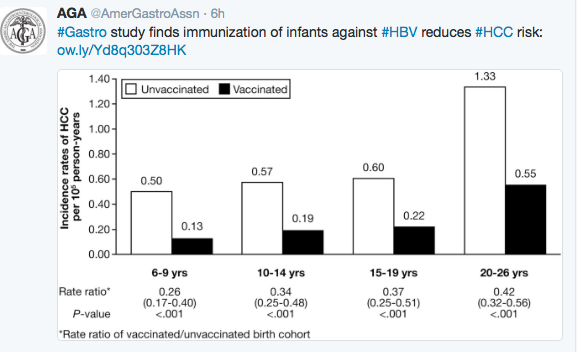
In a Gastroenterology study from Taiwan, HBV vaccination has been shown to reduce the risk of Hepatocellular Carcinoma.

screen-shot-2016-09-07-at-5-54-23-pm


screen-shot-2016-09-07-at-5-54-00-pm

Results

Of the 1509 patients with HCC, 1343 were born before, and 166 were born after, the HBV vaccination program began. HCC incidence per 105 person-years was 0.92 in the unvaccinated cohort and 0.23 in the vaccinated birth cohorts. The RRs for HCC in patients 6–9 years old, 10–14 years old, 15–19 years old, and 20–26 years old who were vaccinated vs unvaccinated were 0.26 (95% confidence interval [CI], 0.17–0.40), 0.34 (95% CI, 0.25–0.48), 0.37 (95% CI, 0.25–0.51), and 0.42 (95% CI, 0.32–0.56), respectively. The RR for HCC in 6- to 26-year-olds was lower in the later vs the earlier cohorts (born in 1992–2005 vs 1986–1992; P < .001 and 1986–1992 vs 1984–1986; P < .002). Transmission of HBV from highly infectious mothers and incomplete immunization were associated with development of HCC.

Hepatitis E Update

Briefly noted:

B Fischler et al. JPGN 2016; 63: 288-94.  This position paper by ESPGHAN suggests testing children with increased transaminases for hepatitis E virus (HEV) and notes that immunocompromised children with HEV may require treatment (with ribavirin or lowering immunosuppression). Best tests: serology for IgM and IgG and HEV RNA PCR.

F Huang et al Hepatology 2016; 64: 350-59. This study from China showed frequent Hepatitis E excreted in milk from infected cows and that this milk is capable of transmit infection when given to rhesus macaques, even if pasteurized.  Also, the article notes that seroprevalence of HEV in recent years has been higher than prior estimates (21% from 1988-94 and 6% from 2009-2010).

Glacier Natl Park

Glacier Natl Park

Prevalence of Diabetes with Pediatric NAFLD

Prevalence of Prediabetes and Type 2 Diabetes in Children With Nonalcoholic Fatty Liver Disease  (JAMA Pediatr. Published online August 01, 2016. doi:10.1001/jamapediatrics.2016.1971)

According to a a multicenter, cross-sectional study at 12 pediatric clinical centers across the United States participating in the National Institute of Diabetes and Digestive and Kidney Diseases NASH Clinical Research Network and with 675 participants (mean age 12.6 yrs):

Screen Shot 2016-08-05 at 7.31.17 AM

NPR: Children Missing Out on Hepatitis C Treatment

From NPR: Children Missing Out on Hepatitis C Treatment

An excerpt:

study by the Philadelphia Department of Health points to what Wen and others in the medical profession see as a worrisome trend: Children with hepatitis C may be unaware of their diagnosis and the potential need for treatments down the road in order to prevent long-term liver damage.

Using city surveillance data, the study found that as many as 8 in 10 children at high risk for hepatitis C exposure in Philadelphia were never screened for the condition. More specifically, of the approximately 500 moms-to-be who were registered as having hepatitis C between 2011 and 2013, only 84 of their newborns, or about 16 percent, were tested for the virus by 20 months of age.

My take: As the article discusses, with the advent of better treatments, which will be available for children (?next 1-2 years), identifying Hepatitis C acquired prenatally is becoming important.

Related blog posts:

Rising HCV mortality

Preventing Neonatal Hepatitis B Transmission with Tenofovir

A recent study (CQ Pan et al. NEJM 2016; 374: 2324-34) showed that tenofovir administered to mothers starting at 30-32 weeks of gestation lowered the rate of perinatal hepatitis B virus (HBV) acquisition.This was a multi center, open-label, randomized parallel-group design trial.  The maternal tenofovir dose was 300 mg.

Key points:

  • 200 mothers with HBeAg and HBV DNA >200,000 IU/mL in this study
  • 68% achieved an HBV DNA level <200,000 IU/mL (compared with 2% of controls).  Above this threshold has been shown to be associated with increased HBV transmission.
  • 5 of 97 (5%) in the treatment group acquired HBV compared to 18 of 100 in the control group.  However, in the per-protocol analysis which excluded infants born to women who withdrew consent, were lost to follow-up, or discontinued therapy there were 0 cases of transmission (0 of 88).
  • There were no specific safety signals identified in this study.  In the discussion, the authors note that the Antiretroviral Pregnancy Registry which includes data from 4013 women who received tenofovir, the rate of birth defects with TDF was 2.4% compared to the general population rate of 2.7%.

My take: This study provides more evidence that antivirals can prevent perinatal HBV infection.

Related blog posts:

Screen Shot 2016-06-19 at 10.56.30 PM