Do Button Battery Guidelines Need To Be Revised?

A recent abstract presented at DDW (R Khalaf et al. abstract Sa2046) with 68 patients identified mucosal findings in the stomach and questioned whether the current guidelines are sufficient.  Generally, guidelines call for the immediate removal of button batteries in the esophagus but in asymptomatic children older than 5 years, most gastric batteries can be observed (see links to previous blog posts below which highlight expert recommendations).

Link: Sa2046 GASTRIC INJURY SECONDARY TO BUTTON BATTERY INGESTIONS IN CHILDREN: A RETROSPECTIVE MULTICENTER REVIEW

This study was reviewed in Gastroenterology & Endoscopy News: Retrieving Swallowed Batteries in Children: Don’t Watch and Wait  This link also highlights an abstract from the Emory pediatric GI group, NASPGHAN 2019 (#24), which found that only 5% of esophageal button batteries were removed within two hours.

An excerpt:

According to the National Poison Data System, between 1985 and 2017, roughly 3,500 button batteries were swallowed in the United States each year (www.poison.org/ battery/ stats). ..

The researchers reviewed 68 cases of children who underwent endoscopy after having swallowed button batteries, which are used in a variety of devices, such as cameras and watches. Eighteen of the patients (26%) were asymptomatic, but 41 (60%) had visible mucosal damage…

Some injuries were more severe. A 9-year-old child with a battery lodged in the antrum experienced a gastric perforation that led to pneumoperitoneum, Dr. Khalaf reported. Although only one other injury was as serious, the researchers identified no risk factors that predicted significant complications.

My take: There are a lot of button battery ingestions.  More data is needed to determine whether more button batteries from the stomach should be retrieved.

Related blog posts:

Disclaimer: This blog, gutsandgrowth, assumes no responsibility for any use or operation of any method, product, instruction, concept or idea contained in the material herein or for any injury or damage to persons or property (whether products liability, negligence or otherwise) resulting from such use or operation. These blog posts are for educational purposes only. Specific dosing of medications (along with potential adverse effects) should be confirmed by prescribing physician.  Because of rapid advances in the medical sciences, the gutsandgrowth blog cautions that independent verification should be made of diagnosis and drug dosages. The reader is solely responsible for the conduct of any suggested test or procedure.  This content is not a substitute for medical advice, diagnosis or treatment provided by a qualified healthcare provider. Always seek the advice of your physician or other qualified health provider with any questions you may have regarding a condition.
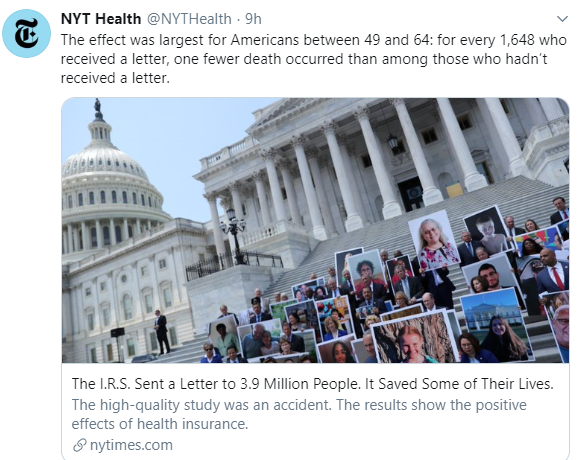
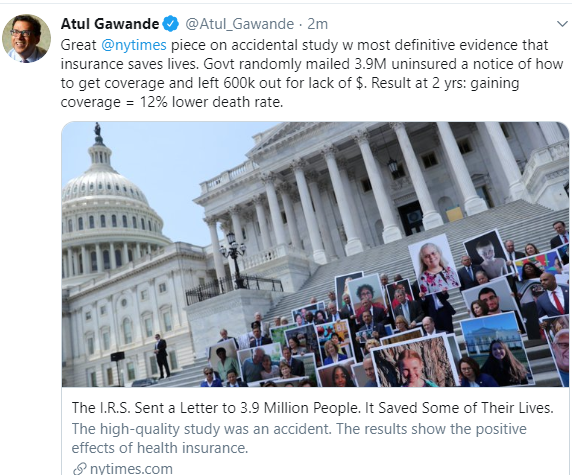
How The IRS Proved That Health Insurance Saves Lives

NY Times: The I.R.S. Sent a Letter to 3.9 Million People, It Saved Some of Their Lives

Recently, economists have shown that an I.R.S. letter encouraging people to sign up for health insurance saved lives.  This letter was an inadvertent randomized trial as 600,000 people who were eligible for the letter did not receive it due to a budget shortfall.

An excerpt:

Three years ago, 3.9 million Americans received a plain-looking envelope from the Internal Revenue Service. Inside was a letter stating that they had recently paid a fine for not carrying health insurance and suggesting possible ways to enroll in coverage…

Obtaining insurance… reduced premature deaths by an amount that exceeded any of their expectations. Americans between 45 and 64 benefited the most: For every 1,648 who received a letter, one fewer death occurred than among those who hadn’t received a letter.

In all, the researchers estimated that the letters may have wound up saving 700 lives…

The results also provide belated vindication for the much-despised individual mandate that was part of Obamacare until December 2017, when Congress did away with the fine for people who don’t carry health insurance…

The uninsured rate for Americans is rising for the first time in a decade, as states tighten eligibility rules for Medicaid, and as the Trump administration cuts back on health care outreach…

Previous research has found a link between expanded health insurance access and fewer deaths. Multiple studies showed a decline in mortality rates after states expanded Medicaid, but none could tie the outcome directly to the policy change, since states typically cannot randomly pick which residents do and don’t receive Medicaid. That makes the Treasury experiment, an unintended result of a budget shortfall, distinctively useful.

My take: This analysis shows that prompting health care coverage by sending a single letter can save lives.  It is unfortunate that we are currently heading in the opposite direction.

Related blog posts:

Our Study: Provider Level Variability in Colonoscopy Yield

Most readers of this blog will recognize that one focus has been on delivering high value medical care.  In pediatric gastroenterology, there is a great deal of variability in the use of endoscopy as a tool.  When there are individuals with high-use/low-value endoscopy, some might question whether this is due to training, expediency, financial motivation, or a lack of clinical confidence.

There have been a number of studies looking at diagnostic yield with pediatric colonoscopy but none on individual provider variation.   To look into this issue, we examined our outpatient experience with colonoscopy among 16 providers.  This work has now been published:

Digestive Diseases (Full Text): Diagnostic Yield Variation with Colonoscopy among Pediatric Endoscopists

Key points:

  • This study found high variability in diagnostic yield among the 16 clinicians ranging from as low as 22% to as high as 86% (p = 0.11) with an overall diagnostic yield of 48% for colonoscopy; excluding follow-up colonoscopies, the diagnostic yield was 42%.
  • Abnormal calprotectin and abnormal blood tests were associated with higher diagnostic yields of 83 and 65%, respectively, compared with symptoms such as diarrhea, and rectal bleeding which had yields of 43, and 61%.
  • Ileal intubation rates averaged 90% (range ­63–100%, p = 0.06). Ileal intubation is important because, among our patients with a normal colon, there were 21 (6%) with a grossly abnormal ileum and an additional 16 (4%) with abnormal histology in the ileum.  Thus, about 10% of patients with a normal endoscopic and histologic evaluation of the colon had abnormalities in the terminal ileum. A NASPGHAN report (JPGN 2017; 65: 125-31) on quality improvement recommended an ileal intubation rate of 90% as a goal.

Comments:

  • Our group’s overall diagnostic yield is similar to previous studies which ranged from 33-64%.
  • Among physicians with the lowest and highest yield, there was not a specialized focus in IBD or functional GI disorders.  Thus, the driving factor for the variation in diagnostic yield is related to the threshold for performing an endoscopy in patients with probable functional disorders and the response to parental pressures.
  • A negative endoscopic study has not been shown to improve outcomes in patients with functional abdominal pain; though a normal colonoscopy would provide reassurance in some situations (eg. familial polyposis).

My take: Goals for pediatric endoscopy to provide high-value care could include ileal intubation rates of >90% and provider diagnostic yields of >40%.  High-value also includes the actual cost of the procedure; most of our outpatient endoscopies are performed in a pediatric ambulatory center with much lower costs than hospital-based endoscopy.

Related blog posts:

Death Valley, Zabriskie Point at Sunrise


No Show (“Unattended Appointment”) Data

A recent study (JC Bohnhoff et al. Pediatrics ) provided data on “unattended appointments.” Thanks to John Pohl for this reference from his twitter feed. Link to Full Abstract: Unscheduled Referrals and Unattended Appointments After Pediatric Subspecialty Referral (article behind paywall).

Key points:

  • Of 20 466 referrals, 13 261 (65%) resulted in an appointment scheduled within 90 days and 10 514 (51%) resulted in a visit attended within 90 days.
  • Compared with appointments scheduled within 7 days, appointments with intervals from referral to scheduled appointment exceeding 7 days were associated with decreasing likelihood of visit attendance (adjusted odds ratio 8–14 days 0.48; 95% confidence interval 0.37–0.61).
  • Patient factors associated with decreased likelihood of both appointment scheduling and visit attendance included African American race, public insurance, and lower zip code median income.

My take: To reduce no show rates, shorter wait times and frequent reminders are important.

Lullwater Park. Atlanta

POEM vs Surgical Myotomy for Achalasia -Randomized Trial

A recent randomized trial (YB Werner et al. NEJM 2019; 381: 2219-29) compared peroral endoscopic myotomy (POEM) and laparoscopic Heller’s myotomy (LHM) for idiopathic achalasia in 221 patients.

Key findings:

  • Clinical success at 2-year followup was observed in 83% in the POEM group and 82% in the LHM group. Clinical success was defined as Eckardt score of 3 or less without the use of additional treatments.
  • Serious adverse events occurred in 2.7% of POEM group and 7.3% of LHM group
  • At 3 months following procedure, 57% of the POEM group and 20% of LHM group had reflux esophagitis; the rates were 44% and 29% at 2 years, respectively.

My take: This study demonstrates similar outcomes between POEM and LHM.  As a practical matter, local expertise is likely a crucial component in choosing between these options.

Related blog posts:

Another Study Questions the Efficacy of Drip Feeds for Reflux

Several years ago, a small study showed that bolus feeds were as well-tolerated in premature infants as drip feeds: Which is Safer -Drip Feeds of Bolus Feeds for Preterm Infants?

Now, a retrospective study (LB Mahoney, E Liu, R Rosen. JPGN 2019; 69: 678-81) found no difference in the rate of reflux in 18 children who were with gastrostomy-tube dependent.

In this study, 24-hour multichannel intraluminal impedance with pH monitoring (MII-pH) examine reflux events in children receiving exclusive enteral nutrition with a combination of daytime bolus feeds and overnight continuous feeds; each patient served as their own control.  this included 6 with prior fundoplication.

Key finding:

  • There was no difference in rate of reflux events when comparing bolus feedings and drip (aka continuous) feedings.

The limitations in this study include the small sample size and retrospective design.  The authors estimate that to achieve adequate power (80% power) to detect a risk ratio of 1.2 would require 211 patients.

My take: This study and other small studies challenge the assumption that drip feedings are safer. Though, until a larger prospective study is performed, we will not know.

Quebec City

Disclaimer: This blog, gutsandgrowth, assumes no responsibility for any use or operation of any method, product, instruction, concept or idea contained in the material herein or for any injury or damage to persons or property (whether products liability, negligence or otherwise) resulting from such use or operation. These blog posts are for educational purposes only. Specific dosing of medications (along with potential adverse effects) should be confirmed by prescribing physician.  Because of rapid advances in the medical sciences, the gutsandgrowth blog cautions that independent verification should be made of diagnosis and drug dosages. The reader is solely responsible for the conduct of any suggested test or procedure.  This content is not a substitute for medical advice, diagnosis or treatment provided by a qualified healthcare provider. Always seek the advice of your physician or other qualified health provider with any questions you may have regarding a condition.

Outcomes of Liver Transplantation in Small Infants

A recent study (H Yamamoto et al. Liver Transplantation 2019; 25: 1561-70) provides data on the outcomes of infants who underwent liver transplantation (LT) in the United Kingdom (King’s College Hospital).

A total of 64 infants underwent LT (1989-2014) at a single institution. The authors compared “extra-small” (XS) infants in the first 3 months of life to “small” (S) who were 3-6 months of age.

Key findings:

  • Acute liver failure was the main indication for LT in the XS group (n=31, 84%) compared to the S group (7, 26%)
  • Hepatic artery thrombosis and portal vein thrombosis were similar in both groups: 5.4% and 10.8% in the XS and 7.4% and 11.1% in the S group
  • Bilary stricture and leakage were similar: 5.4% and 2.7% in the XS and 3.7% and 3.7% in the S group
  • 1-, 5-, and 10-year survivals were 70.3%, 70.3% and 70.3% in the XS group and 92.6%, 88.9%, and 88.9% in the S group (not statistically significant)

Related blog posts:

Quebec City, Frontenac Hotel and Boardwalk (early in the day)

How Benign Are Juvenile Polyps?

A recent retrospective study (N Ibrahimi et al. JPGN 2019; 69: 668-72) reviewed juvenile polyp characteristics over a 14 year period (2003-17) from 213 pediatric subjects who underwent 326 procedures.  The authors state their review was intended for nonsyndromic juvenile polyps, though 23 of the patients had ≥5 polyps (which is incongruous with their presented methods of including children with less than 5 polyps).

Key findings:

  • The authors state that polyp recurrence rates on repeat colonoscopy were 1.5% if one polyp, 19.2% if 2-4 polyps, and 82.6% if 5-10 polyps
  • Juvenile polyps harbored adenomatous changes in 26 (12%) of patients
  • The presence of adenomatous changes did not correlate with polyp number; however, a polyp on the right-sided was more likely to harbor adenomatous changes

It is possible that some of the ‘recurrent’ polyps were missed polyps, as polyps can be easily overlooked.  I had a recent experience of removing numerous polyps (14) from a child recently and some were identified in part due repeated visualization of several colonic segments.  The recent ESPGHAN position paper is useful in children with multiple polyps; their recommendations include: In a child with a single JP, a repeat colonoscopy is not routinely required. (Weak recommendation, very low quality of evidence).

My take: This report is notable for the following:

  1. a fairly high rate of adenomatous changes in juvenile polyps.
  2. a high recurrence rate for children with multiple polyps

Related blog posts:

Quebec City

Disclaimer: This blog, gutsandgrowth, assumes no responsibility for any use or operation of any method, product, instruction, concept or idea contained in the material herein or for any injury or damage to persons or property (whether products liability, negligence or otherwise) resulting from such use or operation. These blog posts are for educational purposes only. Specific dosing of medications (along with potential adverse effects) should be confirmed by prescribing physician.  Because of rapid advances in the medical sciences, the gutsandgrowth blog cautions that independent verification should be made of diagnosis and drug dosages. The reader is solely responsible for the conduct of any suggested test or procedure.  This content is not a substitute for medical advice, diagnosis or treatment provided by a qualified healthcare provider. Always seek the advice of your physician or other qualified health provider with any questions you may have regarding a condition.