Healthcare: “Where the Frauds Are Legal”

A recent NY Times commentary: “Where the Frauds Are Legal” details another group of problems with health care economics.  These problems are on top of a long list of other problems which at their core relate to lack of price transparency/hidden charges and excessive charges for some services.

Here’s an excerpt:

Much of what we accept as legal in medical billing would be regarded as fraud in any other sector…

Medical Swag…Companies are permitted by insurers to bill for “durable medical equipment,” stuff you receive for home use when you’re in the hospital or doctors’ office. That yields some familiar marked-up charges, like the sling you can buy at Walgreens for $15 but for which you or your insurer get a bill for $120 after it is given to you at urgent care…

The Cover Charge…Trauma activation fees have been allowed since 2002, after 9/11, when the Trauma Center Association of America, an industry group, convinced regulators that they needed to be compensated for maintaining a state of “readiness.”…

Impostor Billing…We received bills from doctors my husband never met… for bedside treatment from people who never came anywhere near the bed to deliver the care…

The Drive-By…There was no significant health service given. Just an appearance and some boxes checked on a form. It’s a phenomenon called drive-by doctoring.

The Enforced Upgrade…[like meeting] in the emergency room [because clinic is closed]

Why do insurers pay? Partly because insurers have no way to know whether you got a particular item or service. But also because it’s not worth their time to investigate the millions of medical interactions they write checks for each day. Despite the advertised concern about your well-being, as one benefits manager enlightened me: They’re “too big to care about you.”…these are all everyday, normal experiences in today’s health care system, and they may be perfectly legal. If we want to tame the costs in our $3 trillion health system, we’ve got to rein in this behavior, which is fraud by any other name.

My take: I find it troubling to be a cog in a system that has such devious billing practices.  This particularly relates to my interactions when providing hospital-based care.  In our office, we have at least some measure of control and we can offer services like outpatient endoscopy at one-third of the cost compared to hospital-based endoscopy; similarly, our outpatient infusions are much more cost-effective than hospital-based infusions.

In terms of the health care system, my expectation is that there is not a strong enough incentive or empowerment for physicians to tackle rising health care costs (& low value care) and as such the industry will face a reckoning from outside forces.

Related blog posts:

Marketing of Insulin Explains a Lot About Our Health Care System

A recent commentary (M Fralick, AS Kesselheim. NEJM 2019; 381: 1793-5) describes the U.S. Insulin Crisis.

Background: 

  • In 1922, insulin was first injected into a 14-year-old boy with severe type 1 diabetes mellitus (T1DM). Prior to this, T1DM had been considered a universally fatal disease
  • Frederick Banting, John Macleod, and members or their team that discovered insulin sold their patent for $1 to assure it could be widely affordable
  • “U.S. law allows pharmaceutical manufacturers to price their products at whatever level they believe the market will bear and to raise prices over time without limit”
  • “Direct competition in the insulin market is lacking”
  • Since insulin is a biologic drug, this necessitates “additional testing beyond what is usually required for generic drugs before approval by the” FDA.

Current Situation:

  • A carton of insulin that sells for $300 in the U.S. could be purchased in Canada for $20 (in U.S. dollars)
  • Nearly 100 years after the development of insulin, “insulin is inaccessible to thousands of Americans because of its high cost.”

My take: Why does insulin cost 15 times more in the U.S. than Canada?   These excess costs with insulin are occurring despite a great deal scrutiny; unfortunately, U.S. consumers are paying extra for a wide range of pharmaceuticals.  Going from the Nobel discovery of insulin to our current state is a clear indication of the need to reform of our healthcare system.

Related blog posts:

Mural in Quebec City: La Fresque des Québécois

More Frequent Foreign Body Ingestions

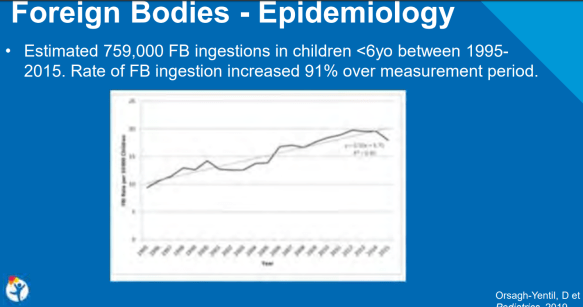
A recent retrospective study (D Orsagh-Yentis) Pediatrics 2019; 143: pii:320181988) examined children <6 years of age (n=759,054) and presentation to an emergency department in the U.S. for a foreign body ingestion (FBI) from 1995-2015. This study was reviewed at our recent national meeting by David Brumbaugh -related blog post: #NASPGHAN19 Postgraduate Course (Part 1) (Slides below).

Key findings:

  • FBI rates increased from 9.5 to 18 per 10,000 during the 20 year study period
  • Coins accounted for 61.7% of FBI
  • Most children (89.7%) were able to be discharged after their suspected ingestion
  • Battery ingestion represented 0.14% of all ingestions in 1995  to 8.4% in 2015

Related blog posts:


Hidden Costs of Medical Schools

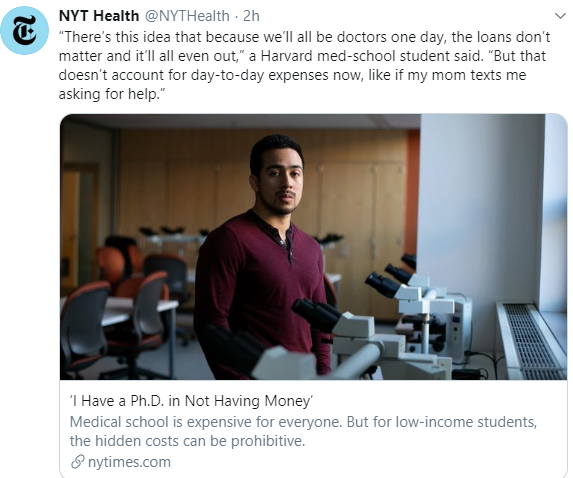
From NY Times: ‘I Have a Ph.D. in Not Having Money’

An excerpt:

Medical school is expensive for everyone. But for low-income students, the hidden costs can be prohibitive…

American medical schools are the training grounds for a white-collar, high-income industry, but they select their students from predominantly high-income, and typically white, households…Between 1988 and 2017, more than three-quarters of American medical school students came from affluent households…

Students from low-income families who choose to apply to medical school find the path lined with financial obstacles. The application phase entails MCAT registration ($315) and preparation, application fees ($170 for the first school and $40 for each additional one), travel and attire for interviews (on average more than $200 per school). After enrollment, students are expected to purchase equipment and study aids. Each year brings new certification tests, with registration fees running upward of $600.

Aspiring doctors know that tuition is costly; the median educational debt held by medical school graduates in 2018 was $200,000, up 4 percent from the previous year. But less advertised are all the hidden costs of a medical education.

Gastrostomy Tube Placement in Extremely Low Birthweight Infants

A recent analysis (MG Warren et al J Pediatr 2019; 214: 41-6) examined gastrostomy tube (GT) placement among 4569 extremely low birthweight (ELBW) infants (birth wt <1000 gm) who were enrolled in the National Instittue of Child Health and Human Development Neonatal Research Network (25 centers).

Key findings:

  • 333 (7.3%) underwent GT placement; 76% had GT placed postdischarge from NICU
  • Among patients with GT placement, 56% had weight <10th percentile, 61% had neurodevelopmental impairment (NDI), and 55% had chronic breathing problems
  • At last follow-up, 32% of infants who required GT placement were taking full oral feeds.
  • Rates of fundoplication varied widely between centers, ranging from 0% to 6.4% among the centers.

In the discussion, the authors note the well-recognized associations between feeding difficulties and language delays in ELBW infants.  In addition, “behavioral and emotional problems have …been described in children with feeding problems.”

The authors also state, without evidence, that the high rate of GT placement after discharge suggests that “a large proportion of ELBW infants were first discharged from the NICU orally feeding but could not maintain these skills.”  Alternative explanations include the following:

  • Many infants were sent home with NG (nasogastric) supplementation and after not making progress with oral feedings, elective GT placement was done when the infant was a more suitable candidate (eg. improved respiratory status, better nourished, etc.)
  • Problems with oral feeding became apparent after discharge including poor growth and aspiration.  In fact, the authors note that “orormotor dysfunction and avoidant feeding behaviors at 3 and 12 months corrected age” were nearly twice as likely in infants born <34 weeks
  • While this study did not fully capture data regarding home NG feedings, 14% of patients sent home with NG feedings eventually received a GT

My take: This study indicates that 7% of ELBW infants undergo GT placement and that about one-third out-grow the need for GT supplementation after ~2 years.

Related blog posts:

Transnasal Endoscopy in Unsedated Children to Monitor Eosinophilic Esophagitis

A recent retrospective study (N Nguyen et al. Clin Gastroenterol Hepatol 2019; 17: 2455-2462) describe the feasibility of unsedated transnasal endoscopy (TNE) for monitoring eosinophilic esophagitis (EoE) in children (n=190, subject ages 3-22 years).

TNE was facilitated by distraction with either video google or virtual reality (starting 2016).  NPO time was 2 hours before the TNE.

Key points:

  • Over 294 TNEs were completed from 300 attempts (98% success)
  • Cost of TNE was halved: $4393 compared to $9444 for EGD (does not count pathology costs)
  • Adverse events: 8 (2.7%) with vomiting, 9 (3.1%) spit up, 11 (3.7%) with epistaxis
  • By 2017, TNE accounted for 31.8% of upper endoscopies in 2017

The authors recommend that TNE be offered starting at age 5 years in those without a known stricture.

My take: I am looking forward to less invasive/less costly ways of monitoring treatment response in EoE.  I think TNE can lower costs –though I am a little surprised that the cost of TNE in their institution was still more than $4000.  In our outpatient endoscopy center, costs for an upper endoscopy/biopsy with anesthesia are typically about one-third the cost of an EGD in their study and about three-fourths the cost of a study TNE.

Related study: A Krigel et al. Clin Gastroenterol Hepatol 2019; 17: 2489-96. This study showed increasing use of anesthesia assistance (AA) for colonoscopy in adults from 16.7% in 2006 to 58.1% in 2015. This data was derived from the Premier Perspective database with more than 4.6 million patients who had an outpatient colonoscopy. AA was associated with a median increase in cost of $182 for patients with commercial insurance.

Related blog post: Waiting for the String Test for EoE


Celiac Disease: “”80 percent of success is just showing up”

“80 percent of success is just showing up” —Woody Allen

Reading a recent (brief) study (BA Blansky et al. Clin Gastroenterol Hepatol 2019; 17: 2503-4) reminded me of the quote from Woody Allen.  This study of children with Celiac disease (CD) demonstrates a high rate of children who were lost to follow-up at a leading Children’s hospital.

Key findings:

  • From a randomly selected retrospective cohort (2010-2014) with 241 eligible subjects, one-fourth of children were lost to follow-up within a year of diagnosis. 22 (9%) had NO GI visits after their diagnostic procedure.
  • Risk factors for loss of follow-up: sibling with CD (HR 1.90), Medicaid insurance (HR 2.19), and older age at diagnosis; those with adherence had median age at diagnosis of 8.7 years compared with 11.4 years for those lost to follow-up.
  • Median time to tissue transglutaminase (TTG) IgA normalization was 17 months.  Of 141 who had recommended follow-up, 25% had elevated TTG IgA at last GI visit.

My take: These numbers should not be surprising to most clinicians.  If clinicians want to improve follow-up and outcomes, then families will need more nudging; EMRs can be configured to help in this task.

Related blog posts:

Quebec City

Easy Advice for Pediatric Hepatologists: PSC Surveillance Recommendations

A recent clinical practice update (CL Bowlus et al. Clin Gastroenterol Hepatol 2019; 17: 2416-22) makes several recommendations on surveillance for hepatobiliary cancers in patients with primary sclerosing cholangitis (PSC).

Full Text Link: AGA Clinical Practice Update on Surveillance for Hepatobiliary Cancers in Patients With Primary Sclerosing Cholangitis: Expert Review

I will highlight the most important recommendation for pediatric hepatologists:

  • Best practice advice 6: Surveillance for cholangiocarcinoma should not be performed in PSC patients with small-duct PSCs or those younger than age 20.

In the text, the authors note that “in pediatric PSC patients, cholangiocarcinoma is very rare, with only 8 of 781 (1%) …developing cholangiocarcinoma” (MR Deneau et al. Hepatology 2017; 66: 518-27)

Here are the other recommendations:

  • Best practice advice 1  Surveillance for cholangiocarcinoma and gallbladder cancer should be considered in all adult patients with PSC regardless of disease stage, especially in the first year after diagnosis and in patients with ulcerative colitis and those diagnosed at an older age.
  • Best practice advice 2 Surveillance for cholangiocarcinoma and gallbladder cancer should include imaging by ultrasound, computed tomography, or magnetic resonance imaging, with or without serum carbohydrate antigen 19-9, every 6 to 12 months
  • Best practice advice 3  Endoscopic retrograde cholangiopancreatography with brush cytology should not be used routinely for surveillance of cholangiocarcinomas in PSC.
  • Best practice advice 4  Cholangiocarcinomas should be investigated by endoscopic retrograde cholangiopancreatography with brush cytology with or without fluorescence in situ hybridization analysis and/or cholangioscopy in PSC patients with worsening clinical symptoms, worsening cholestasis, or a dominant stricture.
  • Best practice advice 5  Fine-needle aspiration of perihilar biliary strictures should be used with caution in PSC patients considered to be liver transplant candidates because of concerns for tumor seeding if the lesion is a cholangiocarcinoma.
  • Best practice advice 7 The decision to perform a cholecystectomy in PSC patients with a gallbladder polyp should be based on the size and growth of the polyp, as well as the clinical status of the patient, with the knowledge of the increased risk of gallbladder cancer in polyps greater than 8 mm.

20-Year Follow-up of Statins in Children

A recent study (IK Luirink et al. NEJM 2019; 381: 1547-56) examined the effects of statin therapy in children with familial hypercholesterolemia (FH) who were followed for 20 years. At baseline, the median age was 13 years in the treated cohort and in their sibling control group.  184 of 214 (86%) of patients with FH were seen in follow-up and 77 of 95 (81%) of siblings.

Key findings:

  • The mean LDL cholesterol had decreased from 237 to 161 mg/dL
  • LDL target of <100 mg/dL was achieved in 37 patients (20%)
  • Mean progression of carotid intima-media thickness over the entire follow-up period was 0.0056 mm/year in patients with FH and 0.0057 mm/year in sibling controls
  • The cumulative incidence of cardiovascular events and death from cardiovascular causes at age 39 years was lower in the treated group compared to  their affected parents: 1% vs. 26% and 0% vs. 7% respectively

Discussion:

“This makes a strong case for not only ‘the lower the better’ but also for ‘the younger the better” as atherosclerotic disease is determined not only by the LDL level but also by cumulative exposure.

My take: This study provides convincing data that statin therapy prolongs health and life in patients with familial hypercholesterolemia.

Related blog posts: