With Regard to Avoiding Excessive Weight Gain, Breastfeeding is Best

A recent study (AR Goetz et al J Pediatr 2018; 201: 27-33) examines the impact of breastfeeding on the growth of infants with high birth weight (HBW).

Background: “Exclusive breastfeeding is protective against high weight and is recommended by” the AAP for the first 6 months.  In this study, the authors hypothesized that “HBW infants would receive a lower percentage of breast milk and consume more formula than NBW infants.”

Key findings:

  • HBW infants with high weights at 7-12 months of age demonstrated a rapid decline in the percentage of breast milk feedings compared with HBW infants with normal weights at 7-12 months of age.
  • Normal birth weight infants with high weights at 7-12 months of age received a lower percentage of breast milk and more formula intake that those with normal weights at 7-12 months of age.

Because HBW is associated with later risk of obesity/overweight, identifying strategies early in life is important.  Furthermore, as a recent study in NEJM has shown (M Geserick et al. NEJM 2018; 379: 1303-12), a lot of weight gain issues happen in the first years of life:

  • Almost 90% of children who were obese at 3 years of age were overweight or obese in adolescence
  • Among obese adolescents, the most rapid weight gain had occurred between 2 and 6 years of age

My take: This study further shows a strong association between consumption of breast milk and normal weights at 7-12 months of age, both in HBW and NBW.

Related blog posts:

Near Lake Louise, Banff

Direct-Acting Antivirals in Patients Without Advanced Hep C Liver Disease

A recent study (LI Backus et al. Hepatology 2018; 68: 827-38, editorial 804-06) indicates that direct-acting antivirals (DAA) improve mortality in patients with hepatitis C virus (HCV) without advanced liver disease.

Using a registry from the Veterans Affairs, the authors identified 40,664 treated with interferon-free DAA regimens.  Overall there was a 96.8% sustained virologic response (SVR).  These patients were compare with 62,882 patients who did not receive DAA and without apparent advanced fibrosis.

Background: Long-term benefits have been established in patients with HCV and advanced fibrosis who have had viral eradication with DAA regimens with less hepatic decompensation and less hepatocellular carcinoma.

Key findings:

  • SVR in this cohort was associated with a 59% unadjusted reduction in all-cause mortality when compared to those who did not achieve SVR and a 69% reduction compared to the untreated cohort.
  • In absolute terms, 1-year mortality rates were reduced by 1.3% with SVR compared to treated group without SVR and by 2.9% compared to no treatments.

These declines in mortality occurred despite the fact that DAA-treated patients had more comorbid conditions and similar access to providers among the three groups.  The findings in this population of veterans will need to be replicated in other populations.

My take: This study is a big leap forward by showing that even in groups without advanced fibrosis, treatment with DAA improved a significant clinical endpoint not just a biomarker.  There are likely other unmeasured benefits in terms of health and quality of life that are likely to accrue after viral eradication

Related blog posts:

Lake Louise, Banff

Almost Everybody Needs Flu Shot –IBD Patients at Higher Risk

Link: CDC Recommendations for Influenza Vaccination

  • Routine annual influenza vaccination is recommended for all persons aged ≥6 months who do not have contraindications.
  • Vaccination should be offered by end of October; however, vaccination should continue to be offered as long as influenza viruses are circulating and unexpired vaccine is available.


Expert Advice for Diagnosis and Treatment of Rumination Syndrome

Full text: M Halland et al Clinical Gastroenterol Hepatol 2018; 16: 1549-1555 provide an excellent review and practical recommendations for rumination syndrome.

The article describes the high prevalence which is ~0.8-0.9% of adults and ~5% of children.  Some populations like patients with eating disorders and fibromyalgia have even higher rates.

Other key points:

  • Long delay in diagnosis: patients “visit an average of 5 physicians over 2.7 to 4.9 years before being diagnosed correctly”
  • The diagnosis is a clinical based on Rome IV criteria, though most patients undergo an esophagogastroduodenoscopy or barium study to rule out other disorders
  • Best Practice Advice 1: Clinicians strongly should consider rumination syndrome in patients who report consistent postprandial regurgitation. Such patients often are labeled as having refractory gastroesophageal reflux or vomiting.
  • Best Practice Advice 2: Presence of nocturnal regurgitation, dysphagia, nausea, or symptoms occurring in the absence of meals does not exclude rumination syndrome, but makes the presence of it less likely.
  • Best Practice Advice 3: Clinicians should diagnose rumination syndrome primarily on the basis of Rome IV criteria after an appropriate medical work-up.
  • Best Practice Advice 4: Diaphragmatic breathing with or without biofeedback is the first-line therapy in all cases of rumination syndrome.
  • Best Practice Advice 5: Instructions for effective diaphragmatic breathing can be given by speech therapists, psychologists, gastroenterologists, and other health practitioners familiar with the technique.
  • This article gives instructions on this technique: “Diaphragmatic breathing can be learned easily by putting a hand on the chest and on the abdomen during respiration, and only allowing the hand on the abdomen to move out with inspiration while the chest remains in position (Figure 3). We instruct patients to take breaths by protruding the abdomen while keeping the chest as stationary as possible. Each inhalation or exhalation should be slow and complete, aiming for 6 to 8 respirations per minute. We recommend diaphragmatic breathing for 15 minutes after each meal, or longer if the sensation of impending rumination remains. The technique also should be practiced in the absence of meals to become expert at the technique. Uncontrolled studies and case series have reported resolution or improvement in rumination symptoms after diaphragmatic breathing in 20%–66% of patients. Figure 3: The patient slowly inhales through the nose while protruding the abdomen and keeping the chest stationary. (B) The patient slowly exhales via the mouth and allows the abdomen to retract.”
  • Best Practice Advice 6: Objective testing for rumination syndrome with postprandial high-resolution esophageal impedance manometry can be used to support the diagnosis, but expertise and lack of standardized protocols are current limitations.
  • Best Practice Advice 7: Baclofen, at a dose of 10 mg 3 times daily, is a reasonable next step in refractory [adult] patients.

My take: This is a useful review article.  Rumination needs to be considered particularly in patients with regurgitation, often labelled vomiting by families, that happens quickly after meals.

Related posts:

In the news…from Washington Post:

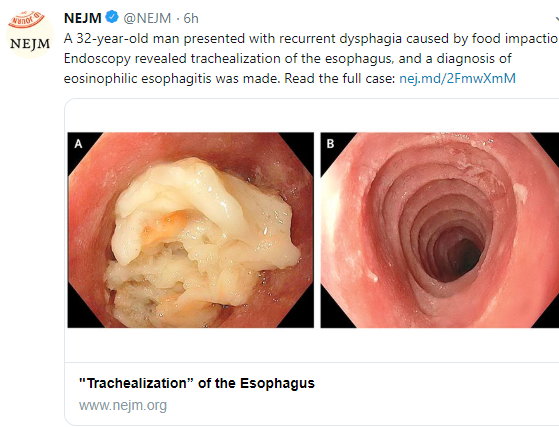
Time to Diagnosis in Eosinophilic Esophagitis

According to a recent retrospective study (CC Reed et al. Clin Gastroenterol Hepatol 2018; 16: 1667-9) the time to diagnosis of eosinophilic esophagitis (EoE) has NOT improved  between 2000 and 2014.  In this single tertiary-care center study with 677 cases, the predicted length of symptoms prior to diagnosis was the following:

  • 2000-2006: 6.1 years
  • 2007-2011: 7.2 years
  • 2011-2014: 7.2 years

While in the pediatric cohort the trend was the same, the length of symptoms preceding diagnosis was shorter: 2.8 years, 3.5 years and 3.7 years respectively for the above-mentioned time periods.

My take: In GI circles, EoE is quickly considered for a variety of clinical presentations.  This study suggests that

  • #1 for families and primary care doctors that many are unaware of this entity
  • #2 the symptoms of EoE are often insidious

Related blog posts:

Updated Consensus Guidelines for Eosinophilic Esophagitis

Full text: ES Dellon, CA Liacouras,  J Molina-Infante, GT Furuta et al. Gastroenterol 2018; 155: 1022-33.

This article provides a thorough review of EoE -including clinical features, differential diagnosis, diagnostic criteria, and treatments.

Key point: “The evidence suggests that PPIs are better classified as a treatment for esophageal eosinophilia that may be due to EoE than as a diagnostic criterion, and we have developed updated consensus criteria for EoE that reflect this change.”

Related blog posts:

Tofacitinib -Where Does it Fit in Treatment Algorithm for Ulcerative Colitis?

A few recent articles provide a lot of practical information regarding implementation of tofacitinib into treatment regimens for ulcerative colitis (UC).

  • S Danese et al. Inflamm Bowel Dis 2018; 24: 2106–12. Review article on Tofacitinib.
  • J-F Colombel.  Inflamm Bowel Dis 2018; 24: 2173–80. Review article on Herpes Zoster due to JAK Inhibitors (eg Tofacitinib).
  • KL Winthrop et al.  Inflamm Bowel Dis 2018; 24:  2258-65. Clinical study detailing the risk of Herpes Zoster in patients with UC receiving Tofacitinib.

The first of these articles reviews the mechanism of action of tofacitinib (TFB) and the relevant studies showing efficacy for UC.  A summary of the results are listed in Table 1. Some of the reported results –with TFB dosed at 10 mg BID:

  • In 2012, Sandborn et al: clinical response in 61% at wk 8 and clinical remission of 48% at wk 8.
  • In 2017 (OCTAVE Induction 1): clinical response in 18.5% at wk 8 and clinical remission of 31.3% at wk 8.
  • In 2017 (OCTAVE Induction 2): clinical response in 16.6% at wk 8 and clinical remission of 28.4% at wk 8.
  • In 2017 (OCTAVE Sustain):clinical response in 40.6% at wk 8 and clinical remission of 45.7% at wk 8.
  • In all of these studies, TFB outperformed the placebo arm and has had a good safety profile

Most common adverse effects had similar rates in the placebo arm:

  • Nasopharyngitis
  • Arthralgia
  • Headache

Other adverse effects have included pneumonia, herpes zoster (HZ) infection, and increased lipid levels (more common than with placebo group).  Trials in patients with rheumatoid arthritis have indicated an increased incidence of nonmelanoma skin cancer, lymphoma, breast cancer, lung cancer, and gastric cancers.

Preclinical studies have shown that TFB could cause fetal malformations when given at much higher doses.  Though, clinical experience in humans have not found teratogenic effects; this is based on one study with 9815 RA/psoriasis patients and 47 women who became pregnant.

Role for tofacitinib:

  • “Tofacitinib could be used in patients suffering mild, moderate and severe UC…after aminosalicylates (5-ASA)…and as second-line therapy in patients who have been treated with TNF inhibitors.”

Advantages of tofacitinib:

  • Oral administration with rapid absorption
  • Short serum half-life
  • Good experience in large number of patients with rheumatoid arthritis
  • No immunogenicity.
  • Effective in patients who have had previous anti-TNF agents

More on Herpes Zoster Infection:

  • The other two references detail the risk of Herpes Zoster infections with TFB usage.
  • Winthrop et al identified 65 (5.6%) of patients developed HZ among phase II/III open-label, long-term extension trials.
  • The review by Colombel notes that patients with UC have “an increased risk of HZ compared with the general population, and this risk can be increase by the use of immunosuppressive therapy.  JAK inhibitors, including tofacitinib, have been associated with HZ risk…The majority of HZ casees are noncomplicated.”
  • In this review, Colombel details an algorithm for treatment of HZ cases and indicates that adults receiving TFB should consider vaccination to lower the risk of HZ.

My take: A significant portion of patients with UC either do not respond to anit-TNF agents or lose response.  Tofacitinib provides an alternative treatment with a different mechanism of action.  Given the few other non-surgical treatment options, I expect it will be rapidly incorporated into treatment algorithms.

Related blog posts:

Are Probiotics Effective in Changing the Microbiome?

Two recent papers in Cell provide additional questions about the effectiveness of probiotics.

Full Studies:

The coverage of these studies in the media has created some controversy; enough so that the International Scientific Association of Probiotics and Prebiotics disseminated a very critical review:

CLINICAL EVIDENCE AND NOT MICROBIOTA OUTCOMES DRIVE VALUE OF PROBIOTICS

Here is a small excerpt:

Two recent papers have generated much adverse publicity for the probiotic field. Headlines driven by sensationalism, not data, claim “Probiotics labelled ‘quite useless’” (BBC) and “Probiotics ‘not as beneficial for gut health as previously thought’” (The Guardian). The quotes are from author Eran Elinav, who generalizes the study findings to all ‘probiotics’ as a class – a generalization that ignores that specific probiotic are meant for specific purposes…

The scope of these papers is limited to microbiome data; no clinical endpoints are assessed. Without clinical evidence, it is not possible to conclude about the tested probiotic’s usefulness, and it is certainly not possible to conclude about probiotic usefulness in general…. The authors discount the existing body of evidence for probiotic health benefits, including Level 1 placebo-controlled, randomized trials. Cochrane reviews (the gold standard used by physicians and public health policy makers) of the totality of evidence show that specific probiotics can prevent antibiotic associated diarrhea (AAD) and C. difficile diarrhea. This evidence has been translated into evidence-based recommendations for probiotics issued by medical groups. Regardless of an effect on the microbiota, these are established, evidence-based benefits of probiotics.

My take: This controversy points to the problem that probiotics are often considered more effective than the science merits.  While there are some conditions that may respond to probiotics, it should be understood that each probiotic needs to be looked at for each specific clinical scenario.

Related blog posts: