Hepatic Tumor Pointers

A grand rounds report (CK McLean et al. J Pediatr 2018; 193: 245-48) focuses on the presentation of a rare tumor in a neonate, angiosarcoma.  A few pointers from the discussion:

  • The most common benign hepatic vascular tumors are congenital hemangiomas and infantile intrahepatic hemangiomas (IHH)
  • The AAP dermatology section recommends assessing for hepatic lesions when there are 5 or more cutaneous hemangiomas.  The risk of a hepatic hemangioma may be 23%, according to one study, when there are >5 cutaneous hemangiomas or one large cutaneous hemangiomas.
  • “Consumptive hypothyroidism is a unique characteristic in some IHH.” This is due to tumor expression of a type 3 iodothyronine deiodinase enzyme which inactivates thyroid hormone.

Related blog post:

Bright Angel Trail, Grand Canyon

Exorbitant Medicine Costs -Generics Discounts Often Minimal

A recent story in the NY Times (Patients Eagerly Awaited a Generic Drug. Then They Saw The Price. ) shows that the availability of a generic drug does not guarantee that exorbitant pricing will be remedied.

An excerpt:

Syprine, which treats a rare condition known as Wilson disease, gained notoriety after Valeant Pharmaceuticals International raised the price of the drug to $21,267 in 2015 from $652 just five years earlier…

In promoting its “lower-cost” alternative to Syprine, a Teva executive boasted in a news release that the product “illustrates Teva’s commitment to serving patient populations in need.”

What the release didn’t mention was the price: Teva’s new generic will cost $18,375 for a bottle of 100 pills, according to Elsevier’s Gold Standard Drug Database. That’s 28 times what Syprine cost in 2010, and hardly the discount many patients were waiting for.

Nearly three years after Valeant’s egregious price increases ignited public outrage, the story of Syprine highlights just how hard it can be to bring down drug prices once they’ve been set at stratospheric levels.

My take: This type of excessive drug cost is why critics demand additional regulation be placed over the entire pharmaceutical industry; it can occur only in a system which has limited competition and indirectly shares the cost across the entire system by having insurance companies foot most of the bill.

Related blog posts:

Bright Angel Trail

Ethnicity and Fatty Liver Disease

A recent systematic review and meta-analysis (NE Rich et al. Clin Gastroenterol Hepatol 2018 16: 198: 210) provides a more comprehensive description of how ethnicity impacts the epidemiology of nonalcoholic fatty liver disease (NAFLD) in the U.S. This study identified 34 previous publications with 368,569 unique patients.

Key points:

  • NAFLD prevalence in hispanic persons is higher than white persons with a pooled relative risk of 1.47; whereas compared to white persons, black persons have a pooled relative risk of 0.74
  • Presence of NASH also had an ethnic predilection with a relative risk of 1.09 for hispanic persons, and 0.72 for black persons in comparison to white persons
  • Approximately one in 6 of all Americans have NAFLD

My take: While hispanic persons have a higher rate of NAFLD/NASH, it is still quite high among white persons and even in black persons who have the lowest rates.

Bright Angel Trail

What Does Richard Thaler’s Work Mean for Medicine?

A recent commentary (J Avorn. NEJM 2018; 378: 689-91) addresses a huge problem in medicine: “medicine’s ongoing assumption that clinicians and patients are, in general, rational decision makers.”

He points out that just as Albert Einstein upended Newtonian physics with the much more complex theory of relativity, Richard Thaler’s work in economics “explained that people often don’t make choices by acting as the rational balancers of risk and reward assumed by classic economics.” (More information about his work at Wikipedia post on Nudge).

Key points:

  • “We are disproportionately influenced by the most salient and digestible information” rather than the totality of information.  This “helps explain the power of simplistic pharmaceutical promotional materials, often delivered..with a tasty lunch.”
  • “Our beliefs are shaped by recent experiences…(Last-case bias).”
  • “We often overestimate small probabilities (such as uncommon drug risks).”  Another example would be fear of dying in a plane crash which is far less likely than dying in an auto accident.

The potential remedies to flawed decision-making include the following:

  • “Academic detailing” which is a process attempting to integrate more information to counter biases
  • Nudge concept. This is a strategy of “making a preferred alternative the default choice when several options exist.”  Order entry systems in computers could default to preferred drugs (ie. best drug in class)
  • Cost constraints can affect decision-making which could include targeting copayments for payments.  For physicians/administrators, looking at what drives revenue is crucial.  “As Upton Sinclair once noted, ‘It is difficult to get a man to understand something when his salary depends on his not understanding it.'”

My take: Addressing these ideas could help reduce unnecessary surgeries, increase  high value care, and improve outcomes.  This is why Richard Thaler’s work is important for medicine.

Related blog posts:


Paris Classification Quiz and Explanation

At one of our ImproveCareNow population management meetings, Dr. Chelly Dykes reviewed the Paris Classification and frequent misconceptions in using this system.  To illustrate this point, I am going to post 6 Quiz Slides and then follow that with the answers and explanation.  These quiz slides were derived from previous ImproveCareNow community meetings.

Answers:

  1. A
  2. B (macroscopic disease counts –erythema alone does not count)
  3. A (macroscopic disease counts)
  4. B (not ileum only unless colonic disease extends beyond cecum)
  5. F (though B acceptable)
  6. F (though B acceptable)

Related blog posts:

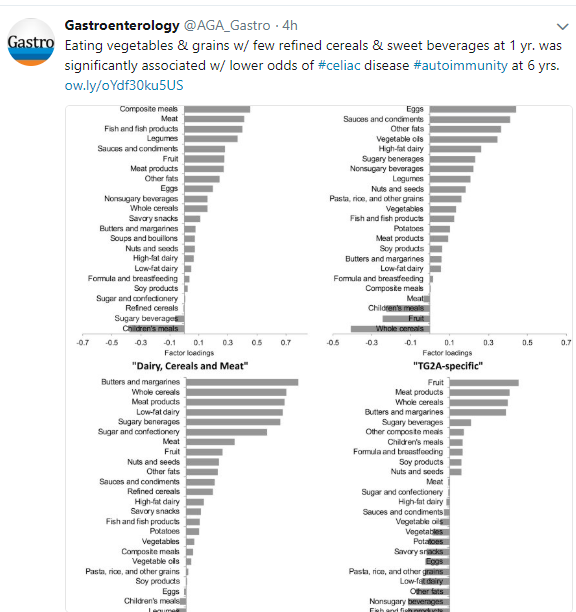
Never Too Old for Celiac Disease

A recent article (P Collin et al. AP&T 2018; 47: 563-72) reviews the presentation of celiac disease in later years (Thanks to Ben Gold for this reference).

Key findings:

  • Approximately 25% of celiac diagnoses are made at age ≥60 years
  • ~4% of celiac diagnoses are made at age ≥80 years
  • About 60% of individuals with celiac disease remain undetected
  • Adherence with gluten free diet results in “resolution of symptoms and improvement in laboratory indices…in over 90% of patients”

This review also focuses on specific related problems besides epidemiology: malabsorption, dermatitis herpetifromis, bone mineral density and fractures, autoimmune disease, heart disease, neurological disturbances, and malignancy.

Bright Angel Trail

Physician Age and Patient Outcomes

Tsugawa Y, Newhouse JP, MacArthur JD, et al. Physician age and outcomes in elderly patients in hospital in the US: observational study. BMJ. 2017;357 doi: https://doi.org/10.1136/bmj.j1797

Thanks to Ben Gold for this reference. Slides from Patient Care newsletter.

Background:

Researchers used nationally representative data on Medicare beneficiaries admitted to hospital with a medical condition during 2011-14. They wanted to find out the association between age of the treating physician and 30 day patient mortality after admission; whether this association varied with the volume of patients a physician treats; and whether physician age is associated with readmissions and costs of care. Their study included 736 537 admissions managed by 18 854 hospitalist physicians (median age 41).

Key findings

Briefly noted: Mongersen, Aprepitant, and Anesthetic Outcomes

BG Feagan et al. Gastroenterol 2018; 154: 61-4.  In this study of GED-0301 (Mongersen), an antisense oligodeoxynucleotide affecting Smad7, was randomly assigned to 63 patients with Crohn’s disease (160 mg/day).  Endoscopic improvement was observed in 37%  at week 12. Clinical remission (CDAI<150) was noted in  32% (4 weeks of Rx), 35%  (8 weeks of Rx) and 48% (12 weeks of Rx). No new safety signals were noted.

Related blog posts:

PJ Pasricha et al. Gastroenterol 2018; 154: 65-76.  First of all, I have to say that I like the visual abstracts in many Gastro studies.  In this randomized, double-masked “APRON” study of 126 patients with chronic nausea or gastroparesis receiving Aprepitant, a neurokinin-1 receptor antagonist, or placebo, the key findings were the following:

  • Aprepitant did not reduce symptoms of nausea significantly compared to placebo
  • Apreptiant-treated patients had improvements in secondary outcomes of symptom severity for nausea (1.8 vs 1.0, P=.005 on Gastroparesis Clinical Symptom Index) and overall symptoms (1.3 vs. 0.7, P=.001)

Related blog post:

B Bielawska et al. Gastroenterol 2018; 154: 77-85. Using data (administrative databases) and propensity matching from more than 3 million outpatient colonoscopies (2005-2012), the authors noted that the use of anesthesia assistance (AA) was associated with an increased risk of aspiration pneumonia (OR 1.63) but not perforation (OR 0.99). Though this study is limited by its retrospective design and reliance on administrative data, the authors state “the potential for residual confounding by indication for AA [is] extremely unlikely, especially because AA use in Ontario appears to be driven by institutional policy or business model rather than by patient factors.”

Related blog posts:

Bright Angel Trail

Predicting Hepatitis B Vaccination Failure in Infants

A brief report (KW Cheung et al. Clin Gastroenterol Hepatol 2018; 16: 144-5) describes a prospective multicenter study (2014-16) in Hong Kong which examined immunoprophylaxis failure (IF) of infants (n=654) born to mothers infected with hepatitis B virus (HBV) infection.  All infants had received HBV vaccine and HBV immunoglobulin (within 12 hours of birth).  Maternal HBV DNA & serology was measured at 28-30 weeks.

Key finding:

  • There were 7 cases of IF (1.1%). All were born to women with positive HBeAg and HBV DNA >8 log10 copies/mL (>17 million IU/mL)
  • The authors note that “although a cutoff of 200,000 IU/mL (~6 log10 copies/mL) has been recommend, the optimal viral load cutoff to initiate HBV antiviral treatment remains debatable.”

My take: HBV prophylaxis with HBV vaccination and HBIG is very effective.  However, HBV DNA levels can be used to target HBV antiviral treatment to further minimize the chance of IF failure.

Related blog posts:

Patient artwork


Briefly Noted: Pantoprazole dosing for obese children

V Shakhnovich et al. J Pediatr 2018; 193: 102-8. Using pharmocokinetic data from 41 obese children (6-17 years), the authors conclude that lean body weight dosing of pantoprazole led to pantoprazole pharmocokinetics similar to nonobese peers.  They also note that variability in age-related changes in CYP2C19 activity affected pantoprazole values in children <12 years of age.

Related blog post: #NASPGHAN17 EoE Session -James Franciosis presented data on how CYP2C19*17 allele was important in whether patients responded to PPIs for Eosinophilic Esophagitis.


Bright Angel Trail, Grand Canyon