HBV Reactivation Risk with HCV DAA Therapy and What to Do About It

A recent prospective study (C-J Liu et al. Gastroenterol 2018; 154: 989-97) provided some reassurance about the likelihood of hepatitis B virus (HBV) reactivation during hepatitis C virus (HCV) treatment with direct-acting antivirals (DAA).

In this study with 111 patients with both HCV and HBV treated with ledpasvir/sofusbuvir, all (100%) of the patients had a sustained virologic response for their HCV infection. Other key findings:

  • Of the 37 patients with baseline HBV DNA < 20 IU.mL, 31 (84%) developed detectable HBV DNA levels through posttreatment week 12.
  • Of the 74 patients with baseline HBV DNA >20 IU/mL, 39 (53%) developed increases in HBV DNA >1 log10 IU/mL through posttreatment week 12.
  • 5 patients developed ALT >2 times ULN and 3 patients were started on HBV therapy.

The associated editorial (pgs 795-8) made the following recommendations:

  • “HBsAg-negative/HBcAb-positive patients should be monitored with ALT alone until SVR12 and should be tested with HBsAg +/- HBV DNA only if ALT increases or fails to normalize on therapy.”
  • “HBsAg-positive patients with undetectable baseline HBV DNA should be considered for preemptive anti-HBV treatment, or monitored with ALT and HBV DNA until SVR12”
  • “HBsAg-positive patients with positive baseline HBV DNA should be started on preemptive anti-HBV treatment until SVR12.”

Using the above management strategy will limit the number of HBV-infected patients who need to be treated.

My take: This study and the associated editorial provide useful information regarding DAA in coinfected HBV/HCV patients; this is important for patients and practitioners, especially given the black box warning on DAA medications.

Related blog posts:

Disclaimer: These blog posts are for educational purposes only. Specific dosing of medications/diets (along with potential adverse effects) should be confirmed by prescribing physician/nutritionist.  This content is not a substitute for medical advice, diagnosis or treatment provided by a qualified healthcare provider. Always seek the advice of your physician or other qualified health provider with any questions you may have regarding a condition.

Predicting Hepatitis B Vaccination Failure in Infants

A brief report (KW Cheung et al. Clin Gastroenterol Hepatol 2018; 16: 144-5) describes a prospective multicenter study (2014-16) in Hong Kong which examined immunoprophylaxis failure (IF) of infants (n=654) born to mothers infected with hepatitis B virus (HBV) infection.  All infants had received HBV vaccine and HBV immunoglobulin (within 12 hours of birth).  Maternal HBV DNA & serology was measured at 28-30 weeks.

Key finding:

  • There were 7 cases of IF (1.1%). All were born to women with positive HBeAg and HBV DNA >8 log10 copies/mL (>17 million IU/mL)
  • The authors note that “although a cutoff of 200,000 IU/mL (~6 log10 copies/mL) has been recommend, the optimal viral load cutoff to initiate HBV antiviral treatment remains debatable.”

My take: HBV prophylaxis with HBV vaccination and HBIG is very effective.  However, HBV DNA levels can be used to target HBV antiviral treatment to further minimize the chance of IF failure.

Related blog posts:

Patient artwork


Defining the Role for Elastography

The ability to determine if a patient has cirrhosis/severe fibrosis with a noninvasive test can help determine appropriate monitoring and treatment for many liver conditions. As such the AGA has provided recommendations for the use of vibration-controlled transient elastography (VCTE).

  • JK Lim et al. Gastroenterol 2017; 152: 1536-43.
  • S Singh et al. Gastroenterol 2017; 152: 1544-77.

Many recommendations are based on the specific unit of measurement, kilopascals (kPa)

Specific recommendations (most with low  or very low quality evidence):

  • “In adults with chronic HCV, we can accurately diagnosis cirrhosis …with VCTE-defined liver stiffness of ≥12.5 (±1) kPa.”  The AGA suggests using VCTE rather than MRE for detection of cirrhosis.
  • “In adults with chronic HCV who have achieved SVR…we can accurately rule out advanced fibrosis (F3 and F4) with post-treatment VCTE-..of ≤9.5 (±1) kPa.” . Even in patients who have had HCV eradicated, if cirrhosis has been identified, careful followup is recommended.
  • “In adults with chronic HBV, we can accurately diagnosis cirrhosis…with VCTE…of ≥11.0 (±1) kPa.”
  • “The AGA makes no recommendation regarding the role of VCTE in the diagnosis of cirrhosis in adults with NAFLD.” For NAFLD, VCTE is not as helpful as with chronic HCV and HBV.  Currently, liver biopsy remains the “gold standard.” However, for noninvasive imaging, “the AGA suggest using MRE, rather than VCTE, for detection of cirrhosis.
  • For adults with suspected compensated cirrhosis, a VCTE of 19.5 or greater can be used “to assess the need for esophagogastroduodenoscopy to identify high risk esophageal varices.”

My take: These elastography recommendations are applicable for adults.  For pediatric patients, these reports suggest that elastography may be helpful in specific circumstances as well.

Related posts:

Omaha Beach

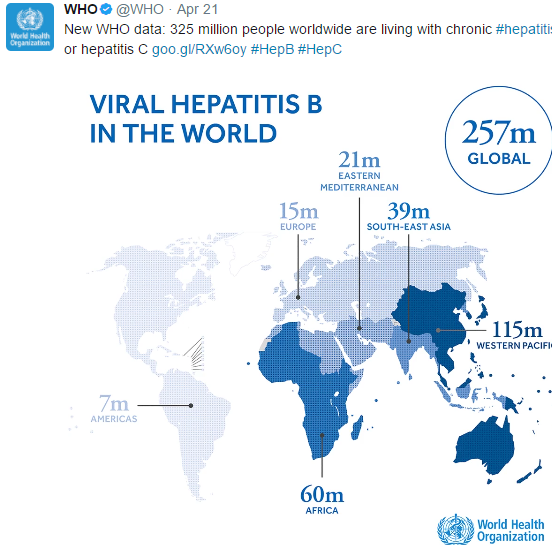
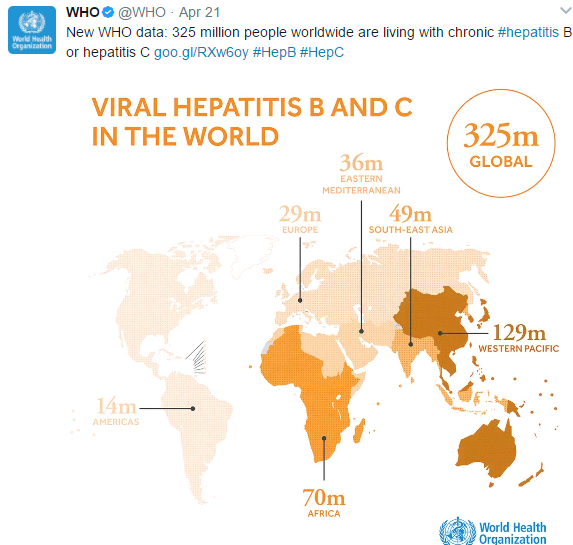
Burden of Hepatitis B and Hepatitis C

Related blog posts:

More on Hepatitis B Treatment in Children

A recent post (New Hepatitis B Treatment Guidelines -AASLD) described the updated treatment recommendations.  When these guidelines were published, a separate review devoted specifically to pediatrics was published (Hepatology 2016; 63: 307-18).

Some of the key points:

  • This pediatric review included 14 studies with 1425 children.  The authors note that 7 of these trials had a high risk of bias.  Also, the studies are limited by relying on surrogate markers of long-term outcomes as clinical outcomes like cirrhosis, HCC, and death are rare in childhood.
  • Among oral agents, entecavir and lamivudine are approved for use in children ≥ 2 years, whereas adefovir and tenofovir are approved for use in children ≥ 12 years.  Both lamivudine and adefovir are associated with frequent development of viral resistance
  • For children with elevated ALT (>1.5 times upper limit of normal [ULN]), treatment is recommended:

9A. The AASLD suggests antiviral therapy in HBeAg-positive children (ages 2 to <18 years) with both elevated ALT and measurable HBV DNA levels, with the goal of achieving sustained HBeAg seroconversion.

Why not treat everyone?

  • Children with immune-tolerant HBV infection (normal or near-normal ALT [< 1.5-2 times ULN] along with high HBV DNA [>10 million IU/mL]), “are not typically candidates for treatment because treatment with any of the currently available drugs has not been demonstrated to improve HBeAg seroconversion compared with no treatment.”
  • Children with ALT >10 time ULN may be in the process of spontaneous seroconversion “and should be observed for several months before treatment” is initiated.
  • “Prolonged treatment with nucleoside or nucleotide analogs in children who are in immune-tolerant phase has not been associated with substantial benefit and carries a risk of developing antiviral drug resistance…An exception may be those…undergoing immunosuppressive therapy.”
Mina Falls, El Yunque Rainforest

Mina Falls, El Yunque Rainforest

New Hepatitis B Treatment Guidelines

Link to full article: Updated Hepatitis B Treatment Guidelines from AASLD

With regard to pediatrics:

9A. The AASLD suggests antiviral therapy in HBeAg-positive children (ages 2 to <18 years) with both elevated ALT and measurable HBV DNA levels, with the goal of achieving sustained HBeAg seroconversion.

“Most studies required ALT elevation (>1.3 times ULN) for at least 6 months with HBV DNA elevations for inclusion. Given that HBV DNA levels are typically very high during childhood (>106 IU/mL), there is no basis for a recommendation for a lower-limit value with respect to treatment. However, if a level <104 IU/mL is observed, therapy might be deferred until other causes of liver disease and spontaneous HBeAg seroconversion are excluded.”

“Duration of treatment with oral antivirals that has been studied is 1-4 years. It may be prudent to use HBeAg seroconversion as a therapeutic endpoint when oral antivirals are used, continuing treatment for an additional 12 months of consolidation, as recommended in adults. It is currently unknown whether a longer duration of consolidation would reduce rates of virological relapse.”

“Children who stop antiviral therapy should be monitored every 3 months for at least 1 year for recurrent viremia, ALT flares, and clinical decompensation.”

9B. The AASLD recommends against use of antiviral therapy in HBeAg-positive children (ages 2 to <18 years) with persistently normal ALT, regardless of HBV DNA level.

Another nice summary of current treatment recommendations: P Martin et al. Clin Gastroenterol Hepatol 2015; 13: 2071-87.  Table 5 lists recommendations for treatment of HBeAg-positive.

  • The main group needing treatment (entecavir, tenofovir, or PEGinterferon alfa-2a) are those with HBV DNA >2000 IU/mL and elevated ALT.  Table 6 lists recommendations for those with HBeAg-negative.  Main group needing treatment are the same (HBV DNA >2000 IU/mL and elevated ALT).
  • With both groups (HBe-Ag negative and positive), “consider liver biopsy or transient elastography” if elevated HBV DNA >2000 and normal ALT.  If histologic disease present, consider treatment.
  • One point the authors make about therapy regards duration: “Historically, HBeAg seroconversion was considered a durable response, and discontinuation of antiviral therapy was recommended after a period of consolidation therapy of 6-12 months from the time of HBeAg seroconversion. However, patients who discontinue therapy …can experience recurrent viremia and ALT flares.  Thus, long-term therapy is justified.”
  • For HBeAg negative patients who have compensated liver disease, loss of HBsAg for 6-12 months may be discontinued from therapy.

Antivirals Reduce Vertical Transmission of Hepatitis B

Chelsea Market, NYC

Chelsea Market, NYC

The latest study that shows antivirals interrupt hepatitis B viral (HBV) transmission from mother-to-infant: H-L Chen et al. Hepatology 2015; 62: 375-86.

In this open-label, non-randomized controlled study from Taiwan, the researchers recruited women to receive tenofovir (TDF) at a dose of 300 mg once a day (n=62), initiated from gestational age 30-32 weeks until 1 month following delivery, and compared them to a control group (n=56).  There were high levels of viremia with HBV DNA ≥7.5 log10 IU/mL. All infants received HBV vaccination and HBIG within 24 hours of birth.

Key findings:

  • Infant transmission of HBV was reduced: at 6 months of age, infant HBsAg positivity was 1.54% versus 10.71%, P=0.0481).  At delivery, HBV DNA positivity was noted in 6.15% compared with 31.48% of the control group.
  • Maternal ALT was improved in the TDF group. ALT elevation more than two times the upper limit of normal for ≥3 months occurred in 3.23% compared with 14.29% of controls.
  • Adverse effects: only mild to moderate (self-limited) gastrointestinal and skin symptoms were noted. No fetal abnormalities were identified.

Bottomline: Antivirals, including both tenofovir and telbivudine, reduce vertical HBV transmission with a favorable safety profile.  The use of antivirals is complementary to standard prevention which consists of providing Hepatitis B immune globulin and Hepatitis B vaccine to infants of HBV-infected pregnant women within 12 hours of birth.

Related blog posts:

Cyclophilin Inhbitor for Chronic Hepatitis B

From AGAblog: A New Approach to Hepatitis B?

Cyclophilins are involved in multiple steps of the hepatitis B virus (HBV) life cycle in hepatocytes—cyclophilin inhibitors reduce viral replication and HBV envelope protein production and secretion, researchers report in the February issue of Gastroenterology. The cyclophilin inhibitor alisporivir, combined with the HBV polymerase inhibitor, reduces markers of HBV infection and HBV replication in cells, revealing a possible new therapeutic approach for chronic hepatitis B.