Here we go again …Miralax Safety Questioned

The issue of miralax safety is something that is discussed on a daily basis in pediatric gastroenterology offices.  It is back in the news.  The headlines suggest that there could be a problem but when one examines these stories we find that these reports have NOT shown data indicating a safety concern.

Here’s a link to a NASPGHAN Neurogastroenterology statement on safety of Miralax:

Here’s a link to a recent article in AJC questioning the safety of Miralax:

In this article, “the FDA told WPVI that there isn’t enough data “to demonstrate a link between PEG 3350 and serious neuropsychiatric issues in children.”

Bayer, MiraLAX’s manufacturer, said in part: “As part of Bayer’s ongoing commitment to consumer well-being, we regularly track, analyze and report all adverse event data related to the use of the product. Results of this ongoing monitoring support the continued safe use of MiraLAX.”

In a 2015 article on Parents.com, Dr. Steve J. Hodges, an associate professor of pediatric urology at the Wake Forest School of Medicine, pointed out that “more than 100 studies have found PEG 3350 is safe to use in children.”

“I have found no published studies linking MiraLAX to severe or harmful side-effects,” said Hodges, who was responding to a New York Times article about the Philadelphia study.”

Here’s a few other posts on Miralax safety:

Related blog posts:

My take (borrowed from expert review): “Generally speaking, if your child has been prescribed PEG 3350 as part of his/her treatment plan, and you feel this medicine provides benefit, you should feel safe continuing PEG 3350. At this time, PEG 3350 appears to be safe based on current medical literature. We recommend discussing any concerns you have about the safety of PEG 3350 with your child’s health care provider. If you would prefer for your child to stop taking PEG 3350, discuss other treatments options with your child’s health care team before stopping PEG 3350 therapy. Although abruptly stopping PEG 3350 is not considered dangerous, it could lead to a relapse/worsening of constipation.”

From 'this week in church signs'

From ‘this week in church signs’

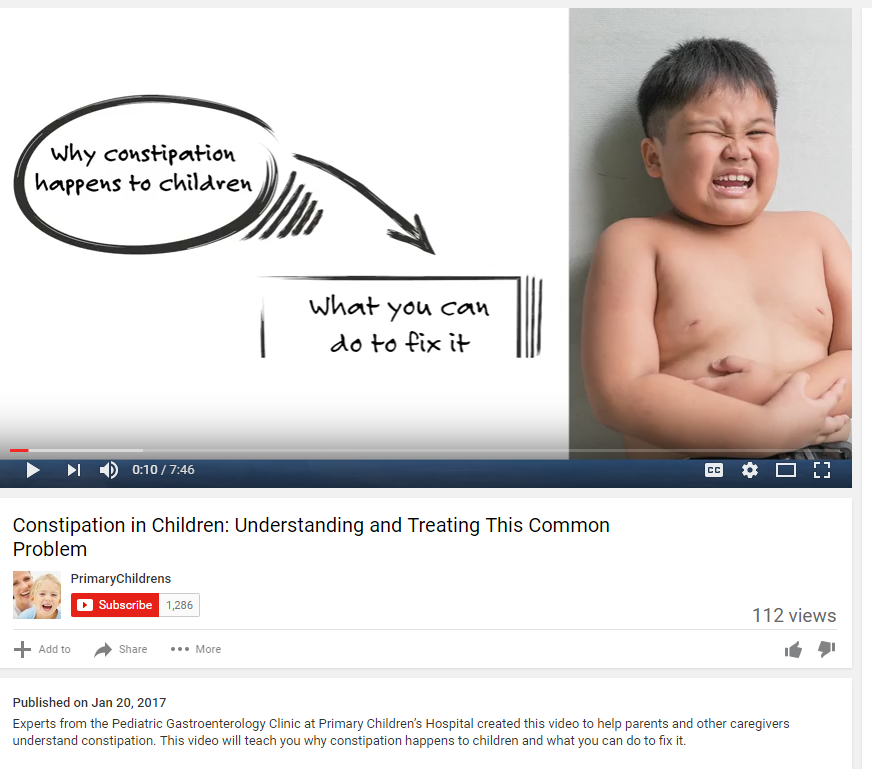
Constipation Video from Primary Children’s Hospital

This is a really good educational video (< 8min) -now on YouTube: Constipation in Children: Understanding and Treating This Common Problem (Thanks to John Pohl’s twitter feed for this resource)

screenshot-78

Related blog posts:


Soap Suds Enemas & ED Management of Impactions

A recent retrospective single-center study (CE Chumpiitazi et al. JPGN 2016; 63: 15-18) identified 512 patients (8 mo-23 years) who were treated with soap suds enemas (20 mL/kg of water with one packet of castile soap).  Key findings: No serious adverse events were identified. “82% were successfully treated.”

While this large study provides a fair amount of reassurance, the associated editorial (pg 1-2) makes some key points:

  • ED diagnosis of fecal impaction is unreliable.  “Abdominal radiographs are often performed…[but] have shown unsatisfactory sensitivity and specificity.”  In this study, only 38% had reported history of constipation; thus a high number of children developed impactions without prior constipation.  Thus, either many of these children were not impacted or the history was unreliable.
  • “SSEs are likely to be very effective, but so are phosphate enemas and milk and molasses enemas that have fallen out of favor because of safety concerns.”
  • In the editorial, until prospective studies are completed, the authors advocate considering oral PEG (high-dose) or ducosate enemas, normal saline enemas, glycerin enemas, mineral oil enemas, or bisacodyl enemas.

My take: While the editorial makes some valid points, particularly making sure that treatment for an impaction is needed, I think this study provides good preliminary data on the safety of soap suds enemas.  As with all pediatric treatments, more high-quality studies would be welcome.

Related blog posts:

AJC Peachtree Road Race 2016

AJC Peachtree Road Race 2016

More than Two Years of Constipation Before Specialty Help

A recent article (S Malowitz et al. JPGN 2016; 62: 600-02) examined the age of onset of constipation in a retrospective review of 538 children with functional constipation between 2012-2014.

Key findings:

  • Median age of onset was 2.3 years
  • On average, “2.7 years pass between the onset of functional constipation and a referral to a specialist.”  In the oldest quartile, the lapse between onset and referral was shorter, 1.8 years.  This may reflect the social consequences of soiling in school-aged children.

The authors note: “encouraging clinicians and parents to think of constipation as a chronic problem with physical and mental health implications may improve outcomes and quality of life for affected children.”

My take: The suffering and burden of constipation is easily overlooked in a busy primary care visit.  This is a shame because this is one area where inexpensive specialty care (i.e. minimal testing) can truly make a big difference.

Related blog posts:

Atlanta Zoo 2016

Atlanta Zoo 2016


Rome IV -Pediatric Changes

What are the changes in Rome IV for children and adolescents?  JS Hyams, C DiLorenzo et al (Gastroenterol 2016; 150: 1456-68) provide a helpful review.

Key point:

The ‘dictum’ that there was “no evidence for organic disease” as an criteria for functional disorders has been dropped in favor of “after appropriate medical evaluation the symptoms cannot be attributed to another medical condition.”  This subtle change discourages excessive investigations.

The functional disorders covered in this article include

  • H1 Functional nausea and vomiting disorders: H1a -cyclic vomiting syndrome, H1b -functional nausea and vomiting (NEW), H1c -rumination syndrome, H1d -aerophagia
  • H2 Functional abdominal pain disorders: H2a -functional dyspepsia, H2b -irritable bowel syndrome, H2c -abdominal migraine, H2d -functional abdominal pain -not otherwise specified
  • H3 Functional defecation disorders: H3a -functional constipation, H3b -nonretentive fecal incontinence

Other points:

  • “There are no published data on the treatment of isolated functional nausea and isolated functional vomiting”
  • “We have eliminated the requirement of pain to fulfill the criteria for FD” [functional dyspepsia]
  • Criteria for cyclic vomiting and abdominal migraines now require only 2 episodes in a 6 month period
  • Criteria for functional constipation requires only 1 month rather than 2 months (this is true for H3b as well).  The authors endorsed the NASPGHAN expert guidelines which included “no role for routine use of an abdominal x-ray to diagnose FC.”  The guideline discourages testing for cow’s milk allergy, hypothyroidism, celiac disease and hypercalcemia in the absence of alarm symptoms.

In a separate article, MA Benninga, S Nurko et al (Gastroenterol 2016; 150: 1443-55) describe the functional disorders affecting infants and toddlers.

In my view, the article in this special edition that incorporates the most changes regards functional disorders of the biliary tree (FGBD) (PB Cotton et al Gastroenterol 2016; 150: 1420-29). This is mainly due to data showing that sphincterotomy is no better than sham treatment for patients with post-cholecystectomy pain.  “The concept of sphincter of Oddi dysfunction type III is discarded.”  In addition, for biliary pain/’gallbladder dyskinesia,’ the authors also acknowledge that the role of obtaining a gallbladder ejection fraction is “controversial.”  “Symptoms suggestive of FGBD often resolve spontaneously so that early intervention is unwarranted.”  Ultimately, the authors state that “treatment recommendations are not firmly evidence-based.”

Related blog posts:

Owl in Our Neighborhood

Owl in Our Neighborhood

538: Gut Science Week

While FiveThirtyEight garners a lot of attention for its political and sports forecasts, there are often health-related posts.  This week is devoted to Gut Science Week.

Here’s the link: Gut Science Week Introduction

Here’s an excerpt:

One of the major leaps forward in gut science began with an accidental shooting at a trading post on June 6, 1822. A fur trader named Alexis St. Martin took a bullet in the abdomen, leaving him with a hole ripped through his muscle, bone and internal organs…

His doctor, William Beaumont, could literally tie a bit of food on a string, shove it into St. Martin’s stomach through the hole, and pull it back out again. Using this one weird trick, Beaumont extracted samples of the man’s gastric juices. Over eight years and more than 200 awkwardly invasive experiments, St. Martin and Beaumont gave humanity its first real understanding of how digestion works.

Another post: Everybody is Constipated, Nobody is Constipated

Here’s an excerpt:

Doctors use diagnostic criteria for constipation, where patients have to experience two or more of six symptoms:

  1. Straining during at least 25 percent of defecations
  2. Lumpy or hard stools in at least 25 percent of defecations
  3. Sensation of incomplete evacuation in at least 25 percent of defecations
  4. Sense of obstruction in at least 25 percent of defecations
  5. Manual maneuvers needed to facilitate at least 25 percent of defecations
  6. Fewer than three defecations per week

And a video: What Your Poop Says About You — FiveThirtyEight

Gut Science Week --FiveThirtyEight

Gut Science Week –FiveThirtyEight

Torsion of Accessory Spleen

A case report (PM Guglietta et al. NEJM 2016; 374; 373-82) presents a 9 year-old girl who had repeated episodes of abdominal pain with associated nonbilious vomiting.  These pains started 5 years prior and were often sudden episodes of sharp pain on the left side or epigastric region and were associated with tachycardia.

AXR in Case Report

AXR in Case Report

Ultimately the diagnosis was established with a CT scan.  “Most persons with accessory spleens are asymptomatic, but abdominal pain can occur with torsion.”

While the case report is interesting, one aspect I did not like was the discussants justification of the delay of the diagnosis based on the presumption of constipation.  The radiologist even commented: “a moderate-to-abundant amount of stool distributed in the colon, particularly the ascending colon; these findings are consistent with the clinical history of constipation.”  This and other comments in the case study go against previous expert recommendations to avoid routine radiographs in the diagnosis of constipation and the finding of reviews which have not found a correlation between clinical symptoms and so-called fecal loading on abdominal radiographs.

Related blog posts:

Flamenco Beach

Flamenco Beach


Microbiome Predicts Constipation plus two

In brief:

G Parthasarathy et al. Gastroenterol 2016; 150: 367-79.  Mucosal and fecal microbiota samples were collected from 25 healthy women and 25 women with chronic constipation.  Key finding: The mucosal, but not fecal, microbiota profile were 94% predictive of constipation. The associated editorial (pg 300) provides a framework for understanding these findings and show the complexity of trying understand the interations between diet, motility and microbes.

S Fukudo et al. Gastroenterol 2016; 150: 358-66.  This prospective study of Ramosetron for 576 women with IBS-D.  Key finding: 50.7% of treatment patients reported global improvement compared with 32.0% of control patients.  Patients had less abdominal pain, less discomfort, and better stool consistency.  Ramosetron, a 5-HT3 antagonist, has not been reported to cause ischemic colitis (in contrast to alosetron).

In followup to a post earlier in the week, another worrisome study on the Zika virus in pregnancy from NEJM. Here’s an excerpt:

Fetal abnormalities were detected by Doppler ultrasonography in 12 of the 42 ZIKV-positive women (29%) and in none of the 16 ZIKV-negative women. Adverse findings included fetal deaths at 36 and 38 weeks of gestation (2 fetuses), in utero growth restriction with or without microcephaly (5 fetuses), ventricular calcifications or other central nervous system (CNS) lesions (7 fetuses), and abnormal amniotic fluid volume or cerebral or umbilical artery flow (7 fetuses).

Farjado, Puerto Rico

Farjado, Puerto Rico

“Simple Remedies for Constipation”

“Common sense is not so common” –Voltaire

A useful review of constipation management in the NY Times: Simple Remedies for Constipation

This review explains the role of diet and exercise in treatment of constipation.  The author notes that coffee helps many and that laxatives are safe. In addition, the idea of “autointoxication” due to infrequent bowel movements is debunked.

Here’s an excerpt:

Dr. Wald and others say that properly designed studies of these [stimulatory] laxatives have shown no harm to the colon when they are taken in recommended amounts.

Yet many doctors still warn – inappropriately, Dr. Wald says — against taking stimulatory laxatives for more than a few days. Indeed, the website FamilyDoctor.org states, “When these laxatives are taken for a long time, the bowel can lose its muscle tone and ‘forget’ how to push the stool out on its own.” Best to forget this outdated idea as long as you stick to the recommended dose if you must take these products.

Related blog posts:

Screen Shot 2016-02-09 at 8.56.54 PM

Do You Know the Best Way to Use Antegrade Enemas?

Currently, there is no best way to use antegrade enemas.  This is the obvious conclusion after reading a study by S Kuizenga-Wessel et al (JPGN 2016; 62: 71-9).  In this study, the authors reviewed 21 articles and also surveyed 23 physicians involved in the care of children who receive antegrade continence enemas (ACE). While the study provides a lot of details, the bottom-line is that there is wide variation in outcomes, definition of success, workup prior to institution of ACE, and irrigation solutions (16 out of 23 used saline).  The only areas of agreement seem to be the following:

  • use of ACE daily: 22 of 23
  • use of antibiotics with placement: 23/23 (though wide variation in specific regimen)
  • indications for ACE were largely in agreement, including constipation with fecal incontinence (21 of 23), anorectal malformations (22 of 23) and spinal abnormalities (23 of 23); however, only 8 of 23 considered due to functional non-retentive fecal incontinence as an acceptable indication

With regard to the type of enema, the vast majority of physicians (19 of 23) only add a stimulant to the solution after initial failure.  Though, one study (J Pediatr 2012; 161: 700-4) has reported “that subjects who use stimulants from the very beginning had significantly better outcomes.”

My take: Like of a lot areas in medicine and throughout pediatric gastroenterology, there is wide variation in clinical treatment approaches.  Variation in treatment is obvious in the use of ACE.  Collaborative work and consensus building in management would improve success; that is, after we define what success looks like.

In the same issue a link to “History of Pediatric Endoscopy” is provided.  This is a ~15 minute video with interviews with many pioneers/leaders in pediatric gastroenterology.

Related blog posts:

Golden Gate Bridge

Golden Gate Bridge