Early Study Shows That Relamorelin Impoves Constipation and Transit Time

An early study shows that Relamorelin relieves constipation & accelerates colonic transit in a placebo-controlled, randomized trial.  Abstract follows.

Relamorelin Relieves Constipation and Accelerates Colonic Transit in a Phase 2, Placebo-Controlled, Randomized Trial A Acosta et. Clin Gastroenterol Hepatol; December 2015Volume 13, Issue 13, Pages 2312–2319.e1. DOI: http://dx.doi.org/10.1016/j.cgh.2015.04.184

Abstract:

Background & Aims

Ghrelin receptors are located in the colon. Relamorelin is a pentapeptide selective agonist of ghrelin receptor 1a with gastric effects, but its effects in the colon are not known. We aimed to evaluate the effects of relamorelin on bowel movements (BMs) and gastrointestinal and colonic transit (CT) in patients with chronic constipation.

Methods

We performed a study of 48 female patients with chronic constipation who fulfilled the Rome III criteria and had 4 or fewer spontaneous BMs (SBMs)/wk. In a randomized (1:1), double-blind, parallel-group, placebo-controlled trial, the effects of relamorelin (100 μg/d, given subcutaneously) were tested during 14 days after a 14-day baseline, single-blind phase in which patients were given placebo at 2 Mayo Clinic sites. The participants’ mean age was 40.6 ± 1.5 y, with a mean body mass index of 25.7 ± 0.6 kg/m2, with 1.7 ± 0.1 SBM/wk, and a mean stool consistency of 1.2 ± 0.1 on the Bristol scale during this baseline period. The effect of treatment on transit was measured in 24 participants with colonic transit of less than 2.4 (geometric center at 24 h) during the baseline period. Gastric emptying, small-bowel transit, and CT were measured during the last 2 days that patients received relamorelin or placebo. Bowel function was determined from daily diaries kept by patients from days 1 through 28. Study end points were time to first BM, SBMs/wk, complete SBMs/wk, stool form, and ease of stool passage. Effects of relamorelin were assessed by analysis of covariance.

Results

Compared with placebo, relamorelin accelerated gastric emptying half-time (P = .027), small-bowel transit (P = .051), and CT at 32 hours (P = .040) and 48 hours (P = .017). Relamorelin increased the number of SBMs (P < .001) and accelerated the time to first BM after the first dose was given (P = .004) compared with placebo, but did not affect stool form. Adverse events associated with relamorelin included increased appetite, fatigue, and headache.

Conclusions

Relamorelin acts in the colon to significantly reduce symptoms of constipation and accelerate CT in patients with chronic constipation, compared with placebo. ClinicalTrial.Gov registration number: NCT01781104.

Lights at Life University

Lights at Life University

Improving ER Performance for Suspected Constipation

While the ultimate goal would be for most constipation to be prevented or managed by primary care physicians, the reality is that a lot of children are seen in the ER setting.  Particularly in the hospital setting, many practitioner’s have relied on abdominal xrays (AXRs) and this practice has been criticized previously (What’s Wrong with Ordering an AXR for Constipation in the …).

It is gratifying that efforts are underway to reverse this tendency.  A recent study (J Kurowski et al. J Pediatr 2015; 167: 706-10) document the effect that a 10 minute training session can have.

In this retrospective chart review, the researchers examined a 2 month baseline period and then a 2 month period after institution of a 10-min educational module for ER healthcare providers.  The module included the following:

  1. Rome III criteria for constipation  -at least 2 criteria weekly for >2 months:
    • ≤2 defecations in the toilet per week
    • at least 1 episode of fecal incontinence per week
    • history of retentive posturing or excessive volitional stool retention
    • history of painful or hard bowel movements
    • presence of a large fecal mass in the rectum
    • history of large stools which may obstruct toilet
  2. Review of the lack of utility of abdominal radiographs
  3. Use of rectal exam

Patients were identified who were discharged from the ER (without hospital admission)  with a diagnosis of constipation and with a chief complaint of abdominal pain.  In the baseline period, there were 105 patients and in the followup period, there were 91 patients.

Key findings:

  • Digital exams increased: 22.9% —>47.3%
  • AXR decreased: 69.5% –>26.4%

This study has numerous limitations; these include retrospective study and patient selection. Nevertheless, it makes several useful points.  If constipation is suspected, better care at a lower cost can be achieved by including a digital exam.  The authors note that “there is no strong evidence to support the utility of radiographs for this diagnosis [constipation] or even reliable standards to evaluate the normal stool burden across different ages.”

My take: The lessons from this study are applicable to primary care physicians and gastroenterologists as well as to ER physicians.  While this educational module is a good start, if I were designing a module, I would include information on irritable bowel syndrome which is often confused with isolated constipation.

Related blog posts:

Soiling Stinks!

The initial title of this post was too boring: “Documenting the Detrimental Effects of Fecal Incontinence on Quality of Life”

In perhaps one of the least surprising conclusions, the authors of a recent study (Kovacic K, et al. J Pediatr 2015; 166: 1482-7) have shown that “fecal incontinence significantly decreases quality of life compared with functional constipation alone in children.”  This multicenter prospective study surveyed families of 410 children (2-18 years).

Despite the obvious findings, I still think that the burden of fecal incontinence is underestimated by families and practitioners.  Here is an excerpt from this article’s discussion:

“Fecal incontinence impairs general functioning for children and their families…[it] is an insidious burden with substantial economic impact and adverse effects on quality of life…this effect increases as children approach adolescence…The devastating effect of fecal incontinence on quality of life and social functioning make it imperative that health professionals address defecation disorders proactively.  When aggressive and appropriate medical therapies are unable to provide a satisfactory outcome, then a multidisciplinary approach or a surgical option (e.g. cecostomy tube for antegrade enema) may be justified.”

Bottomline: Soiling stinks!  We need to keep working on this problem even if aggressive interventions are needed.

Related blog posts:

Not Letting Go of a Log

Not Letting Go of a Log -Can Lead to Problems

Refractory Constipation -Terrific Update

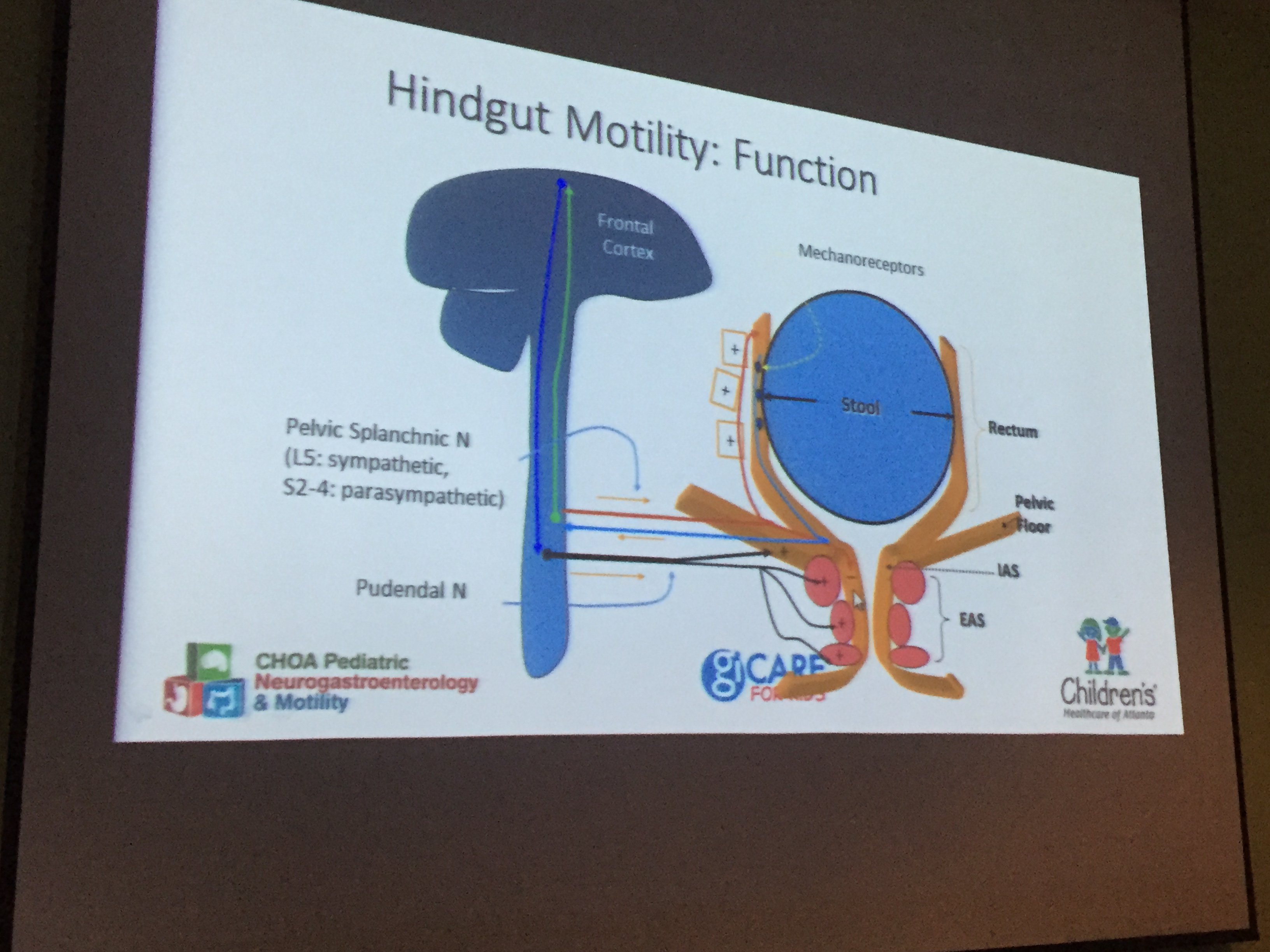
Recently I attended a terrific talk by my partner, Jose Garza.  This lecture provided a great deal of information on refractory constipation for both pediatricians and pediatric gastroenterologists alike.

Elements of the talk included diagnosis, pathophysiology and differential diagnosis.

Rome III Criteria -Helpful in Diagnosis of Constipation

Rome III Criteria -Helpful in Diagnosis of Constipation

JG1 pathophys

Is it Hirschsprung's Disease?

Is it Hirschsprung’s Disease?

Some of the more useful points.

  1. AXR should not be used to make diagnosis of constipation.
  2. Many refractory constipation patients are stooling fine and actually labeled as constipation instead of a functional abdominal pain disorder.  That is, they are complaining of stomach pain and have been erroneously told they are constipated (see point #1).
  3. Miralax remains a 1st line agent for constipation. In individuals with fecal soiling, if miralax is not working and they have had appropriate cleanout, then senna laxative may be helpful.
  4. Sitz markers are particularly helpful in proving stooling when teenager claims to not be stooling for a month and in proving functional fecal retention rather than nonretentive soiling.
  5. If good treatment is not working, then refer to neurogastroenterology.

Related blog posts:

JG3 -Help


Prucalopride -Not Better Than Placebo for Children with Constipation

Background: There were high expectations for prucalopride for the treatment of constipation based on previous small studies as well as a placebo-controlled trial in adults.  In adults, after 12 weeks of treatment, between 19.5-29% were responders compared to 9.6-12.1% in placebo patients. Prucalopride is a 5-hydroxytryptamine receptor-4  (5HT4) agonist which has been shown to accelerate colonic motility and is similar structurally to agents like cisapride and tegaserod; these latter medications have shown effectiveness as prokinetics but were limited by life-threatening cardiovascular side effects.

Design: Large (n=213), multicenter, placebo-controlled trial (Mugie SM, et al. Gastroenterol 2014; 147: 1285-95, editorial 1214-16). Response to medication indicated by >3 spontaneous bowel movements per week and <1 episode of fecal incontinence every 2 weeks.

Findings:

  • 17% of prucalopride subjects and 17.8% of placebo subjects were considered responders.
  • If based solely on bowel movement frequency, 29.2% of prucalopride achieved >3 BMs/week, whereas 35.5% of placebo-treated patients achieved this frequency.
  • Adverse effects were similar

Why did Prucalopride not work?

The authors and editorial make several speculations.  In children, withholding behavior is much more important in the pathophysiology of functional constipation (FC) than in adults.  In addition, slow transit constipation is much more common in adults than in children. In the adolescents (≥12 to <18) there was a mild response noted: 18.5% compared with 14.8% of placebo-treated patients (P=.38). The editorial notes that the short length of the trial (8 weeks) could explain the negative results, though this is unlikely.

The editorial, by Samuel Nurko and Miguel Saps, notes a much higher response to polyethylene glycol which “is the mainstay of treatment.”  “PEG-based solutions achieved a successful outcome in 56% of participants compared with 29% in the lactulose group.”

Take-home message: “This study does not provide new data to justify a change in the indication of PEG as first line of treatment for FC in children.”

In followup to questions regarding Miralax safety, here is a link from NASPGHAN’s Neurogastroenterology and Motility Committee: Miralax FAQ

Related blog posts:

A Sign in Our Office --Needs Clarification

A Sign in Our Office –Needs Clarification

NASPGHAN Postgraduate Course 2014 -3rd Module

This blog entry has abbreviated/summarized the presentations. Though not intentional, some important material is likely to have been omitted; in addition, transcription errors are possible as well.  All of the speakers had terrific presentations.  The course syllabus is attached:

PG Course Syllabus 2014

The 3rd Module had a “potpourri” of GI problems.

Extraesophageal Manifestations of Gastroesophageal Reflux –Ben Gold, MD (GI Care For Kids, Atlanta) (pg 86)

Is reflux really the scurge of the earth and the cause of every malady known to human-kind in the head, neck, and lungs…?

Key points:

Airway protection: “Aerodigestive disease reflexes are intact by 38 weeks gestation.”

Central deglutition apnea: a normal protective mechanism to prevent aspiration during swallowing. (Hasenstab KA, Jadcherla, S. J Pediatr 2014; 165:250-255).  No proof at present that central apnea is caused by reflux though there is a biologic plausibility.

“Although reflux causes physiologic apnea, it causes pathologic apneic episodes in only a very small number of newborns and infants.”  “When reflux causes pathological apnea, the infant is more likely to be awake and the apnea is more likely to be obstructive in nature.”

Laryngeal Reflux:

  • Chronic cough, chronic laryngitis, hoarseness, and asthma may be associated with GERD BUT the data showing a relation between reflux and upper airway disease are weak
  • Airway symptoms attributed to reflux in adults include hoarseness, chronic cough, and globus sensation
  • Affected adults rarely have typical reflux symptoms
  • The sensitivity of laryngoscopic findings to identify reflux disease are poor. Sherman et al. Am J Gastroenterol. 2009;104:1278-95. Vandenplas et al. J Pediatr Gastroenter Nutr. 2009;49:498-547.

Asthma:

“Chronic cough, chronic laryngitis, hoarseness and asthma are multifactorial disease processes and acid reflux can be an aggravating cofactor.” GER is an unlikely contributor to asthma if reflux testing is negative.

“Two NIH-funded blinded, randomized placebo-controlled trials (RCT), one in adults (using esomeprazole), one in children (using lansoprazole) showed NO difference in asthma outcomes comparing placebo and acid suppression therapy”

Multi-Channel Intraluminal Impedance/pH probe studies: Pediatric studies are critically needed to determine if knowing the amount of nonacid reflux changes treatment or outcome

Proton Pump Inhibitors can cause gastric bacterial overgrowth (Rosen R et al JAMA Pediatr 2014; JAMA Pediatr. doi:10.1001/jamapediatrics.2014.696)

Ben Gold (speaker) and Jay Hochman prior to 5K Run

Ben Gold (speaker) and Jay Hochman prior to 5K Run

Related blog posts:

EoE: PPI, PPI-REE, TCS, OVB, SFED, 4FED….…Alphabet Distress — Sandeep K Gupta, MD (Indiana University) pg 105 in Syllabus

Treatment endpoints discussed -histologic, symptomatic, fibrosis, etc.

  • Proton pump inhibitor responsive eosinophilic esophagitis (PPI-REE) may work by blocking STAT6 binding to Eotaxin-3 promoter rather than by acid suppression (PLos ONE 2012;7:e50037).  PPIs work (eos <6/hpf) in in 30-40%.  May need high dose to work long-term (Dr Molina-Infante – DDW 2014)
  • Topical corticosteroids (TCS) -higher dose = better response.  (Budesonide. Gupta SK, Vitanza J, Collins, MH Clin Gastro Hepatol 2014 [ePub], Fluticasone. Butz BK. Gastroenterology 2014). Clinical symptoms do not correlate with histologic response. Discussed long term safety concerns.
  • Reviewed diets -elemental, targeted, 4-food elimination and 6-food elimination.

Related blog posts:

“Gotta keep on movin”: New tricks and treatments for motility disorders –Carlo DiLorenzo (Nationwide Children’s Hospital) pg 116 in Syllabus

Key points:

  1. Most important motility study is a normal study.  If normal study, then there is more concern for sensory dysfunction.   Look for significant findings on motility studies not minor changes.
  2. Key to confirm if motility disorder is present. Hx/o small intestinal transplant in medical child abuse/Munchausen syndrome by proxy (Trans Proc 1996; 28: 2790)
  3. New tool: wireless motility capsule (J Pediatr. 2013;162:1181-7)
  4. Easier to obtain full thickness biopsies (Gastrointest Endosc 2011;73:949-54)

Treatments reviewed -“try everything”

  • prucalopride (JPGN 2014; 57: 197-203
  • cisapride -still available
  • lubiprostone (JPGN 2014;58:283–291)
  • linaclotide boxed warning not for <17 years of age –though has been used by motility specialists
  • cyproheptadine (J Pediatr 2013; 163: 261-7) –use in dyspepsia
  • fludrocortisone -used in orthostatic intolerance
  • augmentin -for small bowel motility (JPGN 2012;54: 780–784)
  • octreotide -for bowel motility
  • pyridostigmine (Colorectal Disease 2010 12, 540–548)
  • iberogast
  • botulinum toxin (Gastrointest Endosc. 2012 ;75:302-9)
  • treat bacterial overgrowth
  • surgery: Jube, GJ tube, ileostomy. “Every child with pseudoobstruction on TPN needs a gastrostomy and an ileostomy –(me, now)”
  • gastric electrical stimulation
  • emerging treatment: Elobixibat (for constipation) Expert Opin. Investig. Drugs

Related blog posts:

What’s New in the Diagnosis and Management of Constipation –Manu Sood (Children’s Hospital of Wisconsin) -page 130 in Syllabus

Reviewed recent guidelines from NASPGHAN

“Miralax is considered a 1st line agent”

Outcomes in children with constipation:

  • Almost 50% of patients experienced at least one relapse in first 5 yrs.
  • Almost 20% of children were symptomatic at 10 yrs. follow up (Bongers ME, et al. Pediatrics. 2010)

Pointers:

  • Slow transit is common
  • Rectal compliance does not predict success with treatment. Van den Berg MM, et al. Gastroenterology 2009.  Patients with mega-rectum may have motility disturbance as well.
  • Success rates for antegrade continence enemas (ACE) 65% to 89%. Colon manometry can help predict ACE success.  Up to 40% may be able to stop ACE w/in 2 years

Related blog posts:

Link to NASPGHAN Lectures and Postgraduate Course

Later this week, our national pediatric GI meeting (North American Society for Pediatric Gastroenterology Hepatology and Nutrition) is starting in Atlanta.  Many in my group are involved and presenting.

The following link (with permission from NASPGHAN) is to the website with links to all of these lectures:

NASPGHAN 2014 Atlanta meeting

For those interested only in the Syllabus for the Postgraduate Course:  NASPGHAN 2014 Postgraduate Course.

Topics include in this 200 page (online) book: primary sclerosing cholangitis, jaundiced infant, acute liver failure, “dreaded” endoscopy wake up calls, endoscopy for biliary tract disease, extraesophageal manifestations of gastroesophageal reflux, constipation, eosinophilic esophagitis, motility disorders, FODMAPs diet, nutrition for neurologically impaired, early onset inflammatory bowel disease, “luminitis” due to non-IBD causes, new IBD treatments, and diet-microbiome.

Should be great!

Also, to plan your meeting -go to NASPGHAN home page and use mobile guidebook: NASPGHAN 2014 has gone mobile using Guidebook!

Naloxegol for Opioid-Induced Constipation

Opioid narcotics are ubiquitous therapeutic agents for acute and chronic pain.  In the United States, more than 240 million opioid prescriptions are dispensed per year.  One of the most common sided effects is constipation.  The mechanism of this side effect is the binding of opioid agonists to μ-opioid receptors located in the enteric nervous system.

The recognition of this mechanism has allowed the development of μ-opioid receptor antagonists. A recent study has shown that Naloxegol helps treat constipation related to opioids in patients with noncancer pain (NEJM 2014; 370: 2387-96).  Naloxegol is a pegylated derivative of the μ-opioid receptor antagonist naloxone.  Pegylation limits the ability of naloxegol to cross the blood-brain barrier; hence, the central pain effects of narcotics are not blocked whereas the effects on the enteric nervous system are limited.

This study reported the results of two phase 3, double-blind studies with a combined 1352 participants.  Response to treatment was defined as having ≥3 spontaneous BMs/week and an increase in baseline of ≥1 spontaneous BM/week for ≥9 of 12 week study period and for ≥3 of the final 4 weeks.

Key results:

  • Response to Naloxegol at 25 mg dosing: 44.4% in first study and 39.7% in second study (compared with 29% of placebo treated patients in both studies).
  • Most adverse effects were mild to moderate and included increased abdominal pain, diarrhea, nausea, and flatulence.  Major cardiovascular events were rare and not increased compared to placebo.

Related blog posts:

What’s Wrong with Ordering an AXR for Constipation in the ER?

My understanding is that shortly before my twin and I were born, a nurse used a pencil test to predict our genders.  Though my mother is quite smart, she believed the nurse knew what she was doing.  However, shortly thereafter, it turned out that I had a twin brother not a twin sister.

ER doctors often perform a similar service to the pencil test when they use an abdominal radiograph (AXR) to determine if their patients have constipation.  A new pediatric study from Toronto highlights this phenomenon and current recommendations (J Pediatr 2014; 164: 83-8).

Background:  this retrospective cohort study of children <18 years took place between 2008-2010.  As part of the study, a single pediatric radiologist (blinded to participant classification, assigned Leech scores to all misdiagnosis AXRs along with 20% of the remaining AXRs.  From a total of 112,381 ER visits, the review identified 3987 where constipation was the discharge diagnosis (3.5% of all visits).  In the cohort diagnosed with constipation, the mean age was 6.6 years.

Key findings:

  • Only 9% of children returned within 7 days.  20 of these (0.5%) had a significant misdiagnosis based on the authors definition, including 7 with perforated appendix, 2 with intussception, and 2 with bowel obstruction.  Other misdiagnosis included ovarian torsion, thalamic brain tumor, acute lymphoblastic leukemia, cardiomyopathy, ileal volvulus, and pancreatitis.
  • Children with a misdiagnosis had similar amounts of stool on AXR as those who were not misdiagnosed.
  • AXR was performed more frequently in those with a misdiagnosis (75% vs. 46%).
  • Rectal examination was documented in only 9% of those with a diagnosis of constipation (low frequency rectal examination has been shown in other ED-based studies).
  • Abdominal pain and tenderness were more common in those with a misdiagnosis.

Why I think this study is important:

While the authors point out that 1 in 200 children ultimately required a surgical or radiologic  intervention within 7 days, I do not think that this error rate or diagnostic delay is particularly high.  What is important is that this study reiterates the fact that AXRs are not useful for the diagnosis of constipation.  The authors note “reviews have concluded that there is no evidence of an association between clinical symptoms of constipation and fecal loading on AXR.”  Furthermore, AXRs may lead ER physicians to a cognitive diagnostic error.

Also, the misdiagnosis rate is much greater than reported in the study due to the definition adopted by the authors.  The authors did not include treatable infectious diseases (e.g.. pneumonia, urinary tract infection) as well as a large number of other medical diagnosis. Other “incipient” disease processes may have been missed including inflammatory bowel disease and celiac disease.

The authors imply that using a more standard definition of constipation would be useful, namely the Iowa criteria which requires the presence of 2 of the following:

  • ❤ stools/week,
  • ≥1 episoded of fecal incontinence/week
  • large stool palpable on rectal/abdominal examination
  • passing large stool which obstructs toilet
  • withholding posturing
  • painful defecation

The authors reference a study which indicated that AXRs should be restricted to patients with high-yield clinical features: prior abdominal surgery, foreign body ingestion, abnormal bowel sounds, addominal distention, and peritoneal signs.

Bottomline: AXRs do not establish a diagnosis of constipation.  Yet, after families have been told their child is constipated because of an AXR it is not easy to convince them that an AXR is about as useful as a pencil test for this diagnosis.

Related blog posts:

What helps kids poop?

While there are a number of answers to the above title, the answer that I’m looking for is physical activity (JPGN 2013; 57: 768-74).

With regard to the referenced study, a large prospective birth-cohort study (n=347 participants) in Rotterdam showed that preschool children with increased physical activity had about 1/3rd less frequency of functional constipation in the fourth year of life.  Activity measurements at the age of 2 years were accomplished by wearing ActiGraph accelerometers during 1 weekday and 1 weekend day.  Additionally, children who had physical activity of 60 min/day at age 4 had about 1/2 the likelihood of having functional constipation.  There are several limitations to the study; reduced activity and constipation could both be present in some individuals as a consequence of personality or psychologic attributes rather than physical activity having a causal relationship in causing constipation.

Bottomline: Another good reason to encourage physical activity –it might help with regular bowel habits.

Also, on a separate note, a recent blog post by Kipp Ellsworth is a useful reference for lab monitoring (micronutrients and vitamins) in children with short bowel syndrome:

Blog | The Pediatric Nutritionist | Covering the world of infant, child 

Related blog entries:

.