IBD School Videos for Patients and Families

While these “IBD School” YouTube videos have been around for several years, I only became aware of them in the past few months.  I think they are good patient education resources.

Here are some links to a few of them:

There are a lot of these videos including the following:

My take: these videos are generally ~4 minutes and a good way to get a lot of information on IBD pretty quickly.

Screen Shot 2016-05-31 at 4.48.09 PM

Extent of Disease: Microscopic or Endoscopic Classification?

Several recent articles highlight the divergence between microscopic and endoscopic classification of disease.

  • Verstraete et al. JPGN 2016; 62: 242-5.
  • Asthon et al. JPGN 2016; 62: 246-51.
  • Pashankar et al. JPGN 2016; 62: 314-16.

The first two references describe histology in comparison to endoscopic extent of disease in pediatric Crohn’s and the 3rd reference provides information on the finding of “duodenitis.”

Verstraete et al selected 60 patients  randomly from their cohort for retrospective review.  Two physicians independently reviewed the patients.  In describing extent of disease, the extent of disease (Paris Classification) was discordant in 34 (56.6%) when comparing  macroscopic disease (imaging and endoscopy) to macroscopic/microscopic combined.  In addition, there was high interobserver variability of the physicians when the physicians reviewed just macroscopic findings (κ= 0.53).

Asthton et al examined data from 172 pediatric patients with inflammatory bowel disease.  They found that histologic disease was more extensive than endoscopic findings.  For example, among those with ileal biopsies, 49% had endoscopic findings compared with 71.3% having histologic disease.

Currently, the Paris classification relies on endoscopic findings; however, together these two studies suggest that the microscopic findings need to be considered as well. How often areas with microscopic disease will eventually develop endoscopic lesions is not clear.

Pashankar et al, reviewed pathology reports over a 5-year periods with 2772 children (mean age 10.6 years).  They identified duodenitis in 352 with a prevalence rate of 12.7%. Gastritis was seen in 64% of children with duodenitis. Interestingly, 63% of the cases with histologic duodenitis had normal endoscopic appearance. Reported reasons for duodenitis:

  • Celiac disease 32%
  • Crohn’s disease 13%
  • Ulcerative colitis 3%
  • Helicobacter pylori infection 6%
  • Functional dyspepsia 7%

The remaining children (36%) were considered to have nonspecific duodenitis.  The authors state: “this finding is similar to the high percentage of nonspecific duodenitis (60%) in adults.”

My take: It is difficult to know how important microscopic findings are in many cases.  With inflammatory bowel disease, whether/how to incorporate microscopic findings in classification is unclear.  With regard to the finding of microscopic duodenitis, when a specific etiology has not been identified, this leads to lots of questions:

  • How important is this finding?
  • How should this be treated?
  • How much additional workup and followup is needed?
  • How helpful is your pathologist –is the threshold for abnormality too low histologically?

Related blog posts:

marriage colonoscopy

More on Anti-TNF Drug Levels

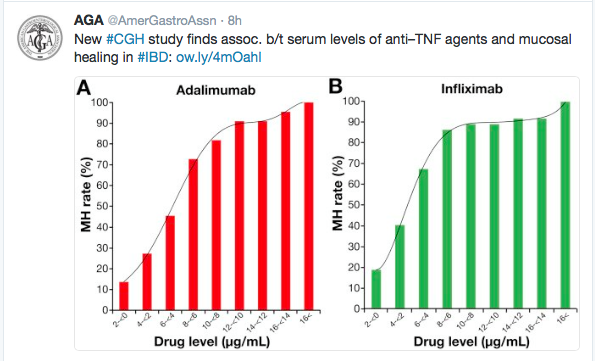
B Ungar et al (Clin Gastroenterol Hepatol 2016; 14: 550-7) report median serum levels of infliximab (n=78) or adalimumab (n=67) in correlation with mucosal healing.

In this retrospective cross-sectional study of adult patients with IBD (median age ~35 years), the authors found a correlation with higher drug troughs and mucosal healing.

“Levels of infliximab above 5 mcg/mL…and levels of adalimumab above 7.1 mcg/mL identified patients with mucosal healing with 85% specificity. Increasing levels of infliximab above 8 mcg/mL produced only minimal increases in the rate of mucosal healing, whereas the association between higher level of adalimumab and increased rate of mucosal healing reached a plateau at 12 mcg/mL”

The authors propose a “therapeutic window” of 6-10 for infliximab and 8-12 for adalimumab.

Clin Gastro Trough Levels

Remarks from DDW

Remarks from DDW

What happens when anti-TNF therapy is stopped

Another study (NA Kennedy et al. Aliment Pharmacol Ther 2016; 43: 910-23) has examined the issue of outcomes after anti-TNF therapy withdrawal among patients with inflammatory bowel disease.

This study included 166 UK patient cohort (117 with Crohn’s disease [median 31 yrs], 19 with ulcerative colitis [median 40 years]) as part of a retrospective observational study and a meta-analysis incorporating 11 further cohorts totalling 746 patients (624 with Crohn’s dissease, 122 with ulcerative colitis).

Key findings:

  • In the UK cohort, relapse rates were 36% at year and 56% at 2 years for Crohn’s disease
  • In the UK cohort, relapse rates were 42% at year and 47% at 2 years for ulcerative colitis
  • Increased relapse rates were noted for those with a diagnosis prior to age 22 years (hazard ratio (HR) 2.78), calprotectin >50 mcg/g (HR 2.95).
  • In meta-analysis, 1-year relapse rates were 39% for CD and 35% for UC/IBDU patients
  • Retreatment with anti-TNF was successful in 88% for CD and 76% of UC/IBDU patients

To understand this study, it is important to note some of the study criteria.  In the UK cohort, inclusion criteria required the patient to have had at least 12 months of ant-TNF therapy and be in corticosteroid-remission for at least 6 months.  In addition, the relapse rate is likely to be underestimated due to using a definition of relapse that required either commencement of steroids, immunomodulator or anti-TNF therapy.  The meta-anlaysis cohort studies also used clinical relapse rather than endoscopic or other objective markers.

My take: Relapse of clinical symptoms occur in about 40% after withdrawal in highly-selected groups who were doing well prior.  Significantly higher rates of endoscopic relapse are likely.  This study provides strong reasons for not interrupting therapy when it is working.

Related blog posts:

Cures Tshirt


Here’s Why Biologic Therapy for Crohn’s Helps Adolescents Grow

It is well-recognized that Crohn’s disease is associated with delays in the onset and progression of puberty with the potential for stunted growth, impaired bone accrual, and diminished quality of life.

Now, a study (MD DeBoer et al. J Pediatr 2016; 171: 146-52) shows that initiation of anti-tumor necrosis factor α (anti-TNFα) treatment results in a rapid increase in sex hormone and gonadotropin levels.

In 72 adolescents, this observational study followed levels of sex hormones, gonadotropin levels, dual-energy x-ray absorptiometry, along with cytokine/inflammatory markers at initiation of anti-TNFα therapy, at 10 weeks and at 12 months.

Key findings:

  • By week 10 , testosterone z scores in males increased from a median of -0.36 to 0.40 (P<0.05)
  • By week 10 , estradiol z scores in females increased from a median of -0.35 to -0.02 (P<0.01)

My take (from the authors): This study suggests that “systemic inflammation suppresses gonadotropin-stimulated production of sex hormones” and that treatment of this inflammation with anti-TNFα agents allows rapid resumption normal production.

Related blog posts:

Law Quad, Univeristy of Michigan

Law Quad, Univeristy of Michigan

Anti-TNF therapy and Pregnancy -More Data

G Broms et al (Clin Gastroenterol Hepatol 2016; 14: 234-41) provide more data on the ‘low risk of birth defects for infants whose mothers are treated with anti-tumor necrosis factor agents during pregnancy.”

From a Danish/Swedish cohort of 1,272,424 live births (2004-2012), the authors found the following (in comparison to healthy infants):

  • Birth defects were increased in chronic inflammatory bowel disease: 4.8% vs. 4.2%
  • 43 (6.3%) of the infants born to women with IBD who received anti-TNF therapy (683) had birth defects.  The OR for any defect was 1.32 (CI 0.93-1.82).  The types of defects were generally similar, including VSD, ASD, hypospadias, and hydronephrosis

Limitations:

  • In infants of mothers with chronic diseases, it is possible that more careful screening identified some less apparent defects.
  • Study did not examine rates of stillborn or abortions

My take: Overall there is a slightly but not significantly increased risk in birth defects based on the use of anti-TNF therapy.  Stopping anti-TNF therapy is likely to be more detrimental.

Briefly noted: P Wils et al. Clin Gastroenterol Hepatol 2016; 14: 242-50.  This retrospective study of 122 patients showed that 65% had a clinical benefit within 3 months of receiving ustekinumab for Crohn’s disease refractory to anti-TNF therapy.  Concomitant immunosuppressant therapy was associated with an increased likelihood of benefit (OR 5.43)

Related blog posts:

More on Hidradenitis Suppurativa and Inflammatory Bowel Disease

In a population-based inception cohort study (S Yada et al. Clin Gastroenterol Hepatol 2016; 14: 65-70) of 679 patients with inflammatory bowel disease (IBD) followed for a median of more than 19.8 years, it was determined that patients with IBD were ~9 times more likely to develop hidradenitis suppurativa (HS) compared with general population. 8 of 679 patients developed HS; only one had HS prior to IBD.

Other findings:

  • Most Crohn’s disease patients with HS had perianal disease.  Most ulcerative colitis patients developed HS after colectomy.
  • Female sex and obesity were risk factors for HS.

In a second retrospective study (N Kamal et al. Clin Gastroenterol Hepatol 2016; 14: 71-9), the authors identified 15 patients with CD and HS.  10 patients had perianal disease.  In this population, “both diseases were characterized by their severity, requirement of systemic medical therapies including anti-TNF and high operative rate.” this article contained some very helpful pictures.

Unrelated article: F Wang, JL Kaplan, BD Gold et al. Cell Reports; 2016: 14: 945-55.  This highly technical study used two independent cohorts of patients with Crohn’s disease and non-IBD controls.  One cohort, RISK, had over 700 patients and ~30,000 mean number of reads per sample; the other cohort, PIBD-CC, and 87 patients and ~3000 mean number of reads per sample.  Overall, the study showed associations between Crohn’s disease and bacteria in the lumen and the study helps provide an information-based method to depict dysbiosis.

Related blog post: Add it to the list

San Juan

San Juan

“Good Job Making the Diagnosis”

Briefly noted: JA Leon et al. Gastroenterol 2015; 149: 1697-99.  Case report of Job syndrome (Autosomal-Dominant Hyper-IgE syndrome) mimicking Crohn’s disease in a 37 yo with perianal fistula, and weight loss. Clues to the diagnosis: “Recurrent skin abscesses and respiratory infections, eczema, marked elevation of serum IgE, eosinophilia, and mucocutaneous candidiasis are the hallmark of the infectious and immunologic features…Boils and furuncles almost always occur and characteristically lack of the usual inflammatory findings…”cold” abscesses…associated with markedly increase IgE or eosinophil levels, should always raise a suspicion for AD-HIES.”

Related blog post: Add it to the list | gutsandgrowth

Optimism for New Treatment in Inflammatory Bowel Disease: AJM300

Yesterday’s post on “Eternal Nutrition” had a link to podcasts on enteral nutrition as therapy for Crohn’s disease.  I listened to the podcasts and they were helpful (Enteral Therapy as Primary Therapy for Crohn’s Disease Podcast).  A few points that were made included the following:

  1. Try to have the right person teach/place the nasogastric feeding tube.  If the first experience is bad, this may make further attempts quite difficult.  At CHOP, their facility has an education center and they schedule 3-hour learning session for enteral feeds.  Teaching the teen to place the NG tube is preferred.
  2. Many pediatric gastroenterologists in U.S. are not informing their patients that enteral feedings are a treatment option.
  3. In most parts of the world, induction with enteral nutrition involves virtually 100% of diet as enteral nutrition for ~8-12 weeks.  CHOP modification involves 80-90% of calories delivered enterally, typically over an overnight drip.  If someone is not responding to enteral feeds, CHOP may increase calories delivered enterally.
  4. For maintenance with CHOP modification, gradually reduction from 7 days per week to 5 days per week is attempted.  At CHOP, they prefer hydrolysate for enteral tube feedings and think more rapid gastric emptying could be helpful.  However, the podcast state that specific formulas have not been shown to be superior in trials to date.  At CHOP, if formula is taken orally, then an intact protein formula is selected.
  5. If someone uses enteral formula for maintenance, then consideration of a gastrostomy tube (after 3 months) is reasonable.  They have not had local issues at sites due to Crohn’s disease.
  6. Resources include the Oley.org website and the Crohn’s Survival Guide.
  7. Enteral therapy seems to work in small bowel as well as colonic disease, despite early reports suggesting less efficacy with colonic disease.

———————

A recent phase II study (N Yoshimura et al. Gastroenterol 2015; 149: 1775-83) indicates that an oral antagonist of α4 integrin may be quite useful for ulcerative colitis.

This double-blind, placebo-controlled trial with 102 patients found the following:

  • A clinical response rate at 8 weeks of 62.7% in the treatment group and 25.5% for placebo)
  • Rates of remission were 23.5% in the treatment group  compared with 3.9% in the placebo group.
  • Mucosal healing were 58.8%% in the treatment group  compared with 29.4% in the placebo group.
  • No serious adverse events were noted.

In the commentary by  BG Levesque and S Ghosh (pg 1669-72), it is noted that subsequent oral integrins will be compared to vedolizumab and similar safety concerns exist; that is making sure that there are no cases of progressive multifocal leukoencephalopathy (PML) which has been associated with natalizumab therapy.  For vedolizumab, the RAMP safety monitoring program has NOT identified PML in 2884 IBD patients.

The commentary (in blue) discusses several integrins as potential therapeutic targets and outlines future therapies.

Nontargeted therapies:

  • A) Induction: corticosteroids, 5- aminosalicylates, cyclosporin, and tacrolimus
  • B) Maintenance: thiopurines, methotrexate, 5-aminosalicylates, and tacrolimus.

Targeted therapies (those in development phase in italics)

  • A) Monoclonal antibodies (induction and maintenance): tumor necrosis factor inhibitors, vedolizumab, other integrin/adhesion molecule inhibitors, interleukin-12/23 inhibitors, and interleukin-6 inhibitors.
  • B) Oral synthetic (induction and maintenance or stop and start): Jakinibs, integrin blockers, sphingosine-1-phosphate (s1P) regulators, and SMAD7 antisense oligonucleotide.

“The results of AJM300 demonstrate feasibility of such an approach, and we anticipate a proliferation of such approaches given the robust evidence supporting integrins as a target, especially if the drug can be targeted or delivered in a gut-specific manner.”

My take: There are a number of therapies being developed that are likely to transform the treatment of inflammatory bowel disease; future treatments will be more precise, more effective and have many more options.

Related blog posts:

Banning Mills

Banning Mills


Using Ustekinumab for Crohn’s Disease

From GI & Hepatology News: New targeted Crohn’s therapy performs well in phase III trial.

This study of Ustekinumab (aka Stelara) was different than previous studies (see previous gutsandgrowth blog from 2012: Ustekinumab for Crohn’s disease) in that this study targeted patients who were NOT ant-TNF failures; however, about 80% of patients had failed corticosteroids.

An excerpt:

Ustekinumab, a monoclonal antibody targeted against interleukins 12 and 23 (IL-12 and IL-23)…

 The trial, called UNITI-2, enrolled patients with moderate to severe Crohn’s disease who had failed traditional therapies but were naive to or at least had not failed a tumor necrosis factor (TNF) inhibitor…

In UNITI-2, 628 patients were randomized to placebo, 130 mg of ustekinumab in a fixed subcutaneous dose of 130 mg, or a weight-based dose of 6 mg/kg of subcutaneous ustekinumab…The primary endpoint was a CDAI reduction of at least 100 points at 6 weeks. Clinical remission at 8 weeks, defined as CDAI less than 150, was a secondary endpoint.

The primary endpoint was reached by 28.7% randomized to placebo, 51.7% of those randomized to the fixed dose of ustekinumab, and 55.5% of those randomized to weight-based dosing. The advantage for the active treatment arms was statistically significant (both P less than .001). For the secondary endpoint of clinical remission at 8 weeks, the rates were 19.6% for placebo, 30.6% (P = .009 vs. placebo) for fixed-dose ustekinumab, and 40.2% (P less than .001 vs. placebo) for the weight-based dose…

Ustekinumab was well tolerated with similar rates and types of adverse events reported in the active treatment and placebo groups.

My take: This study indicates that ustekinumab is likely to be another treatment option for patients with Crohn’s disease.