Surgical Reset for Anti-TNF Therapy with Crohn’s Disease

A recent study (A Assa et al. Inflamm Bowel Dis 2017; 23: 791-97) indicates that after surgery, anti-TNFα treatment is worth another try.

In this retrospective study with 53 children, 18 had “pharmacodynamic failure” with anti-TNFα medications (PK group) and 35 were controls. “Phamacocynamic failure is characterized by either a lack of improvement of CD symptoms or  loss of response after initial improvement in the setting of adequate serum drug levels without ADAs” [antidrug antibodies].

Key findings:

  • Mean age at time of intestinal resection was 14.8 years
  • Median time from resection to anti-TNF initiation was 8 months
  • Compared to the control group, the PK group had similar response to anti-TNF therapy.   “Similar proportions of patients from both groups were in clinical remission on anti-TNF treatment after 12 months and at the end of follow-up (1.8 years)”
  • At 12 months, remission rates were 89% (PK) versus 88.5% (control)

The authors propose an explanation: “A plausible explanation for this finding is that in severely inflamed tissue with high inflammatory burden, local high levels of TNFα serves as a sink for anti-TNFα antibodies and that tissue injury and local hypoxia might further limit drug penetrance to its target.”

My take: This information is useful.  Many patients who have surgery may respond to anti-TNFα therapy subsequently.  The unanswered question: Could more frequent dosing of anti-TNFα therapy have averted surgery in some patients by overcoming areas of intense disease?

 

Ileocecal Resection in Pediatric Crohn’s Disease

A recent retrospective study (K Diederen et al. Inflamm Bowel Dis 2017; 23: 272-82) provides data on the likelihood of complications and recurrence following ileocecal resection in pediatric Crohn’s disease (n=122).

Key findings:

  • Severe postoperative complications were noted in 9.8%.  Risk factors included colonic disease (Odds ratio 5.6), microscopically positive resection margins (OR 10.4), and emergency surgery (OR 6.8)
  • Overall complication rate was reported as 29.5% which is similar to rates reported in adults
  • Clinical recurrence rates after 1, 5, and 10 years: 19%, 49%, and 71%
  • Surgical recurrence rates after 1, 5, and 10 years: 2%, 12%, and 22%
  • Immediate postoperative therapy reduced the risk of clinical recurrence (HR 0.3) and surgical recurrence (HR 0.5)
  • “In this study, postoperative catch-up growth was found in patients younger than 16 years in the year after surgery.” Thus, surgery could be an important to reverse growth retardation.

Complications within 30 days of surgery were categorized with the Clavien-Dindo classification. Those with grade ≥III which required either surgical, endoscopic or radiologic intervention were considered severe.  In this population, the complications included intraabdominal septic complications and/or anastomotic leakage.

My take: In some patients, ileocecal resection should NOT be a last resort.  Waiting too late, increases the risk of complications.  The task at hand is prospectively identifying those who merit surgery sooner and then convincing the family to proceed.

screenshot-118

Related blog posts:

Closer Look at Ustekinumab Data

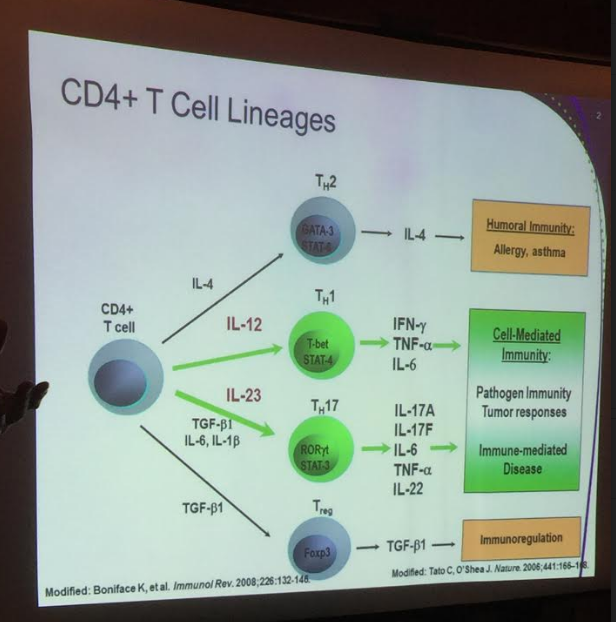
At a recent dinner, we had the opportunity to hear a review of some of the recent data on ustekinumab.  These notes may include some errors in transcription and errors of omission.  Most of this data is derived from a recent publication that has been summarized in this blog: Landmark Publication for Ustekinumab (Stelara) | gutsandgrowth

Some key points:

  • In numerous studies of biologic agents, longer duration of disease is associated with a much lower response to therapy.  For the UNITI-1/UNTI-2 studies, the patients enrolled had long duration of disease (~10 years in UNIT1-1, ~8 years in UNITI-2)
  • Recent data indicate that vedolizumab is effective for Crohn’s disease, but works slowly. It likely takes ~6 months to determine if it is working.
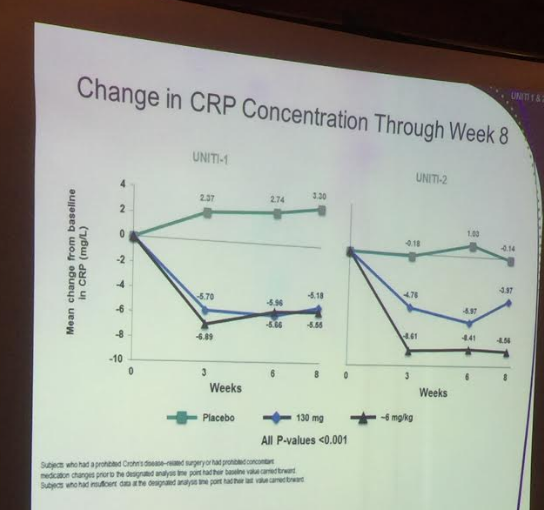
  • With ustekinumab, most patients respond within 3 weeks of the induction dose; however, among nonresponders, many responded after the first maintenance dose.  Thus, probably need to give at least the induction dose and the first maintenance dose for determining whether ustekinumab is effective.
  • Overall safety profile looks very good for ustekinumab.  More than 4000 patients in a psoriasis registry showed no serious safety signals (though psoriasis patients receive a lower dose).
  • Overall, the 6 mg/kg induction dose outperformed the 130 mg dose with regard to objective measures.
  • High placebo rate in the IM-UNITI study likely is due to some residual response to the initial induction dose.
  • Every 8 week dosing for ustekinumab was more effective than every 12 week dosing in these studies, though, there are likely patients who need more frequent and some who could benefit from less frequent dosing.
  • 2.3% of patients in IBD studies had detectable antibody to ustekinumab but this did not preclude efficacy.
  • ~20% of IBD patients do not develop increased CRP
  • Pediatric studies of ustekinumab are ongoing testing different dosing regimens.
  • One other anecdote in regards to magical thinking about which premedications are most effective:  A man with a ridiculous hat was approached as he walked in an Atlanta.suburb.  A lady asked him why he wore such an unusual hat. He replied that “the hat keeps elephants far away.”  The lady said, “there are no elephants around here.” He said, “See it is working.”

screenshot-86 screenshot-87 screenshot-88 screenshot-89 screenshot-90 screenshot-91 screenshot-92 screenshot-93

Top Posts 2016

The following posts are the ones that I think are most useful from 2016.

Gastroenterology:

Liver:

General:

Doctoring:

IBD:

Nutrition:

truth-johnpohl

Good News from the Bad News Department: Outcomes of Intestinal Transplantation in Patients with Crohn’s Disease

Briefly noted:  A recent retrospective study (BN Limketkai et al. Clin Gastroenterol Hepatol 2016; 14: 1574-81) examined outcomes of 142 patients with Crohn’s disease (CD) out of a total of 1115 cases of intestinal transplantation.  The authors examined the Scientific Registry of Transplant Recipients. Since intestinal transplantation would be a very undesirable outcome in patients with CD, I titled this post as coming from the “Bad News Department.”  The good news is that in the last 15 years, patients with CD disease do not appear to have worsened outcomes compared to patients without CD.  Overall, during the period 1990-2014, the risk of graft failure was higher, mainly due to the initial 10 years.  Graft failure was 18.6% at 1 year, 38.7% at 5 years, and 49.2% at 10 years in patients with CD compared with 14.1%, 32.1% and 41.0% in non-CD patients.  The cumulative risk of death at 10 years for CD patients was 59.7%.

My take: It is good that intestinal transplantation outcomes for CD patients are now similar to all patients.  In addition, intestinal transplantation outcomes are improving. Nevertheless, there is still a high death rate over 10 years.

Briefly Noted: Inflammatory Bowel Disease Updates

Gut Microbial Diversity is Reduced in Smokers with Crohn’s Disease. JL Opstelten et al. Inflamm Bowel Dis 2016; 22: 2070-77.  This study compared stools from 21 nonsmoking patients with Crohn’s disease (CD) with 21 smokers with CD.  Smoking was accompanied by a reduced relative abundance of multiple genera.  My take: It is unclear whether smoking’s effect on the microbiome directly contributes to worsened outcomes or whether the changes in the microbiome are only an epiphenomenon.  Regardless, smoking increases the likelihood of worse outcomes in CD.

A Systematic Review on Infliximab and Adalimumab Drug Monitoring Levels, Clinical Outcomes and Assay. F Silva-Ferreira et al. Inflamm Bowel Dis 2016; 22: 2289-2301. This review selected 20 studies from an initial query of 1654 articles. Key points:

  • Different studies are difficult to compare due to distinct assays with different limitations. Thus, specific cutoffs are based on the specific assay used.
  • The authors state that proactive monitoring may be helpful at week 6, 14, 30 and 54 for infliximab.  They recommend checking infliximab level and antidrug antibodies in those with loss of response, mucosal ulceration or elevated biomarkers (eg. CRP, Fecal calprotectin).

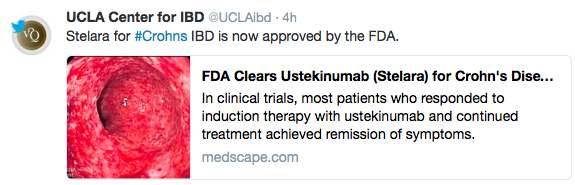
FDA Gives Ustekinumab (Stelara) Approval for Crohn’s

Here’s a link summarizing FDA approval: Medscape: FDA Clears Ustekinumab (Stelara) for Crohn’s Disease

An excerpt:

The US Food and Drug Administration (FDA) has approved ustekinumab (Stelara, Janssen Biotech, Inc) for the treatment of moderately to severely active Crohn’s disease in patients aged 18 years or older.

Specifically, the interleukin-12/23 inhibitor is indicated for Crohn’s patients who have failed or were intolerant to immunomodulator or corticosteroid therapy but who never failed treatment with a tumor necrosis factor (TNF) blocker or who failed or were intolerant to treatment with one or more TNF blockers, according to a company news release.

Ustekinumab is already approved in the United States for treatment of patients with plaque psoriasis and psoriatic arthritis…The clinical development program for ustekinumab for Crohn’s disease included more than 1300 patients across three pivotal phase 3 studies, which served as the primary basis for FDA approval.

In clinical studies of patients who were either new to, experienced with, or failed anti-TNF therapy, between 34% and 56% of patients experienced symptom relief in the 6 weeks after receiving a one-time intravenous induction dose of ustekinumab. “Noticeable improvement was observed as early as 3 weeks,” the company said.

Most patients who responded to induction dosing and who continued ustekinumab treatment with subcutaneous maintenance doses every 8 weeks were in remission at the end of 44 weeks (52 weeks from initiation of the induction dose), the company said.

Full prescribing information and a medication guide are available online.

screen-shot-2016-09-28-at-4-18-01-pm


Small Pediatric IBD Studies …Briefly Noted

G Wahbeh et al. JPGN 2016; 63: 348-51.  This retrospective case series with 4 children  (aged 12-17 years) indicated that 2 had a ‘clinical response’ to ustekinumab therapy, though one of these had ongoing elevation of CRP.  The dosing may have been too low: 90 mg at week 0 and 4, then every 8 weeks.  My take: This study shows that ustekinumab’s use in pediatric IBD seems to be a ‘shot in the dark’ given the lack of coherent data.

Related posts:

L Zimmerman et al. JPGN 2016; 63: 352-56. Among a cohort of 123 children who had underwent a bowel resection, from 1977-2011, the overall postoperative complication rate was 13%.  This included 3 of 24 who had prior infliximab and 9 of 99 who had not received infliximab. It is noteworthy that the infliximab group had more corticosteroid exposure. The authors concluded that preoperative infliximab was not associated with increased complications but noted that their sample size was small. My take: Studies of adults with Crohn’s disease have yielded conflicting results on whether preoperative infliximab increases the risk of complications.  This study shows that children likely have a lower rate of postsurgical complications and more pediatric specific data are needed.

Related post:

From KT Park’s Twitter Feed:

calprotectin

4-week-ada-trough-ktparj

Lower Fiber Intake May Increase Risk of Crohn’s Flare

According to a recent study, lower fiber intake was associated with an increased risk of a flare of Crohn’s disease over a 6-month period (CS Brotherton et al. Clin Gastroenterol Hepatol 2016; 1130-36).

This study examined dietary surveys from 1619 participants (Crohn’s disease in 1130, Ulcerative colitis in 489).  All participants were considered to be in remission at baseline. The key endpoint was disease flare at 6 months which was defined as a disease activity index score exceeding remission cutoff values.

Key finding: “Compared with those in the lowest quartile of fiber consumption, participants with Crohn’s disease in the highest quartile were less likely to have a flare” (adjusted odds ratio 0.58). There was no significant association with ulcerative colitis.

The associated editorial (1137-39) notes that “among 12 RCTs that enrolled patients with Crohn’s disease, fiber did not influence disease activity in studies of induction (flare to remission) or maintenance (remission to flare)…most RCTs had small sample size.”

My take (borrowed from editorial): “A high fiber diet is likely safe in patients with IBD [in the absence of a known stricture/obstructive symptoms] and may impart a weak benefit.”  Overall, dietary approaches are gaining traction and careful evaluation of competing claims will likely be of great benefit.

Related blog posts:

This is where I was completely soaked. Grinnell Trail

This is where (moments later) I was completely soaked. Grinnell Trail

More on Ustekinumab, plus Allopurinol Study

More data emerging that indicates that subcutaneous ustekinumab will be useful for refractory Crohn’s disease: S Khorrami et al. Inflamm Bowel Dis 2016; 22: 1662-69.

  • This open-label cohort of 116 patients identified a clinical response (Harvey-Bradshaw Index) in 97 (84%) after loading dose, and clinical benefit in 58% at 12 months of followup.
  • Perianal disease improved in 11 of 18 (61%).
  • This cohort had refractory disease with almost 90% had failed or were intolerant to 2 or more anti-TNFs.

Another strategy for managing inflammatory bowel disease is using allopurinol which can help low-dose azathioprine achieve therapeutic levels.  In the largest cohort to date, Pavlidis et al (Inflamm Bowel Dis 2016; 22: 1639-46) showed that at the end of followup (median 19 months after treatment initiation) 113/164 (69%) of patients with Crohn’s disease and 83/136 (61%) with ulcerative/unclassified colitis had a clinical response; 52% and 54% respectively were in remission. The azathioprine dose was 25% of weight-based monotherapy dose adjusted based on TPMT status; thus, for normal/high TPMT activity, azathioprine was dosed at 0.5 mg/kg whereas for heterozygous/intermediate activity, azathioprine was dosed at 0.25 mg/kg.

Related blog posts:

Disclaimer: These blog posts are for educational purposes only. Specific dosing of medications/diets (along with potential adverse effects) should be confirmed by prescribing physician/nutritionist.  This content is not a substitute for medical advice, diagnosis or treatment provided by a qualified healthcare provider. Always seek the advice of your physician or other qualified health provider with any questions you may have regarding a condition.

Vickery Creek, Sandy Springs

Vickery Creek, Sandy Springs