Selective Acid Suppression for Esophageal Atresia Patients

This year’s masterpiece!

Link from AAP HealthyChildren.org: Halloween Fun & Safety Tips for Kids of All Ages


S Zeneddin et al. J Pediatr Gastroenterol Nutr. 2025;81:960–966. Acid suppression after esophageal atresia repair: Some infants do benefit

Methods: The authors performed a retrospective study using the Pediatric Health Information System for infants undergoing EA/TEF repair between 2010 and 2022 (n=1445 infants). Acid suppression was defined as receipt of an H2 blocker or proton pump inhibitor on the day of discharge or longer than 30 inpatient days. Complex EA/TEF repair was defined as delayed repair (>7 days), G-tube placement before repair (likely a sign of a long gap or type A anomaly), prolonged hospitalization (>60 days), or multiple inpatient fluoroscopies. The authors defined stricture solely if it required intervention.

Key findings:

  • 257 (17.8%) required dilation by 1 year. Of the 688 (47.6%) infants who met criteria for complex EA/TEF, 126 (18.6%) required a dilation.
  • At 1 year, stricture rate was similar in infants with simple EA/TEF, with or without acid suppression (17.5% vs. 17.0%, p = 0.90)
  • In infants with complex EA/TEF, stricture rates were lower among those who received acid suppression compared to those who did not (15.3% vs. 26.0%, p = 0.001).
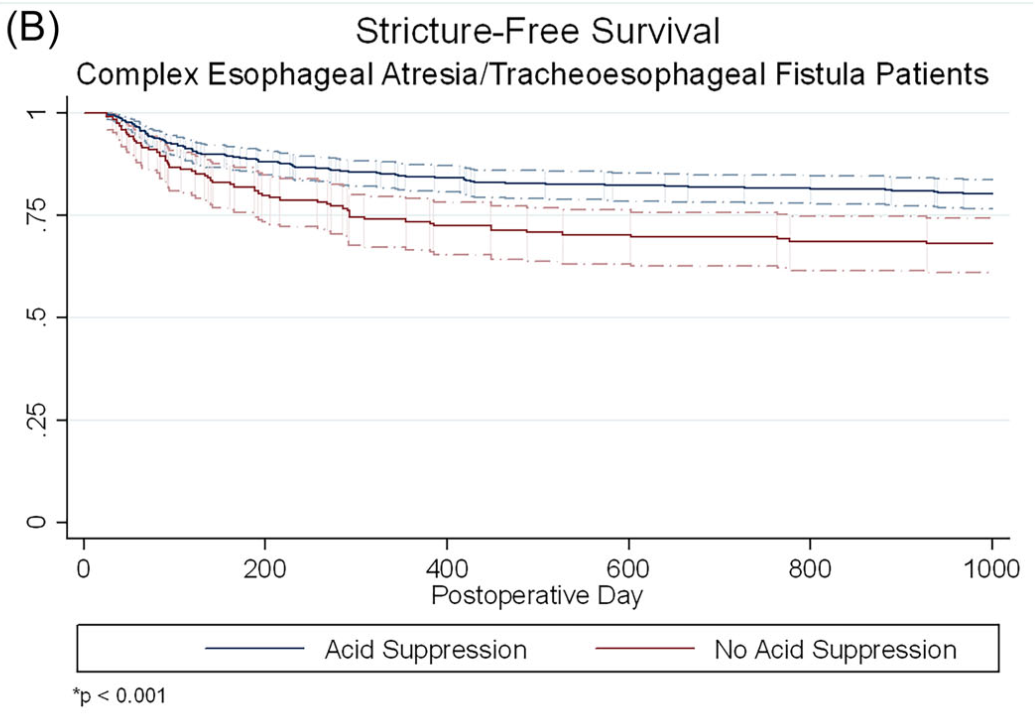
The associated editorial (D George, DK Robie. J Pediatr Gastroenterol Nutr. 2025;81:911–912) reviews some of the limitations of the study but does not provide clear recommendations on utilization of acid suppression therapy: the decision should be “should be individualized, weighing the potential benefits against the risks.”

My take: It is not surprising that more complex EA would have higher stricture rates. In my training (in the 1990s!), it was routine practice to use indefinite acid suppression. This article indicates that patients with low risk EA likely do not need acid suppression. In high risk patients, the algorithm by Yasuda et al (see post below J Am Coll Surg 2024; 238: 831-843) provides their approach to weaning acid suppression.

Related blog posts:

Disclaimer: This blog, gutsandgrowth, assumes no responsibility for any use or operation of any method, product, instruction, concept or idea contained in the material herein or for any injury or damage to persons or property (whether products liability, negligence or otherwise) resulting from such use or operation. These blog posts are for educational purposes only. Specific dosing of medications (along with potential adverse effects) should be confirmed by prescribing physician.  Because of rapid advances in the medical sciences, the gutsandgrowth blog cautions that independent verification should be made of diagnosis and drug dosages. The reader is solely responsible for the conduct of any suggested test or procedure.  This content is not a substitute for medical advice, diagnosis or treatment provided by a qualified healthcare provider. Always seek the advice of your physician or other qualified health provider with any questions you may have regarding a condition.

Key Advances in 2024: An Overview from GutsandGrowth (Part 2)

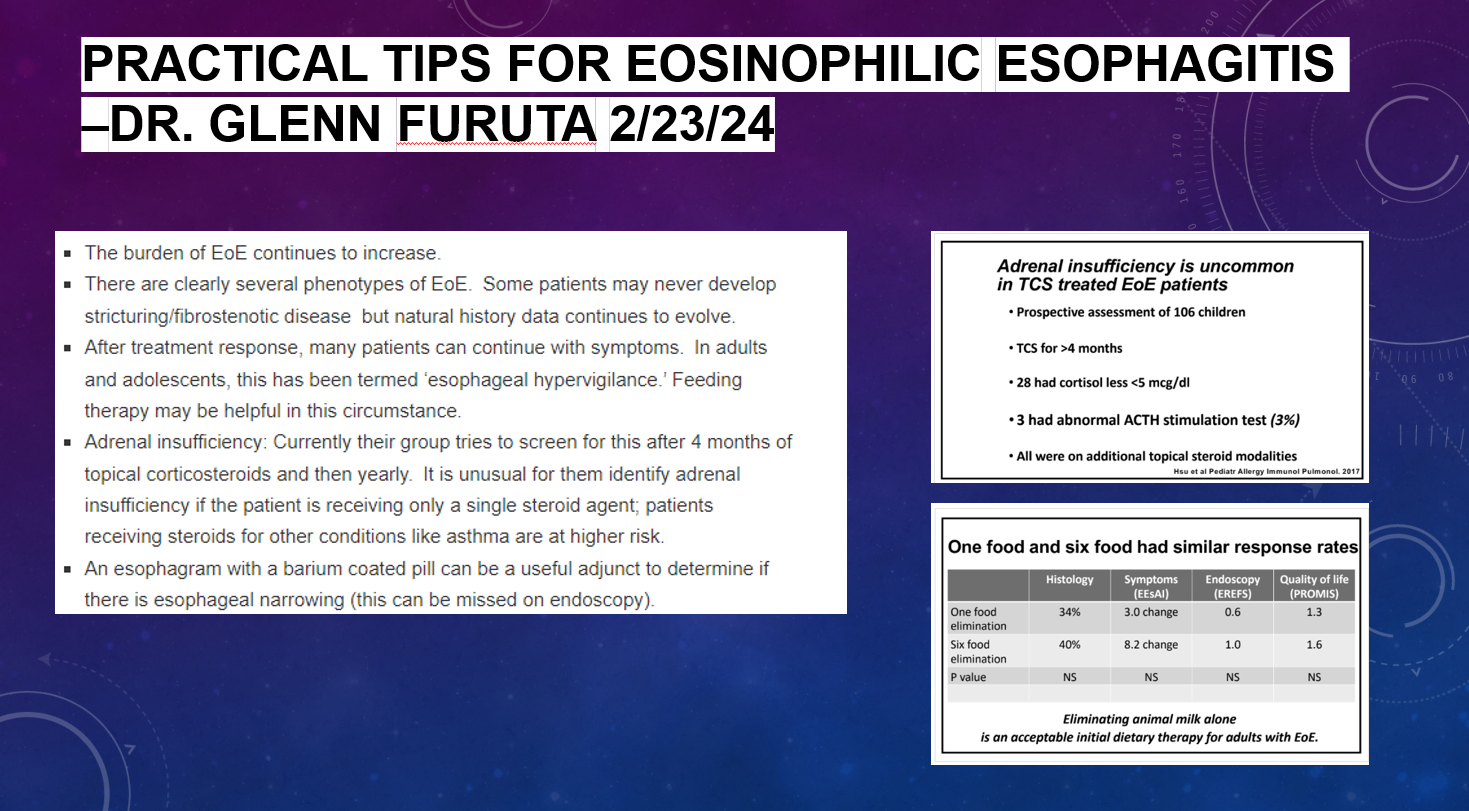
This year I had the opportunity to give a lecture to our group that reviewed much of the important advances that happened in 2024. Here are some of the slides (if you have any trouble reading the slides, you can search for the original blog post using author name).

Evidence-Based Algorithm for Surveillance in Esophageal Atresia Patients

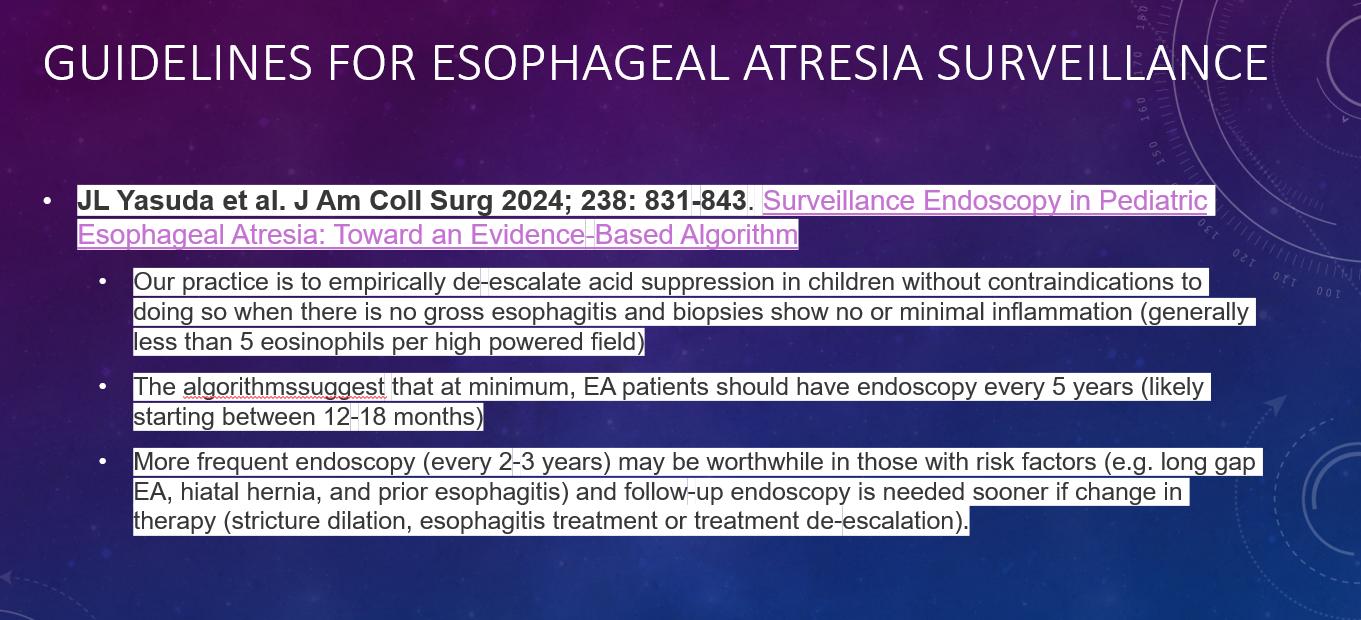
JL Yasuda et al. J Am Coll Surg 2024; 238: 831-843. Surveillance Endoscopy in Pediatric Esophageal Atresia: Toward an Evidence-Based Algorithm

This retrospective study examined 546 children with esophageal atresia (EA) who underwent 1,473 surveillance endoscopies (2004-2023). The authors defined a hiatal hernia as at least 1 cm of gastric folds present above the level of the diaphragmatic pinch. “Actionable findings” were any finding that prompted a change in management.

Key findings:

  •  A total of 770 endoscopies (52.2%) in 394 unique patients (72.2%) had actionable pathology
  • The most common actionable finding was esophagitis which lead to escalation of therapy (484 endoscopies in 32.9% of patients). However, de-escalation of therapy was common as well; this occurred in 233 patients (after 310 endoscopies)
  • Barrett’s esophagus (intestinal metaplasia) was identified in 7 unique patients (1.3%) at a median age of 11.3 years. 6 of 7 patients with Barrett’s were receiving acid suppression at time of diagnosis
  •  Actionable findings leading to surgical intervention were found in 55 children (30 refractory reflux and 25 tracheoesophageal fistulas).
  • Significant predictors of actionable pathology included increasing age, long gap atresia, and hiatal hernia.
  • Symptoms were not predictive of actionable findings, except dysphagia (OR 5.80), which was associated with stricture.
  • Acid suppression was associated with a reduced odds of actionable findings (OR 0.78); however, there was still a high rate of actionable findings in this group. 51% of endoscopies while a patient had been receiving acid suppression had actionable findings.
  • Fundoplication was NOT associated with protection against actionable findings (OR 1.42)
  • Table 2 notes that 52 (3.5%) patients had eosinophilic esophagitis therapy escalated. Infrequently, non-esophageal diseases were identified: Celiac in 3 patients (0.2%), Crohn’s disease in 2 patients (0.1%), eosinophilic gastritis and/or duodenitis in 2 (0.1%), and H pylori in 4 patients (0.3%).

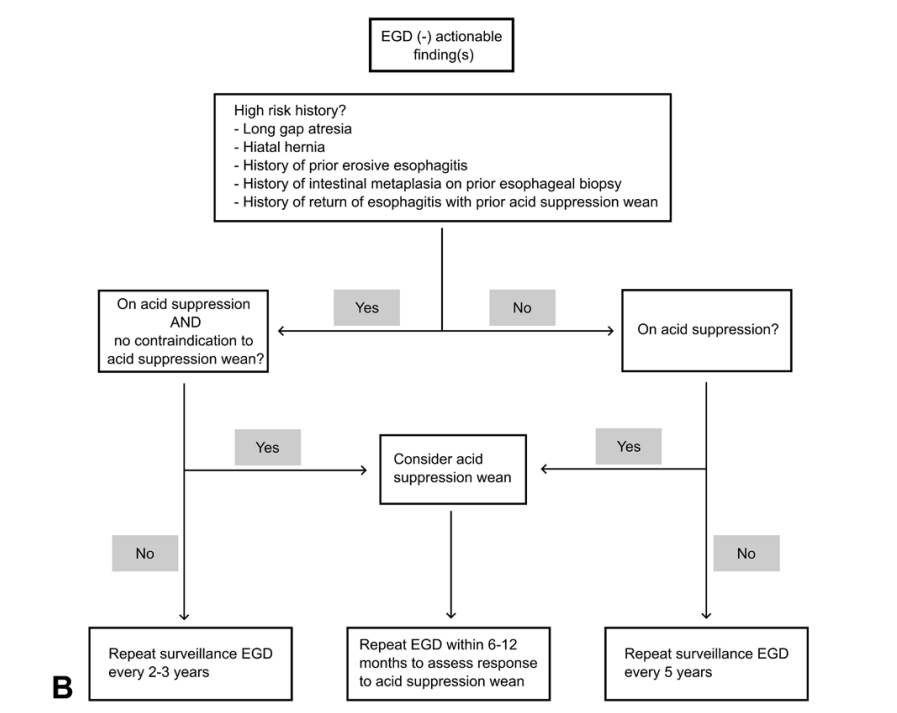
Proposed Management Algorithms:

Discussion Points (from authors):

Take multiple levels of esophageal biopsies: “Any surveillance esophagogastroduodenoscopy (EGD) should at minimum include 2 to 3 levels of esophageal biopsies”

Acid suppression recommendations: “Barrett’s esophagus is proposed to be an absolute contraindication to acid suppression wean; relative contraindications to weaning acid suppression include earlier erosive esophagitis, earlier failed acid suppression discontinuation attempt(s) with rebound esophagitis, or hiatal hernia; if acid suppression is weaned in these high-risk situations, we believe close follow-up endoscopy is warranted to assess for rebound pathology [which happened in nearly 20%].” And, “our practice is to empirically de-escalate acid suppression in children without contraindications to doing so when there is no gross esophagitis and biopsies show no or minimal inflammation (generally less than 5 eosinophils per high powered field).”

Consider doing endoscopy off acid suppression for approximately three months: “To maximize the information yield from the initial endoscopy, a patient may first wean off acid suppression approximately 3 months before endoscopy to permit evaluation for both anatomy and esophagitis off acid suppression. Subsequent surveillance is performed
according to our algorithm and within at most 6 to 12 months of any acid suppression changes.”

The authors do not generally recommend pH-Impedance. “There are no consensus “normal” values for pH-impedance reflux parameters in either healthy or EA children, and pH-impedance has failed to show any predictive correlation with actual esophagitis in multiple pediatric studies. In particular, children with EA with “normal” numbers of reflux events cannot adequately clear their refluxate in the context of poor esophageal motility and can still develop reflux injury. pH-impedance tracings in EA require manual review by an experienced reader, with automated analysis being highly unreliable in the setting of low baseline impedance values.”

Limitations: 1. Some of the actionable findings may have been expected based on prior endoscopies (e.g. prior stricture) and could influence value of symptoms like dysphagia. 2. This population was skewed to patients with more severe EA as it is a subspecialty center. One indicator was that their group had 24% with long-gap EA compared to an overall expected rate of 10% in the general EA population 3. Retrospective study 4. Many of the patients were not truly “surveillance” endoscopies but were done due to reported symptoms

My take: It’s unfortunate that this article did not get published in a more mainstream pediatric journal (e.g. JPGN, J Pediatr, Pediatrics) or a more mainstream gastroenterology journal (eg. Gastroenterol, Clin Gastroenterol Hepatol, AJG) as this article provides a lot of great data and useful advice. More than 70% of subjects had actionable findings during the course of their follow-up, including more than 40% of 1 year-olds.

The algorithms above suggest that at minimum, EA patients should have endoscopy every 5 years (likely starting between 12-18 months). More frequent endoscopy (every 2-3 years) may be worthwhile in those with risk factors (e.g. long gap EA, hiatal hernia, and prior esophagitis) and follow-up endoscopy is needed sooner if change in therapy (stricture dilation, esophagitis treatment or treatment de-escalation).

Related blog posts:

Disclaimer: This blog, gutsandgrowth, assumes no responsibility for any use or operation of any method, product, instruction, concept or idea contained in the material herein or for any injury or damage to persons or property (whether products liability, negligence or otherwise) resulting from such use or operation. These blog posts are for educational purposes only. Specific dosing of medications (along with potential adverse effects) should be confirmed by prescribing physician.  Because of rapid advances in the medical sciences, the gutsandgrowth blog cautions that independent verification should be made of diagnosis and drug dosages. The reader is solely responsible for the conduct of any suggested test or procedure.  This content is not a substitute for medical advice, diagnosis or treatment provided by a qualified healthcare provider. Always seek the advice of your physician or other qualified health provider with any questions you may have regarding a condition.
How Effective are Stents for Anastomotic Esophageal Strictures in Patients with Esophageal Atresia

O Baghdadi et al. JPGN 2022; 74: 221-226. Predictors and Outcomes of Fully Covered Stent Treatment for Anastomotic Esophageal Strictures in Esophageal Atresia

This retrospective review of 45 patients (n=92 stents) examine the effectiveness of esophageal stenting in patients with esophageal atresia (EA). All patients had multiple dilatations prior to stenting and/or had a stricture diameter that rapidly narrowed within 2 weeks of dilatation to a diameter that was the same or smaller to predilatation. Patients were observed in the hospital after stent placement and outpatient management was considered if oral nutrition was tolerated for at least 3 days.

Key findings:

  • According to the authors, the stents prevented surgical resection in 41% of patients
  • ΔD (change in diameter) of ≤4 mm (area under the curve = 0.790; 95% confidence interval: 0.655–0.924; P < 0.001) was the optimal cutoff point in differentiating stent success. If the change in diameter decreases by 4 mm or more after stent removal at endoscopic followup, it is likely that stricture contains significant scar tissue and is not amenable to dilatation/stenting.
  • Median stent duration was 11.5 days
  • The most common adverse events were erosions/ulcerations (29%), granulation tissue formation (27%), vomiting/retching (26%) and stent migration (9%). Three stents were complicated by an esophageal leak (treated medically).

My take: Complications were frequent; thus, stenting for refractory strictures requires highly-specialized technical expertise.

Related blog posts:

Azalea trail, near the Chattahoochee River (Atlanta)

More Often Than Not Esophagitis in Children with Esophageal Atresia is NOT due to Reflux

A long time ago in a galaxy far far away, I was taught that children with esophageal atresia would have reflux for life due to dysmotility following repair. Thus, these children presumably should remain on acid blockers indefinitely. It turns out that this was fiction (just like Star Wars).

R Tambucci et al J Pediatrics 2021; 228: 155-165. Full text: Evaluation of Gastroesophageal Reflux Disease 1 Year after Esophageal Atresia Repair: Paradigms Lost from a Single Snapshot?

In this retrospective study with 48 children, the authors had the following key points:

  • Microscopic esophagitis was found in 33 (69%)
  • Pathological esophageal acid exposure on MII-pH was detected in 12 (25%)
  • The presence of long-gap esophageal atresia was associated with abnormal MII-pH.

The authors conclude that “histological esophagitis is highly prevalent at 1 year after esophageal atresia repair, but our results do not support a definitive causative role of acid-induced GERD. Instead, they support the hypothesis that chronic stasis in the dysmotile esophagus might lead to histological changes.”

My take: Along with endoscopy, pH probe testing can be helpful in selecting which children with esophageal atresia should continue with PPI therapy.

Related blog posts:

Big Study on Intralesional Steroid Injection for Esophageal Anastomotic Strictures & 8 Truths on COVID-19

A recent retrospective study (PD Ngo et al. JPGN 2020; 70: 462-7) describes the largest published experience with intralesional steroid injection (ISI) for esophageal anastomotic strictures; the population studied in this report were strictures associated with esophageal atresia (EA) repair.

Key Details:

  • 158 patients, 2010-2017, were included
  • 1055 balloon dilatations and 452 ISI+
  • Triamcinolone acetate (10 mg/mL) was injected into the scar tissue “at a typical doses of 1 to 2 mg/kg with a weight-based maximum of 20mg and not >40 mg per procedure (typically 10-20 mg).  The total injected dose was divided into 4 or more injection sites.”
  • Dilatation was performed with controlled radial expansion (CRE) balloons.
  • Prior to dilatation, a brief intraoperative contrast esophagram with half-strength ioversol 68% (Optiray 320) was performed.  This allowed estimation of the anastomotic diameters. In some cases with poor contrast distention, the estimation was completed using the endoscope diameter or biopsy forceps size.

Key findings:

  • The median change in stricture diameter was significantly greater in the ISI+ group compared to the ISI-neg group with stricture dilatation, with an adjusted odds ratio of 3.24
  • The likelihood of ISI injection being helpful was more pronounced with the first three sessions, with a median change of 1 mm compared to 0.5mm (after the first three).  The authors note that after the first 3 ISI+-dilatations, there was not a statistically-significant difference in stricture dilatation between those receiving ISI and those with balloon alone
  • There was no difference in perforation rates with ISI than without
  • The authors noted that patients who received ISI were less likely to be subsequently characterized as refractory

The study has a number of limitations including lack of precision/reproducibility with stricture diameter with dilatation; in addition, it was non-randomized and retrospective.

My take: This study, completed in a highly-specialized center, provides evidence that stricture dilatation following esophageal atresia repair is likely to be more successful with steroid injection.

Related blog posts:

Also, a good read (thanks to 33mail Bryan Vartabedian for this reference): Can We Discuss Flatten-the-Curve in COVID19? My Eight Assertions by JOHN MANDROLA, MD

” I will argue that the cumulative deaths from COVID19 will not be reduced significantly by flatten-the-curve policies. And that this virus will be as dangerous to vulnerable patients in 6 months to a year. We should be allowed to debate this.”

Key points: flattening of the curve does not mean that we will substantially lower the total mortality related to COVID-19 –though hospitals now have had time to avoid being overwhelmed.  The virus is not contained, tests will underperform, new treatments do not help much (thus far), the overall mortality is ~1%, it may be difficult for a vaccine to prove its effectiveness, and COVID-19 (& our response) will likely lead to a large number of deaths not due to COVID-19.

Curbside Humor

Esophagus! & Nutritional/GI Outcomes with Esophageal Atresia

In 8th grade, our English teacher would say ‘Esophagus, recite that poem.’  He would say this to everybody.  It is possible that the flask that he carried could have influenced his word choice.

That anecdote came to mind as reading a recent article (K Birketvedt et al. J Pediatr 2020; 218: 130-7) which showed that a large number of adolescents with history of esophageal disease (esophageal atresia [EA]) had a high likelihood of suboptimal nutritional parameters. In this study with 68 pediatric subjects, extensive investigations including 4-day diet records, blood tests, pH measuring, EAT (eating assessment test) questionnaire, and interviews. Median age at follow-up was 16 years.

Key findings:

  • Median height-for-age Z score was -0.6. 10 patients (15%) were considered stunted (height-for-age Z score <-2).
  • More than two-thirds reported symptoms of dysphagia (EAT score ≥3) and avoided specific foods.
  • 48 (71%) had suboptimal energy intake on diet records –intake below age-appropriate recommendations.  Many had low vitamin D and iron intake.
  • 13 of 68 patients had VACTERL association and 17 (25%) had congenital heart disease

My take: If your esophagus is not working right, it definitely can impair one’s nutritional status.  Some patients have other reasons (other comorbidities) that could influence these reported results.

As for the anecdote, I still remember some of the poems we had to recite.  The one I remember best:

To An Athlete Dying Young  A. E. Housman – 1859-1936 

The time you won your town the race
We chaired you through the market-place; 
Man and boy stood cheering by, 
And home we brought you shoulder-high.  

To-day, the road all runners come,    
Shoulder-high we bring you home,  
And set you at your threshold down,  
Townsman of a stiller town.  

Smart lad, to slip betimes away  
From fields where glory does not stay, 
And early though the laurel grows  
It withers quicker than the rose.  

Eyes the shady night has shut  
Cannot see the record cut,  
And silence sounds no worse than cheers 
After earth has stopped the ears:  

Now you will not swell the rout  
Of lads that wore their honours out,  
Runners whom renown outran  
And the name died before the man. 

So set, before its echoes fade,  
The fleet foot on the sill of shade,  
And hold to the low lintel up  
The still-defended challenge-cup.  

And round that early-laurelled head
Will flock to gaze the strengthless dead,  
And find unwithered on its curls  
The garland briefer than a girl’s.

Related blog posts:


How Bad is Reflux in Children with Esophageal Atresia?

A recent retrospective study (FWT Vergouwe et al. JPGN 2019; 69: 515-22) with 57 children with esophageal atresia (EA) found most children have a normal reflux index.

This study, analyzing data between 2012-2017, reviewed all 24-hour pH-impedance (MII) studies in children at ≤18 months and 8 year olds with EA.  “All children with EA born in our hospital are offered a 24-hour pH-MII study at the age of 0.5 years and 8 years.”  In this institution, PPI treatment is given for at least 6 months after surgery. Of the 57 in the cohort, 20 had completed pH-MII at <18 months of age and 32 at age 8 years.

Key findings:

  • In children ≤18 months of age, median reflux index was 2.6% (abnormal in 2), median number of retrograde boluses was 61 (62% nonacid, 58% mixed)
  • In the older cohort (~8 years of age), median reflux index was 0.3% (abnormal in 4) and median number of retrograde boluses was 21 (64% nonacid, 75% mixed)
  • Overall, 10 of 57 children (17.5%) had GERD with reflux index >7% (n=6) or positive SI/SAP (n=4).  The authors note that much higher rates of GERD have been found in prior studies.  If they included children with fundoplication who were considered as having GERD (prior to fundoplication), then the GERD rate was 32%.

My take: This study showed that reflux in this cohort of children with EA was similar to the general population and likely indicates that a substantial portion of patients with EA do not need indefinite PPI therapy.  In children with more complex EA, PPI therapy is likely to be more beneficial.

Related blog posts:

Recent (November 4th) GI-Related Tweets:

Esophageal Disorders: POEM in Kids, Mitomycin C for Refractory Strictures

At our recent national meeting, Dr. Peter Kahrilas indicated that POEM (Per-oral Endoscopic Myotomy) was now the treatment of choice for most adults with achalasia (#NASPGAN19 Postgraduate Course -Part 3).

A Chone et al (JPGN 2019; 69: 523-7) provide recent multicenter retrospective data on POEM in the pediatric age group (mean age 14 years), n=117.

Key findings:

  • Clinical success, defined as Eckardt score ≤3 during followup, was achieved in 90.6% of cases. The Eckardt score was >3 in 5 (4.3%) and data was missing in 6 (5.1%)
  • Adverse events included 1 case with significant bleeding, 2 cases of aspiration pneumonia (related to anesthesia), 1 esopleural fistula (managed endoscopically), and 6 mild AEs (4 mucosomtomies, 2 subcutaneous emphysema)

Additional related blog posts:

D Ley et al (JPGN 2019; 69: 528-32) provide retrospective data on 39 patients, median age 19 months, with refractory esophageal strictures which were treated with mitomycin C.  The authors considered mitomycin C after a minimum of two previous dilatations.

Key findings:

  • Etiology: The majority had strictures/stenosis associated with esophageal atresia (n=25) followed by caustic ingestion in 9.
  • Number of stenosis: The majority (n=35) had a single stenosis.
  • In 26 patients (67%), topical application of mitomycin C was considered a success based on a reduction in the number of dilatations.  In this group, the number of dilatations dropped from 102 to 17 over a comparable period.
  • 16 (41%) never required further dilatation following mitomycin C application

My take: This study provides some of the best evidence that mitomycin C may be helpful.  Long-term followup and more studies are needed.

Related blog posts:

Disclaimer: This blog, gutsandgrowth, assumes no responsibility for any use or operation of any method, product, instruction, concept or idea contained in the material herein or for any injury or damage to persons or property (whether products liability, negligence or otherwise) resulting from such use or operation. These blog posts are for educational purposes only. Specific dosing of medications (along with potential adverse effects) should be confirmed by prescribing physician.  Because of rapid advances in the medical sciences, the gutsandgrowth blog cautions that independent verification should be made of diagnosis and drug dosages. The reader is solely responsible for the conduct of any suggested test or procedure.  This content is not a substitute for medical advice, diagnosis or treatment provided by a qualified healthcare provider. Always seek the advice of your physician or other qualified health provider with any questions you may have regarding a condition.
Lincoln Park, Chicago

Esophagitis in Pediatric Esophageal Atresia

A recent study (JL Yasuda et al. JPGN 2019; 69: 163-70) shows that esophagitis is common with and without proton pump inhibitor (PPI) therapy in children with esophageal atresia (EA).

Background: This study encompassed 310 patients (34% long gap EA) and 576 endoscopies (median age 3.7 years)

Key findings:

  • Erosive esophagitis was found in 8.7% of patients.
  • 15.2% of patients had esophagitis with >15 eos/hpf; 49% of patients had ≥1 eos/hpf (histologic eosinophilia)
  • 87% of endoscopies were preceded by acid suppression therapy; being on acid suppression reduced the odds for abnormal esophageal biopsy (P=0.011).
  • Histologic esophagitis was “highly prevalent even with high rates of acid suppressive medications use.”
  • For example, among those receiving PPI monotherapy, 150 had normal biopsy and 136 had abnormal biopsy.  Among those off all acid suppression, 30 had normal biopsy and 45 had abnormal biopsy.
  • For erosive esophagitis, this occurred in 12 on PPI and was not present in 274 on PPI therapy. Among those off all acid suppression, 4 had erosive esophagitis and 70 did not.
  • Presence or integrity of fundoplication was not significantly associated with esophagitis.

While this is a large study, the findings have several limitations. This is a single center retrospective study and this center attracts highly complex cases of EA.

My take: In addition to fairly high rates of erosive esophagitis and eosinophilic esophagitis, this study shows a high incidence of microscopic esophagitis, the significance of this is unclear.   This study supports the current recommendations of 3 endoscopies in childhood and perhaps more frequent surveillance in those with more complex EA.

Related blog posts:

Sign in Hood River, OR