Is it Helpful to Check Celiac Serology Titers After 3 Months of a Gluten Free Diet?

A recent prospective study (D Petroff et al. Clin Gastroenterol Hepatol 2018; 16: 1442-49) with 345 pediatric patients with biopsy-proven celiac disease (CD) examined serologic response to a gluten-free diet (GFD) between 2012-2015.

Key findings:

  • Mean TTG IgA concentration decreased 14-fold after 3 months of a GFD.  The study assay used kits from EUROIMMUN.
  • TTG IgA remained above 1-fold ULN in 83.8% and above 10-fold ULN in 26.6%.
  • Deamidated gliadin IgA (DGL IgA) decreased in the vast majority but did not distinguish response of GFD from random fluctuations.
  • The authors note that symptoms improved in most on GFD, but short-term response could reflect “regression to the mean…for a considerable share” as symptoms improved in the non-GFD group as well.

In their discussion, the authors reference a large study (n=487) which showed mean normalization of TTG IgA of ~400 days; longer times were noted in those with type 1 diabetes and higher baseline values.

My take: This study, while showing that TTG IgA levels improve after 3 months of a GFD, helps solidify my opinion that in those who are improving, followup serology could be obtained later.  My practice is to have followup serology after 6 months of a GFD in the majority of patients.

Related blog posts:

Lake Moraine, Banff

More Sensitive Detection of Gluten Free Diet Adherence

A recent cross-sectional study (K Gerasimidis et al. JPGN 2018; 67: 356-60) examined the use of fecal gluten immunogenic peptide (GIP) to assess for adherence with gluten free diet (GFD) in biopsy-proven celiac disease (CD).

GIP reflects recent gluten consumption.  There is a commercially-available kit available (Ivydal GIP Testing) –though I am uncertain about how its reliability compares to the GIP measured in this study.

In the study, the authors note that GIP positivity can occur with as little as 100 mg of gluten/day ingestion.  GIP is a 33-mer peptide from α2-gliadin that is stable against breakdown by gastric, pancreatic, and intestinal brush border enzymes.

Key findings of this study:

  • GIP was detectable in 16% of patients with previous CD diagnosis (N=67)
  • GIP was detectable in 95% of newly-diagnosed CD patients (n=19) and was detectable in 27% at 1 year afterwards.
  • When compared with traditional indicators of GFD adherence (eg. TTG levels, Biagi score, clinical assessment), 4 out of 5 children with detectable GIP were missed

My take: Fecal GIP for celiac disease adherence has similar potential as a biomarker as calprotectin has for IBD.  A normal GIP appears to be much more sensitive at detecting gluten ingestion.

Related blog posts:

Wheat Intolerance –Self-Reported in 15%!

A recent study (MDE Potter et al. Am J Gastroenterol 2018; 113: 1036-44 -thanks to Ben Gold for this reference) examined the frequency of wheat intolerance and chronic gastrointestinal symptoms in a randomly selected population of 3542 in Autstralia via a mail survey.

Key findings:

  • Self-reported wheat sensitivity was 14.9%
  • Prevalence of celiac disease (CD) was 1.2%
  • A doctor-diagnosis of CD was associated with functional dyspepsia with an odds ratio (OR) of 3.35.
  • Self-reported wheat sensitivity was independently associated with irritable bowel syndrome with an OR of 3.55 and almost half (45%) have an underlying functional GI disorder.

In a related editorial (pgs 945-8), Imran Aziz makes several useful points:

  • Gluten-free industry has boomed in U.S. with retail sales going from $0.9 billion in 2006 to ~S24 billion in 2020.
  • While previous studies have shown that gluten can induce symptoms in the absence of CD (Biesiekierski JR et al. Am J Gastroenterol 2011; 106: 508-14), more recent rigorous studies have indicated that “gluten-per-se accounts for 1-in-6 cases with the remaining majority either due to fructans (a type of FODMAP or a nocebo effect.”
  • There are no accurate biomarkers of wheat intolerance
  • Dr. Aziz also cautions against adopting a gluten-free diet without proper counseling.  “The greatest concern is whether these diets are safe in the long-run, given the emerging data suggesting cardiovascular, nutritional, metabolic, and microbial changes.”

My take: This study shows that about 1 in 10 individuals have self-reported wheat intolerance; gluten, though, is the actual culprit in less than 20%.

Related Blog Posts:

Celiac Disease: How Long Is a Gluten Free Diet Needed? (30 Year Data)

A recent study (L Norsa et al. JPGN 2018; 67: 361-6) examines data from 197 patients with celiac disease (CD) (out of a cohort of 337) who had a diagnosis established before 1985. The authors examined three groups: lifelong strict GFD (n=133), discontinued GFD (n=29), and no GFD (22).  A total of 63 had follow-up endoscopy data available, with 29 in lifelong GFD, 20 in discontinued GFD, and 14 in no GFD.

Key findings:

  • In those with followup endoscopy, in those with lifelong GFD 27 of 29 (93%) had no atrophy (Marsh 0-1-2) on histology, in those with discontinued GFD 12 of 20 (60%) had no atrophy on histology, and in those with no GFD 8 of 14 (57%) had no atrophy on histology.
  • Thus, among the group with long-term poor adherence to gluten-free diet, almost two-thirds showed no recurrence of villous atrophy on duodenal biopsies.
  • In the entire cohort of 197, there were no apparent differences in autoimmune diseases between those receiving lifelong GFD (26%) compared to the other two groups, 17% and 23% respectively.

Limitations:

  • retrospective design.
  • initial diagnosis was more than 30 years ago & there are significant differences in the diagnostic approach currently
  • sample size

My take: This study indicates that some individuals who have been diagnosed with celiac disease may be OK with ongoing gluten consumption. Those who maintained a GFD were much more likely  to have no villous atrophy on duodenal biopsies.

Related blog posts:


Eliminating Gluten Challenge for the Diagnosis of Celiac Disease

Many patients receive a gluten-free diet (GFD) prior to a definitive diagnosis of celiac disease.  The diagnostic yield of serology can significantly decrease within a month after institution of a GFD.  A recent study (VK Sarna et al. Gastroenterol 2018; 154:886-96) has identified an HLA-DQ-Gluten Tetra

mer Blood test which can accurately identify celiac disease despite the implementation of a GFD.  This test quantifies HLA-DQ-gluten tetramer binding to T cells with flow cytometry. Key findings:

  • For patients receiving a GFD, the sensitivity was 97% and the specificity was 95% for the diagnosis of celiac disease
  • For patients not receiving a GFD, the sensitivity was 100% and the specificity was 90% for the diagnosis of celiac disease

My take: An accurate test to determine if celiac disease is present for those who have started a GFD would be quite helpful.  This HLA-DQ-Gluten Tetramer blood test still needs further validation in more patient populations. This test is NOT commerically-available at this time.

Morgan Falls

Related blog posts:

Disclaimer: These blog posts are for educational purposes only. Specific dosing of medications (along with potential adverse effects) should be confirmed by prescribing physician.  This content is not a substitute for medical advice, diagnosis or treatment provided by a qualified healthcare provider. Always seek the advice of your physician or other qualified health provider with any questions you may have regarding a condition.

Chattahoochee river -Morgan Falls

How Gluten Free is a Gluten-Free Diet?

A recent analysis (JA Syage et al.The American Journal of Clinical Nutrition, Volume 107, Issue 2, 1 February 2018, Pages 201–207, https://doi.org/10.1093/ajcn/nqx049) (Thanks to Kipp Ellsworth for this reference) of 259 patients with celiac disease (~75% pediatric) showed that a large number with ongoing gluten ingestion based on urine and stool tests of gluten excretion.

Results: The average inadvertent exposure to gluten by CD individuals on a GFD was estimated to be ∼150–400 (mean) and ∼100–150 (median) mg/d using the stool test and ∼300–400 (mean) and ∼150 (median) mg/d using the urine test. The analyses of the latiglutenase data for CD individuals with moderate to severe symptoms indicate that patients ingested significantly >200 mg/d of gluten.

My take (borrowed from authors): These surrogate biomarkers of gluten ingestion indicate that many individuals following a GFD regularly consume sufficient gluten to trigger symptoms and perpetuate intestinal histologic damage.

Free link to full article: Determination of gluten consumption in celiac disease patients on a gluten-free diet

Despite signs like these, a lot of individuals veer off the path.

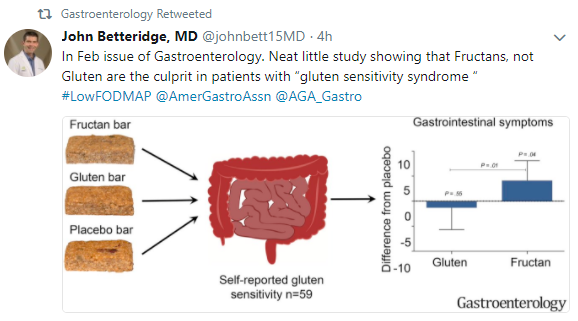
Fructans, not Gluten, Inducing Symptoms In Patients with Reported Non-Celiac Gluten Sensitivity

As with yesterday’s post, today’s study (GI Skodje et al. Gastroenterol 2018; 154: 529-39) implicates fructans, not gluten, as a culprit in increasing symptoms in those with self-reported non-celiac gluten sensitivity (NCGS).

These researchers performed a double-blind crossover challenge in 59 individuals who had instituted a gluten-free diet (GFD). The symptoms were assessed with a Gastrointestinal Symptom Rating Scale Irritable Bowel Syndrome (GSRS-IBS) through 3 challenges –gluten, fructan, and placebo.

Key findings:

  • GSRS-IBS mean values for gluten 33.1, for fructan 38.6, and placebo 34.3.  The overall GSRS-IBS value for fructans was significantly higher than for gluten P=.04
  • GSRS-IBS mean values for bloating with gluten 9.3, for fructan 11.6, and placebo 10.1

In a related editorial (K Verbeke, pages471-3), the commentary notes that  alpha-amylase-trypsin inhibitors (ATIs) may be another factor which contributes to symptoms in those with reported NCGS.  ATIs protect plants from pests/parasites by inhibiting their digestive enzymes.  They also resist proteolytic degradation in the human intestine and are known to be potent activators of innate immune cells.

My take: This is yet another study showing that among individuals with NCGS that a GFD is often unnecessary and ineffective.  Fructans are more likely to induce gastrointestinal symptoms; however, their are likely to be several food components which contribute to GI symptoms & sometimes extra-intestinal symptoms.

Related blog posts:

American Academy of Pediatrics: Georgia Chapter Governing Board Meeting

As usual, I learned a great deal from our recent governing board meeting of the Georgia Chapter of the American Academy of Pediatrics ((AAP).   Here are some notes, including nutrition committee notes at the bottom of this post. Though not intentional, some important material is likely to have been omitted; in addition, transcription errors are possible as well.

Influenza This Year –Harry Keyserling:

  • 85% of pediatric deaths have occurred in those without influenza vaccine. The vaccine, even when not stopping the influenza (lower efficacy this year), lowers the risk of death.  Probably 50-60% of all Georgia kids are immunized against the flu and  there is a higher rate of immunization (~75%) in younger age (~75%)
  • ‘We are not seeing Tamiflu resistance with this year’s strain’
  • 53 pediatric deaths this year at this point (2/3/18)
  • Children attending public schools have higher rates of vaccination than children attending private schools

Amy Jacobs, Commissioner of Ga Dept of Early Care & Learning (DECAL)

  • decal.ga.gov Website is resource for child care and sponsored meals
  • Georgia Pre-K now in 25th
  • QualityRated.org Useful website for identifying high quality child care
  • ~50,000 children supported with scholarships for childhood care caps.decal.ga.gov 833-442-2277
  • Text “FOODGA” to 877-877 Summer Meal Programs or Call toll free 855-550-7377

Project S.A.V.E.  –Robert Campbell, Richard Lamphier

  • Started in 2004 with the mission of promoting and improving prevention of sudden cardiac arrest (SCA) in children, adolescents and others in Georgia communities..  Website: Project S.A.V.E.
  • Primary prevention: pediatric office, preparticipation physical exams
  • Secondary prevention: after cardiac arrest –emergency action plan
    • Where’s the nearest AED? (Mr. Lamphier’s car).  At our office, GI Care For Kids’ AED –>Formula closet/Stan’s dictation area
    • Is there a plan if an emergency occurs? Name of building, address. Any barriers?
    • Almost always someone is willing to donate AED (~$700) -not a lot of money, this is a process issue much more than a financial one
    • If you wait for an ambulance (~10 minutes) with SCA, you probably won’t need an ambulance –the patient will not survive
  • There are fire drills –last death from fire in Georgia School in 1950s. Schools need emergency action plans in place.  For AEDs to be useful, there is a need for them to be accessible; thus, schools may need to have them in multiple locations.  About 15 pediatric cardiac arrests (data not formally collected) per year in Georgia.

Nutrition Committee Notes:

“Is There a Downside to Going Gluten-Free if You’re Healthy?” Yes

From NY Times: Is There a Downside to Going Gluten-Free if You’re Healthy?

Yes. This short commentary explains a lot of reasons why going gluten-free is not a great idea for healthy individuals.

  1. Often, a gluten-free diet incorporates more fat, more sugar, more salt and less fiber –all bad for your health.  A gluten-free diet can increase the risk of weight gain, type 2 diabetes, and cardiovascular disease.
  2. A gluten-free diet may make definitive testing for celiac disease inaccurate after more than a few weeks.
  3. “While much has been written in books and online sources about the purported benefits of avoiding gluten, such as weight loss, cognitive well-being and overall wellness, these claims are not supported by evidence….Though some patients with irritable bowel syndrome, or I.B.S., may see symptoms improve after cutting out gluten-containing foods, research suggests it’s likely to be a result of something other than gluten.”

My take (borrowed): “There’s no reason for someone who feels well to start a gluten-free diet to promote wellness,” said Dr. Benjamin Lebwohl, director of clinical research at the Celiac Disease Center at Columbia University. “It is not an intrinsically wellness-promoting diet.”

Related blog posts:


NASPGHAN Postgraduate Course 2017 (Part 2): Celiac, Fad Diets, and H pylori

Over the next 2 weeks or so, I am posting my notes/pictures from this year’s annual meeting.  This post reviews the 2nd module from the postgraduate course.

This blog entry has abbreviated/summarized these presentations. Though not intentional, some important material is likely to have been omitted; in addition, transcription errors are possible as well.

Here is a link to postgraduate course syllabus: NASPGHAN PG Syllabus – 2017

Celiac Disease Diagnosis: ESPGHAN vs. NASPGHAN Guidelines

Michelle Pietzak   Children’s Hospital of Los Angeles

This lecture started with a succinct history of celiac disease, including discussion of the banana diet and the observation that wheat deprivation during World War II was associated with improvement in children with celiac disease. The sequential diagnostic recommendations of ESPGAN and NASPGHAN were reviewed.

Key points:

  • ESPGHAN 2012 guidelines separated children in two groups: symptomatic and asymptomatic.  The guidelines indicated that symptomatic children with high titer serology (TTG IgA >10-fold ULN and positive EMA) could be diagnosed without an intestinal biopsy.
  • ACG 2013 Guidelines: TTG IgA preferred serologic test if over age 2 years,  TTG IgA along with deamidated gliadin (IgG and IgA) recommend if younger than 2 years. Even if negative serology, a biopsy was recommended if significant suspicion of diagnosis.
  • NASPGHAN, AGA, ACG all recommend small bowel biopsy to confirm this lifelong condition
  • The speaker did not critically discuss the Leonard et al study suggesting that 19% of individuals had persisting enteropathy on a gluten fee diet (see previous posts below)
  • Jimmy Fallon: “10% of the population is allergic to gluten and 90% are tired of hearing about it”

Related posts:

Fad Diets: The Good, the Bad, and the Just Plain Ugly

Mark Corkins      University of Tennessee Health Science Center

Key points:

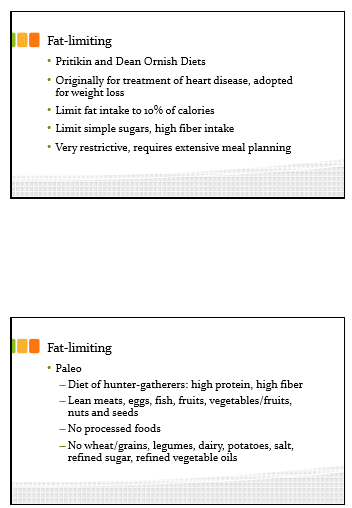
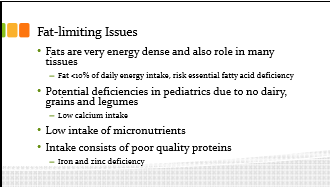
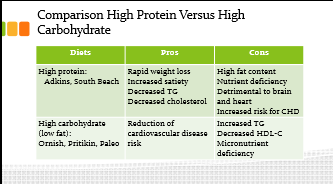
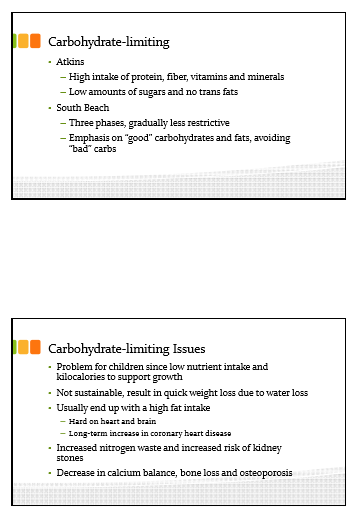
  • Fad diets driven in part by obesity
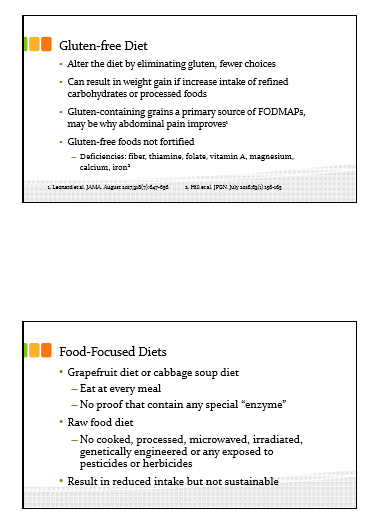
  • Gluten-free diet is the most trendy, ~30% of U.S. adults are ‘limiting’ gluten, though most do not understand what gluten is.  “Wheat Belly” book by Dr. William Davis has been influential despite lack of data.
  • According to marketing report, 35% who consumer gluten limited diet have no reason for this, 26% for ‘healthier option,’, 19% for ‘digestive health,’, 13% for weight loss, 8% for gluten sensitivity
  • Recommends: choosemyplate.gov. These feeding guidelines have been developed by nutrition experts.
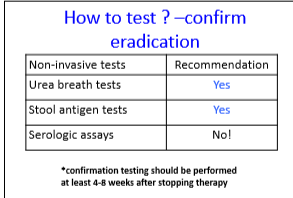
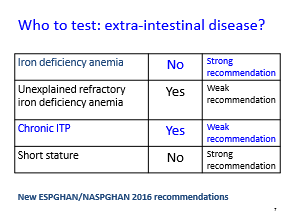
Update on H pylori

Nicola Jones    Hospital for Sick Children (Toronto)

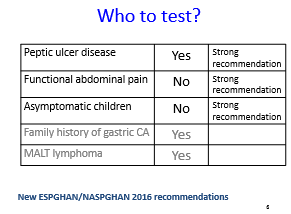
  • Reviewed current recommendations based on ESPGHAN/NASPGHAN 2016 recommendations.
  • The speaker indicates that upper endoscopy is recommended for initial diagnosis of H pylori but testing is not recommended for functional abdominal pain.  The lecture did not address the issue that there can be an overlap in the presentations of these disorders.
  • Adherence is crucial for adequate eradication
  • Newer studies show improved eradication rates for quadruple therapy (bismuth-based) & in U.S. this is recommended as first-line treatment unless resistance patterns are known (which could allow for triple therapy)