NPR: Banana Diet for Celiac Disease

A recent report from NPR highlights a previous diet for celiac disease -the banana diet. While celiac disease had been discovered in the 1890s by Dr. Samuel Gee, the role of gluten was not understood until WWII.

NPR: Doctors Once Thought Bananas Cured Celiac Disease

Here’s an excerpt:

a high-calorie, banana-based diet [was] invented by Dr. Sidney Haas in 1924. The diet forbade starches but included numerous daily bananas, along with milk, cottage cheese, meat and vegetables…

Haas arrived at his banana diet through an honest error — one that, unfortunately, had serious repercussions for people with celiac disease. In his 1924 paper, he wrote of a town in Puerto Rico where “dwellers who eat much bread suffer from [celiac] sprue while the farmers who live largely on bananas never.”

Haas skipped over the role of wheat and focused instead on the exotic bananas, which he thought held curative powers…

But Haas’ honest error led to serious consequences. As the children recovered, wheat was reintroduced.

It was a Dutch pediatrician, Willem Karel Dicke, who first realized that wheat might be linked to celiac disease. He noticed that in the last few years of World War II, when bread was unavailable in the Netherlands, the mortality rate from celiac disease dropped to zero. In 1952, Dicke and his colleagues identified gluten as the trigger for celiac disease, and the gluten-free diet was born.


How Slow Do Objective Markers of Celiac Change After Treatment?

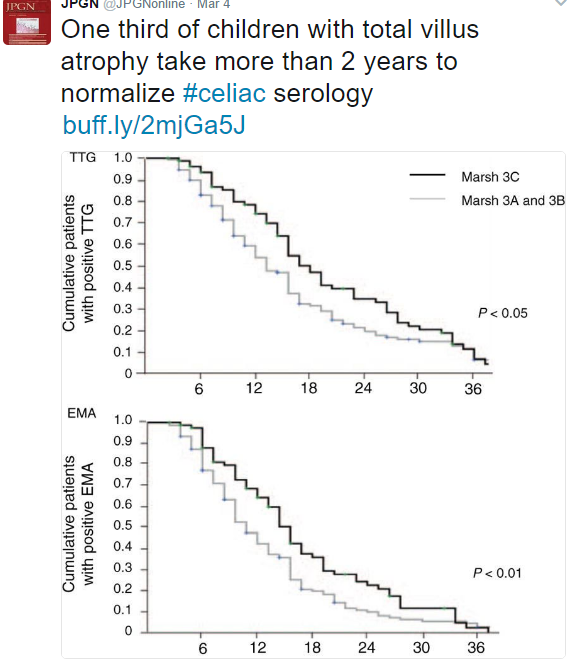
In a recent study (D Gidrewicz et al. JPGN 2017; 64: 362-7) with 228 consecutive, newly diagnosed children with biopsy-proven celiac disease, the authors followed improvement in serology.  Patients were divided into tertiles based on the degree of TTG IgA/EMA abnormalities. For example, Group A had the most abnormal serology: TTG >10 times ULN and EMA ≥1:80.

My take: This data confirms the fact that it takes a long time for resolution of celiac serology, particularly in those with the most severe disease.

Is a Gluten-Free Diet a Healthy Diet for Those without Celiac Disease?

A helpful commentary (NR Reilly. J Pediatr 2016; 175: 206-10) on the gluten-free diet (GFD) tries to separate fact from fiction.  A few key points:

  1. There are some health problems that can occur with a GFD, particularly when the diet is started without the support of an experienced dietician. GFD foods frequently contain a greater density of fat and sugar and can contribute to obesity and metabolic syndrome.  A GFD may lead to nutrient deficiencies in B vitamins, folate, and iron.  GFD without sufficient dietary diversity may contain increase in toxin exposures (eg. arsenic, and mercury).
  2. Gluten is not toxic. “There are no data to support the theory of an intrinsically toxic property of gluten for otherwise-healthy and asymptomatic adults and children, and certain studies have specifically demonstrated a lack of toxic effects.
  3. Most individuals with NonCeliac Gluten Sensitivity (NCGS) do not have NCGS!  First of all, many receive a GFD without proper testing to exclude celiac disease.  Secondly, most will tolerate gluten reintroduction.  In an Italian study, “only 6.6% of consecutive patients with presumed gluten sensitivity…actually had NCGS. 86% did not experience symptoms when gluten was reintroduced.”
  4. Timing of gluten introduction: “The most current understanding…in at-risk infants is that neither delaying gluten introduction from the recommended 6 months of age to 1 year, nor introducing at 4 months of age alters long-term CD risk estimates.”

My take: This is an excellent commentary.  While many people (without celiac disease) perceive benefit from a GFD, only a minority are likely  to derive better health or improved quality of life.  Those who stick with a GFD should seek the help of a well-qualified dietician.

Related blog posts:

Glacier Nat'l Park

Glacier Nat’l Park

Gluten-Free for IBS-D?

A recent study (I Aziz et al. Clin Gastroenterol Hepatol 2016; 14: 696-703) shows that a 6 week gluten-free diet reduced IBS-D symptoms in 29 of 41 (71%) patients.

  • The authors performed a prospective study with all patients receiving a gluten-free diet.  At 6 weeks, 21 of 29 who had responded to GFD continued GFD through 18 months followup.
  • One difference with this study compared to prior studies –these patients were irritable bowel syndrome with diarrhea and fulfilled Rome III criteria.  Celiac disease had been excluded with serology and histology; thus, these patients did not have “potential” celiac disease.
  • In addition to GI symptoms like abdominal pain, distention, and stooling problems, patients experienced improvement in mood, fatigue and quality of life.
  • The authors note that the response rate of 71% is much higher than they would have expected if the response was related solely to a placebo effect.

My take: This small study shows that a gluten free diet may be effective in improving the symptoms in many patients with IBS-D.  Other studies have shown that several other diets are effective as well.

Related blog posts:

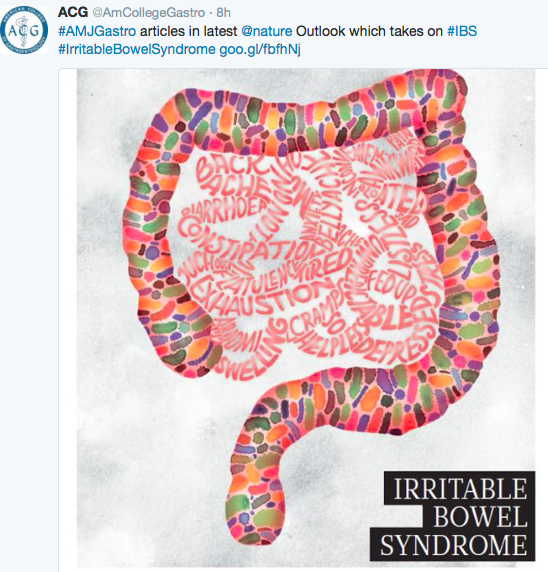
IBS diagram


Will Asymptomatic Patients with “Potential” Celiac Disease Benefit from a Gluten-free Diet?

A recent study (Volta et al. Clin Gastroenterol Hepatol 2016; 14: 686-93) indicates that those with “potential” celiac disease, who are asymptomatic, are unlikely to benefit from a gluten-free diet.  A useful summary is available on the AGA blog: What Happens to Patients with Markers of Celiac Disease but No Symptoms?

An excerpt:

Celiac disease is an immune-mediated gluten-dependent systemic disorder characterized by serologic and genetic factors and villous atrophy in the small intestine. Although some people test positive for antibodies and carry genetic alleles associated with celiac disease, they have relatively normal or slightly inflamed intestinal mucosa, with no or mild enteropathy. These patients are considered to have potential celiac disease (defined as increased serum levels of antibodies against tissue transglutaminase [tTG] without villous atrophy). They can have gastrointestinal and extra-intestinal symptoms or be completely asymptomatic…

To learn more about progression of potential celiac disease, Umberto Volta et al performed a prospective study to track clinical, serologic, and histologic features of 77 patients. The subjects had normal or slight inflammation of the small intestinal mucosa and were followed for 3 years.

Sixty-one patients had intestinal and extra-intestinal symptoms and 16 were completely asymptomatic at diagnosis…

Gluten withdrawal led to significant clinical improvement in all 61 symptomatic patients.

Of the 16 asymptomatic patients, who were left on the gluten-containing diets, only 1 developed mucosal flattening; levels of anti-endomysial and tTG antibodies fluctuated in 5 of these patients or became undetectable.

My take: In symptomatic patients (but not asymptomatic patients) with potential Celiac disease, a gluten-free diet may be worthwhile.

Related blog posts:

Mina Falls, El Junque

Mina Falls, El Junque

Celiac Disease: “Ten Things That Every Gastroenterologist Should Know”

Turns out that a recent review (AS Oxentenko, JA Murray. Clin Gastroenterol Hepatol 2015; 13: 1396-1404) is a succinct summary on celiac disease with questions focused on diagnosis, endoscopy, genetics/HLA typing, at risk groups, management, adherence, non responsive celiac patient, and refractory patients.  Most of these topics have been addressed previously on this blog.

However, here are a few pointers:

  • “Histologic improvement is slow in adults…Mucosal recovery, defined by a villous:crypt ratio of 3:1, was present in 34% at 2 years and 66% at 5 years, with healing complete in 90% by 9 years.”
  • “Mucosal recovery is faster and more complete in children, with 95% recovery in 2 years and 100% recovery long-term in children following a GFD.”
  • With nonresponsive celiac disease, “defined as a lack of response to 6 months on a GFD or a recurrence of celiac-related features despite compliance,” the authors recommend reviewing serology and biopsies.  Other etiologies to consider include bacterial overgrowth, autoimmune enteropathy, tropical sprue, Crohn’s disease, combined variable immunodeficiency, collagenous sprue, and eosinophilic gastroenteritis.
  • For refractory celiac disease with ongoing villous atrophy, this “should prompt immunophenotyping and T-cell rearrangement studies” of duodenal biopsies.

Briefly noted: ET Jensen et al. Clin Gastroenterol Hepatol 2015; 13: 1426-31.  The authors examined 88,517 patients who had undergone both esophageal and duodenal biopsies.  “Odds of EoE (eosinophilic esophagitis) were 26% higher in patients with celiac disease than in patients without celiac disease” (adjusted odds ratio 1.26).

Related blog posts:

From the High Line, NYC

From the High Line, NYC

Another Look at Gluten-free Diet for Asymptomatic Celiac

Previously, a blog entry (Benefits of Gluten-Free Diet for “Asymptomatic” Celiac …) reviewed the abstract (available early online) from Gastroenterol 2014; 147: 610-17.  With the publication of the printed version, some useful commentary (Gastroenterol 2014; 147: 557-59) provides perspective.

Study limitations: small number (20 assigned to gluten-free diet, 20 regular diet).

Key points from editorialists:

  • “This study provides some of the strongest data yet supporting celiac disease screening of family members of patients with celiac disease.  However, important issues must be addressed before screening is widely adopted.”
  • “This [study] leaves us in the uncomfortable position of offering a diagnosis that may improve gastrointestinal symptoms, but simultaneously worsen socialization, offer limited overall change in health-related quality of life, and for which the long-term risk-to-benefit ratios are unknown.”
  • This “makes the cost of a gluten-free loaf of bread for all with asymptomatic celiac disease too high, unless and until additional more substantial benefits can be demonstrated.”

Related blog posts:

Low-FODMAPs with or without Gluten-Free Diet in IBS

In a small study with 60 patients with irritable bowel syndrome (DDW abstract 374), the response rate to a Low-FODMAPs/Normal gluten diet was as effective as a Low-FODMAPs/Gluten-free diet.  Both diets were more effective in reducing abdominal symptoms than a normal diet.  A summary of this abstract from Gastroenterology & Endoscopy News: Nixing Gluten Offers No Added Benefit To Low-FODMAPs Diet for IBS

According to Lin Chang, MD: “The beneficial effect of low FODMAPs does not appear to be predominantly due to gluten avoidance.”

Related blog post: An Unexpected Twist for “Gluten Sensitivity” | gutsandgrowth


How Accurate is Serology at Predicting Mucosal Healing in Pediatric Celiac Disease?

A recent study (Am J Gastroenterol doi: 10.1038/ajg.2014.200) shows that in children, unlike adults, that normalization of celiac disease (CD) serology correlates well with mucosal healing.

In this study, 150 children with biopsy-proven CD were prospectively evaluated with duodenal biopsies, tissue transglutaminase (tTG) IgA serology, and deamidated gliadin peptide (DPG) IgG serology.  After maintaining a gluten-free diet (GFD) for at least 1 year, participants underwent followup evaluation.

  • Of the 97 with normalization of their serology, 91 had normal biopsies (Marsh 0) and 6 had slight abnormalities (Marsh 1).
  • Of the 27 with positive serology, only 6 had Marsh 3 changes.
  • Overall, 124 (82.7%) had normalization of duodenal mucosal biopsies irregardless of serology.

Higher rates of mucosal healing are possible with longer duration of GFD.

On the other hand, a recent retrospective study (JPGN 2014; 59: 229-31) notes that among 40 children who underwent followup endoscopic evaluation (>4 months after GFD, median 24 months), most of whom were symptomatic, only 25 had complete healing. Though among those with adherence to a GFD, only five had persistent villous atrophy (Marsh 3 lesion) . Serological correlation was not provided.

Take-home message: Followup biopsies are not needed in children with normalization of their serology (tTG IgA and DGP IgG).  That is, serology correlates well with mucosal healing in children with celiac disease on a GFD >12 months. However, it is certainly reasonable to consider followup endoscopy in those who are symptomatic, especially if serology is abnormal.
In a related matter, the new requirements regarding gluten-free labeling have been implemented -here’s a link from the LA Times: Celiac Regulations or First federal glutenfree regulation takes effect

Related blog posts:

Disclaimer: These blog posts are for educational purposes only. Specific dosing of medications (along with potential adverse effects) should be confirmed by prescribing physician.  This content is not a substitute for medical advice, diagnosis or treatment provided by a qualified healthcare provider. Always seek the advice of your physician or other qualified health provider with any questions you may have regarding a condition.

Use of Gluten-Free Diet with Inflammatory Bowel Diseases

As noted in a previous blog (The Search for a Dietary Culprit in IBD | gutsandgrowth), alternative diets have been explored both for symptom improvement and in efforts to improve inflammation in individuals with inflammatory bowel diseases (IBD).  A new study from North Carolina indicates that nearly 20% of patients have tried a gluten-free diet (GFD) to help control clinical symptoms in IBD (Inflamm Bowel Dis 2014; 20: 1194-97).

While adoption of a GFD clearly is effective for celiac disease, it has become popular, along with a low FODMAPs diet, as an alternative treatment for irritable bowel syndrome (IBS)/and “non-celiac gluten sensitivity.”  Since IBS is a common comorbidity with IBD (see recent blog: New Biomarker for Crohn’s Disease (Plus Two ), it is not surprising that a GFD would be used by some with IBD.  In this study, the authors performed a cross-sectional study using a GFD questionnaire in 1647 IBD patients though a CCFA longitudinal internet-based cohort.

Results:

  • 19.1% had previously tried a GFD and 8.2% reported current use of GFD.
  • 65.6% described improvement while on a GFD.  Improved symptoms included fatigue, nausea, bloating, abdominal pain, and diarrhea.
  • 0.6% of patients reported a concurrent diagnosis of celiac disease (which is similar to overall celiac prevalence in U.S.)

Given the structure of this study, which is mainly an internet survey, there are many limitations in its interpretation.  Certainly, this study does not prove that a GFD is effective for IBD.  However, it is clear that a GFD is used frequently and may improve IBD/IBS symptoms.

Take-home message: Particularly in patients who have ongoing symptoms despite  mucosal healing, pursuing either a low FODMAPs diet or a GFD may be helpful.

Related blog posts:

Disclaimer: These blog posts are for educational purposes only. Specific dosing of medications (along with potential adverse effects), implementation of diets and specific medical management interventions should be confirmed by prescribing physician.  Application of the information in a particular situation remains the professional responsibility of the practitioner.