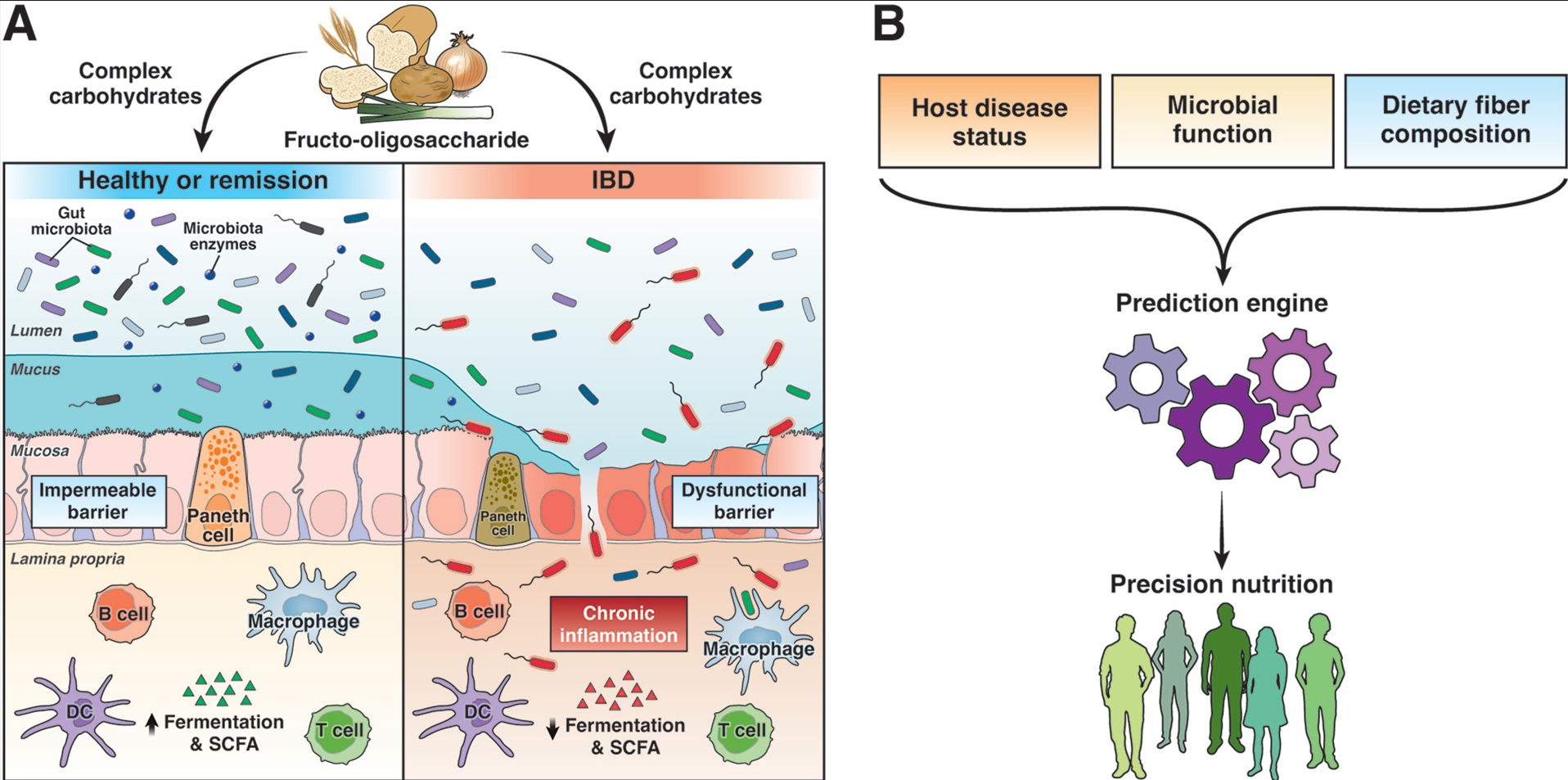
IBD Updates: Low Lymphoma Risk, Fewer Biopsies for Ulcerative Colitis, MRE Distinguishes Backwash Ileitis, Beta-Fructans and IBD Activity

M Egberg et al. AJC 2023: 118: 354-359. Low Risk of Lymphoma in Pediatric Patients Treated for Inflammatory Bowel Disease

Key finding:

  • Using a database with 10,777 pediatric patients (2007-2018) with more than 28,000 patient years, there were 5 lymphomas reported. 4 had received thiopurines and none received anti-TNF monotherapy.

My take: This is a very reassuring study for the safety of anti-TNF agents.

AE Mikolajczyk et al. Inflamm Bowel Dis 2023; 29: 222-227. Assessment of the Degree of Variation of Histologic Inflammation in Ulcerative Colitis

  • In this retrospective study with 92 patients (182 colonoscopies), the authors found “minimal variability between degree of inflammation among biopsy fragments within and among different colorectal segments in UC, suggesting that even a single biopsy would adequately reflect the inflammation of the entire colorectum.”

My take: This study suggests that taking biopsies from every segment of the colon (when it looks uniform) is usually not needed, unless the purpose is to look for dysplasia. Also, it is worth recognizing that individuals with primary sclerosing cholangitis often have greater histologic activity in the right colon.

References only:

Celiac Disease Identified After Family Index Case

MJ Gould et al. JPGN 2023; 76: 49-52. Characteristics of Pediatric Patients With Celiac Disease Identified Due to an Affected First-Degree Family Member

In this retrospective study, 49 patients were screened due to an affected first-degree relative with celiac disease. They were compared to 178 patients who were screened for other clinical indications. Key findings:

  • Although 51% of patients screened due to an affected first-degree relative were asymptomatic, their disease histology and TTG levels were as severe as those screened for symptoms suggestive of celiac disease (in the comparison group 16% were asymptomatic). 

Comments:

  1. “Previous studies have shown that asymptomatic adolescents and those diagnosed with CD by serologic screening are less likely to adhere strictly to a GFD when compared to younger children and adults diagnosed because of classical symptoms” (Dig Dis Sci. 2008 Jun; 53(6): 1573–1581).”
  2. Some individuals who are thought to be asymptomatic, clinically improve with a gluten free diet (GFD). In one study, “the GFD group also had reduced indigestion (P=.006), reflux (P=.05), and anxiety (P=.025), and better health, based on the visual analog scale (P=.017), than the gluten-containing diet group” (Gastroenterology  2014 Sep;147(3):610-617).

My take: In this study, being asymptomatic (identified due to affected first-degree relative) was NOT associated with milder celiac disease based on serology or histology.

Relate blog posts:

Garden Lights, Holiday Lights at Atlanta Botanical Gardens

Lingering Histologic Changes with Eosinophilic Esophagitis in Remission, Plus One

A recent study (KA Whelan et al. Clin Gastroenterol Hepatol 2020; 18: 1475-82) examined esophageal histology in 243 patients (mean age 16.9 years) in 3 groups: active eosinophilic esophagitis (EoE), inactive EoE (<15 eos/hpf), and a control non-EoE group.

Key findings:

Basal cell hyperplasia and spongiosis were present in 43 (29%) and 109 (74%) respectively of patients with inactive EoE. In comparison, these findings were present in 98% and 100% respectively of those with active EoE and in 6% and 33% of non-EoE patients

My take: This study provides some insight into the idea that esophageal damage may be ongoing in the absence of eosinophils.  These histologic findings could provide part of the reasons for symptoms in those who have had resolution of esophageal eosinophilia.

Related study: ES Dellon et al. Clin Gastroenterol Hepatol 2020; 18: 1483-92. This study showed rapid recurrence of eosinophilic esophagitis after discontinuation of topical steroids.  33/58  (57%) had symptom recurrence before 1 year (median time 244 for symptoms). At time of symptom recurrence, 78% had histologic relapse (≥15 eos/hpf).

Related blog posts:

Extent of Disease: Microscopic or Endoscopic Classification?

Several recent articles highlight the divergence between microscopic and endoscopic classification of disease.

  • Verstraete et al. JPGN 2016; 62: 242-5.
  • Asthon et al. JPGN 2016; 62: 246-51.
  • Pashankar et al. JPGN 2016; 62: 314-16.

The first two references describe histology in comparison to endoscopic extent of disease in pediatric Crohn’s and the 3rd reference provides information on the finding of “duodenitis.”

Verstraete et al selected 60 patients  randomly from their cohort for retrospective review.  Two physicians independently reviewed the patients.  In describing extent of disease, the extent of disease (Paris Classification) was discordant in 34 (56.6%) when comparing  macroscopic disease (imaging and endoscopy) to macroscopic/microscopic combined.  In addition, there was high interobserver variability of the physicians when the physicians reviewed just macroscopic findings (κ= 0.53).

Asthton et al examined data from 172 pediatric patients with inflammatory bowel disease.  They found that histologic disease was more extensive than endoscopic findings.  For example, among those with ileal biopsies, 49% had endoscopic findings compared with 71.3% having histologic disease.

Currently, the Paris classification relies on endoscopic findings; however, together these two studies suggest that the microscopic findings need to be considered as well. How often areas with microscopic disease will eventually develop endoscopic lesions is not clear.

Pashankar et al, reviewed pathology reports over a 5-year periods with 2772 children (mean age 10.6 years).  They identified duodenitis in 352 with a prevalence rate of 12.7%. Gastritis was seen in 64% of children with duodenitis. Interestingly, 63% of the cases with histologic duodenitis had normal endoscopic appearance. Reported reasons for duodenitis:

  • Celiac disease 32%
  • Crohn’s disease 13%
  • Ulcerative colitis 3%
  • Helicobacter pylori infection 6%
  • Functional dyspepsia 7%

The remaining children (36%) were considered to have nonspecific duodenitis.  The authors state: “this finding is similar to the high percentage of nonspecific duodenitis (60%) in adults.”

My take: It is difficult to know how important microscopic findings are in many cases.  With inflammatory bowel disease, whether/how to incorporate microscopic findings in classification is unclear.  With regard to the finding of microscopic duodenitis, when a specific etiology has not been identified, this leads to lots of questions:

  • How important is this finding?
  • How should this be treated?
  • How much additional workup and followup is needed?
  • How helpful is your pathologist –is the threshold for abnormality too low histologically?

Related blog posts:

marriage colonoscopy