
NASPGHAN Notes –Last Word for this Year

This blog entry has abbreviated/summarized several presentations. Though not intentional, some important material is likely to have been omitted; in addition, transcription errors are possible as well.

IBD Treatment: Targets for the Modern Age –Eric Benchimol (Children’s Hospital of Eastern Ontario)

Goal: Review mucosal healing and best targets to measure to predict prognosis

Treat-to-target:

  • Regular assessment of disease activity using objective outcome measures.
  • Adjust treatment if not accomplishing goal.
  • Proven helpful in rheumatoid arthritis, hypertension, diabetes, and hypercholesterolemia.

Old targets:

  • “Clinical remission”
  • “Feeling better”
  • Indices: PCDAI, CDAI, Harvey-Bradshaw
  • Problem: Active disease is not well-predicted by symptoms or laboratory markers
  • 2nd Problem: Active symptoms not always due to active IBD (could be due to functional complaints)
  • PUCAI score in ulcerative colitis does reflect ulcerative colitis severity fairly well

New Targets

  • High correlation with outcomes
  • Cost-effective
  • Available

Is mucosal healing achievable?   If you were scoped and adjustments made in therapy, then much higher rate (HR >4) of remission. Bougen, Clin Gastroenterol Hepatol 12: 978.  Endoscopy may be best way to assess mucosal healing.  Since it is invasive, efforts have been made to identify surrogate markers.
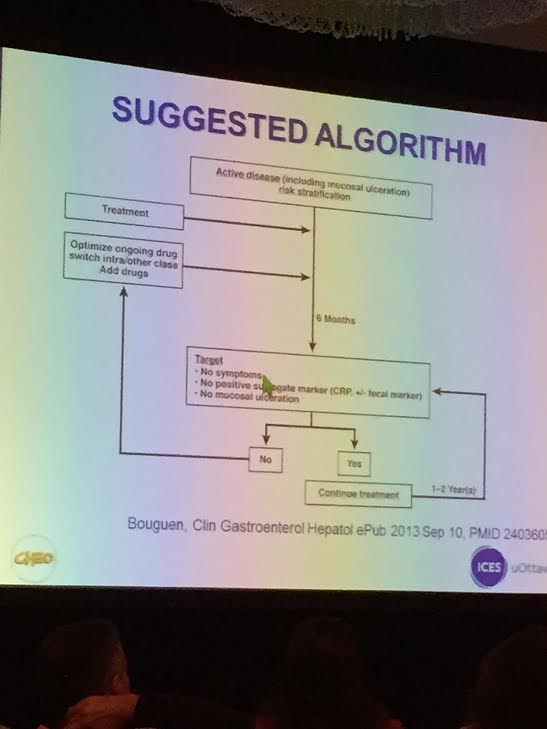
Treat-to-Target Algorithm

Treat-to-Target Algorithm

Surrogate Markers

  • Ultrasound –can be useful but operator-dependent
  • MRE had 83% accuracy for endoscopic remission: Gastroenterol 2014; 146: 374.
  • Calprotectin not as accurate in children? Am J Gastroenterol 2014; 109: 637. Sensitivity high 97%, specificity for remission 68%
  • CRP –if elevated, higher risk of complications or surgery. However, sensitivity is much lower for disease activity than calprotectin/imaging studies for active disease
  • Drug levels. Therapeutic IFX trough levels (and adalimumab) are highly predictive of mucosal healing.

Bottomline (my interpretation): Resolution of clinical symptoms and improvement in bloodwork is not good enough.  When/timing to assess with sensitive surrogate markers is still uncertain.  In many patients, endoscopy is needed to assure adequate improvement; however, in others, a followup imaging study (eg. MRE) or sensitive stool assays may be the best approach.

A related story (from AGA’s Today in Medicine email feed & pointed out to me by Ben Gold) indicates that estimation of clinical symptoms is not accurate:

Survey Suggests Severity Of IBD Is Underestimated By Gastroenterologists.

MedPage Today (10/31, Walsh, 186K) reports that survey results presented at a medical conference indicate that “the severity of inflammatory bowel disease is significantly underestimated by gastroenterologists.” Researchers found that “a total of 55% and 67% of physicians who participated in a web-based survey rated cases of Crohn’s disease and ulcerative colitis as being mild when they were actually moderate.” Meanwhile, “for case studies that represented severe disease, 76% and 81% of the physicians gave ratings of either moderate or mild for Crohn’s disease and ulcerative colitis, respectively.”


Related blog posts:

Risk Stratification in Pediatric IBD: Are we there yet? Jeffrey Hyams (Connecticut Children’s

Initially, Dr. Hyams described the exploding head syndrome; many attendees might have thought they had this due to information/”big data” overload, but this syndrome is a sleep disorder/parasomnia event.  Here’s a link to the image from his talk.  Then, Dr. Hyams reviewed data on risk stratification:

  • Mutations: Some genetic mutations are associated with disease severity
  • Still needed: specific pediatric data
  • Microbiome: Some profiles associated as prognostic factors in pediatric RISK study
  • Early anti-TNF associated with improved outcomes (using propensity analysis) Gastroenterol 2014; 146: 383.

Bottomline: Not there yet with risk stratification. Many factors environmental, genetic susceptibility, immune response, and treatment need to be sorted out with “big data.”

Key Clinical Questions for your practice at this time:

  • Does this patient have known risk factors for doing poorly?
  • Am I using current therapies properly?
  • What is the risk of undertreated disease? This needs to be considered with discussion of safety of IBD meds.

Cross Examination of Cross-Sectional Imaging in IBD –Sudha Anupindi (Radiology/CHOP)

  • For the most part, barium studies discouraged (eg. UGI/SBFT) by speaker; radiation ~1 mSv.
  • CT (conventional) widely available and easy –if needed urgently/middle of night.

Initial presentation: imaging of choice

  • MR enterography –no radiation, better contrast resolution, best for perianal disease, able to evaluated peristalsis. Two limitations: cost, interpretation
  • CT enterography –fewer motion artifacts (0.6 seconds), lower cost, increased availability, better spatial resolution radiation reduced with current technology at most Children’s hospitals: 1-2 mSv

Abdominal ultrasound holds promise as alternative imaging with lower cost.


“Silent” Crohn’s Disease

David Binion comments on Silent Crohn’s Disease (CD) in a recent Gastroenterology & Hepatology: Here’s the link —Silent Crohn’s Disease

Key points:

  • “Approximately one-quarter of patients with active disease are asymptomatic.”  Some have termed these patients to have Silent CD.
  • Biomarkers including blood tests (eg. CRP), fecal markers (eg. Calprotectin), imaging and endoscopy can reveal active disease in many asymptomatic patients.  Conversely, about one-sixth of patients are “overreporters” who describe abdominal complaints without objective evidence of inflammation.
  • “CRP elevation represents a more significant threshold of mucosal damage compared with endoscopic assessment.”  “In our study, 37% of the silent Crohn’s disease cohort [with elevated CRP] at our center required hospitalization within 2 years compared with 7% of patients who felt well and had no elevation of CRP level.”

These findings reinforce the notion that mucosal healing in combination with symptoms is important at predicting long-term response to treatment.  A commonly-used physician global assessment may miss silent CD.

Bottomline: In those with “inactive” CD, obtaining a CRP (and possibly a fecal calprotectin) will improve detection of silent CD.

Related blog posts:

Treating to Target

As alluded to in a previous post (CCFA Conference Notes 2014 (part 2) | gutsandgrowth), there has been increasing discussion and efforts aimed at mucosal healing (MH) because it is associated with improved clinical outcomes in patient’s with Crohn’s disease (CD).  Even before its print publication, this study (Clin Gastroenterol Hepatol 2014; 12: 978-85) by William Sandborn’s group has influenced the discussion.

This retrospective study analyzed 67 patients with CD (2011-2012).  These 67 were selected from a population of 510 patients seen at UCSD who had at least several endoscopies and ulcers  seen at the initial procedure.  In this cohort of 67 patients, the median disease duration was 9.8 years.  Only 26 (38.8%) were naive to both immunosuppressives and biologics at referral.

Key findings:

  • Only half of the patients achieved MH.  “After a median follow-up of 62 weeks, 50.7% had MH and 61.1% had endoscopic improvement.”  79% of those who underwent adjustments achieved MH.
  • Clinical symptoms do not correlate with MH. “40.9% of patients experienced clinical symptoms despite MH and 18.8% of patients without clinical symptoms had significant endoscopic lesions.”
  • Biomarkers may be effective at predicting MH. “None of the patients with MH had an increased concentration of CRP.”
  • Adjusting treatment is needed if abnormal endoscopy; this is inherent in the philosophy of treating-to-target.

The authors conclude that “serial endoscopic procedures to guide treatment to the goal of MH is feasible in clinical practice.” Ultimately the goal is to influence the natural history of Crohn’s disease.

Study limitations:

  • retrospective study
  • small number of highly-selected patients
  • lack of randomization
  • definition of MH remains debated
  • no cost data
  • lack of data on stool biomarkers (e.g. calprotectin) which could serve as alternative
  • no answer to the question of what to do for the patient without MH who is receiving ‘maximal medical treatment’

From Dr. Sandborn: (from Healio Gastro summary):

Evidence has accumulated that the complications of Crohn’s disease [CD] … are due to chronic inflammation that has not been fully treated,” William J. Sandborn, MD, chief of the gastroenterology division and director at the University of California, San Diego, IBD Center, told Healio.com. “This in turn has led to the concept of ‘treat to target’ in which patients are assessed with endoscopy for active inflammation prior to making important changes in therapy, and then reassessed with endoscopy within 4 to 6 months to ensure that the therapy change healed the bowel and resolved the inflammation.

“If active disease persists at endoscopy, even in the absence of clinical symptoms, then therapy is intensified and this cycle is repeated until mucosal healing (MH) is achieved.”

Take-home message: This study is one of many that are likely to influence the practice of clinicians to prove that the treatment is exerting a biologic effect and not solely improvement in clinical scoring indices.  With the emergence of multiple modalities to assess improvement, including biomarkers and imaging, it is not clear that repeated endoscopy will be the best assessment tool.

Related blog postEXTEND & MUSIC: Optimizing Crohn Disease Care …

Also noted:

Clin Gastroenterol Hepatol 2014; 12: 986-94.  “Association Between Telephone Activity and Features of Patients with Inflammatory Bowel Disease.”  The authors found that 15% of patients were responsible for half of all telephone calls.  These patients were more likely to be seen in ED and hospitalized.

Clin Gastroenterol Hepatol 2014; 12: 929-34. “Histologic Remission: The Ultimate Therapeutic Goal in Ulcerative Colitis?” This article reviews definitions for histologic remission and highlights questions that need to be addressed before histologic remission is used more widely as a clinical endpoint in trials and in practice.

EXTEND & MUSIC: Optimizing Crohn Disease Care

As noted in recent posts (see links below), there is increased interest in showing direct mucosal healing and achieving optimal drug levels in controlling Crohn disease (CD).

  1. Clin Gastroenterol Hepatol 2014: 12: 414-422.
  2. Clin Gastroenterol Hepatol 2014: 12: 423-431.

The first study examines the rates of deep remission induced by adalimumab.  Deep remission is “defined as the absence of mucosal ulceration and CD Activity Index scores less than 150.”

Design: The data is derived from the EXTEND (EXTend the Safety and Efficacy of Adalimumab Through ENDoscopic Healing) trial.  EXTEND was a 52-week randomized, double-blind, placebo-controlled trial of adalimumab (ADA) for adults (n=135) with moderate to severe ileocolonic CD.  All patients received open-label induction with ADA (160/80 mg at weeks 0/2), then were randomized to ongoing ADA 40 mg every other week or placebo.

Results: Rates of DR were 16% in ADA patients compared with 10% of placebo-treated patients at week 12.  By week 52, 19% of ADA patients were in DR compared with 0% of placebo-treated patients.

Key findings:

  • Analysis showed that shorter disease duration was associated with DR.  One-third of patients with CD for <2 years achieved DR.
  • Patients with DR had better outcomes than those with only mucosal healing (n=8); those with isolated clinical remission (n=19, no mucosal healing), but not DR, had similar outcomes to those with DR.  The associated editorial (pg 432) notes “symptoms will still make patients go to the emergency department, or miss work, or feel miserable, regardless of how good their mucosa looks.”
  • The authors state that during the 40 weeks after early CR, “estimated savings were $6117 for direct medical costs and $4243 for indirect costs” (total $10,360).  This monetary savings may not be offset in clinical practice by ileocolonoscopy which is not only invasive but also expensive.

Conclusion (from the authors): “Before any recommendation to adopt DR as a treatment target, establishing a clear association between achievement of DR and better long-term prognosis is necessary.”  The editorial advises against adopting DR as a treatment goal: “combining symptoms and mucosal healing into 1 end-point should be reconsidered as a measure of response to anti-inflammatory therapies.”

The second study, referenced above, examined plasma concentrations of certolizumab pegol (CZP) and endoscopic outcomes of patients with Crohn disease.

Design: The authors analyzed data (post hoc analysis) from the MUSIC (The Endoscopic MUcoSal Improvement in Patients with Active CD Treated with CZP) study. Adult patients received subcutaneous CZP (400 mg) at weeks 0, 2, and 4 followed by every 4 week treatment for 52 weeks.  Endoscopic evaluation took place at weeks 0, 10, and 54 and CZP concentrations were measured at weeks 8 and 54. At week 10, there were 45 patients analyzed and at week 54, 18 patients.

Key findings:

  • Mean CZP concentrations: 11.1 mcg/mL at week 8 (4 weeks after previous dosing) and 14.9 mcg/mL at week 54 (2 weeks after previous dosing).
  • Higher CZP concentration (by quartile values) correlated with endoscopic response (P=.0016) and remission (P=.0302) at week 10.
  • Among those with the highest CZP values, their 8-week CDEIS (CD Endoscopic Index of Severity) remission rate was 75% (12/16).  Overall, CDEIS remission was noted in 56% (25/45) at week 8.
  • At week 54, endoscopic remission correlated with plasma CZP values (P=.0206).
  • Both high CRP and high body weight inversely correlated with CZP concentrations.

Conclusion from this study: As with other anti-TNF agents, higher serum levels were associated with mucosal healing.  However, the data do not prove causality.  “It is possible that higher trough concentrations at week 8 may be a consequence of mucosal healing” rather than the reverse.

Bottomline: These two studies together show that achieving optimal long-term response correlates with therapeutic drug levels and mucosal healing.  At the same time, these studies along with many other indicate that we have along way to go in order for us to achieve these objectives consistently.

Related blog posts:


CCFA Conference Notes 2014 (part 1)

Each year our local CCFA chapter holds a one day seminar with separate lectures for health care providers and families.  Overall, it is a good opportunity to hear ‘cutting edge’ material.  I did not pick up as much at this year’s seminar as in previous years, but will highlight what I thought was most important.

Key points:

  1. Symptoms are not accurate at determining effectiveness of IBD therapy.
  2. More frequent use of objective markers are needed to optimize treatment.  Mucosal healing is starting to be a target in clinical practice, but limited by number of medications available.
  3. Stricture classification and operative techniques were reviewed.
  4. IBD frequently results in psychological problems: anxiety, depression, pain, sleep. 15% of kids and 25% of adults are having thoughts of death on screening tool intake.
  5. Fecal microbiota transplantation (FMT) –not enough data to recommend for IBD.  Clinical trials ongoing.

Debate: What should be the End Points in Therapy? 

  • Tanvi Dhere (Emory): Goal: clinical symptoms
  • Cary Sauer (Emory Pediatrics): Goal: mucosal healing and normal bloodwork

In my opinion, this was the most thought-provoking and best presentation

Mucosal healing (MH) consensus definition –normal mucosa after previously abnormal with complete absence of ulceration, macroscopic and histologic signs of inflammation.  In practice MH = absence of ulcerations.

Reasons why mucosal healing as a target is problematic:

  • Problems with MH –not validated.  No long-term data utilizing endoscopic scoring indices of MH.
  • MH relies on a binomial endpoint –Yes or no, but there may be intermediate endpoints.
  • How likely is MH (different definitions in these studies)?  SONIC –MH in 43.9% of combination Rx (30.1% in those with infliximab monotherapy); EXTEND (Adalimumab) 27% and 24.2% 12/52 weeks; MUSIC (certolizumab at 10/54 weeks) 11.5% and 18.9%.

In practice, Mayo Score 0-1 both considered to have MH.

MayoScore Visual

Images above online at www.nature.com

In small study, MH at 1 year were not associated with improved outcomes at 5 years.  Risks of MH: more procedures, more costs of treatment, and potential for more complications.

Dr. Sauer’s reply.  Three simple questions –why should I try to target MH, is it possible, what is needed to get this done?

  1. If the goal were only an asymptomatic patient – why do screening colonoscopy in the general population, much less in IBD?
  2. In IBD, long-term evolution of IBD (Cosnes J et al. Inflamm Bowel Dis. 2002 Jul;8(4):244-50) is toward structuring and penetrating disease. CD Evolution This needs to be modified if possible.

Why MH? Improved symptoms, better quality of life, less likely to develop colon cancer, and it is an objective measure of treatment response.

  • In MH patients, less steroids and fewer flares over 2 year period.
  • MH healing patients have sustained clinical benefit over 96 months.
  • With MH, there is a decreased colectomy in UC.  In one study, there was a lower  colectomy rate at 8 years if colonic CD (62% vs 8%), decreased steroids in CD, decreased hospitalizations, & decreased fistulae.

Is MH possible in clinical practice?  The accuracy of CDAI to detect endoscopic healing is low in patients with CD. (Bouguen G et al Clin Gastrohep 2014).  More frequent adjustments in medical therapy –could lead to MH in up to 80% over 80 week study period.  Same story in UC (Bouguen G et al IBD 2014).

What do I need to do to obtain MH? Endoscopy (or MRE), maximize medications (checking levels), change medications, and most important –set a target. “Adjusting infliximab dose alone could lead to MH in up to 60%.”

When to assess for MH?  Consider endoscopy at 6 months into treatment if symptoms and at 12 months if in clinical remission.

Other viewpoints on MH from panel:

Dr. Loftus –“I think of this like oncology.” He agreed with using the best evaluating tool 6 months into treatment.  Cross-sectional imaging is often more helpful, but may need more than one tool.

Dr. Long—“Are we going to check every 6 months?” No.  She stated that she does not do this and tries to avoid repeated endoscopic procedures if this will not change treatment.  Goal is to make sure patient is headed in right direction, often after starting therapy.  Dr. Long stated that stool biomarkers most useful for colonic disease.

Dr. Dhere—documenting MH is important for deescalating treatment.

Millie Long  “Quality of Care in IBD”

  • 75% of Crohn disease patients will need surgery, 10% in 1st year
  • “One way to gauge quality of care is to examine the degree of consistency in care”
  • High variability in care in IBD (Aliment Pham Ther 2007; 26: 1005-18)
  • “Over half of institutions with worst quality have mortality in normal range.” Outcomes may not occur until several years after treatment, thus more useful to measure process measures

PQRS IBD Quality Measures in Adults: 10 Measures

  • #1 Establishing/documenting IBD type, anatomic location, and activity
  • #2 Preventive care: corticosteroid sparing.  Steroids associated with mortality (OR 2.1 in TREAT registry)
  • #3 Preventive care:  Preventing bone loss.  Limiting steroid use.  Recommend weight-bearing exercise, Quit Smoking, Measure DEXA, added Calicum/Vit D/Bisphosphonates
  • #4: Vaccination –pneumococcal vaccine.  Avoid live virus vaccines
  • #5 Vaccination –influenza vaccine, zoster vaccine
  • #6 Testing for latent TB prior to anti-TNF
  • #7 Testing for hepatitis B virus
  • #8 Testing for C diff with patients hospitalized with IBD
  • #9 VTE prophylaxis in adult IBD patients.  Risk assessment on admission to hospital is recommended.  IBD patients have 1.5-3.5-fold higher risk of VTE àwhich can increase mortality risk
  • #10 Screening for tobacco.  Tobacco use after surgery increases recurrence by 2.5-fold.  It also increases risk for reoperation.

Last year’s notes:

Disclaimer: These blog posts are for educational purposes only. Specific dosing of medications (along with potential adverse effects) should be confirmed by prescribing physician.  This content is not a substitute for medical advice, diagnosis or treatment provided by a qualified healthcare provider. Always seek the advice of your physician or other qualified health provider with any questions you may have regarding a condition.

Predicting Remission in Pediatric Ulcerative Colitis

Trying to offer realistic information to families on the long-term success of infliximab (Remicade) for pediatric ulcerative colitis has been difficult due to a limited amount of data.  In addition, many studies have a number of limitations which can make it difficult to extrapolate to a less-selected population (According to the study which you would never qualify for ).

A recent post hoc analysis (Clin Gastroenterol Hepatol 2013; 11: 1460-65) from 51 children (age 6-17 years) provides some insight into this issue.  The authors used data collected prospectively during the T72 clinical trial (Clin Gastroenterol Hepatol; 10: 391-99 -reviewed in blog post: Infliximab for children with Ulcerative Colitis | gutsandgrowth).

Results:

  • Week 8 PUCAI scores best predicted which patients would be in steroid-free remission after 1 year of treatment: 9 of 17 (53%) with scores <10 points were in sustained remission compare with 4 of 20 (25%) with scores ≥10.
  • Week 8 PUCAI outperformed mucosal healing in predicting remission.

Key points:

  • PUCAI may have outperformed mucosal healing because the latter can lag behind clinical response.  Furthermore, mucosal healing is more subjective with less interobserver reliability.
  • In patients with known inflammatory bowel disease, endoscopic assessment remains important in several situations: condition or reason for symptoms is in question (eg. exclude irritable bowel symptoms or medication-induced symptoms), acute severe colitis not responding to 3-day treatment with intravenous steroids to exclude superinfection, and to assess mucosa before major treatment changes “such as when starting or stopping biologics and before referral for colectomy.”

Related blog posts:

Predicting long-term response with calprotectin levels

This blog has been a fan of calprotectin levels (see related posts below) as both a screening test for inflammatory bowel disease and as a marker of disease activity.  Now more data is available indicating that calprotectin levels, much like endoscopic mucosal healing, after induction therapy correlates with long-term response (Inflamm Bowel Dis 2012; 18: 2011-17).

This retrospective study (2005-2010) examined 60 patients with IBD with elevated baseline calprotectin levels.  34 patients had Crohn’s disease (CD) and 26 had ulcerative colitis (UC).  42 patients received infliximab therapy and 18 patients received adalimumab.  After induction therapy, therapy was discontinued in primary non responders or continued as scheduled maintenance therapy for at least one year if not relapsing.

The average age at induction for CD patients was 30 and the corresponding age at diagnosis was 21.  For UC patients, the average age at induction was 29 and the corresponding age at diagnosis was 26.

Median calprotectin level at baseline was 810 μg/g (n=60).  After induction, the median value dropped to 97 μg/g (n=60) and at 1 year the value dropped to 27 μg/g (n=25).  The calprotectin level normalized in 31 patients after induction.  At 12 months, the sustained remission was present in 84% (26/31).  In contrast, only 38% (11/29) who had elevated levels after induction were in remission at 12 months.

Related blog entries:

Food as medicine

Two recent articles add some useful information regarding enteral therapy for Crohn’s disease (Inflamm Bowel Dis 2012; 18: 246-53 & JPGN 2012; 54: 298-305).

The first article enrolled 34 children with newly-diagnosed Crohn’s disease.  Patients were divided into elemental and polymeric formula groups and followed in a prospective, double-blind randomized controlled trial for two years.  Measures of improvement included the PCDAI as well as fecal calprotectin and fatty acids.  Both groups of patients responded clinically.  93% (14/15) of the elemental formula group achieved remission based on PCDAI scores (<11) and 79% (15/19) of the polymeric formula group.  The initial treatment was use of formula (along with only clears) either by NG or oral for 6 weeks.  All patients had NG placed at time of endoscopy and if sufficient oral intake was demonstrated (for 2 days), NG was removed.  All subjects had small bowel and colonic disease.  Although calprotectin levels decreased, they remained very elevated.  In the EF group, the median calprotectin dropped from 2023 μ/g to 1113 μ/g, though only one patient had a level below 400; similarly in the PF group the calprotectin dropped from 1929 μ/g to 1134 μ/g, and only two patients had a level below 400.  Some to the reasons why changes in diet may be useful have been alluded to in a previous post: Eat your veggies…if you don’t want to get sick.

The second reference is a clinical guideline on the use of exclusive enteral nutrition EEN).  The introduction notes that 65% of European pediatric gastroenterologists use EEN compared to 4% for North American pediatric gastroenterologists.  In pediatric trials, EEN and corticosteroids were considered ‘equally effective’ in a pediatric meta-analysis which included five randomized controlled trials (n=147).  However, a Cochrane review favored corticosteroid treatment over EEN in a meta-analysis that included adult and pediatric patients (n=192 EEN, n=160 corticosteroids).  According to the authors, small studies have demonstrated other potential advantages of EEN including higher rates of mucosal healing and better linear growth.  With regard to mucosal healing, the initial cited study casts with ongoing elevated calprotectin indicates that this does not occur in the majority of children with EEN therapy.  Other caveats:

  • Disease location: some evidence favors small bowel disease rather than colonic disease
  • Formula composition: does not seem to matter whether elemental or polymeric
  • Duration of therapy: majority treat for 6-8 weeks of EEN.  The authors recommend at least 8 weeks
  • Time for response: Inflammatory markers improve in a little as a week, remission typically 2-4 weeks
  • Concomitant medications: many places initiate immunomodulator treatment; others cycle EEN
  • Start with goal 120% of ‘maintenance’ nutrient needs.  On 1st day, authors recommend starting at 1/2 goal volume and gradually increase over 1-2 days
  • Partial enteral nutrition (PEN) (eg. overnight feedings & normal daytime diet) has been helpful in improving growth and may improve remission rates.
Why not EEN or PEN? Potential barriers include cost, difficulty changing diet, fear of tube feedings, and more acceptable alternatives.  At the same time, some of these barriers could be overcome.  Quality of life measures have improved in children receiving enteral nutrition.

The use of more top-down therapy may affect all of the above considerations (Only one chance to make first impression).

Additional references:

  • -Cochrane Database Syst Rev 2007; CD000542.  Enteral nutritional therapy vs corticosteroids to induce remission in Crohn’s disease.
  • -Gastroenterology 2011; 141: 742. AGA guidelines on use of enteral nutrition in wide variety of conditions.
  • -Gastroenterology 2008; 135 : 1005. omega-3 fatty acids ineffective in Crohn’s dz for maintaining remission.
  • -Pediatr Res 2007; 61: 356-60.  Enteral nutrition effect on protein turnover in adolescents with Crohn’s disease.
  • -J Pediatr 2000; 136: 285-91. Nutritional Rx w polymeric diet is effective w/in 8 weeks in 32/37.
  • -Scand J Gastro 2001; 36: 383-8. Elemental & polymeric diets successful in maintaining remission in ~43% of adults with complete steroid withdrawal
  • -JPEN 1992; 16: 499. improved wt,ht, decreased prednisone, decreased CDAI
  • -JPGN 2000; 31 (supp 2) A291. Polymeric vs elemental diet.
  • -JPGN 2002; 35: 339-40. Lactase deficiency – same prevalence in IBD as in RAP.
  • -JPGN 2000; 31: 3 & 8. EN about as effective as steroids for primary Rx.