Better Diet -Less Fatty Liver

A recent study (J Ma et al. Gastroenterol 2018; 155: 107-17) shows that a “better diet” was associated with less liver fat.

Among the 1521 participants form a Framingham Heart Study cohort (Mean age 51 years at start of study), the authors assessed diet with a 125-item Harvard food frequency questionnaire and liver fat using liver-phantom ratio (LPR) on CT images between 2002-2005 and then again 2008-2011.  They specifically looked at 2 diet scores:

  • Mediterranean-style diet score (MDS)
  • Alternative Healthy Eating Index (AHEI)

Key findings:

  • For each 1 standard deviation increase in MDS, the LPR increased (less liver fat) by 0.57 and the odds for incident fatty liver decreased by 26% (P=.002)
  • Similarly, for each 1 standard deviation increase in AHEI, LPR increased by 0.56 and the odds for incident fatty liver decreased by 21% (P=.02)

My take: This study shows that Improved diet quality over 6 years was associated with reduced liver fat accumulation

Related posts:

Lake Louise, Banff


NAFLD Guidance from American Association for the Study of Liver Diseases

Link: AASLD Guidance for the Diagnosis and Management of Nonalcoholic Fatty Liver Disease

This guidance provides a 2018 review of NAFLD and current diagnostic/management recommendations in both adults and children.  Some points from this practice guidance:

  • “Liver-related mortality is the second or third cause of death among patients with NAFLD.” Cardiovascular disease remains the number one and cancer-related mortality is in the top three.
  • “Routine screening for NAFLD in high-risk groups attending primary care, diabetes, or obesity clinics is not advised at this time because of uncertainties surrounding diagnostic tests and treatment options.” Likewise, screening of family members is not recommended.
  • In children: “Because of a paucity of evidence, a formal recommendation cannot be made with regard to screening for NAFLD in children with overweight and obesity.”
  • In patients undergoing evaluation with suspected NAFLD, the authors specifically recommend checking ferritin, iron saturation, and autoantibodies that could indicate autoimmune liver disease.
  • In patients with suspected NAFLD, the authors recommend evaluation for comorbities including dyslipidemia, diabetes, hypothyroidism, polycystic ovary syndrome, and sleep apnea.
  • “Liver biopsy should be considered in patients with NAFLD who are at increased risk of having…advanced fibrosis” and in “whom competing etiologies…cannot be excluded without a liver biopsy.”
  • Pharmacologic therapies are not recommended in those without biospy-proven NASH and fibrosis.  Specifically, the authors suggest consideration of pioglitazone and vitamin E and recommend against metformin, GLP-1 agonists, omega-3 fatty acids, and ursodeoxycholic acid.
  • “Weight loss (7%-10%) is needed to improve the majority of histopathological features of NASH.”
  • In patients with cirrhosis due to NASH, screening for varices is recommended and consideration of screening for HCC.

My take: This practice guidance is quite reasonable.  At this time, more focus on systemic measures to counter overweight and obesity is crucial.  Pharmacologic therapies for NAFLD will need to be effective for the cardiovascular, metabolic, and liver-related problems.

Related blog posts:

Bright Angel Trail, Grand Canyon

Silymarin for Nonalcoholic Steatohepatitis

A recent study (CW Kheong et al. Clin Gastroenterol Hepatol 2017; 15: 1940-9) examined the use of silymarin (milk thistle) in a randomized, placebo-controlled, double-blind trial for nonalcoholic steatohepatitis (NASH). Patients (n=49) who were assigned to silymarin received 700 mg three times a day for 48 weeks; there were 50 patients assigned to placebo..

Key findings: 

  • Silymarin did not significantly improve the primary outcome of achieving a lower NAS score by 30% or more; this occurred in 32.7% of the silymarin group vs. 26.0% in the placebo group.
  • Reduction in fibrosis was noted in the silymarin group (histology drop by 1 point or more): 22.4% compared to 6.0% in the placebo group.

Silymarin has many potential beneficial properties: anti-oxidant, anti-inflammatory, anti-fibrotic, anti-viral, and metabolic functions.

My take: Given the safety of silymarin, if these findings can be confirmed in a larger trial, it would be an exciting advance in the field of fatty liver disease which has no proven pharmacologic therapies.

Related blog post:


Grand Canyon Basin

Fatty Liver Disease with Craniopharyngioma and with Down Syndrome

A recent retrospective study (SY Yung et al. Ann Pediatr Endocrinol Met 2017; 22 https://doi.org/10.6065/apem.2017.22.3.189 –thanks to Jeff Schwimmer for this reference) describes the problem of nonalcoholic fatty liver disease (NAFLD) in long-term survivors of childhood-onset (CO) craniopharyngioma.

This study reviewed 75 children with CO-craniopharyngioma who had surgery prior to 15 years of age. The mean followup was 4.3 years.

Key findings:

  • 51 had either elevated AST or ALT above 40 IU/L. ALT ≥60 IU/mL was observed in 15 patients.
  • Estimated prevalence of NAFLD based on mainly imaging was 47%. 27 underwent ultrasonography and 5 underwent CT scan.
  • Among those with available growth data, 41% were obese and 18% were overweight.
  • NAFLD developed within a year after surgery in many patients.

This study had many limitations, including reliance of ultrasonography for diagnosis and incomplete evaluations.  Despite this, it is clear that hypothalamic obesity places patients at a high risk for developing NAFLD.  In addition, NAFLD in this population may be more aggressive.

My take: This study documents the well-recognized phenomenon of NAFLD in CO-craniopharyngioma with obesity.  Current treatment relies on trying to preserve hypothalamic function and optimizing lifestyle/nutrition.

Briefly noted: D Valentini et al. J Pediatr 2017; 189: 92-7.  Using ultrasound in 280 Italian children with Down syndrome, the authors identified NAFLD in 45% of those considered nonobese and 82% of those overweight/obese. In a related commentary (pg 11-13 Full text: Down syndrome and Pediatric NAFLD …), the authors (AD Matteo, P Vajro) note that Down syndrome patients may have increased NAFLD due to less activity, more obesity including possible excess adiposity in those with normal BMI, obstructive sleep apnea, or perhaps other mechanisms.

Related blog posts:


Nonalcoholic Steatohepatitis Review

A concise and useful review of nonalcoholic steatohepatitis (NASH): AM Diehl, C Day. NEJM 2017; 377: 2063-72

A couple points:

  • About 25% of adults have fatty livers in the absence of excessive alcohol consumption
  • NASH is strongly associated with obesity/overweight which occur in  >80% of patients
  • NASH comorbidities in adults: 72% with dyslipidemia, 44% with type 2 diabetes mellitus
  • In a typical patient with NASH, liver fibrosis progresses “at a rate of approximately one stage per decade, suggesting that F2 fibrosis will progress to cirrhosis within 20 years.” However, there is considerable variability.
  • It is expected that NASH will be the leading reason for liver transplantation by 2020.
  • Cirrhosis related to NASH increases the risk of hepatocellular carcinoma with this occuring in 1-2% per year of patients with cirrhosis.
  • NASH is estimated to cost >$100 billion currently in annual direct medical costs
  • Staging of NASH and differentiation from isoloated steatosis identifies those at high risk for sequelae.
  • In Table 2, the authors list more than 10 pharmacologic agents in phase 2/3 studies

Current lifestyle treatment recommendations (for adults):

  • Lose 7% of body weight if overweight or obese
  • Limit consumption of fructose-enriched beverages
  • Limit consumption of alcohol (no more than 1 drink/day for women and 2 drinks/day for men)
  • Drink two or more cups of caffeinated coffee daily

Related blog entries:


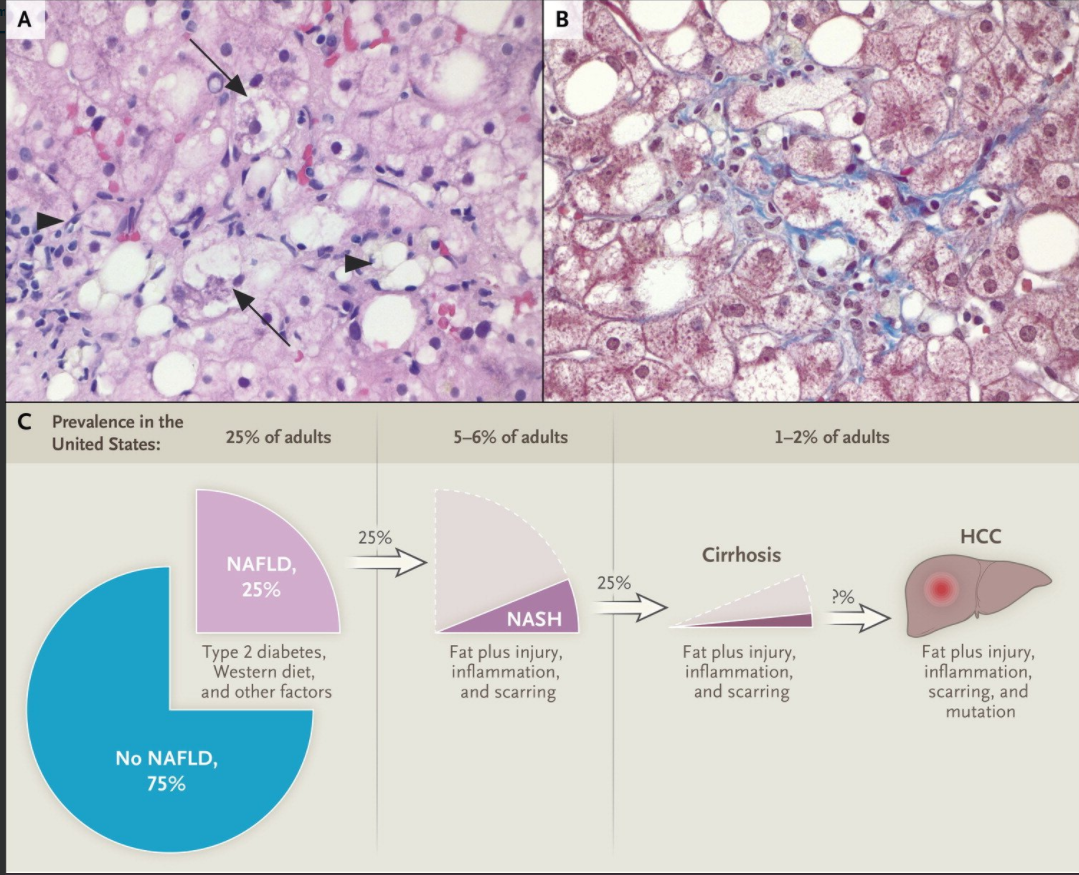
Panels A & B show typical histologic findings: ballooned hepatocytes (arrows), inflammatory infiltrates (arrowheads), and fibrosis Panel C shows the relative distribution of NASH, cirrhosis, and hepatocellular carcinoma in U.S. Adults.

Research for Fatty Liver Disease

Recently the AASLD Postgraduate Course discussed emerging treatments for nonalcoholic fatty liver disease/nonalchoholic steatohepatitis. From AASLD News: Emerging Treatments for NASH 

Key point:

  • Quentin Anstee: “It is important to remember that our patients with fatty liver disease will most likely die of cardiovascular disease, not liver disease.”

Four principles in treating nonalcoholic fatty liver disease (NAFLD) to address both cardiovascular and liver risks.

  • Target obesity with lifestyle changes and, possibly, bariatric surgery.
  • Target metabolic syndrome to reduce cardiovascular disease risk using medications with additional liver-directed benefits.
  • Target liver disease to prevent progression of steatohepatitis to fibrosis and cirrhosis.
  • Minimize downstream complications such as hepatocellular carcinoma.

More than 60 phase 3 trials are underway –Primary Therapeutic Targets:

  • PPAR signaling (insulin signaling, glucose and lipid metabolism, energy homeostasis, inflammation)
  • FXR signaling (insulin sensitivity, glucogenesis, lipogenesis)
  • ASK1 signaling (apoptosis)
  • CCR2/CCR5 signaling (inflammation and fibrogenesis).

Programming for Fatty Liver Disease May Occur Prior to Birth

A recent study (KP Newton et al. J Pediatr 2017; 187: 141-6; associated editorial pg 13-15)) in a multicenter retrospective cross-sectional study of children (n=538) with biopsy-proven nonalcoholic fatty liver disease (NAFLD) showed that birth weight influenced the development of NAFLD.  The participants were enrolled in the Nonalcoholic Steatohepatitis Clinical Research Network (NASH CRN).

Key findings:

  • There was increased NAFLD among both low birth weight (LBW) and high birth weight (HBW).
  • LBW occurred more commonly in the NAFLD cohort 9.3% compared with the general population prevalence 6.1%.
  • HBW occurred more commonly in the NAFLD cohort 14.9% compared with the general population prevalence 10.5%

The authors speculate that the explanation/mechanisms for increase in both LBW and HBW are likely to differ. It has been recognized that LBW is associated with higher cardiovascular disease and type 2 diabetes.  HBW start bigger and often stay bigger; that is, there are increased risks of more severe obesity.

There are numerous limitations to this study -there is a lot of data that is not available, including gestational age, maternal weight, breastfeeding exposure, and antibiotic administration.

My take: These findings add to the literature that risks for NAFLD along with other metabolic problems may be present at birth.  Is there a way to modify this risk?

Related study: ET Jensen et al. J Pediatr 2017; 187: 50-7, editorial pg 10-12.  In this study of 535 ten-year-old children, enrolled in a prospective multicenter extremely low gestational age newborn cohort study, the authors found that maternal overnutrition and undernutrition affected the brain health of these children. The authors used neurocognitive assessment tools.

  • Children born to women with a pregravid BMI >30 scored “lower on measures of general cognitive ability, executive functioning, fine motor function, and academic achievement.”
  • Children born to women with inadequate maternal weight gain during pregnancy had “lower language and academic achievement.”

Hidden Falls, Highlands NC


NAFLD Adult Prospective MRI Study: 42% Prevalence

From Jeff Schwimmer Twitter feed:

Prevalence of Fatty Liver Disease in NE Germany Based on MRI RSNA Radiology, http://dx.doi.org/10.1148/radiol.2017161228

Excerpt from abstract:

From 2008 to 2013, 2561 white participants (1336 women; median age, 52 years; 25th and 75th quartiles, 42 and 62 years) were prospectively recruited to the Study of Health in Pomerania (SHIP). Complex chemical shift–encoded magnetic resonance (MR) examination of the liver was performed, from which PDFF and R2* were assessed…

Prevalence of fatty liver diseases was 42.2% (1082 of 2561 participants); mild, 28.5% (730 participants); moderate, 12.0% (307 participants); high content, 1.8% (45 participants).

Vincent Van Gogh, Portrait de l’artiste, Musee d’ Orsay


Proof That Diet Changes Can Improve a Fatty Liver

A recent prospective study (M Markova, O Pivovarova, et al. Gastroenterol 2017; 152: 571-85) showed that among individuals with nonalcoholic fatty liver disease (NAFLD) and type 2 diabetes that a diet high in protein (animal or plant) reduced liver fat over a 6 week period.

Among 37 participants, body fat and intrahepatic fat were detected with MRI and spectroscopy, respectively. Protein was increased to 30% of the diet. Fat was reduced to 30% and carbohydrates to 40% of diet composition. .

Key findings:

  • With a high animal protein diet, liver fat was reduced by 36%.  In the high plant protein diet group, liver fat was reduced by 48%.
  • Theses changes were unrelated to change in body weight.  However, these changes were correlated with down-regulation of lipolysis and lipogenic indices.

Some of the findings may be limited to older patients as this cohort was older than 60 years of age.  In the pediatric population, the dietary factor that has been linked most closely to NAFLD has been fructose, mainly in sugar-sweetened beverages (R Patusco et al. Top Clin Nutr 2017; 32: 27-46 -thanks to Ben Gold for this reference).

My take: This study shows improvement in liver fat with increased protein/reduced dietary fat.  While this study indicates that dietary modification is important in treating NAFLD, the optimal dietary intervention (eg. higher protein, lower sugar, lower fat) remains uncertain.

Related posts:


Rising Rates of Pediatric Fatty Liver

The alarming rates of pediatric nonalcoholic fatty liver disease are summarized in a recent Lancet Blog (Thanks to John Pohl for this link).  Seven million children in U.S. have fatty liver disease.

Link: An alarming trend in fatty livers (in children)

An excerpt:

The rate of NAFLD among US children has tripled over the last twenty to thirty years, rising from 3-4 percent to 10-11 percent, according to Dr. Naim Alkhouri, Director of the Metabolic Liver Center at the Texas Liver Institute in San Antonio…

Lifestyle changes, such as better nutrition and increased exercise, are currently the best-known way of mitigating and possibly reversing its effects…

Some 35-50 percent of obese children have NAFLD, and 20 percent of children with NAFLD have the advanced form of NASH. Also, 10-15 percent of children with NAFLD are in a predicament that could be described as “pre-cirrhosis.”

“Though most cases of juvenile NAFLD are caused by excess weight and associated insulin resistance, “up to 7% of non-overweight or obese children may have NAFLD,” according to a new study that Alkhouri and others will present at the upcoming International Liver Congress, held in Amsterdam this April.

Related blog posts:

Chattahoochee near Azalea Drive

Chattahoochee near Azalea Drive