Hepatitis B & C -Winter 2016

The large randomized pediatric entecavir study for Hepatitis B virus (HBV) is now in print: MM Jonas et al. Hepatology 2016; 63: 377-87.  Full link to this study on previous blog: Pediatric Entecavir Data  This study has led to FDA approval for use of entecavir in children as young as 2 years.  One interesting aspect of the study was the 2.6% drug resistance rate in the second year of the study.  This further validates current recommendations to treat children with “immune active” phases (e.g. abnormal transaminases and abnormal histology).

Briefly noted:

H Roberts et al. Hepatology 2016; 63: 388-97.  This study provides prevalence data for chronic HBV, 1988-2012.  During 2011-12, there were approximately 850,000 Americans with chronic HBV infections.  Migration of persons from HBV endemic countries has “largely contributed to prevalence rates remaining constant since 1999.”

JM Wilder et alHepatology 2016; 63: 437-44. This study showed that ledipasvir/sofosbuvir was similarly effective in black and non-black patients, with SVR12 rates of 95% and 97% respectively.  This is important because older interferon-based treatments were much less effective in black patients.

TB Dick et al. Hepatology 2016; 63: 634-43.  This review provides in-depth guidance regarding drug-drug interactions relevant to the new direct-acting antiviral agents used to treat Hepatitis C viral infection.

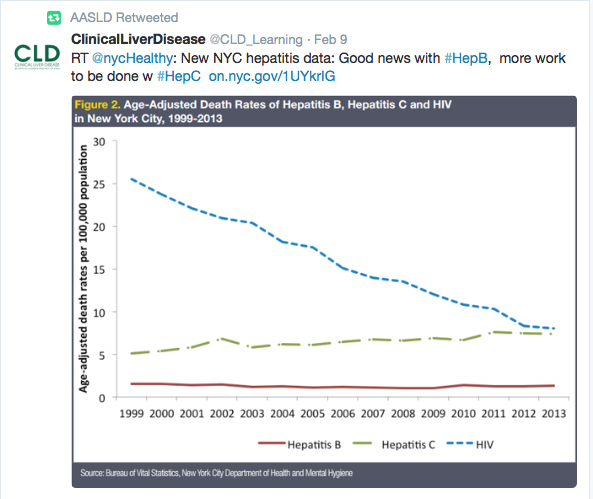
NY City Data for HIV, HBV, HCV

NY City Data for HIV, HBV, HCV

HCV Guidelines

The AASLD-IDSA Recommendations for Hepatitis C Virus have been published (Hepatology 2015; 62: 932-954).  The entire report is accessible from hcvguidelines.org and from the link: HCV Guidance 2015. While having a hard copy is easy to work with, the HCVguidelines website is likely to remain more up-to-date.

A few recommendations to highlight:

  • #6. “Antiviral treatment is recommended for all patients with chronic HCV infection, except those with limited life expectancy due to nonhepatic causes (I-A)
  • #7. “If resources limit the ability to treat all infected patients immediately as recommended, then it is most appropriate to treat those at greatest risk of disease complications” (see Tables 3 and 4)
  • #8. “Use of noninvasive testing or liver biopsy is recommended in order to assess the degree of hepatic fibrosis and, hence, the urgency of immediate treatment. (I-A)”

Other Hepatology studies of interest, briefly noted:

Hepatology 2015; 62: 684-93.  Nucleos(t)ide analog “treatment does not increase the risk of renal and bone events in general.  Nucleotide analogs may increase the risk of hip fractures, but the overall event rate is low.”  This study examined 46,454 untreated chronic hepatitis B patients in comparison to 7,046 treated patients.

Hepatology 2015; 62: 715-25. This study looked at the safety of simeprevir and sofosbuvir in hepatitis C-infected patients.  “Adverse safety outcomes were similar to matched untreated controls, suggesting that safety events reflect the natural history of cirrhosis and are not related to treatment.”

Hepatology 2015; 62: 773-83. This study found that “NAFLD is independently associated with subclinical myocardial remodeling and dysfunction.”

Bruce Munro, Atlanta Botanical Gardens

Bruce Munro, Atlanta Botanical Gardens

Changing Narrative on Affordability of HCV Treatments

A recent commentary (J Chhatwal et al. Clin Gastroenterol 2015; 13: 1711-13) makes the point that HCV treatment is looking a lot better lately with regard to cost.

Key points:

  • “Sofosbuvir-based treatment in 2015, on average, costs 54% of the wholesale acquisition cost”
  • When considering the recent discounts, “the cost of treatment decreased to $56,000…and the cost per SVR decreased to $58,000.”  The cost of an SVR with the first generation protease inhibitors, boceprevir and teleprevir, has been estimated to have been $213,000.
  • “The discounted cost of treating 1 person with HIV in the United States is $315,000 in 2014 US dollars.” Thus, curing HCV which is more deadly, at 18% of the cost, looks more favorable.
  • More discounts and more competition are expected.

Bottomline: Based on these cost considerations, the authors state that HCV treatment should be used broadly and not solely in those with advanced fibrosis.

Related blog posts:

Atlanta Botanical Gardens

Atlanta Botanical Gardens

HCV Update -Fall 2015

Briefly noted:

S Naggie et al. NEJM 2015; 373; 705-13.  Among patients coinfected with HIV-1 and HCV (genotypes 1 and 4), 12 weeks of ledpasvir and sofosbuvir resulted in a 96% sustained HCV virological response.

DL Wyles et al. NEJM 2015; 373; 714-25.  Among patients coinfected with HIV-1 and HCV (genotype 1), 12 weeks of daclatasvir plus sofosbuvir resulted in a 97% sustained HCV virological response.

HA Innes et al. Hepatology 2015; 62: 355-64. Review of a Scottish HCV clinical database showed that a sustained viral response was associated with a reduced liver mortality (adjusted Hazard Ratio 0.24), a reduced non liver mortality (aHR 0.24) and reduced behavioral events (eg. violence-related injury aHR 0.51).  The latter improvement suggests that HCV eradication leads to healthier lives.

Also, seeing as today is ICD-10 Rollout: ICD-10: Source for humor? | gutsandgrowth

View from Signal Lodge, Grand Tetons

View from Signal Lodge, Grand Tetons

Hepatitis C : New and Newer Treatments

A recent study (KR Reddy et al. Hepatology 2015; 62: 79-86) shows that the combination of ledipasvir/sofosbuvir is a safe, effective therapy for patients with genotype 1 Hepatitis C (HCV) and compensated cirrhosis.

The authors performed a post-hoc analysis of seven clinical trials in 513 treatment-naive and previously treated patients; 69% were previously treated. Key findings:

  • Overall, 493 (96%) achieved an SVR12; 98% of treatment-naive patients achieved an SVR12.
  • However, many patients in this analysis had received ribavirin.  In those treated without ribavirin (ledipasvir/sofosbuvir alone), the SVR12 was 90%.
  • Most common adverse effects included headache (23%), fatigue (16-19%), and asthenia (14-16%).

Bottomline: While ledipasvir/sofosbuvir was effective in this population, the 90% SVR12 is not as good as 96%.  This leads to the question of whether ribavirin is needed as well.

Related & briefly noted: SA Alqahtani et al. Hepatology 2015; 62: 25-30.  Ledipasvir/sofosbuvir treatment (8-24 weeks) resulted in SVR of 97% (with or without ribavirin) among the 1952 patients treated in the ION-1, ION-2, and ION-3 studies.

Related blog posts:

From FDA (July 24th): FDA approves new treatment for chronic hepatitis C genotype 3 infections

The U.S. Food and Drug Administration today approved Daklinza (daclatasvir) for use with sofosbuvir to treat hepatitis C virus (HCV) genotype 3 infections. Daklinza is the first drug that has demonstrated safety and efficacy to treat genotype 3 HCV infections without the need for co-administration of interferon or ribavirin, two FDA-approved drugs also used to treat HCV infection….

The safety and efficacy of Daklinza in combination with sofosbuvir were evaluated in a clinical trial of 152 treatment-naive and treatment-experienced participants with chronic HCV genotype 3 infection. Participants received Daklinza 60 mg plus sofosbuvir 400 mg once daily for 12 weeks and were monitored for 24 weeks post treatment. The studies were designed to measure whether a participant’s hepatitis C virus was no longer detected in the blood 12 weeks after finishing treatment (sustained virologic response), suggesting a participant’s infection had been cured.

Results showed that 98 percent of the treatment-naive participants with no cirrhosis of the liver and 58 percent of the treatment-naive participants with cirrhosis achieved sustained virologic response. Of the participants who were treatment-experienced, 92 percent with no cirrhosis of the liver and 69 percent with cirrhosis achieved sustained virologic response. Daklinza labeling carries a Limitations of Use statement to inform prescribers that sustained virologic response rates are reduced in HCV genotype 3 infected patients with cirrhosis.

From FDA (July 24th): FDA approves Technivie for treatment of chronic hepatitis C genotype 4

“The U.S. Food and Drug Administration today approved Technivie (ombitasvir, paritaprevir and ritonavir) for use in combination with ribavirin for the treatment of hepatitis C virus (HCV) genotype 4 infections in patients without scarring and poor liver function (cirrhosis).

Technivie in combination with ribavirin is the first drug that has demonstrated safety and efficacy to treat genotype 4 HCV infections without the need for co-administration of interferon, an FDA-approved drug also used to treat HCV infection…

The safety and efficacy of Technivie with ribavirin were evaluated in a clinical trial of 135 participants with chronic HCV genotype 4 infections without cirrhosis. Ninety-one participants received Technivie with ribavirin once daily for 12 weeks. Forty-four participants received Technivie once daily without ribavirin for 12 weeks. The studies were designed to measure whether a participant’s hepatitis C virus was no longer detected in the blood 12 weeks after finishing treatment (sustained virologic response), suggesting a participant’s infection had been cured.

Results showed that 100 percent of the participants who received Technivie with ribavirin achieved a sustained virologic response. Of those who received Technivie without ribavirin, 91 percent achieved sustained virologic response.

Garden of the Gods, Colorado Springs
Garden of the Gods, Colorado Springs

Hepatitis C -Can We Really Accomplish Widespread Screening?

A pessimist sees the difficulty in every opportunity; an optimist sees the opportunity in every difficulty.  -Winston Churchill

The aforementioned quote leads a recent editorial (Lutchman G, Kim WR, Hepatology 2015; 1455-8) which discusses the challenges of widespread Hepatitis C virus (HCV) screening and avoiding late diagnosis/missed opportunity for timely treatment.  The associated article (Moorman AC et al. Hepatology 2015; 1479-84) reviewed a large cohort of 14,717 patients with HCV and noted that 17% (n=1056) had a ‘late diagnosis’ which resulted in high rates of hospitalization and mortality.  Late diagnosis was defined as having cirrhosis at time of diagnosis or hepatic decompensation within 12 months of initial diagnosis.

The editorialists note that the related article presents data from 2006-11 which models ‘real-life’ practice settings.  Late diagnosis was more common in African-Americans and in patients with Medicare insurance.

With regard to widespread screening, pessimists argue that “we do not have coherent strategies and resources” to implement.

  • there are too few health care providers who are qualified and interested
  • the ‘treat-all” strategy is too expensive.  “For example, in the first 3 months after the release of sofosbuvir, a large commercial health insurance carrier announced that it had spent over $100 million on hepatitis C prescriptions…cause[d] a substantial drop in its stock price”
  • “while prioritizing treatment to patients who are at risk of future problems seems the optimal solution to deliver the most benefits at the lowest costs, the problems lies in the identification of those patients.”

Optimists see the opportunity for early intervention and improved outcomes.

Bottomline: While more effective treatment is available, there are still many questions, especially who should receive treatment and how to identify those most in need.  If/when costs of therapy are reduced, some of the difficult questions will resolve.

Related blog posts:

Briefly noted:

  • “Adding Pegylated Interferon to Entecavir for Hepatitis e Antigen-Positive Chronic Hepatitis B: A Multicenter Randomized Trial (ARES Study)” Brouwer WP et al. Hepatology 2015; 1512-22). “Peg-IFN add-on therapy may facilitate the discontinuation of nucleus(t)ice analogs.”
  • “The Impact of Phlebotomy in Nonalcoholic Fatty Liver Disease: A prospective, randomized, controlled trial.” Adams LA et al. Hepatology 2015; 1555-64).  “Reduction in ferritin by phlebotomy does not improve liver enzymes, hepatic fat, or IR in subjects with NAFLD”
  • “Nonalcoholic Steatohepatitis is the Second Leading Etiology of Liver Disease Among Adults Awaiting Liver Transplantation in the United States.” Wong RJ et al. Gastroenterol 2015; 148: 547-55.
Chattahoochee River

Chattahoochee River

Understanding HCV Treatment Failures with Sofusbuvir

While the new treatments for hepatitis C have improved dramatically in terms of cure rates and side effects (and pharmaceutical companies bottom-line), there are still patients who do not respond, especially those with genotype 3.  A recent study (Hepatology 2015; 61: 56-65) has provided some information into why this is happening.

A division of the FDA looked into five sofosbuvir (SOF) trials and performed sequencing to characterize potential resistance-associated substitutions.

Key findings:

  • Nonstructural protein 5B (NS5B) substitutions, L159F and V321A, emerged in 2.2%-4.4% of subjects who failed SOF treatment.
  • Baseline substitutions in 316 were associated with a reduced response in HCV genotype 1b subjects.
  • This study identified only 11 patients with genotype 3 with potentially relevant substitutions.

Bottomline: In the vast majority of patients, no resistance-associated substitution could be identified, indicating that we have a lot to learn why some patients are not responding.

Related blog posts:

Theses Eggs Contain Eggs!

Theses Eggs Contain Eggs!  Is the “allergen information” really necessary in this case?

HCV: When to Spike the Ball

When a team scores a touchdown in football, often one sees a player spike the ball in celebration.  The equivalent of spiking a ball rarely happens in medicine.  That being said, a recent study (Hepatology 2015; 61: 41-45) indicates that after treatment sofosbuvir regimens, you can celebrate if you have a sustained virological response (SVR) at 12 weeks (SVR12).

The authors conducted a retrospective review of five trials with 863 patients with HCV genotypes 1-6.  “Of the 779 patients with an SVR12, 777 (99.7%) also achieved an SVR24.” Of the patients who relapsed, most (77.6%) did so within 4 weeks of completing therapy.

Related blog posts:

Clinical Science Year in Review in Pediatric GI – NASPGHAN 2014

For many participants at NASPGHAN, the “year in review” presentations are a highlight.  This year was no exception.

This blog entry has abbreviated/summarized this presentation. Though not intentional, some important material is likely to have been omitted; in addition, transcription errors are possible as well.

William Balistreri –Clinical Science Year in Review 

Lay press remains excellent source of information.

Benefit of microbiome. (from NPR) Now there is elephant poop coffee -$645/lb ($70/cup).  Link: No. 1 Most Expensive Coffee Comes From Elephant’s No. 2 : The ... Collecting elephant poop is probably a less ideal job than what most of us have.  As for coffee, “make mine de-crap.”

Elephant Microbiome Collector

Topic of the year: Hepatitis C

  • 25 years since identification of Hepatitis C in 1989
  • Now approaching cure (Related blog post: Wiping out Hepatitis C | gutsandgrowth). All-oral highly effective regimen –newest regimen as easy as one pill per day for 8-12 weeks. Direct-acting antivirals (DAAs). Moving past 1st generation of DAAs: telaprevir/boceprevir with interferon/ribavirin.(refs = Pawlotsky, Gastroenterology 146:1176, 2014 and Schmidt, Clinical Gastroent Hepatol 12:728, 2014)
  • New drugs for HCV –just in time –increasing risk of HCV complications. Ann Intern Med 2014; 160: 293.
  • Goal –SVR –sustained virological response
  • Reviewed large number of articles: Sofosbuvir, Simeprevir, Sofosbuvir/Ledipasvir (Harvoni).  3-D regimen: ABT-450, ABT-267, ABT-333 –will be approved in coming weeks (Related blog post:Have You Heard of Harvoni? | gutsandgrowth)
    • Gane, NEJM 368:34, 2013
    • Zeuzem, NEJM 370:1993,2014
    • Kowdley, N Engl J Med 370:1879, 2014
    • Lawitz, Lancet 383:515, 2014
    • Feld, New England Journal of Medicine, 370:1594, 2014
  • Mild side effects with newer drug therapies
  • Awaiting pediatric studies.
  • Costly $1000/pill –“if dog swallows it,” may have to look for it in the stool
  • Stay updated with recommendations: www.hcvguidelines.org  (AASLD/IDSA)

Hepatitis B –success of vaccination.

  • Preventing perinatal transmission with HBIG/vaccine. JAMA 2013; 310: 974. Those born after 1984, with much lower HCC. Ann Intern Med 2014; 160: 828; Hepatology 2014; 60: 448
  • Give antivirals (eg. telbivudine) for HBeAg-positive mothers prior to delivery. (Related blog post: Hepatology Update -Summer 2014 | gutsandgrowth) Greenup, Journ of Hepatology 61:502, 2014 AND Zhang, Hepatology 60:468, 2014
  • Antiviral therapy lowers the risk of HCC. Hepatology 2014; 147: 143 (Wu et al).
  • Make sure children with IBD are being screened for hepatitis B. ~13% may not be immune. Moses, Am J Gastro 107:133, 2012

Trend of the Year: Social Media

  • Genome sequencing –tremendous advance. Families may push for this option on their own.
  • Magnets –banned. Social media allowed this problem to be quickly identified. (Related blog post: Buckyball Recall –It’s Official | gutsandgrowth)
  • Social media allows family to share information and get answers. Internet blogging allows families to reach out to scientists.
    • Schumacher, Pediatrics 133:e1345, 2014
    • Enns, Genetics in Medicine, March 2014
  • BiliCam –can take picture with mobile phones.

Biliary Atresia

Threat of the Year: Obesity along with NAFLD

  •  NAFLD can have significant liver histologic abnormalities even with normal ALT levels. J Pediatr 2014; 164: 707.
  • Clinical burden of NAFLD is not restricted to liver-related morbidity or mortality Armstrong, HEPATOLOGY 59:1174, 2014. Also, concern for obstructive sleep apnea and cardiovascular disease.  Sundaram, J Pediatr 164:699, 2014. Pacifico, HEPATOLOGY 59:461, 2014
  • Elastography is promising tool. Xanthakos, J Peds 164:186, 2014
  • Current treatment –lifestyle changes. Snacking contributes to fatty liver. Sleep curtailment is associated with obesity. Spaeth. SLEEP 36:981, 2013, Taveras, Pediatrics 133:1013, 2014, Mitchell, Pediat 131:e1428, 2013
  • Increased antibiotics in early life associated with obesity due to alteration of microbiome. Bailey, JAMA Pediatrics, Sept 29, 2014
  • Suggestion for future: “Diet Water.”

Diet Water.jpg

For those who want to learn more from Dr. Balistreri directly, I would recommend the Aspen Conference:

Aspen Meeting

Related link: Dr. Balistreri’s Review of the Growth and Development of the Pediatric Gastroenterology Specialty.


Have You Heard of Harvoni?

The U.S. Food and Drug Administration on 10/10/14 approved Harvoni (ledipasvir and sofosbuvir) to treat chronic hepatitis C virus (HCV) genotype 1 infection.

“Harvoni is the first combination pill approved to treat chronic HCV genotype 1 infection. It is also the first approved regimen that does not require administration with interferon or ribavirin, two FDA-approved drugs also used to treat HCV infection.”

Full FDA press release –includes data supporting approval.

Related blog postThe Future is Now (for Hepatitis C) | gutsandgrowth