
Carbapenem-Resistant Enterobacteriaceae (CRE) are difficult to treat infections. A recent story in USA Today noted their association with endoscopic retrograde cholangiopancreatography (ERCP)/duodenoscopes. According to the article, the FDA is working with the manufacturers to eliminate this risk. Compared to other endoscopes, the side-viewing scopes are more technically-difficult to clean because of its “elevator” mechanisms. “The biggest cases involved dozens of patients and multiple deaths.” It is likely that more frequent and easier-to-treat infections may be transmitted as well; these types of infections generally do not result in full-fledged epidemiological investigations. Here’s the link: “Deadly bacteria on medical scopes trigger infections” This link has particularly good diagrams explaining resistant organisms. It is important to emphasize that these infections, to my knowledge, have not been reported with the more common endoscopic procedures. Because of technical differences in the scopes, the standard cleaning procedures are effective for upper endoscopies and colonoscopies. Related posts:
Category Archives: Gastroenterology
Miralax -More Scrutiny, Research Study
A recent NY Times article is probably ‘required reading’ for all pediatric gastroenterologists, pediatricians, and family practitioners:
Here’s the link: Mirlax -Scrutiny for a Childhood Remedy
Here are some excerpts:
The [FDA] agency has asked a team of scientists in Philadelphia to look more closely at the active ingredient in Miralax and similar generic products, called polyethylene glycol 3350, or PEG 3350. While outlining the scope of the research, the agency also disclosed that its scientists had discovered trace amounts of two potential toxins in batches of Miralax tested six years ago.
The news is likely to surprise parents and some doctors.
“Every pediatric GI physician, I would guarantee you, has told a family this is a safe product,” said Dr. Kent C. Williams, a gastroenterologist at Nationwide Children’s Hospital in Columbus, Ohio. Now, he worries, “it may not be true.”
Doctors have long recommended these laxatives for their convenience and on the grounds that very little PEG 3350 is absorbed in the intestines. But the F.D.A. says there is little data on its absorption in children, especially the very young and chronically constipated. The agency never approved long-term daily use of the laxatives, even in adults….
Moreover, for years the F.D.A. has received occasional reports of tremors, tics and obsessive-compulsive behavior in children given laxatives containing PEG 3350. It is not known whether the laxatives are the cause….
The F.D.A. said that it had tested eight batches of Miralax and found tiny amounts of ethylene glycol (EG) and diethylene glycol (DEG), ingredients in antifreeze, in all of them. The agency said the toxins were impurities resulting from the manufacturing process.
Those tests were conducted in 2008..The agency again tested PEG 3350 laxatives from five makers in 2013, Mr. Ventura said. None had detectable amounts of EG or DEG. “The amounts were so low,” he added, and “complied with internationally recognized safety standards.”
Bottomline: The previous pediatric studies of Miralax that have been published have shown favorable benefits and not disclosed adverse effects. It is difficult to exclude the possibility that there is a small subset of children in which Miralax results in adverse effects. As with many medications, more pediatric data is needed.
Question: Will this or should this change how Miralax is discussed with families?
Related blog posts:
Can an Altered Microbiome Explain Persistent Symptoms in Treated Celiac Disease?
A recent study (Am J Gastroenterol dii:10.1038/ajg.2014.355) from Helsinki examined 177 patients with celiac disease. Their goal was to investigate whether altered intestinal microbiota may be associated with persisting gastrointestinal symptoms in celiac patients who had been following a strict gluten-free diet (GFD) for at least 3 years.
After administering a questionnaire (Gastrointestinal Symptom Rating Scale or GSRS) to those with negative celiac antibodies and normal small bowel mucosa (n=164), the researchers identified the 18 subjects with the highest total score (persistent symptom group) and compared them to the 18 subjects with the lowest total score. Three duodenal biopsies during endoscopy had been frozen and were subsequently analyzed for their microbial DNA. In each group, one microbial profile was unsuccessful.
Key findings:
- In the persistent symptom group, there was lower relative abundance of Bacteroidetes (15% vs. 25%, P=0.01), lower Firmicutes (33% vs 46%, P=0.05) and higher relative abundance of Proteobacteria (40% vs 21%, P=0.04).
- The “microbial richness,” measured as a number of detected genera or operational taxonomic units (OTUs), was reduced in patients with persistent symptoms. On average, patients with persistent symptoms had 32 genera and 72 OTUs per sample; in contrast, those without symptoms, on average had 37 genera and 106 OTUs.
Some of the strengths of this study include the normal villous architecture for all of the patients; this helps exclude refractory celiac disease as an etiology for the persistent symptoms. In the discussion, the authors note that the “intestinal microbiota composition in healthy adults is relatively stable and can tolerate normal stress in the intestine caused by, e.g. daily changes in diet.” The speculate that long-term untreated celiac disease “may disrupt a stable intestinal microbiota community that, in some patients, could then reform in a dysbiotic state.”
The limitations of this study include the difficulty of excluding small intestinal bacterial overgrowth which could be related and the difficulty of excluding coexisting irritable bowel syndrome. Like most studies regarding the micro biome, this study cannot “show causality or distinguish the effects of different bacteria to the persistent symptoms.”
Bottomline: Treated celiac patients with persistent symptoms have a different duodenal microbiome compared to treated celiac patients whose symptoms resolved with a gluten-free diet.
Related blog posts:
Taking a History: Man versus Computer
As noted in a previous blog (“The future of gastrointestinal disease and symptom … – gutsandgrowth), a well-designed computer program (Link: Computer-generated history) allows GI patients to provide a history that is better than a history taken by a physician.
Here’s a link: LA Times Business review of this report
Here’s the abstract of the study:
Computer-Generated Vs. Physician-Documented History of Present Illness (HPI): Results of a Blinded Comparison
, , , , , , , , , , , , , , , , , , and
Abstract
Objectives:
Healthcare delivery now mandates shorter visits with higher documentation requirements, undermining the patient–provider interaction. To improve clinic visit efficiency, we developed a patient–provider portal that systematically collects patient symptoms using a computer algorithm called Automated Evaluation of Gastrointestinal Symptoms (AEGIS). AEGIS also automatically “translates” the patient report into a full narrative history of present illness (HPI). We aimed to compare the quality of computer-generated vs. physician-documented HPIs.
Methods:
We performed a cross-sectional study with a paired sample design among individuals visiting outpatient adult gastrointestinal (GI) clinics for evaluation of active GI symptoms. Participants first underwent usual care and then subsequently completed AEGIS. Each individual thereby had both a physician-documented and a computer-generated HPI. Forty-eight blinded physicians assessed HPI quality across six domains using 5-point scales: (i) overall impression, (ii) thoroughness, (iii) usefulness, (iv) organization, (v) succinctness, and (vi) comprehensibility. We compared HPI scores within patient using a repeated measures model.
Results:
Seventy-five patients had both computer-generated and physician-documented HPIs. The mean overall impression score for computer-generated HPIs was higher than physician HPIs (3.68 vs. 2.80; P<0.001), even after adjusting for physician and visit type, location, mode of transcription, and demographics. Computer-generated HPIs were also judged more complete (3.70 vs. 2.73; P<0.001), more useful (3.82 vs. 3.04; P<0.001), better organized (3.66 vs. 2.80; P<0.001), more succinct (3.55 vs. 3.17; P<0.001), and more comprehensible (3.66 vs. 2.97; P<0.001).
Conclusions:
Computer-generated HPIs were of higher overall quality, better organized, and more succinct, comprehensible, complete, and useful compared with HPIs written by physicians during usual care in GI clinics.
Looking More Closely at a Persistent Question
Virtually everyday, families that I care for are trying to ascertain the link between their GI symptoms and the foods in their diet. Many authoritative recommendations on irritable bowel have concluded that “food allergies (symptoms caused by an immune response) are rarely the culprit in IBS patients. Most IBS patients with food-related symptoms have food sensitivities or intolerances, which are not caused by an immune response.” (From Univ Virginia Irritable Bowel Diet PDF)
Whether the process is a sensitivity or an immune-reaction, many patients are quite sensitive to certain foods and many have had improvement with a low FODMAPs diet.
A much closer look at this problem with confocal laser endomicroscopy (CLE), in a pilot study (Gastroenterol 2014; 147: 1012-20), has shown measurable changes within five minutes of a food challenge that takes place during an endoscopy. In this study, the researchers examined 36 patients with IBS who had suspected food intolerance and 10 control patients with Barrett’s esophagus. Then during an endoscopy, the researchers used provoking solutions of cow’s milk, wheat, yeast, or soy. The subjects had CLE before and after the challenges. To enhance visualization of changes, subjects had fluorescein dye injected intravenously prior to examination of the duodenum.
Results
- In 22 of 36 patients, the challenges were considered positive. These patients had mucosal changes including increase in intraepithelial lymphocytes, followed by disruption of the villi tips/shedding of cells, then fluorescein leakage into the lumen.
- None of the control patients exhibited these changes.
- 19 of 22 patients with positive challenges had a >50% reduction, after 4-weeks, in symptom score with individualized diet based on inciting antigen.
Bottomline:
This provocative study indicates that subtle mucosal changes can occur in a number of IBS patients in a quick and direct response to food challenges. Perhaps when we look closer with technologies like CLE we will find more answers as to why certain foods provoke symptoms in adults and children with IBS.
Related blog posts:
- UVA Links | gutsandgrowth
- An Unexpected Twist for “Gluten Sensitivity” | gutsandgrowth
- Mechanism for FODMAPs diet | gutsandgrowth
Also noted –web-based information on gastroparesis:
AGA Guidelines on Medicines for Irritable Bowel
New guidelines on the use of medicines for irritable bowel syndrome from Atlanta Gastroenterology Association (AGA) have been published (Gastroenterol 2014; 1146-48, technical review: 1149-72).
Here’s the link: AGA IBS Guidelines.
In brief:
For IBS-C
- Linaclotide: AGA recommends as better than no drug treatment in adult. This is the only “strong” recommendation with high-quality evidence.
- Lubiprostone: AGA suggests over no drug treatment.
- PEG Laxatives: AGA suggests over no drug treatment.
For IBS-D:
- Rifaximin: AGA suggests over no drug treatment.
- Alosetron: AGA suggests over no drug treatment.
- Loperamide: AGA suggests over no drug treatment.
For IBS:
- Tricyclic antidepressants: AGA suggests over no drug treatment.
- Selective Serotonin Reuptake Inhibitors: AGA suggests against using for IBS.
- Antispasmotics: AGA suggests over no drug treatment.
Also noted:
Am J Gastroenterol 2014; 109: 1547-61. (Thanks to Ben Gold for this reference.) Meta-analysis of prebiotics/probiotics for IBS. 43 RCTs were eligible for inclusion. Key finding: IBS symptoms, including pain, bloating and flatulence were improved with RR of 0.79 compared with placebo. “Probiotics are effective treatments for IBS, although which individual species and strains are the most beneficial remains unclear.”
Related blog posts:
“The future of gastrointestinal disease and symptom monitoring: biosensor, E-portal, and social media”
At this year’s NASPGHAN meeting, the keynote lecture was given by Brennan Spiegel. (Brennan Spiegel, MD (@BrennanSpiegel) | Twitter) This was a great talk!
This blog entry has abbreviated/summarized the presentation. Though not intentional, some important material is likely to have been omitted; in addition, transcription errors are possible as well.
Challenges in healthcare:
- Time with patient is limited/poorly-timed in comparison to health care needs.
- Care is reactive rather than proactive.
- Care is expensive.
We spend all our time within walls of our clinic/hospital, but patients spend 99% time outside
How do we tailor care to the individual and make it more cost-effective? How do we get there? Potential/Emerging Tools:
- Patient provider portals (including mobile)
- Social media
- Wireless biosensors
Key question for patients: What is the most important goal for you/your family today?
How to improve communication with family? Electronic medical records often designed for billing rather than educating
MyGiHealth website/soon-to-be-app. Here’s a link to YouTube video introduction.
- HISTORY: Trained computer to interview patient re: abdominal pain –where, timing, risk factors for H pylori, etc.
- Symptoms and severity: constipation, abdominal pain, gas/bloating, heartburn, diarrhea, dysphagia, incontinence, nausea/vomiting (Promise scales –percentiles).
- Computer history looked better than history by physician (example below with fictional patient). If history obtained prior to physician coming into room, this would allow physician more time to communicate with patient rather than documenting (Related post: Aptly titled “The Cost of Technology” | gutsandgrowth)
- Man vs Machine (Spiegel in press Am J Gastro 2014). History performed well with regard to billing complexity and completeness.
- THIS IS COOL!
- Physician still needed to analyze information and make diagnosis/treatment plan.
- Also website/app with EDUCATION applicable to patient.
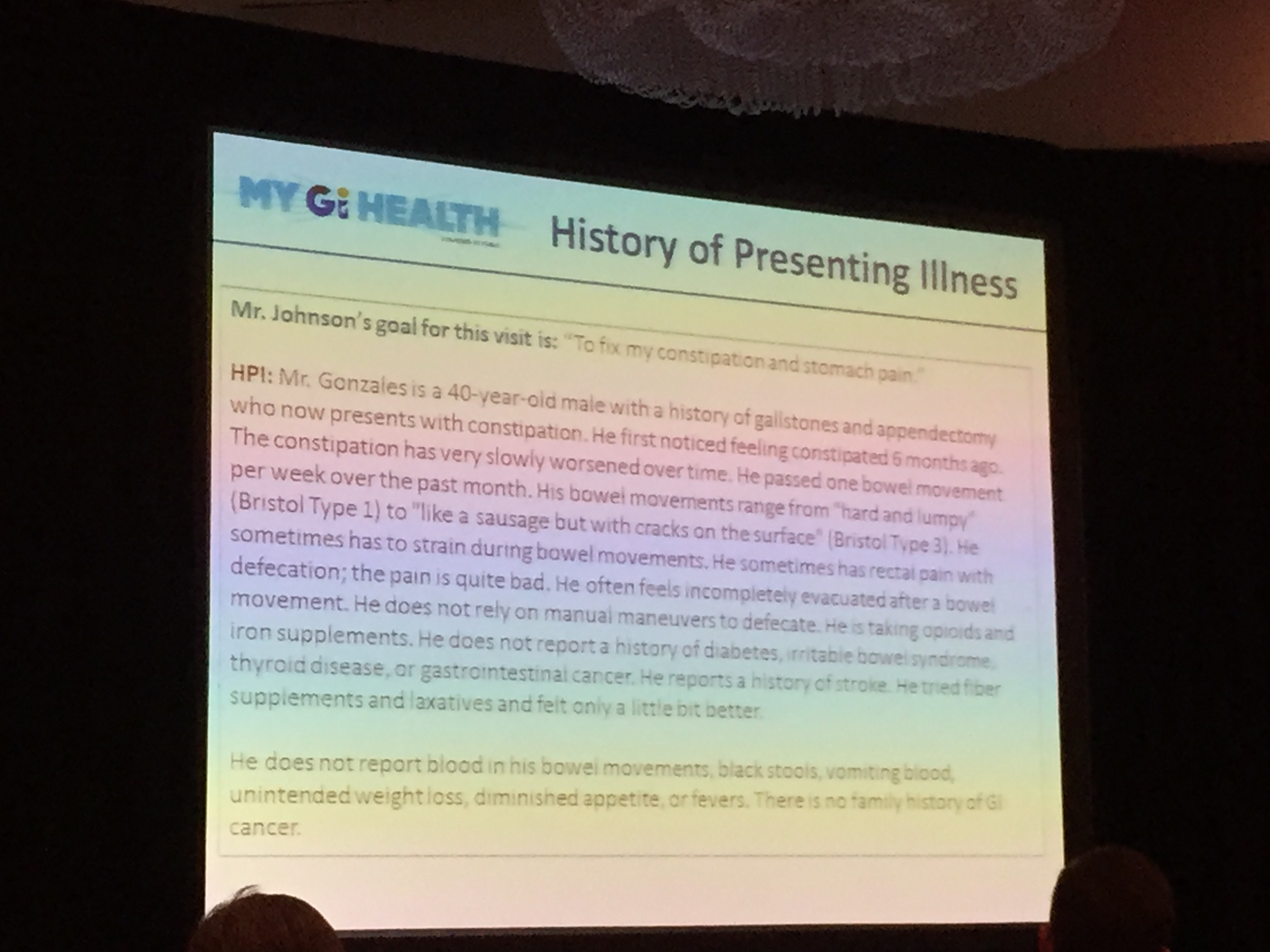
History by computer outperformed physicians
Obtaining information outside the confines of the office can help overcome Hawthorne effect. (Related blog post: Checklists -Helpful? Overhyped? Hawthorne Effect …). Passive vs Active monitoring.
Twitter: “What you say on twitter may be seen by everyone all over the word instantly”
- Tool for epidemiologic data.
- Marketing/advertising
- Recruiting for clinical studies
- Measure consumer sentiment
- Educate patients/providers
- Forge patient affinity groups
- Monitor patients for clinical practice
- Help to manage and direct care
Mayo clinic is studying the impact of social media.
Example of patients initiating research. “Spontaneous Coronary Artery Dissection: A Disease-Specific Social Networking Community-Initiated Study” Lead author: Marysia Tweet
Biosensors:
- “91% of people keep their phone within 3 feet of themselves 24 hours a day.”
- Can be used to track intake of food, air quality, movements etc
- Current sensors: Fit bit, amigo (?sp), shine (?sp), Zeo (for sleep) others.
- Fitbit: Calories, distance, active time, sleep time
- More advanced sensors for athletes. Stride dynamics can predict marathon winner at mile 16!
- Wireless sleep (eg. Zeo) monitor equivalent to formal sleep study
- Q Sensor –can measure stress: physical ,cognitive, emotional (watching horror movie)
- Hapi fork –can tell if you are eating too fast (correlated with BMI)
- Proteus –monitors intake
- Propeller –monitors MDI use for asthma (FDA approved)
- AbStats Digestion Sensor –adheres to abdomen and can provide neurogastroenterology data. Green light –will tolerate feeds, Yellow light –will tolerate clears
75,000 health apps available at this time.
Recommended Reading by Dr. Spiegel: The Creative Destruction of Medicine by Eric Topol. The Creative Destruction of Medicine: How the Digital …
Genetics of Autoimmune Hepatitis
Briefly noted:
Recently, the first genome-wide association identified mutations associated with type 1 autoimmune hepatitis (AIH1) (Gastroenterol 2014; 147: 443-52).
Cohort: 649 Dutch adults with AIH1 and 13,436 controls
Findings: prominent association with rs2187668 (associated with variants in the major histocompatibility complex region) and with variants of SH2B3 (rs3184504) and CARD10 (rs6000782)
Interpretation (from authors): “These findings support a complex genetic basis for AIH pathogenesis and indicate that part of the genetic susceptibility overlaps with that for other immune-mediated liver diseases.”
Related blog posts:
Podcast on Vedolizumab Efficacy for Crohn’s Disease
According to AGA Journals blog, one may need to wait up to 10 weeks to determine whether vedolizumab is effective for Crohn’s disease. Here’s the link: Vedolizumab for Crohn’s.
Here’s an excerpt: (re: Bruce Sands’ article in the September issue of Gastroenterology)
Sands et al. report that vedolizumab, an antibody against the integrin α4β7, is no more effective than placebo in inducing clinical remission at week 6 in patients with Crohn’s disease in whom previous treatment with tumor necrosis factor antagonists had failed.
However, at week 10, a higher proportion of patients given vedolizumab were in remission (26.6%) than of those given placebo (12.1%)… Adverse events were similar between groups.
Related blog post:
Ondansetron for Irritable Bowel with Diarrhea?
Briefly noted: A selected summary (Gastroenterol 2014; 147: 527-28) reviews the potential utility of ondansetron (median dose in adult participants was 4 mg) for irritable bowel syndrome with diarrhea (IBS-D) based on a recent study (Link to full online journal article: Randomized Trial of Ondansetron for IBS-D in Gut).
Several limitations are discussed including patient dropout, crossover study design, and short term study (in chronic disease). As such, even though this study provides some evidence that ondansetron may be helpful for IBS-D, this probably needs “to be replicated in large-scale, parallel group, randomized, placebo-controlled trials…with longer duration of therapy..before the true place of ondansetron in the management of IBS-D is known.”
Related blog posts:

