My take: While the prices are very good, I know some have had trouble working with the online pharmacy to get their prescriptions filled in a timely manner.
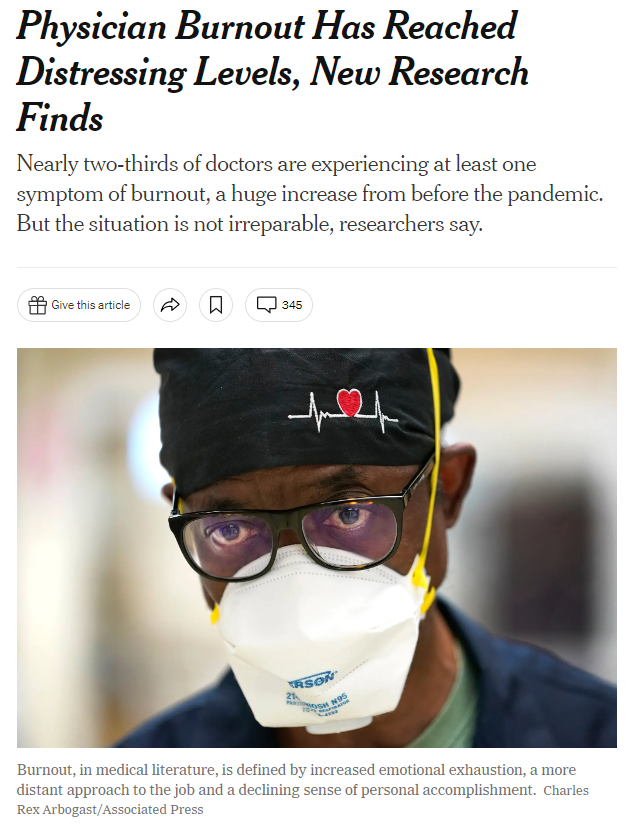
S Sen. NEJM 2022; 387: 1629-1630. Is It Burnout or Depression? Expanding Efforts to Improve Physician Well-Being
Key points:
“This growing attention has helped to reduce the stigma associated with burnout, highlighting the health care system, rather than the individual, as the primary driver of the problem.”
What is burnout? “One review identified 142 different definitions of physician burnout in 182 studies.3 …the most commonly used is the Maslach Burnout Inventory, which assesses continuous scores for three domains: emotional exhaustion, depersonalization, and reduced sense of personal accomplishment.”
There is a lot of overlap with depression especially with emotional exhaustion. However, depression is still stigmatized as due to individual weakness. “Work-related stress is the primary driver of depression among physicians. A stark illustration of this dynamic is the fact that the prevalence of depression among training physicians before they enter residency is similar to that among young adults in the general population, but depression rates quintuple immediately after residency begins.”
“Whether burnout is meaningfully distinguishable from depression, the argument that depression and burnout are caused by fundamentally different precipitants is unsupported by the evidence to date”
My take (borrowed from the author): “Crucially, identification and treatment of depression can help reduce the risk of suicide among physicians. Unfortunately, when we encourage clinicians to consider themselves burned out rather than depressed, they tend not to seek or receive the individual-level interventions that can improve well-being.”
“The majority opinion in Bruen, written by Justice Clarence Thomas, will have a devastating impact on efforts to mitigate gun violence and address racial disparities, but the reasoning used in the decision could cause even more havoc moving forward.”
“Allowing more guns in public does nothing to address the real drivers of criminal behavior, which include social determinants such as poverty, neighborhood violence, poor education, and substandard housing.2 Instead, an increased presence of firearms in public is likely to escalate confrontations, with data suggesting either that people who act aggressively are more likely to arm themselves or that people who are armed are more likely to act aggressively — or perhaps both.1“
“No right is absolute, and the government is able — if not obligated — to prevent harm to the broader public even in the exercise of constitutional rights. Such authority holds for the speech and religious practices covered by the First Amendment, and the Second Amendment should be no different. But the Court’s new theory of the Second Amendment compels lower courts to ignore public health research, empirical evidence, the current gun-violence epidemic, and other rights and liberties of the broader public.”
“Pregnancy is associated with both the initiation of IPV [intimate partner violence] and an increase in IPV severity, making it a particularly dangerous time.3 Homicide is the leading cause of pregnancy-associated death in the United States; pregnant and postpartum women are more than twice as likely to die from homicide as from either hemorrhage or hypertensive disorders.3 …Studies show that abortion access plays an important role in reducing IPV.4 “
“In his dissent in Bruen, Justice Stephen Breyer noted that U.S. women are five times as likely to be killed by an intimate partner if the partner has access to a gun…In expanding the right to carry firearms, the Bruen decision exacerbates safety concerns for people actively trying to escape abusive relationships.”
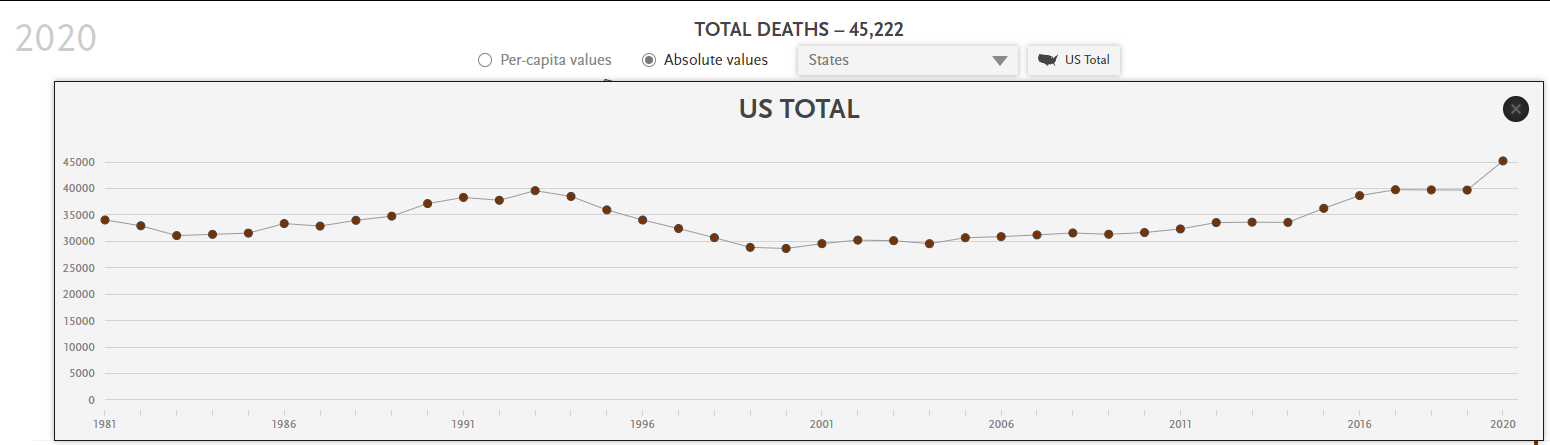
2022: 240 Mass Shootings in U.S as of 6/3022 Gun Deaths have been increasing with more than 45,00 in 2020. Per capita deaths in 2020 -Wyoming and Mississippi have mortality rates
No Exaggeration: Too Many Children Are Dying in the U.S. “The sad fact is that a child or adolescent in the United States is 57% more likely to die by the age of 19 years than those in other wealthy nations.” This is due mainly to more deaths from MVAs and from gun violence.
This article makes a compelling case that most U.S. consumers do not know the true risks of alcohol intake; this is likely in part due to the >$1 billion spent each year on marketing by the alcohol industry.
Leading causes of alcohol-related harms:
Fatal and nonfatal injuries resulting from acute intoxication (including injuries caused by motor vehicle crashes)
Chronic diseases including hypertensive heart disease, cirrhosis, pancreatitis and several types of cancer.2 Even light or moderate drinking increases the risk of these conditions, particularly cancer (eg. breast, colon, and stomach)2
Risks during pregnancy include miscarriage, preterm birth, and fetal alcohol syndrome (these risks are not specifically addressed in this commentary)
Also not noted in this article, alcohol is considered a major contributor to violence, including intimate partner violence
Key points –Scope of Problem and Informing Consumers:
“In April 2022, the Centers for Disease Control and Prevention (CDC) released new mortality statistics showing that alcohol consumption now accounts for more than 140,000 deaths per year in the United States, or more than 380 deaths per day. The Covid-19 pandemic has exacerbated alcohol-associated harm in the United States, with alcohol-related deaths increasing by 25% during the first year of the pandemic as compared with the previous year”(White AM, Castle IP, Powell PA, Hingson RW, Koob GF. Alcohol-related deaths during the Covid-19 pandemic. JAMA 2022;327:1704-1706).
“A national survey of U.S. adults, for example, found that nearly 70% are unaware that alcohol consumption increases the risk of cancer.3…Some alcohol companies even seek to link their products to health campaigns. Several companies, for example, have sold seasonal, pink ribbon–themed alcoholic drinks during October to promote their efforts to raise funds for breast-cancer research — despite compelling evidence that alcohol increases the risk of developing breast cancer.”
The authors advocate for better warning labels. They argue that “updated alcohol warnings would provide new risk information to many Americans, … implementing such warnings would be a sensible policy for addressing industry dominance over alcohol-related information, even if warnings’ effects on consumption are fairly small.”
Eric Topol: Paxlovid and Long Covid This in-depth article reviews the benefits of paxlovid (early) and later, including the reduction of Long Covid in 26% in a recent study. It also provides a table for potential drug interactions (Thanks to Jeff Lewis for sharing).
“A provision in the 21st Century Cures Act, a federal law ….requires all medical testing centers to release results to patients “without delay.” In practice, this means that doctors and patients often receive results simultaneously — and some patients are seeing them before their doctors have a chance to look…
Its intention was to bring health care into the modern era. And the provision has successfully given patients easy access to their medical records, empowering them to play a more active role in their care by eliminating the doctor as gatekeeper.
But it has also led to experiences … in which patients are confronted with material they never wanted to see. Some have learned about life-altering diagnoses and developments — from cancer to chronic illness to miscarriage — through emails and online portals, left to process the information alone…
When difficult, life-changing information is delivered in this way, “it cuts off any opportunity for doctors to get ahead of things,” said Dr. Emily Porter, an emergency room and sexual health physician in Austin, Texas, who has criticized the policy on social media.”
My take: I would prefer that physicians have a short period (~24 hrs) to see test results so that we can inform families and provide context. Currently, at times, I get panicked messages through MyChart from families regarding results, even in cases in which the results are fine.
AGA released new evidence-based guidelines strongly recommending patients with obesity use recently approved medications paired with lifestyle changes.
The following medications, paired with healthy eating and regular physical activity, are first-line medical options and result in moderate weight loss as noted as a percentage of body weight (reported as the difference compared to percent weight loss observed in the placebo group).
Semaglutide (Wegovy®), weight loss percentage: 10.8%
Phentermine-topiramate ER (Qsymia®), weight loss percentage: 8.5%
Liraglutide (Saxenda®), weight loss percentage: 4.8%
Naltrexone-Bupropion ER (Contrave®), weight loss percentage: 3.0%
This is a very useful review article detailing efforts of insurance companies and pharmacy benefit managers to create hurdles to try to limit the utilization of expensive new medications and how physicians can respond on behalf of their patients.
Key points:
Pharmacy Benefit Managers: “Typically, third-party payers utilize a pharmacy benefit manager (PBM, middleman) to determine whether a drug will be included in their formulary. In the United States, PBMs include Express Scripts, CVS Caremark, or Optum…[these three] control 89% of the market…these companies restrict access to costly medications and generate a profit for themselves.”
Lack of FDA Pediatric Indication: “In pediatrics, the average lag time from approval in adults is 9 years…At this time, none of the newer [IBD] agents such as certolizumab, golimumab, vedolizumab, tofacitinib, ustekinumab, and ozanimod are FDA approved for children.”
Dose Optimization: “TDM [therapeutic drug monitoring] and dose optimization often requires higher doses than those approved by the FDA…result in higher costs for the payer.”
Step Therapy: “A number of insurance companies follow a “step therapy” algorithm, otherwise known as “fail first formularies…cheaper medication is required before use of a more expensive medication.” Two problems with this approach: these policies in essence force clinicians to “prescribe medications they do not feel are appropriate” and “the majority of these policies are inconsistent with IBD treatment guidelines.”
Biosimilar/Non-medical switches: “We generally try to educate patients about the clinical data, and endorse switching to biosimilars without appealing the denial.”
Site of care: “The authors oppose insurance mandated home infusions and suggest appeal of “site of care” switches” due to safety concerns (increase ED visits, infusion reactions), lack of communication with home infusion providers (who often lack pediatric expertise), potential for critical labs not being drawn, and reports of increased loss of response with home infusions.
Peer-to-peer: “The “peer” may not have the appropriate background…Therefore, …it is very important to inform the peer that the discussion will be documented in the medical record. The clinician should ask for the reviewer’s credentials, specialty, and employer (insurance company, pharmacy benefit manager, or third-party review company).”
Next Steps: beyond appeal letters (templates at NASPGHAN & CCFA) and peer-to-peer discussions, next steps include an internal appeal (patient files a formal grievance with insurance provider) or external appeal (State Insurance Commissioner). In addition, treatment can be started in the hospital if there are delays in approvals. Though, this could result in the hospital ‘eating’ the cost, the hospital has extensive resources to advocate for coverage and can utilize charitable funds if needed.
My personal experience with appeals:
For appeal letters, besides including important clinical details, I always try to engage a reviewer’s humanity by explaining how important this approval is for the health of this young boy/girl who faces a lifelong serious illness.
Most peer-to-peer calls go well but tend to be inconvenient. Lately, I have had several “peer-to-peer” calls with pharmacists who are not authorized to approve the treatment and insist that I schedule a 2nd call with another “peer.”
Filing a complaint with the State Insurance Commissioner can be very helpful in getting a quick response. In Georgia: Consumer Complaints. It is important to keep the family informed about the status of authorization. A few families have been more successful/persistent at navigating this process than those with years of experience.
My take: This is a helpful and timely article. Trying to quickly get medications authorized is needed to avoid delays in patient care that could result in harm.
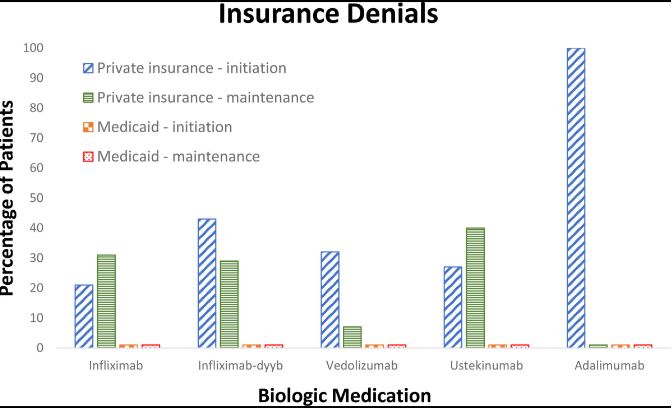
Related article: CA Lepus, JS Hyams. JPGN Reports. 2022; doi: 10.1097/PG9.0000000000000215. Open Access! Barriers From Third-Party Payers to Biologic Use in Pediatric Inflammatory Bowel Disease This study prospectively identified pediatric patients with IBD who were started on a biologic medication at our institution, and third-party payer decisions were recorded:
“The average time between TPI (therapy plan initiation) and biologic initiation (first infusion) was 9.7 days (±3.7 days) for patients with Medicaid, 11.3 days (±5.2 days) for patients with private insurance who had approvals, and 18.8 days (±7.6 days) for patients with private insurance who initially had denials”
“Reasons for denial are generally for use of a specific off-label agent or dosing of an approved agent. These denials lead to delayed treatment, nonmedically sound changes in therapy, and increased administrative burden on providers.”
“Despite the growing body of literature supporting use of [proactive] TDM (therapeutic drug monitoring), third-party private payers customarily deny adjustments unless the patient is symptomatic, a situation that clinicians try to avoid.”
FDA IBD Workshop -Take-Home PointsOff-label does not equate to experimentalFDA Statement: The FD&C Act does not, however, limit the manner in which a physician may use an approved drug. Once a product has been approved for marketing, a physician may prescribe it for uses or in treatment regimens or patient populations that are not included in approved labeling. Such “unapproved” or, more precisely, “unlabeled” uses may be appropriate and rational in certain circumstances, and may, in fact, reflect approaches to drug therapy that have been extensively reported in medical literature
“Good surgeons know how to operate; better surgeons know when to operate. But only the wisest surgeons know when not to operate.”
Key points:
“Qualitative evidence concerning the relationship between QoL and a wide range of disabilities suggests that subjective judgments regarding other people’s QoL are wrong more often than not1,2 and that such judgments by medical practitioners in particular can be biased.3,4 “
“Physicians had treated the severely burned patient Dax Cowart against his express and capacitated refusal of treatment.8 Cowart’s refusal was based in part on his judgment that if he survived, his QoL would be such that death was preferable. His physicians, on the other hand, believed it was their ethical duty to preserve his life regardless of his assessment of its quality. Cowart’s case was one of the first to highlight the importance — ethically, not just medically — of letting the patient’s own QoL valuation guide surgical decision making.”
When physicians do not offer a treatment due to concerns about potential QoL concerns, the “patient may never know that surgery was a possibility because the surgeon dismissed it as not indicated and never offered it.”
“In a recent survey of practicing physicians in the United States, 82.4% of 714 physicians indicated their belief that people with significant disability (as defined by the study) have worse QoL than people without disabilities.3 Yet this judgment directly conflicts with a large body of social science research spanning decades suggesting that people with significant disability, like those with less severe disability, experience QoL that is similar to that of people without disabilities.1,14-17 “
“We are not advocating that surgical interventions should be offered indiscriminately. Rather, we believe that a patient’s candidacy for a proposed treatment should be based on an objective assessment of the likely outcome of the treatment and the value that the patient, rather than the physician, places on that outcome, rather than on a flawed intuitive assessment.”
My take: The authors make a compelling argument that treatment recommendations need to be based on more than a physician’s subjective assessment of a patient’s quality of life.
According to Dr. David Stukus, director of the Food Allergy Treatment Center at Nationwide Children’s Hospital in Columbus, Ohio, the term food sensitivity is used more in marketing than in medicine. “There really is no consensus definition of what a food sensitivity is,”…A food intolerance or sensitivity is different from a food allergy, Dr. Stukus said, which is an immune reaction to certain foods that can cause more severe symptoms like vomiting, hives, shortness of breath or even life-threatening anaphylaxis, usually within minutes of eating even a small amount. There are also more chronic immune reactions to foods, like those from celiac disease, a serious autoimmune condition triggered by gluten.
Aside from the breath tests that gastroenterologists sometimes use to diagnose certain intolerances, like those to lactose or fructose, there aren’t validated tests for food intolerances or sensitivities… The only way to figure out if you are sensitive to certain foods or ingredients is to see how your symptoms change after eliminating them from your diet, ideally with the help of a registered dietitian or physician
Medical organizations, including those in the United States, Europe and Canada, have recommended against using food sensitivity or intolerance tests because there is no good evidence that they work.













 gutsandgrowth