CDC: Increase in Acute Hep B in Appalachia

MMWR 2016; 65: 47-50. Increases in Acute Hepatitis B Virus Infections — Kentucky, Tennessee, and West Virginia, 2006–2013

An excerpt:

  • During 2006–2013, a total of 3,305 cases of acute HBV infection were reported to CDC from Kentucky, Tennessee, and West Virginia. During 2009–2013, incidence of acute HBV infection increased 114% in these three states, but remained stable in the United States overall
  • Among cases in which at least one risk factor was reported, the proportion of persons reporting injection drug use as a risk factor was significantly greater in 2010–2013, compared with 2006–2009 (75% versus 53%; p<0.001)…the increase was statistically significant only among cases occurring in non-urban counties
  • The findings in this report are subject to …limitations. First, NNDSS is a passive surveillance system, and therefore, unreported cases might have been missed. Second, the current case definition for acute HBV infection captures only symptomatic persons and excludes persons with asymptomatic HBV … Third, … certain populations at high risk (e.g., persons who are incarcerated, homeless, and uninsured) with limited access to care could potentially be underrepresented

My take: Increased drug use appears to be driving an increase in acute HBV in Appalachia. “Evidence-based prevention strategies, including increasing hepatitis B vaccination coverage, testing and linkage to care activities, and education campaigns targeting persons who inject drugs are urgently needed.”

Gibbs Gardens, Ball Ground

Gibbs Gardens, Ball Ground

Hepatitis A Vaccine Should Work for 30 Years

A recent study (PR Spradling et al. Hepatology 2016; 63: 703-11) provided data indicating that the Hepatitis A virus (HAV) vaccine would likely work for 30 years after childhood vaccination.  Much has changed since the implementation of the HAV vaccine.  Since 2000, the number of HAV case in the U.S. has dropped almost 90%, from 13,397 to 1781 in 2013 with the lowest incidence in those ≤18 years.

This study (n=183) examined three groups of Alaska Native children who received a two-dose inactivated HAV vaccine.

  • Vaccine starting at age 6 months (group 1)
  • Vaccine starting at age 12 months (group 2)
  • Vaccine starting at age 15 months (group 3)

Key findings:

  • All participants in groups 2 and 3 through age 10 years were seropositive (anti-HAV ≥ 20 mIU/mL), whereas in group 1 it was >90%.
  • At 15-16 years following vaccination, the seropositivity was 50-75% in group 1 and 67-87% in groups 2 and 3.
  • Using modeling, the overall 30-year anti-HAV seropositivity was predicted to be present in 64% of all participants and 84% of those that were seropositive at 15-16 years.

HAV continues to represent an ongoing threat, despite a reduction in the number of cases.  This is particularly due to unvaccinated travelers and unvaccinated adutls.  In vaccinated adults, a study (Vaccine 2015; 33: 5723-27) inidcates that seropositivity would be present in at least 95% after 30 years and 90% after 40 years.

My take: these data provide reassurance that HAV vaccine’s protection will be durable among those who were vaccinated between 6-21 months of life.

Related blog posts:

Culebra, Puerto Rico

Culebra, Puerto Rico

Which patients with asymptomatic gallstones need a cholecystectomy?

Update: re: Yesterday’s post on tax inversion.  NPR report: Pfizer calls off Allergan Merger due to anti-inversion rules instituted by Treasury Dept

—-

“Generally, the clinical course for the majority of gallstones is asymptomatic…Overall, little knowledge exists about the development into symptomatic disease.”  This introduction from a recent study (DM Shabanzadeh et al. Gastroenterol 2016; 150: 156-67-thanks to Ben Gold for sharing his interest in this study) provides the rationale for their study which analyzed 3 randomly selected groups in Denmark (ages 30-70 years) and followed them for a median of 17.4 years.

Out of an initial 6037 participants, 664 had gallstones at baseline (after excluding 189 who had cholecystectomy and 5180 without gallstones). Only 10% were aware that they had gallstones.

Key findings: 

19.6% developed symptomatic disease (8% complicated, 11.6% uncomplicated)

Risks for symptomatic disease: Female sex, Younger age, Stone size >10 mm, Multiple stones

  • Male with small stone: 2/67 (HR 1.0)
  • Male with multiple stones: 4/97 (HR 1.83)
  • Male with large stone: 2/47 (HR 2.79)
  • Male with multiple and large stones: 3/29 (HR 5.12)
  • Female with small stone: 4/102 (HR 2.16)
  • Female with multiples stones (no large stones) 11/120 (HR 3.96)
  • Female with large stone: 12/67 (HR 6.02)
  • Highest risk: female with multiple stones and with largest stone >10 mm: 10/53(HR 11.05)

Interestingly, the 10% who knew that they had gallstones before randomly being selected  into the study had significantly higher rates of all outcomes, especially uncomplicated events.  “This finding may reflect a protopathic bias.” Patients who were aware were more likely to have suffered bilary colic attacks before study entry and thus had a higher risk of events.

My take: First of all, completion of this study over more than 17 years is an astonishing feat, particularly without informing the participants of their gallstone status.  In patients who are truly asymptomatic, my interpretation would be that only those at substantial risk would benefit from cholecystectomy.  This study does not account for other factors that could favor cholecystectomy (in asymptomatic patients) such as hemolytic diseases (e.g. sickle cell), cystic fibrosis, and other conditions in which symptomatic gallbladder disease is more likely to develop.

Related blog posts:

Hunter Museum, Chattanooga

Hunter Museum, Chattanooga

Hepatitis B Vaccine Protects for Up to 30 Years

From summary at GI & Hepatology News: Hepatitis B vaccine protection lasts 30 years

An excerpt:

  • Ninety percent of patients in a 1981 hepatitis B vaccine trial still had evidence of immune protection 30 years later, according to a study in the Journal of Infectious Diseases…
  • 243 members of the original cohort who responded to the original primary vaccine series but received no subsequent doses during the 30-year period…
  • Of the patients tested, 125 (51%) had anti-HBs levels greater than or equal to 10 mIU/mL. Among participants with anti-HBs levels below 10 mIU/mL who were available for follow-up, 75 of 85 (88%) responded to a booster dose with an anti-HBs level greater than or equal to 10 mIU/mL at 30 days.
  • Read the full study in the Journal of Infectious Diseases (J Infect Dis. 2016 Jan 21. doi: 10.1093/infdis/jiv748).

Related blog posts:

Bell Tower, Univ Mich

Bell Tower, Univ Mich


Bad News Bili

A study (BL Schneider et al. J Pediatr 2016; 170: 211-7) from ChiLDReN (Childhood Liver Disease Research Network) shows that infants with biliary atresia whose total bilirubin (TB) does not drop below 2 mg/dL (34.2 microM) at anytime during the first 3 months after hepatoportoenterostomy (HPE) (Kasai) are at high risk for disease progression.

Key findings:

  • 68/137 (50%) had TB <2.0 at some point following HPE.
  • In the cohort with TB ≥ 2.0, the odds ratio for liver transplantation or death was 16.8.  Higher TB was associated with diminished weight gain, coagulopathy, and hypoalbuminemia
  • In the cohort with TB ≥ 2.0, transplant-free survival at 2 year occurred in only 20% compared with 86% in the TB <2.0 group
  • Interestingly, only 6.6% had variceal bleeding among the entire cohort by age 2 years.

The TB was associated with multiple other parameters of worsening liver function, indicating that TB is not the only measure to affect the decision of liver transplantation.

My take: About half of all patients following a Kasai were at high risk for early progressive liver disease.  TB ≥ 2.0 is a useful indicator of high risk.

Related blog posts:

Walnut Street Bridge, Chattanooga

Walnut Street Bridge, Chattanooga

Sertraline and Liver Disease

A recent case report (MA Conrad, HC Lin. J Pediatr 2016; 169: 313-5) on sertraline-associated cholestasis provided a good reason to take a quick review on the NIH Liver Toxicity website:

Hepatotoxicity with sertraline (zoloft)

Liver test abnormalities have been reported to occur in up to 1% of patients on sertraline, but elevations are usually modest and infrequently require dose modification or discontinuation.  Rare instances of acute, clinically apparent episodes of liver injury with marked liver enzyme elevations with or without jaundice have been reported in patients on sertraline.  The onset of injury is usually within 2 to 24 weeks and the pattern of serum enzyme elevations has varied from hepatocellular to mixed and cholestatic.  Autoimmune (autoantibodies) and immunoallergic features (rash, fever, eosinophilia) are uncommon.  Actue liver failure due to sertraline has been described but is very rare.

The case report describes a 15 yo who developed jaundice (peak bilirubin 33.7 mg/dL with a direct fraction of 29.2 mg/dL) after 6 months of treatment with 75 mg per day.  After negative blood tests, he had a liver biopsy which was notable for rare bile ducts.  A jaundice chip was negative for underlying disorders like Alagille syndrome.  Urine bile acids were negative as well.  His laboratories normalized completely four months after cessation of sertraline.

It is interesting to note that sertraline has been used therapeutically for patients with pruritus due to cholestasis (Understanding Cholestatic Pruritus | gutsandgrowth)

My take: This case report describes bile duct paucity (vanishing bile ducts) as a result of sertraline therapy.  For practitioners, the bottom line is that SSRIs rarely cause liver toxicity; however, for patients with persistently-abnormal liver chemistries on SSRI therapy, discontinuation and identification of a safe alternative medication may be warranted.

Castillo San Felipe del Morro

Castillo San Felipe del Morro

Hepatitis B & C -Winter 2016

The large randomized pediatric entecavir study for Hepatitis B virus (HBV) is now in print: MM Jonas et al. Hepatology 2016; 63: 377-87.  Full link to this study on previous blog: Pediatric Entecavir Data  This study has led to FDA approval for use of entecavir in children as young as 2 years.  One interesting aspect of the study was the 2.6% drug resistance rate in the second year of the study.  This further validates current recommendations to treat children with “immune active” phases (e.g. abnormal transaminases and abnormal histology).

Briefly noted:

H Roberts et al. Hepatology 2016; 63: 388-97.  This study provides prevalence data for chronic HBV, 1988-2012.  During 2011-12, there were approximately 850,000 Americans with chronic HBV infections.  Migration of persons from HBV endemic countries has “largely contributed to prevalence rates remaining constant since 1999.”

JM Wilder et alHepatology 2016; 63: 437-44. This study showed that ledipasvir/sofosbuvir was similarly effective in black and non-black patients, with SVR12 rates of 95% and 97% respectively.  This is important because older interferon-based treatments were much less effective in black patients.

TB Dick et al. Hepatology 2016; 63: 634-43.  This review provides in-depth guidance regarding drug-drug interactions relevant to the new direct-acting antiviral agents used to treat Hepatitis C viral infection.

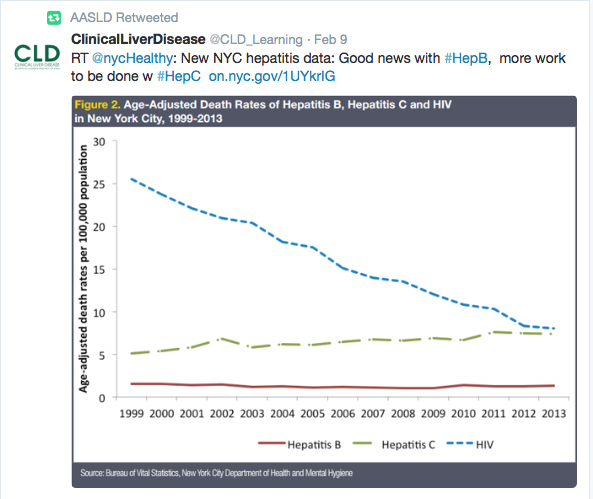
NY City Data for HIV, HBV, HCV

NY City Data for HIV, HBV, HCV

More on Hepatitis B Treatment in Children

A recent post (New Hepatitis B Treatment Guidelines -AASLD) described the updated treatment recommendations.  When these guidelines were published, a separate review devoted specifically to pediatrics was published (Hepatology 2016; 63: 307-18).

Some of the key points:

  • This pediatric review included 14 studies with 1425 children.  The authors note that 7 of these trials had a high risk of bias.  Also, the studies are limited by relying on surrogate markers of long-term outcomes as clinical outcomes like cirrhosis, HCC, and death are rare in childhood.
  • Among oral agents, entecavir and lamivudine are approved for use in children ≥ 2 years, whereas adefovir and tenofovir are approved for use in children ≥ 12 years.  Both lamivudine and adefovir are associated with frequent development of viral resistance
  • For children with elevated ALT (>1.5 times upper limit of normal [ULN]), treatment is recommended:

9A. The AASLD suggests antiviral therapy in HBeAg-positive children (ages 2 to <18 years) with both elevated ALT and measurable HBV DNA levels, with the goal of achieving sustained HBeAg seroconversion.

Why not treat everyone?

  • Children with immune-tolerant HBV infection (normal or near-normal ALT [< 1.5-2 times ULN] along with high HBV DNA [>10 million IU/mL]), “are not typically candidates for treatment because treatment with any of the currently available drugs has not been demonstrated to improve HBeAg seroconversion compared with no treatment.”
  • Children with ALT >10 time ULN may be in the process of spontaneous seroconversion “and should be observed for several months before treatment” is initiated.
  • “Prolonged treatment with nucleoside or nucleotide analogs in children who are in immune-tolerant phase has not been associated with substantial benefit and carries a risk of developing antiviral drug resistance…An exception may be those…undergoing immunosuppressive therapy.”
Mina Falls, El Yunque Rainforest

Mina Falls, El Yunque Rainforest

In brief: Pediatric HCV trial, Exercise for NAFLD, and Urso for Unconjugated Hyperbilirubinemia

Schwarz et al. JPGN 2016; 62: 93-96.  This study showed that all 21 children who had achieved a sustained virological response with PEG-interferon/ribavirin maintained an SVR during followup of 4.4-7.0 years.  Hopefully, new direct-acting highly effective oral agents will be approved in pediatrics and make this study less relevant.

U.S. Food and Drug Administration approved Zepatier (elbasvir and grazoprevir) Jan 28, 2016

Anderson et al. JPGN 2016; 62: 110-17.  Participants (n=2612) from a large longitudinal study with prospectively collected data were followed. “The adolescents who are more active in late childhood have lower risk of ultrasound scan fatty liver and lower ϒ-gluamyl transferase levels.”  In addition, they showed that more activity was correlated with lower fat mass in adolescence.

Saki et al. JPGN 2016; 62: 97-100. In a double-blind randomized clinical trial of 80 neonates with unconjugated hyperbilirubinemia, treatment with added ursodeoxycholic acid (5 mg/kg/dose BID) resulted in improved clearance of bilirubin compared to phototherapy alone. At 12, 24 and 48 hours, total bilirubin in the treatment group was 12, 10 and 9.8 respectively compared with 14.4, 12.5, and 10.1 for the control group.  Furthermore, the mean time for phototherapy to decrease bilirubin to <10 was 15.5 hours in the treatment group compared with 44.6 hours in the control group.  This study, if confirmed, could result in shorter hospital stays.

Old Town, San Juan

Old Town, San Juan