Clinical Features of Byler Disease

A recent article (Morris AL, et al. JPGN 2015; 60: 460-6) provides a detailed analysis of six cases of Byler disease during their first two years of life.  These cases were strictly defined and defined by homozygous c.923G>T mutation of ATP8b1.

Presenting features:

  • 2 with newborn direct hyperbilirubinemia
  • 2 with complications of coagulopathy. “Bleeding diathesis is a particular issue in the Amish community where home delivery is common and vitamin K may not be administered perinatally.”
  • 1 with failure to thrive and rickets
  • 1 was a sibling identified with newborn genetic testing

Key features:

  • Intensive fat-soluble vitamin supplementation was needed. “Vitamin K deficiency can be lethal.”
  • Poor growth was frequent (Figure 2): “growth trajectories were generally at the low end of percentiles and did not reflect parental size.” It was “typically responsive to supplementation with medium-chain triglyceride-based formula. and/or use of 30 cal per ounce formulae.”
  • Elevated serum bile acids and low normal GGT (Υ-glutamyltranspeptidase)
  • Diarrhea was commonly reported
  • Intractable pruritus in 4 of 6 children which developed between 6-12 months of age;  in two patients rifampin therapy was effective.
  • Partial external biliary diversion was used in 4 children during 2nd year of life; there was a “generally favorable response to PEBD.”
  • There were not issues noted with portal hypertension

Bottomline: This report shares some practical experience with this rare disorder.

Related blog posts:

Reaching Consensus on Bariatric Intervention in Children and Adolescents

A recent medical position paper (Nobili V, et al. JPGN 2015; 60: 550-61) provides guidance for bariatric surgery intervention in children and adolescents with and without nonalcoholic fatty liver disease (NAFLD).

While the authors acknowledge that bariatric surgery can “dramatically reduce the risk of adulthood obesity and obesity-related diseases,” they advocate its use in adolescents with the following:

  • BMI >40 kg/m-squared with severe comorbidities: type 2 diabetes mellitus, moderate-to-severe sleep apnea, pseudotumor cerebri, or NASH with advanced fibrosis (ISHAK score >1)
  • BMI >50 kg/m-squared with mild comorbidities: hypertension, dyslipidemia, psychological distress, gastroesophageal reflux, anthropathies, NASH, impairment in activities of daily living, mild obstructive sleep apnea, panniculitis, chronic venous insufficiency, urinary incontinence
  • Additional criteria: have attained 95% of adult stature, failed behavioral/medical treatments, psychological evaluation perioperatively, avoid pregnancy for 1 year after surgery, will adhere to nutritional guidelines after surgery, informed assent from teenager (along with parental consent)

Key points:

  • “There is a lack of randomized controlled trials examining the effects of bariatric surgery on NAFLD or NASH.”  In Table 3, the authors provide a summary of 16 previous studies/outcomes; though none of the studies enrolled more than 60 patients.
  • In an adult prospective study with 381 patients (Mathurin P et al. Gastroenterol 2009; 137: 532-40), there was a significant decline in the severity/prevalence of steatosis and resolution of NASH at 1 and 5 years.
  • Bariatric surgery, in adult studies, have improved diabetes, insulin resistance, hypertension, and dyslipidemia.
  • Patients who have “undergone bariatric surgery show higher suicide rates than the general population.”  Psychological evaluation should be integrated with surgical decision.
  • Type of surgery: Roux-en-Y Gastric Bypass (RYGB) is favored by the authors; they also discuss studies with Laparoscopic Adjustable Gastric Banding (LAGB).  “RYGB and LAGB are the 2 main surgical procedures that have been used in pediatric obesity.  RYGB is considered a safe and effective option for adolescents with extreme obesity, as long as appropriate long-term follow-up is provided. LAGB has not been approved by Food and Drug Administration for use in adolescents, and there should be considered investigational only.”

It is interesting that the authors are so deferential to the Food and Drug Administration.  It is clear from their position paper that LAGB has similar evidence supporting its use in adolescents as RYGB.  They even note that it has potential for reversibility and “an excellent safety profile with a lower risk of postoperative vitamin deficiencies when compared with biliopancreatic diversion and RYGB.”

Bottomline: Given the continuation of the obesity epidemic, additional pediatric medical expertise will be needed to help evaluate adolescents for bariatric surgery and to follow them postoperatively.

Related blog posts:

Weight Loss Improves NASH

A recent study (http://dx.doi.org/10.1053/j.gastro.2015.04.005) helps confirm the notion that the most effective therapy for nonalcoholic steatohepatitis is weight loss. (From Rohit Kohli twitter feed).

Abstract:

Background & Aims

It is not clear how weight loss affects histologic features of liver in patients with nonalcoholic steatohepatitis (NASH). We examined the association between the magnitude of weight loss through lifestyle modifications and changes in histologic features of NASH.

Methods

We conducted a prospective study of 293 patients with histologically proven NASH who were encouraged to adopt recommended lifestyle changes to reduce their weight over 52 weeks, from June 2009 through May 2013, at a tertiary medical center in Havana, Cuba. Liver biopsies were collected when the study began and at week 52 of the diet, and analyzed histologically.

Results

Paired liver biopsies were available from 261 patients. Among 293 patients who underwent lifestyle changes for 52 weeks, 72 (25%) achieved resolution of steatohepatitis, 38 (47%) had reductions in NAFLD activity scores (NAS), and 56 (19%) had regression of fibrosis. At week 52, 88 subjects (30%) had lost 5% or more of their weight. Degree of weight loss was independently associated with improvements in all NASH-related histological parameters (odds ratios, 1.1–2.0;P<.01). A higher proportion of subjects with 5% weight loss or more had NASH resolution (51/88, 58%) and a 2-pt reduction in NAS (72/88, 82%) than subjects that lost less than 5% of their weight (P<.001). All patients who lost 10% of their weight or more had reductions NAS, 90% had resolution of NASH, and 45% had regression of fibrosis. All patients who lost 7%−10% of their weight and had few risk factors also had reduced NAS. In patients with baseline characteristics that included female sex, body mass index ≥35, fasting glucose >5.5 mmol/L, and many ballooned cells, NAS scores decreased significantly with weight reductions of 10% or more.

Conclusions

A greater extent of weight loss, induced by lifestyle changes, is associated with the level of improvement in histologic features of NASH. The highest rates of NAS reduction, NASH resolution, and fibrosis regression occurred in patients with weight losses of 10% or more.

Stool Color Cards -Not Flashy but Effective

A recent report (Gu YH et al J Pediatr 2015; 166: 897-902) shows the cumulative experience of 19 years of using stool color cards to detect biliary atresia.  Cards were distributed to all pregnant women (Tochigi Prefecture, Japan) prior to or during the postnatal one-month health check.

Key findings:

  • 34 patients detected among 313,230 live births. Reported sensitivity: 76.5% and specificity 99.9%.
  • Mean age for performance of Kasai was 59.7 days.
  • Improved long-term retention of native liver: 88% at 5 years, 77% at 10 years, and 49% at 15 years.

Limitation: Children in Western countries have had lower success rates following Kasai procedure, so it is unclear whether stool cards would be as effective in different regions.

Take-home message: Detecting biliary atresia earlier will improve outcomes.  Stool color cards should be an easy low-tech option.  Other options would include stool color apps and checking bloodwork.

Image below from Screenshot from John Pohl’s twitter feed:

Embedded image permalink

Related blog posts:


Fatty Liver at Birth

A provocative study (Patel KR, White FV, Deutsh GH. JPGN 2015; 60: 152-58) shows that hepatic steatosis/fatty liver is prevalent at birth in at-risk stillborns.

The authors retrospectively examined autospy results from 33 stillborns (20-40 weeks) delivered to women with diabetes (pregestational or gestational) along with 48 age-matched controls.  The majority of women (54%) were African American women; 27% were white and 9% were hispanic.

Key findings:

  • Hepatic steatosis was common and severe in the stillborns of diabetic women.  Prevalence: 78.8% (26/33) compared with 16.6% (8/48) of controls.
  • No direct correlation was identified between steatosis and glycemic control.

Whether nonalcoholic fatty liver disease (NAFLD) begins at birth is not known and what happens to the fat in newborns with hepatic steatosis is not clear.  This study indicates that maternal diabetes may increase the risk of NAFLD.

Related blog posts:

Bile Acid Therapy for BAAT

In a previous post (From theory to bedside practice | gutsandgrowth), I reviewed an article which described the diagnosis of a rare inborn error of bile acid metabolism –bile acid CoA:amino acid N-acyl transferase (BAAT).  A new report (Hepatology 2015; 61: 268-74) describes treatment and outcome in five patients with BAAT (I am thankful for acronyms!).

Treatment with 15 mg/kg of glycocholic acid (GCA) improved duodenal bile acid concentrations (to 23.3 ± 19.1 mmol/L).  Patients also received oral vitamin D2 (1000 IU/kg) and tocopherol (100 IU/kg).  With the combination of GCA and fat soluble vitamin provision, there was improvement in growth (3/3 prepubertal patients) and in fat-soluble vitamin absorption.

Bottomline: In patients with neonatal cholestasis growth failure, or fat-soluble vitamin deficiencies, identification of BAAT with fast atom bombardment mass spectrometry allows for institution of GCA which is efficacious and safe.

Also noted: FDA approves Cholbam to treat rare bile acid synthesis disorders FDA announcement 3/17/15, an excerpt: the first FDA approved treatment for pediatric and adult patients with bile acid synthesis disorders due to single enzyme defects, and for patients with peroxisomal disorders (including Zellweger spectrum disorders). Patients with these rare, genetic, metabolic conditions exhibit manifestations of liver disease, steatorrhea (presence of fat in the stool) and complications from decreased fat-soluble vitamin absorption. Individuals with these rare disorders lack the enzymes needed to synthesize cholic acid, a primary bile acid normally produced in the liver from cholesterol. The absence of cholic acid in these patients leads to reduced bile flow, accumulation of potentially toxic bile acid intermediates in the liver (cholestasis), and malabsorption of fats and fat-soluble vitamins in the diet. If untreated, patients fail to grow and can develop life-threatening liver injury. Cholbam is approved as an oral treatment for children aged three weeks and older, and adults.

Two Shorts -Minimal Hepatic Encephalopathy and Fish Oil Protection

Briefly noted: JPGN 2014; 59: 689-94.  In this study, the authors took a consecutive sample of 13  children (ages 4-18 years) with non cirrhotic extrahepatic portal vein portal vein obstruction (EHPVO).  Three tests (fasting ammonia, quantified EEG, a psychometric battery) identified that minimal hepatic encephalopathy (MHE) affects approximately 50% of children with EHPVO.

Also: JPGN 2014; 59: 708-13.  In this study in 7-day old rabbits, those who receive TPN with fish oil-based lipid emulsion had protection against biochemical and liver histologic damage in comparison to rabbits who received TPN with soybean oil. Given the lack of head-to-head randomized studies in infants, this study provides some important evidence of fish oil benefit compared with standardized soybean lipid emulsion.

Related blog posts:

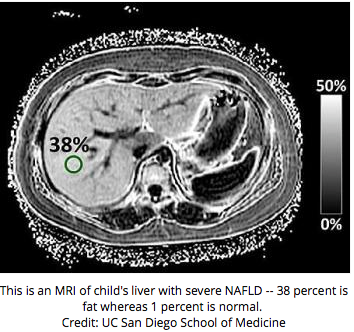
Improving MRI for NAFLD

From MedicalNewsToday – a summary of a recent Hepatology study by Jeffrey B. Schwimmer, MD and colleagues.

Excerpts from http://www.medicalnewstoday.com/releases/289088.php along with image.

In this study, the researchers compared a new MRI technique to the standard liver biopsy method of assessing fat in the liver. To do this, the team enrolled 174 children who were having liver biopsies for clinical care. For each patient, the team performed both MRI-estimated PDFF and compared the results to the standard pathology method of measuring fat on a liver biopsy.

Screenshot from MedicalNews

Screenshot from MedicalNewsToday

The team found a strong correlation between the amount of liver fat as measured by the new MRI technique and the grade of liver fat determined by pathology. This is an important step towards being able to use this technology for patients. Notably, the correlation was influenced by both the patient’s gender and the amount of scar tissue in the liver. The correlation between the two techniques was strongest in females and in children with minimal scar tissue.

Depending on how the new MRI technology is used, it could correctly classify between 65 and 90 percent of children as having or not having fatty liver tissue.”

“… However, further refinements will be needed before this or any other MRI technique can be used to diagnose NAFLD in an individual child.

Liver Update -January 2015

Briefly noted:

1. Gastroenterology 2014; 147: 1327-37 (editorial 1216-18).  “Probiotic VSL#3 reduces liver disease severity and hospitalization in patients with cirrhosis: a randomized, controlled trial.” 66 patients received VSL#3 (9 x 10 to the 11th bacteria), 64 patients received placebo -both groups studied for 6 months. Treatment with lactulose and rifaximin were withdrawn a week prior to study entry. Key findings: ‘fewer hospitalizations for severe encephalopathy, better quality of life, and decreases in Child-Turcotte-Pugh class and Model for End-Stage Liver Disease.’  Hazard ratio for preventing hospitalization with VSL#3 was 0.52. However, the findings did not show that VSL#3 reached a statistically-significant reduction in recurrence rate for hepatic encephalopathy. No adverse events were noted.

2. NY Times: Gilead sued over cost of Sovaldi.

3. N Engl J Med 2014; 371:2375-2382.  Link to abstract: Interferon-free Antiviral Regimen for HCV after Liver Transplantation:  “Treatment with the multitargeted regimen of ombitasvir–ABT-450/r and dasabuvir with ribavirin was associated with a low rate of serious adverse events and a high rate of sustained virologic response among liver-transplant recipients with recurrent HCV genotype 1 infection, a historically difficult-to-treat population.

4. “Transplantation Traffic –Geography as Destiny for Transplant Candidates” NEJM 2014; 271: 2450-52.  Describes ongoing geographic inequality in organ distribution and obstacles to improving allocation.

5. Liver Transpl 2015; 21: 57-62. Immediate Extubation After Pediatric Liver Transplantation –feasible in 67% according to this retrospective review.

Local Law Office  --Truth in Advertising?

Local Law Office –Truth in Advertising?

Sorting Out Discrepancies in Hepatitis B Testing

A recent study (J Pediatrics 2014; 165: 773-8) highlighted the clinical problem of discrepant hepatitis B virus (HBV) testing in pregnant women.

Design: The Centers for Disease Control and Prevention analyzed a nonrandom sample of discordant cases of HBV reported by US Perinatal Hepatitis B Prevention Program.  Discordant cases indicated that there were differences between an initial HBsAg result and a subsequent test.  Among 142 cases, 89 had sufficient information to determine accuracy of the initial test.

Key finding: 14 (15.7%) of these cases were true positives, the remainders were false-positives.

How did authors sort out cases?

Negative testing for “total anti-HBc or no detectable HBV DNA result indicating no HBV infection…A positive total anti-HBc indicates current or past HBV infection, is not elicited by vaccination, and usually persists for life.”

Pointers regarding serology:

  • IgM anti-HBc -acute or recent infection and can persist for more than 6 months.
  • HBV DNA confirms active infection and can detect infection at levels below those of HBsAg assays.  This can occur either due to “occult HBV infection” or due to a mutant HBV strain that results in non-reactive test for HBsAg.
  • There were at least 11 HBsAg assays that have been FDA-approved –most but not all of them will confirm results before reporting.

It is important to sort out patients with discrepant HBV serology.  In infants who are not identified with HBV testing (false-negatives), this results in suboptimal post exposure prophylaxis and increased likelihood of chronic HBV.  Whereas, infants with false-positive results, incur unnecessary prophylaxis and costs.  The authors note that “total anti-HBc was the most useful single test to resolve HBsAg discrepancies.

Also noted: J Pediatr 2014; 165: 767-72.  “Factors Affecting the Natural Decay of Hepatitis B Surface Antigen in Children with Chronic Hepatitis B Virus Infection during Long-Term Followup”  This study followed 349 Taiwanese children over 20 years and noted annual HBsAg clearance of 0.58% (42 cleared HBsAg).  Spontaneous clearance was more common in HBeAg-seroconverters, infants with low initial HBsAg level <1000 IU/mL, and to those born to non-HBsAg-carrier mothers.