Fortune Dec 2021-Jan 2022: Insulin’s Deadly Cost Thanks to Stan Cohen for sharing article.
Some excerpts/key points:
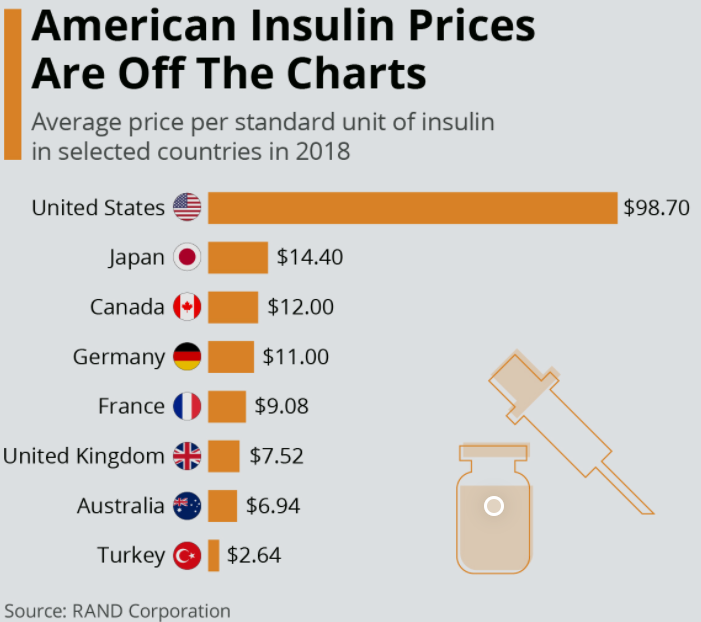
“Insulin in the U.S. costs on average some 800% more than in other developed economies. And yes, people die for lack of it, sometimes within days or even hours of missing their dose. No one knows how many; data suggests that in the U.S. it’s at least a few every day. Far more may suffer other ravages of diabetes—blindness, heart attacks, loss of limbs.” In addition, 40% of Americans who have died from COVID-19 were diabetics.
“Manufacturer’s compete not by cutting prices but by raising them.” This is often due to pharmacy benefit managers (PBMs), the middleman between manufacturer’s and insurers. PBMs negotiate drug prices and establish formularies. PBMs make more money if they able to discount higher rebates on the list cost; hence, to influence PBMs to choose their products, manufacturer’s are incentivized to raise drug costs, even if the average price is unchanged. Higher list prices affect those least able to cover the costs, namely those without insurance as well as many with high deductibles.
List price for Humalog (Eli Lilly) more than doubled from 2013 to 2018, Lantus (Sanofi) more than quadrupled from 2005 to 2016
Some patients have obtained insulin in Canada where costs for a vial could be more than 10-fold less (though this is illegal). There are also more than 12,000 GoFundMe.com listings with “insulin” in the title.
For the insulin market, some recent changes include the emergence of GLP-1 analogs for Type 2 diabetes (~90% of diabetes in U.S.). Trulicity is now Eli Lilly’s bestselling medication. In addition, the FDA recently approved Semglee, an interchangeable biosimilar for Lantus which is reducing costs.
My take: “The story of insulin is a poster child for everything that’s wrong with a free-market approach to drug availability,” says Arthur Caplan…”It’s almost inexcusable morally.”
Day-to-day, I find I am focused (?inundated) on problems that are literally right in front of me. Every once in a while, it is important to look more broadly and try to consider/address the larger issues.
Along those lines, I would recommend a series of important articles on adolescent nutrition published by The Lancet. Thanks to William Balistreri for sharing these references.
This is an introduction to the series of articles. “Given these increasingly transnational dimensions of the ultra-processed food industry, it is timely for WHO, the Food and Agriculture Organization of the UN, and their partners to revisit calls for global regulatory frameworks to assist governments in taking action. Given the speed of nutritional change, there is perhaps no greater immediate threat to the health of adolescents. Equally, tackling adolescent nutrition presents an unparalleled opportunity to interrupt intergenerational cycles of malnutrition and respond to the urgent challenges of planetary change”
The review highlights how nutrition in youth/adolescence influences weight, height, BMI as well as the timing of puberty, neurodevelopment, cardiorespiratory fitness, immune function, body composition and bone mass
Adolescents are “growing up at a time of momentous shift—ie, rapid urbanisation, climate change, food systems shifting towards foods with an increased caloric and decreased nutritional value, the COVID-19 pandemic, and growing socioeconomic inequality. The consequences of these changing contexts have profound impacts on adolescent nutrition and development”
“Adolescents have a lot to say about why they eat what they eat, and the factors that might motivate them to change. Adolescents must be active partners in shaping local and global actions that support healthy eating patterns. Efforts to improve food environments and ultimately adolescent food choice should harness widely shared adolescent values and desire for social interaction around food”
The article reviews in depth information from prior surveys including India’s Comprehensive National Nutrition Survey and the Global School-based Student Health Surveys. However, they note that nationally representative detailed dietary intake data are still scarce
Food choices by adolescents in modern communities is more heavily influenced by convenience and autonomy; in more traditional communities, family and community priorities often supersede individual considerations of adolescents
In the setting of the pandemic, more families (worldwide) are being pushed into food insecurity and shifting towards lower-cost, less nutritious non-perishable foods.
“Even in less food-insecure contexts, social isolation is resulting in negative trends among some adolescents, such as reported weight gain, poor eating habits, and stress eating”
“Adolescence (10–24 years of age) is “characterised by transition, exploration, and openness to change [good and bad], offering opportunities for radical shifts in diet, physical activity, and other risks for non-communicable diseases. This same novelty-seeking and openness to change also makes adolescents a vulnerable group to commercial exploitation and other unhealthy influences, with lifelong and intergenerational consequences”
“Despite micronutrient deficiencies and food insecurity persisting in many places, and overweight and obesity rapidly increasing, adolescents have been largely overlooked in global nutritional policy frameworks. Targets should be established for adolescent nutrition in its global tracking and accountability mechanism”
“Greater government fiscal and policy action to both restrict the availability of highly processed foods and enhance healthy and diverse adolescent diets is urgently needed”
Nutrition education needs to be leveraged in schools: “knowledge of dietary diversity, food environment, and practical skills; use opportunity of school curricula to support nutrition and food preparation; improving choice architecture”
Social media has become a huge influence on dietary choices, body image, and psychological well being, both through advertising and marketing to adolescents and subsequent peer interactions
My take: If we truly hope to improve population health, improving diet choices cannot remain the province of only the well-educated wealthy. Adolescence offers a chance to change health trajectories before habits are more rigid and before the development of fixed health consequences.
This study utilized the Swedish nationwide health registry (2002-2017; n = 5767 with IBD) and controls from the general population (n= 58,418). One reason for this study is the increased frequency and changing patterns of immunosuppressive medications that are being used in pediatric IBD. Key findings:
672 serious infections (38.6/1000 person-years) occurred among the children with IBD compared with 778 serious infections in the control group (4.0/1000 person years; adjusted HR 9.46 ). HRs were increased for children with ulcerative colitis 8.48, Crohn’s disease 9.30, and IBD unclassified 12.1
Particularly high HRs were also seen in the first year of diagnosis with HR of 12.1 and n children with IBD undergoing surgery, HR 17.1. This 17-fold risk translates to an average of 6 per 100 children having a serious infection among those with operations.
340 of the 672 serious infections were gastrointestinal, including 34 due to Clostridium difficile
20 opportunistic infections were identified during 19,000 person-years
Potential risk factors for infection, besides medications, include malnutrition, chronic inflammation, impaired response to vaccination, and dysregulation of immune responses. A limitation of this study is ascertainment bias as families/patients with underlying disease may be more likely to seek medical attention for otherwise self-limited infections.
My take: This report confirms and quantitates daily clinical practice: children with IBD are more frequently hospitalized due to infections.
A recent commentary (PJ Zettler et al. NEJM 2021; 385: 2409-2411. A Divisive Ruling on Devices — Genus Medical Technologies v. FDA) highlights another challenge facing the FDA’s role in regulating devices, especially as the definition of devices and medications becomes more murky.
Key points/excerpts:
In April 2021, however, the U.S. Court of Appeals for the District of Columbia decided, in Genus Medical Technologies v. FDA, that products meeting the FDCA’s definition of a device “must be regulated as devices”…The Genus case concerned a challenge to the discretion of the FDA to classify Genus Medical Technologies’ Vanilla SilQ line of diagnostic barium sulfate contrast agents as drugs rather than as devices…FDCA’s drug and device definitions overlap.
Ultimately, the D.C. Circuit Court held that products meeting both definitions must be regulated as devices because the FDCA’s “text unambiguously forecloses the FDA’s interpretation.” The court did not give the FDA so-called Chevron deference, a doctrine under which courts defer to an agency’s reasonable interpretation of a statute that it implements, if the statute is ambiguous.
Because technological innovation often outpaces legal change, we believe it could serve both public health and industry for the FDA to retain some discretion regarding the most appropriate regulatory pathways for anticipated and as-yet-unforeseen device classes… overly restricting the FDA’s flexibility to use its expertise could endanger important public health priorities, especially when there are compelling reasons why Congress permitted flexibility.
The Genus decision comes at the end of a decade of growing challenges to the FDA’s authority to regulate. From court decisions in the early 2010s that were sympathetic to arguments that FDA policies regarding off-label drug promotion violate the Constitution’s First Amendment, [and] to the political (and legislative) success of right-to-try laws
My take: This commentary shows the difficulties the FDA faces as the judiciary curtails its discretion. While the legislative branch could codify FDA authority, this is unlikely. As such, this will limit FDA oversight in some new medical products. When problems arise, it is likely that the FDA (not the courts) will be blamed despite the fact that their ability to regulate has been undermined.
Methods: 3,983 air force men were enrolled in the Manitoba Follow-up Study in 1948. The comprehensive database on results of routine physicals and health encounters was examined for evidence of chronic liver disease (CLD) and metabolic syndrome (MetS).
Key findings:
5.2% of men developed CLD and 6.4% MetS
Among the 206 with CLD, 162 (79%) were diagnosed with CLD as a non-terminal event; however, CLD was clinically significant with 50.5% (n=104) with cirrhosis (of whom 56 had hepatic decompensation)
The most common etiologies for CLD were alcohol-related liver disease (32.5%, n=67) and fatty liver disease (20%, n=41); chronic viral hepatitis (B & C) accounted for 4.4% (n=9). In 20%, the etiology was not specified
The relative risk of mortality in men with vs. without CLD was 3.33 (95% CI – 2.83 to 3.91, p < .0001)
An increasing gradient of risk for CLD was apparent with increasing numbers of MetS components; the HR of 3.67, 5.97 and 14.3 for IR/DM (insulin resistance /diabetes mellitus), IR/DM + one component, and IR/DM + two or more components respectively
Discussion –The authors note that the lifetime risk of CLD was much higher in NHANES studies (11.8% to 14.8% prevalence); this is attributed to active surveillance for liver disease in the NHANES study (and different study population). It is also likely that there is a substantially increased risk over the last 65 years due to factors like increasing rates of obesity as well as possibly higher rates of alcohol use and infections.
My take: Among healthy 18 year old males, a substantial number develop chronic liver disease, much of which could be prevented by limiting alcohol intake and maintaining a healthy diet/exercise.
This was a retrospective study of 82 pediatric patients (31% female) with IBD-SC and a mean age at diagnosis of 11.9 ± 2.8 years who were followed up for a mean of 6.8 ± 3.3 years. Tests for SC included immunoglobulins and serology (ANA, ASMA, LKM-1, and SLA). Patients with ASC were maintained on low dose prednisolone (5 mg/day) and azathioprine (up to 2 mg/kg/day).
Key findings:
Autoimmune SC (ASC) was diagnosed in 72%, and small duct SC was diagnosed in 28%
Complication-free and native liver survival were 96% and 100%, respectively, at 5 years after diagnosis and 75% and 88%, respectively, at 10 years after diagnosis
The discussion notes generally better outcomes in this cohort than in previous studies. The authors note that this may be due to earlier diagnosis (though lead-time bias could be a factor as well). To increase earlier diagnosis, the gastroenterology diagnostic pathway at one institution (CUH) includes mandatory assessment of liver function and a low threshold for performing a liver biopsy (with initial panendoscopy). Diagnosis of ASC was based on the ESPGHAN diagnostic score for AILD (JPGN 2018; 66: 345-360, related post has image with scoring: Aspen Webinar 2021 Part 5 -Autoimmune Liver Disease & PSC). Also, they note that SCOPE score “seemed to overestimate the risk for developing complications.”
My take: In those with IBD and abnormal liver enzymes/GGT, looking for SC/ASC may improve outcomes.
Methods: In this single center pediatric study, interleukin 6 (IL -6), monocyte chemotactic protein-1 (MCP-1) and CRP were obtained within 48 hours of admission in 66 subjects (20 controls, 36 with mild acute pancreatitis (AP), and 10 with severe AP) in a derivation cohort. and then in a validation cohort with 35 subjects (10 controls, 19 mild AP and 6 severe AP)
Key findings:
In both the derivation and vaildation cohorts, IL-6 (P = 0.02, P= 0.02 respectively) and MCP-1 (P= 0.02, P = .007) were found to differentiate mild acute pancreatitis from severe acute pancreatitis.
CRP values were obtained from 53 of the subjects, revealing a strong association between elevated CRP values and progression to severe disease (P < .0001). CRP were stratifed into 3 distinct groups, <0.4 mg/dL, 0.4-2.5 mg/dL, and >2.5 mg/dL
The discussion notes a few points:
“BUN as part of a standard initial clinical biochemical evaluation on admission, as well as the response of the patient’s BUN to fluid resuscitation can help predict disease severity with high specificity and a high negative predictive value which can help to determine those patients least likely to progress to severe disease”
“There is adult literature showing the benefit of placing patients at highest risk of progression to severe disease on Cox-2 inhibitors and monitoring, among other measures, the response of IL-6. Patients who received the investigational drug had significantly lower levels of IL-6, and the therapy was associated with an almost 50% reduction in the progression of patients to severe disease.”
My take: In clinical practice, both elevated CRP and BUN are associated with a higher risk of progression to severe pancreatitis. The reason why I was interested in this study was the potential for targeting IL-6 to improve outcomes.
This interview has a lot of useful ‘food for thought.’
Some excerpts:
Every year, millions of Americans go on a diet. Americans also spend billions of dollars on weight loss products. So why, despite all of that, are obesity rates in the U.S. are continuing to rise?….
There’s a very clear correlation between weight and bad health outcomes, but weight is not the only thing that’s correlated with health. We know that poverty has a devastating effect on people’s health. The life expectancy in various counties in America can be up to 20 years of difference…And yet, weirdly, when it comes to obesity, it’s like, oh, no, no, we know that the obesity is causing this, right? Like, people have kind of jumped to this causal explanation…
Paradoxically, and unfortunately, what we have seen in the years since that redefinition [of obesity as a disease] is a skyrocketing of bias against fat people. That has happened amongst health care providers. It has happened amongst social workers. It has happened amongst the general public in the United States…
I think we would all do ourselves a really significant service by actually just focusing on the health markers and not the proxy for the health markers, which is weight…
What we find is really consistent stories from fat people of going into the doctor with a migraine headache and their doctor tells them to lose weight. They go in with a car accident, their doctor tells them to lose weight. They go in with a tumor, their doctor tells them to lose weight. This is something that is, like, really, really devastating to the health of fat people that essentially people don’t listen to them.
My take: Diets for weight loss have very low rates of success. Focusing on healthy eating habits (eg. food/beverage composition, eating together) along with encouraging healthy activity levels is likely to be most beneficial for long-term outcomes. .
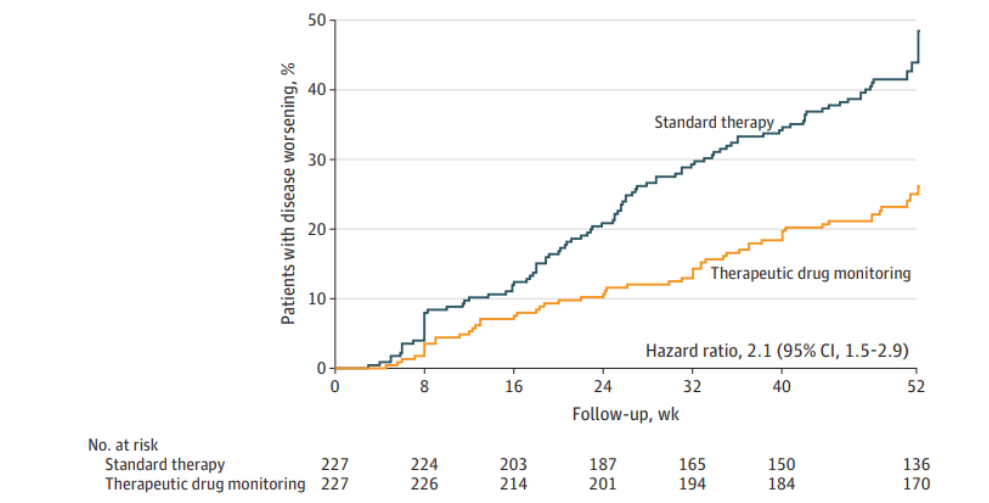
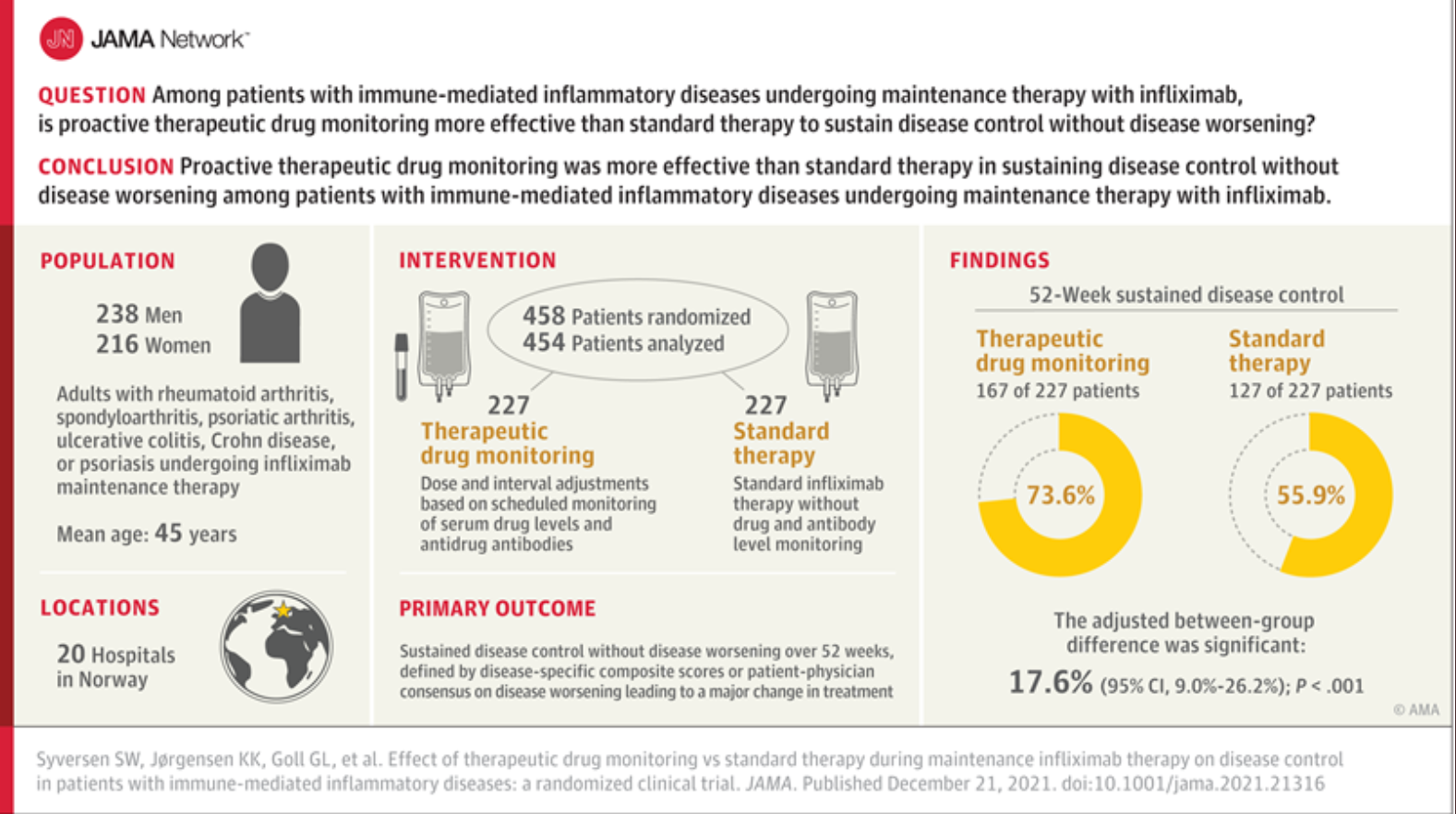
Methods: Randomized, parallel-group, open-label clinical trial including 458 adults (mean age, 44.8 years; 49.8% women) with rheumatoid arthritis, spondyloarthritis, psoriatic arthritis, ulcerative colitis (n=81), Crohn disease (n=66), or psoriasis undergoing maintenance therapy with infliximab in 20 Norwegian hospital
Key finding:
Sustained disease control without worsening was evident in 73.9% of pTDM group compared with 55.9% in standard infliximab group
Some limitations of this study:
The open-label study was not powered to detect the difference of pTDM in each of the six diseases
The therapeutic goal for maintenance infliximab was 3 to 8 mg/L, which is a little lower than current goals (ACG expert panel suggests a level of at least 5-10)
My take: This study supports recent expert guidance (see blog post below) on the benefit of pTDM as part of evidence-based care. It is likely that pTDM is even more important in children/teens due to growth.
This retrospective cohort study with 236 subjects (55% received acid blockers) provides a compelling argument that acid suppression is unlikely to be beneficial in infants with laryngomalacia and to consider the possibility of aspiration in them as well. Among all subjects, 27% received H2RA, 11% received PPI, and 17% received both.
Key findings:
Subjects treated with acid suppression had a greater risk of supraglottoplasty (hazard ratio 3.36, 95% CI 1.36-8.29, P = .009), shorter time to supraglottoplasty (5.64 ± 0.92 vs 7.98 ± 1.92 months, P = .006), and increased respiratory hospitalization risk (relative risk 1.97, 95% CI 1.01-3.85, 0.047), even after adjustment for covariates
Subjects receiving thickening had fewer respiratory hospitalization nights and longer time to supraglottoplasty (9.3 ± 1.7 vs 4.56 ± 0.73 months, P = .004), even after adjustment.
Subjects with moderate-to-severe laryngomalacia were more likely to have aspiration on a video fluoroscopic swallow study (VFSS)
Of the 40 patients who had a supraglottoplasty, only 4 (10%) had a VFSS before and afterwards. All repeat VFSS showed improvement at a mean of 4.7 months after supraglottoplasty
It is noted that 36% of subjects underwent a VFSS and 40% had a clinical feeding evaluation. The authors note that other studies have found “a high rate of silent aspiration in laryngomalacia.”
My take:
Acid blockers are unlikely to be beneficial in infants with laryngomalacia and are potentially detrimental (findings limited by retrospective design in a tertiary care setting)
Symptoms in children with laryngomalacia may be due to aspiration and evaluation is needed in those with significant symptoms









 gutsandgrowth