Fecal Microbial Transplantation -Evidence for Use Beyond Recurrent Clostridium Difficile

Briefly noted: GR D’Haens, C Jobin. Gastroenterol 2019; 157: 624-36. This review sums up the emerging evidence for use of fecal microbial transplantation for conditions besides recurrent Clostridium difficile infection.

Table 2 succinctly provides list of disease, types of study/evidence, and potential effect.

  • Among gastrointestinal diseases, the authors note that there is an “overall positive” effect for ulcerative colitis, “suggestive” benefits for IBS, GVHD, post-antibiotic diarrhea, constipation, and hepatic encephalopathy.  No effect has been evident with Crohn’s disease or pouchitis.
  • Among nongastrointestinal diseases, the authors note a “suggestive” benefit in autism and metabolic syndrome and “unknown” effect with psoriasis and multiple sclerosis.

My take: The review indicates a need for more studies and the need to define which factors in fecal material mediate the therapeutic effects.

Related article: OC Aroniadis. Lancet Gastroenterology and Hepatology; 2019. https://doi.org/10.1016/S2468-1253(19)30198-0. In this double-blind, randomized, placebo-controlled crossover trial in patients aged 18–65 years with moderate-to-severe IBS-D with 48 patients, FMT (capsule study) was safe, but did not induce symptom relief at 12 weeks compared with placebo.

Related blog posts:

Vedolizumab versus Adalimumab for Ulcerative Colitis (part 2)

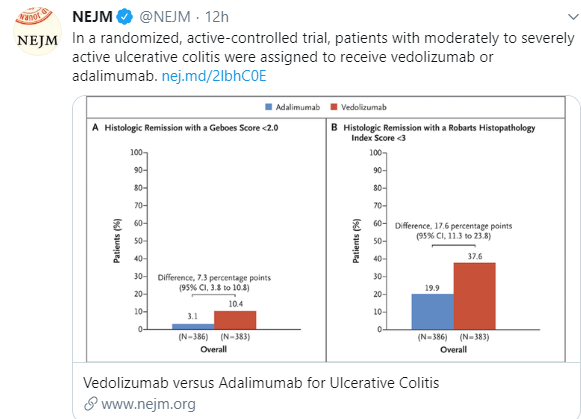
A previous blog post (Vedolizumab More Effective Than Adalimumb for Ulcerative Colitis) highlighted a preliminary report on the “VARSITY” study. The full report has now been published (BE Sands et al NEJM 2019; 381: 1215-26) and a little nuance is needed.

This double-blind, double-dummy randomized trial included 769 patients who underwent randomization to receive at least one dose of one of the study medications.

Key findings:

  • At week 52, clinical remission was higher in the vedolizumab group: 31.3% compared to 22.5% for adalimumab
  • Endoscopic improvement was better for vedolizumab: 39.7% compared to 27.7%
  • Corticosteroid-free remission was better for adalimumab: 21.8% compared to 12.6% for vedolizumab

Limitations:

  • dose escalation was not allowed during the study –this limitation likely favors vedolizumab compared to adalimumab
  • previous exposure to an anti-TNF agent was allowed in up to 25% of patients

My take:  In two of three key measures, vedolizumab outperformed adalimumab.  This study provides a rationale for vedolizumab to be considered a first-line agent.  That being said, in my clinical experience, infliximab is a much more frequently used anti-TNF agent in moderate-to-severe ulcerative colitis.  So a head-to-head study with infliximab would be of interest.

The image below shows histologic remission differences at week 52


Related posts:

What to Tell Patients About Ranitidine From AGA

Here’s the link: Talking to your patients about ranitidine  Thanks to John Pohl for sharing this information.

Oct. 3, 2019

Talking to your patients about ranitidine

The recent FDA safety alert might be causing concern among your patients about their heartburn treatment.

The FDA recently released several safety alerts on ranitidine formulations, including the brand-name drug Zantac, that were found to contain a nitrosamine impurity called N-nitrosodimethylamine (NDMA) at low levels. NDMA is classified as a probable human carcinogen (a substance that could cause cancer) based on results from laboratory tests and animal studies. NDMA is a known environmental contaminant and found in water and foods, including meats, dairy products, and vegetables. This contaminant is similar to was recently found in losartan, an angiotensin II receptor blocker used to treat hypertension, that was recalled by the FDA.

The FDA is continuing to test ranitidine products from multiple manufacturers and is assessing the potential impact on patients who have been taking ranitidine. 

With the voluntary recall of 14 lots of prescription ranitidine capsules distributed by Sandoz Inc., as well as the voluntary recall of over-the-counter (OTC) ranitidine tablets (75 mg and 150 mg), labeled by Walgreens, Walmart, and Rite-Aid and manufactured by Apotex Corp, your patients might be asking a lot of questions about whether to continue to using their medicines and what alternatives are available. 

TALKING TO YOUR PATIENTS 

The FDA safety alerts have been covered by various media outlets since early September. This may cause your patients to question whether they should stay on or start using ranitidine products. When discussing the recall with your patients, let them know that: 

  • Ranitidine is an H2 blocker (antihistamine) — available OTC and in prescription strength — used to prevent and relieve heartburn associated with acid ingestion and sour stomach. It reduces stomach acid and works longer but not as quickly as antacids.
  • Not all ranitidine medicines marketed in the U.S. are being recalled and the FDA is not recommending individuals stop taking all ranitidine medicines at this time.
  • It might be prudent to hold off taking Zantac until a final FDA conclusion.
  • Multiple drugs are approved for the same or similar uses as ranitidine. Other treatment options are available, both prescription and OTC, for patients who are concerned about ranitidine.
  • Life-style modifications may reduce or eliminate the need for heartburn drugs for long-term use. These may include weight loss, avoiding tobacco or a change in eating patterns. Share AGA’s patient education content on gastroesophageal reflux disease (GERD) for more tips for your patients.

Related blog post: Preliminary Recommendations from NASPGHAN on Ranitidine Warnings

Gluten-Free –No Evidence It is Helpful for Healthy Individuals

A recent study (ID Croall, et al. Gastroenterol 2019; 157: 881-3) provides additional data indicating that a gluten-free diet does not confer health benefits to healthy individuals.

A double-blind randomized placebo 2-week trial with 30 healthy adults divided subjects into two groups –some received flour sachets to consume with organic gluten (14 g) and some received a gluten-free blend (rice, potato, tapioca, maize, buckwheat flour). Both groups were instructed to take their flour sachets twice a day along with a gluten-free diet (GFD).

Key finding: The group receiving gluten did not experience any increase in gastrointestinal symptoms or fatigue compared to the placebo group.

My take: While this study lasted only 2 weeks and had a small sample size, nevertheless, it adds to the literature indicating that a GFD is unlikely to be beneficial in otherwise healthy individuals. Those who stick with a GFD should seek the help of a well-qualified dietician.

Related blog posts:

Portland, OR. Portland aerial trams –between the city’s South Waterfront district and the main Oregon Health & Science University (OHSU) .

Ustekinumab for Ulcerative Colitis (UNIFI Trial)

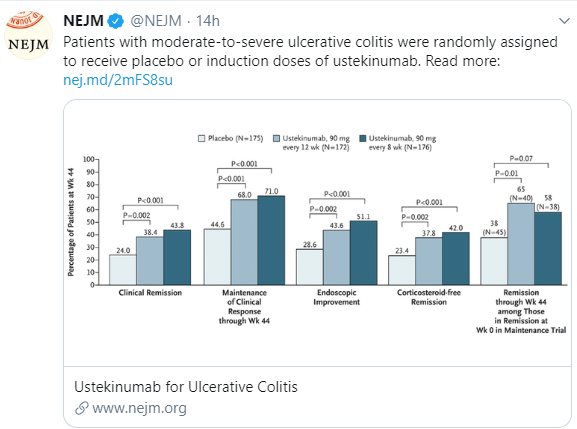
A landmark study (BE Sands et al. NEJM 2019; 381: 1201-14) shows that ustekinumab (Stelara) can be an effective therapy for moderate-to-severe ulcerative colitis (UC); it is already an approved, established therapy for Crohn’s disease. This randomized placebo-controlled study included an 8-week induction trial (n=961) followed by a 44-week maintenance trial (n=523) for patients with response.

Clinical remission was defined as a total socre of ≤2 on the Mayo scale (range 0-12) and no subscore >11 on any of the four Mayo scale components.

Key findings:

  • During induction, there was a similar clinical remission rate between those who received 130 mg fixed intravenous dose compared to those who received 6 mg/kg: 15.6% and 15.5% compared to 5.3% for placebo group.
  • During maintenance, among patients receiving 90 mg every 8 weeks the clinical remission rate at 44 weeks was 43.8%, in those with 90 mg every 12 weeks the rate was 38.4%; placebo group was 24.0%.
  • The response to ustekinumab occurred in those with or without previous treatment failure with biologic agents, though response was lower in both induction and maintenance in those with prior treatment failure.  In both phases, at least 59% of participants had failed either or both anti-TNF agents or vedolizumab.
  • In this study, there were similar serious adverse events with ustekinumab compared to placebo.  In the treatment groups, there were two deaths (one from ARDS, one from esophageal varices) and 7 cases of cancer (3 nonmelanoma skin cancer, two colon cancer, one prostate, one renal).  There was one death from testicular cancer in the placebo group. Also four patients in the ustekinumab group had opportunistic infections including CMV in two, legionella in one and HSV in one.

In terms of dosing, the authors note that there was greater improvement in calprotectin values during induction in the group who received 6 mg/kg compared to those who received 130 mg.  At week 44, using more objective and stringent end points (eg. endoscopic improvement), greater clinical benefit was observed with the every 8 week regimen.

Visual abstract from NEJM Twitter Feed:

The following image depicts patients response during the maintenance phase –the lightest color is placebo, followed by every 8 weeks, and then the darkest color is every 12 weeks.  The x-axis measures (left to right) are clinical remission, maintenance of clinical response at week 44, endoscopic improvement, corticosteroid-free remission, and remission at 44 weeks in those with remission after induction.

My take: Ustekinumab is more effective for placebo in patients with ulcerative colitis.  More experience is needed to understand its long-term safety.

Related blog posts:

The High Toll of Sudden Infant Death

Sudden unexpected infant death (SUID) is not frequently an issue that is addressed by pediatric gastroenterology.  However, it is very common and needs to  be considered as we see infants with reflux, irritability, diarrhea, and dyschezia.

A recent report (DR Roehler et al. J Pediatr 2019; 212: 224-7) puts the magnitude of this problem into perspective.

Key points:

  • From 2013-2015, there was an average of 3523 US infants each year who died from SUID, peaking at 1-2 months of life.
  • The average annual risk of SUID during the first year of life was more than 5 times the peak risk of mortality from firearms homicide, motor vehichle-traffic, drugs/opioid overdose, and suicide.
  • More black infants died of SUID in the first year than black children who died from firearm homicides in all of childhood through age 19 years.
  • SUID deaths from 2013-2015 (10,568) was similar to the total number of motor vehicle-traffic deaths in all of childhood (10,714) and greater than the total number of any of the other causes.
  • Rates of SUID deaths were much higher for non-hispanic blacks than non-hispanic whites or hispanics.  Peak rates reached 481 per 100,000 per month compared with 215 per 100,000 per month and 130 per 100,000 per month respectively in these three groups (Figure 1).

Related study: AB Erck Lambert et al. Pediatrics 2019; 13.pii.e20183408.  In a SUID database analysis, 14% (250) of SUID cases from 2011-2014 were due to suffocation, most commonly due to soft bedding (69%), overlay (19%), and wedging (12%).

My take: The first year of life, particularly the first 3 months, is a very dangerous time for infants.  More attention to SUID could prevent a great amount of tragedy.

Related blog posts:

Useful website: Charlieskids.org This website has a book called “Sleep Baby Safe and Snug” which incorporates updated recommendations on safe sleep practices.

Children should sleep in the same room but on a separate surface from their parents for at least the first six months of their lives, and ideally the first year. They say that this can halve the risk of SIDS…You can read the AAP’s full guidance here. These are a few more of the pediatricians’ recommendations:

  • Infants under a year old should always sleep lying on their backs. Side sleeping “is not safe and is not advised,” the AAP says.
  • Infants should always sleep on a firm surface covered by only a flat sheet. That’s because soft mattresses “could create a pocket … and increase the chance of rebreathing or suffocation if the infant is placed in or rolls over to the prone position.”
  • Any other bedding or soft objects, like pillows or stuffed animals, could obstruct a child’s airway and increase the risk of SIDS and suffocation, according to the AAP.
  • The pediatricians say breastfeeding reduces the risk of SIDS.
  • The same goes for pacifiers at nap time and bedtime, although the doctors say the “mechanism is yet unclear.” They add that “the protective effect is observed even if the pacifier falls out of the infant’s mouth.”
  • Smoking – both during pregnancy and around the infant after birth – can increase the risk of SIDS. Alcohol and illicit drugs during pregnancy can also contribute to SIDS, and “parental alcohol and/or illicit drug use in combination with bed-sharing places the infant at particularly high risk of SIDS,” the pediatricians say.

Pittock Mansion, Portland, OR


What Infants and Toddlers Should and Should NOT Be Drinking

NY Times: What Should Young Children Drink? Mostly Milk and Water, Scientists Say

An excerpt:

A panel of scientists issued new nutritional guidelines for children on Wednesday, describing in detail what they should be allowed to drink in the first years of life. The recommendations, among the most comprehensive and restrictive to date, may startle some parents.

Babies should receive only breast milk or formula, the panel said. Water may be added to the diet at 6 months; infants receiving formula may be switched to cow’s milk at 12 months. For the first five years, children should drink mostly milk and water, according to the guidelines.

Children aged 5 and under should not be given any drink with sugar or other sweeteners, including low-calorie or artificially sweetened beverages, chocolate milk or other flavored milk, caffeinated drinks and toddler formulas.

Plant-based beverages, like almond, rice or oat milk, also should be avoided. (Soy milk is the preferred alternative for parents who want an alternative to cow’s milk.)…

Young children should drink less than a cup of 100 percent juice per day — and that none at all is a better choice…Children do not need juice and are better off eating fruit, the panel said. ..

With the exception of soy milk, plant-based milks are poor in protein. Though they are often fortified, scientists do not know whether people are able to absorb these nutrients as efficiently as those naturally present in other foods.

Formulas marketed for toddlers are usually unnecessary, since most toddlers eat solid food

My take: These recommendations provide good advice.


“Bystander Effect” –Not the Norm

A recent study has cast some “shade” on the concept of the “bystander effect.”

From Washington Post: Forget What You May Have Been Told. New Study Shows Strangers Help 90 Percent of the Time

An excerpt:

Bystanders will intervene 9 times out of 10 to assist the victim in a public fight, an international team of researchers found in a study called “Would I be helped?,” published in American Psychologist this summer. After reviewing surveillance footage of more than 200 violent altercations around the world, the researchers concluded that having more bystanders around makes it more likely that someone will intervene…

On average, at least three people chose to intervene — and every additional bystander present increased the odds that the victim would receive assistance by roughly 10 percent.

Related blog posts:


PPIs: Good News on Safety (Part 2)

Earlier this year, I noted that a recent publication provided reassurance on PPI safety. (related blog post: PPIs: Good News on Safety).  In the journal issue with the printed version, a detailed editorial provides useful context.

DA Corley. Full Text Link:Safety and Complications of Long-Term Proton Pump Inhibitor Therapy: Getting Closer to the Truth” Gastroenterol 2019; 157: 604:-7.

The Table 1 contrasts the useful information from this large double-blind randomized study and prior data/data quality.

The new study found NO ASSOCIATION between PPI use and kidney disease, dementia, bone fractures, myocardial infarction, pneumonia, or gastrointestinal malignancies.

An excerpt:

Recent publications have summarized both the evidence and evidence-based approaches toward teasing out whether proton pump inhibitors cause certain diseases or are only associated with them through other pathways (e.g., confounding).  Helpful strategies include using the classic criteria for evaluating causation such as the:

  • strength of the association
  • consistency of the findings between studies
  • specificity when an outcome happens almost exclusively from a specific exposure
  • temporality such that the exposure comes before the outcome
  • biological gradient whereby higher exposure doses or longer durations increase risk of the outcome
  • biological plausibility for the proposed association
  • coherence such as between observed effects and known biology of disease
  • experiment such as randomized trials that decrease confounding; and
  • analogy to similar exposure–disease associations known to be causal…

This massive undertaking included >17,000 patients from 33 countries who were randomized to pantoprazole versus placebo, followed for a median of approximately 3 years, and evaluated prospectively for potential complications. The study found an increased risk of enteric infections among pantoprazole users, a result found in both the intention-to-treat and “as-treated” analyses, which excluded people who stopped their medications. This association makes sense—stomach acid markedly decreases bacterial load in food, so decreasing stomach acid may increase the risk of enteric bacterial infections. The authors found no increased risk for several of the most feared associations previously reported, such as cardiovascular disease, kidney disease (directly measured using estimated glomerular filtration rate), dementia, pneumonia, fracture, and all-cause mortality.

My take: (borrowed from editorial): The current study would indicate, from the strongest study design available,… that there is an increased risk of gastrointestinal infections and no detectable excess risk for several other potentially important clinical events…Given known problems with overprescribing and overuse, patients and clinicians should maintain appropriate vigilance in prescribing acid suppression only to persons with defined indications and at the lowest effective dose and duration.

Lava Cave -near Bend, OR


AGA Guidelines for Evaluation of Functional Diarrhea and IBS-D

W Smalley et al. Gastroenterol 2019; 157: 851-54. Full Text Link: AGA Clinical Practice Guidelines on the Laboratory Evaluation of Functional Diarrhea and Diarrhea-Predominant Irritable Bowel Syndrome in Adults (IBS-D)

Clinical support tool on pg 855, Patient Summary 856-57, and Technical Review 859-80.

These guidelines/recommendations (listed below) do NOT apply to patients with any of the following:

  • Alarm features such as gross blood, weight loss, anemia, and hypoalbuminemia
  • Family history of of IBD, colon cancer, or celiac disease
  • Travel to areas with high prevalence of infectious diarrhea
  • Immune suppression
  • Ingestion of medications or substances known to cause diarrhea


Table 3  Summary of Recommendations of the American Gastroenterological Association on the Laboratory Evaluation of Functional Diarrhea and Diarrhea-Predominant Irritable Bowel Syndrome in Adults
Statement Strength of recommendation Quality of evidence
Recommendation 1: In patients presenting with chronic diarrhea, the AGA suggests the use of either fecal calprotectin or fecal lactoferrin to screen for IBD. Conditional Low
Recommendation 2: In patients presenting with chronic diarrhea, the AGA suggests against the use of ESR or CRP to screen for IBD. Conditional Low
Recommendation 3: In patients presenting with chronic diarrhea, the AGA recommends testing for Giardia. Strong High
Recommendation 4: In patients presenting with chronic diarrhea with no travel history to or recent immigration from high-risk areas, the AGA suggests against testing stools for ova and parasites (other than Giardia). Conditional Low
Recommendation 5: In patients presenting with chronic diarrhea, the AGA recommends testing for celiac disease with IgA-tTG and a second test to detect celiac disease in the setting of IgA deficiency Strong Moderate
Recommendation 6: In patients presenting with chronic diarrhea, the AGA suggests testing for bile acid diarrhea. Conditional Low
Recommendation 7. In patients presenting with chronic diarrhea, the AGA makes no recommendation for the use of currently available serologic tests for diagnosis of IBS None Knowledge gap

For recommendation #6, the authors note that tests for bile acid mediated diarrhea in the U.S. include total bile acid in a 48-hour stool collection and serum fibroblalt growth factor 19.

Image available online: